


What a Clogged Furnace Valve Taught Us About Summer Air Conditioning Failures


The Hidden Link Between Winter Heating and Summer Cooling Breakdowns
The thermostat reads 80 degrees, the outdoor unit is buzzing loudly, but the vents are barely pushing out a trickle of lukewarm air. You are facing a sudden cooling breakdown right in the middle of the summer cooling season, and the natural instinct is to blame the air conditioner itself. However, when examining exactly what a clogged furnace valve taught us about summer air conditioning failures, the reality of residential climate control is often much more complex. In our years of servicing homes across Maple Ridge, the team at Valley Pacific Mechanical frequently discovers that the root cause of a sudden cooling failure is not actually a broken outdoor condenser, but rather a neglected heating component hiding inside the home.
If you are dealing with a sudden breakdown and need immediate help with your air conditioning systems, reaching out to our professional team is the safest first step.
The critical diagnostic decision point: When a home loses cooling capacity, our technicians must determine whether the failure is an isolated cooling issue—like a bad capacitor or low refrigerant—or a symptom of a broader, systemic failure originating in the indoor air handler. Most homeowners view their heating and cooling units as two completely separate appliances that take turns working throughout the year. In reality, they are deeply intertwined. A restriction, malfunction, or blockage inside the winter heating equipment directly impacts the summer cooling cycle, often leading to severe and expensive cascading failures if left misdiagnosed.
The Shared Anatomy of Your Year-Round HVAC System
To understand how a winter component can destroy a summer cooling cycle, you have to look at the anatomy of your home comfort system. The furnace acts as the lungs of the entire house, operating year-round regardless of whether you are calling for heat or air conditioning. While the outdoor condenser handles the heavy lifting of compressing refrigerant and releasing absorbed heat into the outside air, it relies entirely on the indoor equipment to circulate the air inside your living space.
The indoor air handler—which is typically the lower compartment of your gas furnace—houses the primary blower motor. This single motor is responsible for pulling stale air from your return ducts, pushing it through the air filter, forcing it past the heat exchanger (in winter) or the evaporator coil (in summer), and distributing it through the supply vents into your rooms. If anything compromises the performance of your furnace systems, the entire air distribution network suffers.
Why the Furnace Runs When the AC is On
A common misconception we hear from homeowners is that the furnace shuts down completely and goes dormant from May through September. While the gas burners and the ignition sequence are certainly inactive during the warmer months, the mechanical heart of the furnace is working harder than ever.
• Continuous air distribution: The furnace's blower motor must run continuously during a cooling cycle to push indoor air over the chilled AC evaporator coil.
• Closed-loop dependency: Because the heating and cooling systems share the exact same ductwork, filter housing, and blower compartment, a restriction in one automatically becomes a restriction in the other.
• Airflow volume requirements: Air conditioning actually requires a higher volume of airflow (measured in cubic feet per minute, or CFM) than heating does. A blower motor that is slightly restricted in winter might completely fail to meet the higher airflow demands of summer.
How a Clogged Furnace Valve Triggers an AC Coil Freeze-Up
The mechanical relationship between indoor airflow and outdoor cooling is a delicate balance of physics and thermodynamics. During a recent summer cooling season, the Valley Pacific Mechanical team responded to a call where an AC unit was completely locked up and failing to cool the home. The homeowner assumed the outdoor condenser had died of old age. Upon running a full diagnostic, we found that the furnace had a severely clogged and damaged valve restricting the system's internal airflow. By servicing the furnace, clearing the restriction, and replacing the damaged valve, we resolved the issue quickly, restored proper airflow, and brought the air conditioner back online without replacing a single outdoor component.
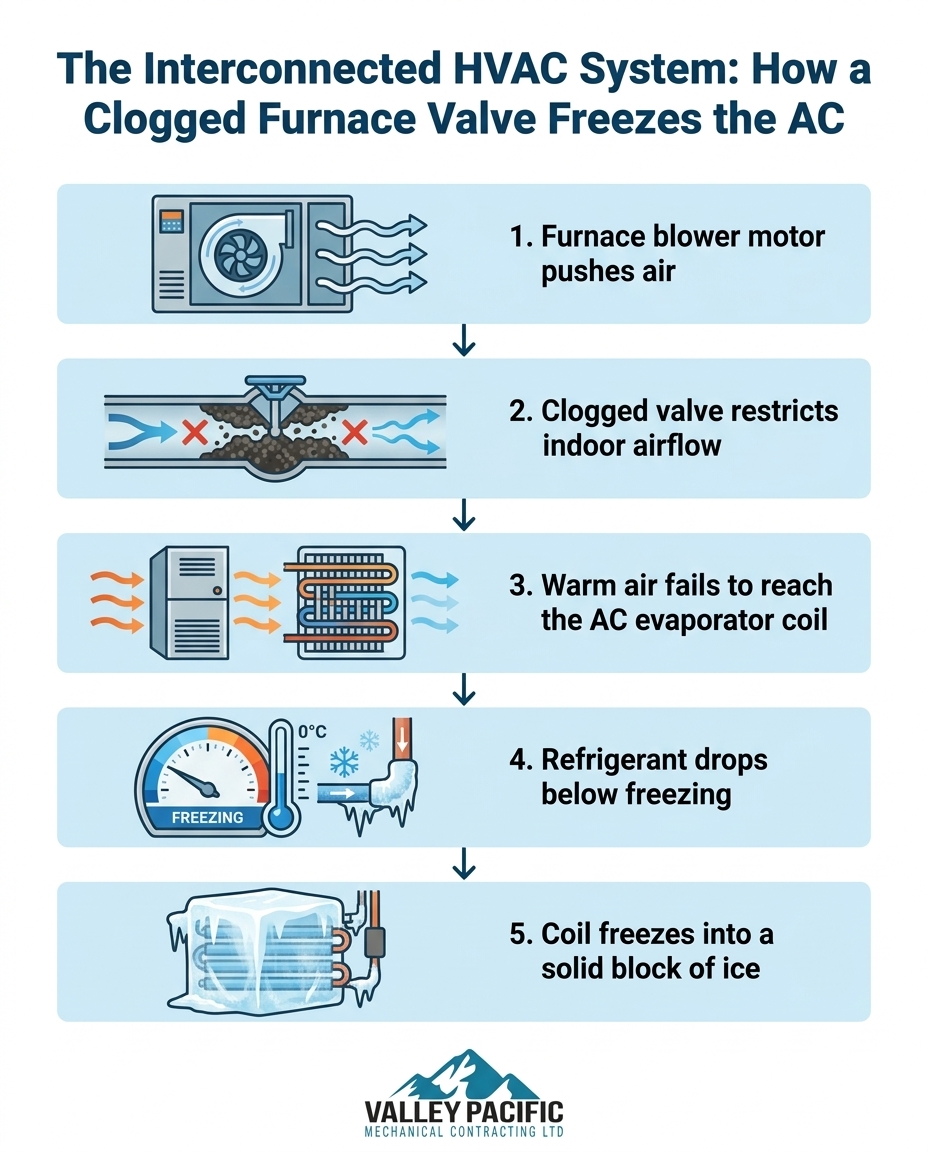
When a furnace valve or internal component becomes clogged with debris, rust, or soot, it creates a physical barrier that restricts the blower motor's ability to push air through the cabinet. This restricted indoor airflow leads to an immediate crisis for the air conditioner. The AC evaporator coil—the A-shaped component sitting just above the furnace—relies on a steady stream of warm, unconditioned indoor air blowing across it. The warm air provides the heat energy that the liquid refrigerant absorbs in order to turn into a gas and travel back outside.
The physics of a freeze-up: When a clogged furnace component chokes off that airflow, the warm air never reaches the evaporator coil. Without that heat load, the temperature of the refrigerant inside the coil drops rapidly below freezing. As the system continues to run, the natural humidity and condensation on the outside of the coil freeze into a solid block of ice. This ice block acts as an even larger restriction, completely suffocating the system until it breaks down entirely.
• Weak Airflow at Vents — The Mechanical Cause: A clogged furnace valve or dirty blower wheel restricts the volume of air moving through the system. — The Professional Solution: Deep cleaning of the blower compartment and replacement of compromised furnace valves.
• Frozen Evaporator Coil — The Mechanical Cause: Lack of warm air passing over the coil causes refrigerant temperatures to drop below 32°F, freezing condensation. — The Professional Solution: Thawing the coil safely, then correcting the indoor airflow restriction at the furnace level.
• Constant AC Cycling — The Mechanical Cause: The system short-cycles because the restricted airflow causes internal safety sensors to trip prematurely. — The Professional Solution: Re-calibrating indoor static pressure and ensuring the furnace blower is operating at the correct speed.
The Climate Factor: Damp Winters and Latent Component Wear
Understanding why these interconnected failures happen requires looking at the specific environmental conditions your equipment endures. As local experts serving Maple Ridge BC, we see firsthand how our specific climate plays a massive role in the degradation of indoor HVAC components. Our region experiences long, damp, and cool winters that force heating systems to run consistently for months on end. This persistent moisture in the ambient air, combined with the natural byproducts of combustion, accelerates wear, corrosion, and clogging inside the furnace cabinet.
The danger of latent wear: Environmental degradation rarely causes an immediate, catastrophic breakdown on the day it occurs. Instead, it creates what professionals call "latent wear." A furnace valve might begin to corrode and clog in January due to the damp climate, but because the heating cycle requires less overall airflow than the cooling cycle, the homeowner might not notice the slight drop in performance. The damage hides in plain sight.
It isn't until the weather shifts and the sudden, continuous demand of the summer cooling season hits that these weaknesses are exposed. When the blower motor is suddenly asked to run for ten to twelve hours a day to fight off the summer heat, that latent winter damage becomes a critical summer restriction. A pattern we see often is that the damp climate of the Pacific Northwest effectively sets a trap during the winter that the air conditioner steps into during the summer.
Our Diagnostic Methodology: Looking Beyond the Outdoor Condenser
At Valley Pacific Mechanical, our first-person field experience working on local residential systems has fundamentally shaped how we approach system breakdowns. A novice technician or a well-meaning homeowner will often walk straight past the indoor equipment during a summer service call, heading directly to the outdoor condenser to check the refrigerant levels. If the coil is frozen, they might assume there is a leak, add more refrigerant, and leave. This "gas and go" approach is a recipe for disaster because it treats the symptom while ignoring the disease.
What this specific scenario taught us is that a professional diagnostic must prioritize indoor airflow checks before ever touching a refrigerant gauge. We look for the subtle clues that indicate a systemic restriction. For example, unusual symptoms like a whistling sound coming from your AC vents often point directly to an airflow blockage at the furnace level, rather than a mechanical failure of the air conditioner itself. By evaluating the system as a whole, we prevent misdiagnoses and save homeowners from replacing parts that are actually functioning perfectly.
Tracing the Root Cause of Airflow Restrictions
1. Evaluating blower motor amp draw: Our technicians start by measuring the electrical current the furnace blower motor is pulling. A motor that is struggling against a clogged valve or dirty filter will pull higher amps as it fights to move air, giving us an immediate red flag.
2. Inspecting the furnace cabinet and valves for latent winter damage: We safely open the indoor air handler and physically inspect the gas valves, the heat exchanger, and the blower wheel for rust, soot buildup, or physical blockages that carry over from the heating season.
3. Measuring temperature drops across the evaporator coil: Using digital psychrometers, our team measures the exact temperature of the air entering the return and leaving the supply. If the temperature split is too wide, it confirms that air is moving too slowly across the coil due to an internal restriction.
Preventing Cascading Failures Before the Heat Arrives
The most effective way to handle an interconnected HVAC failure is to prevent it from happening in the first place. This requires a shift in how homeowners view their annual system care. Waiting until the hottest day of the year to find out if your air conditioner works is a gamble that often results in emergency service calls. Instead, the focus should be on transitional, off-season system evaluations.
Catching the problem early: When a professional evaluates your system in the spring, they are looking specifically for the latent wear left behind by the winter. From what we typically see in the field, catching a clogged furnace valve, a dirty blower wheel, or a failing motor capacitor in April prevents the expensive, cascading damage of a frozen evaporator coil in July. It is always more cost-effective to clear a restriction than it is to replace a compressor that burned out trying to fight through a block of ice.
This is why a comprehensive, year-round approach to system care is non-negotiable for modern high-efficiency equipment. Enrolling in a professional HVAC maintenance plan ensures that a qualified technician is putting eyes on the entire interconnected system—both heating and cooling components—before the extreme weather arrives.
Trust a Whole-Home Approach for Your Comfort Systems
If there is one major takeaway from what a clogged furnace valve taught us about summer air conditioning failures during our service calls, it is that your residential comfort components are deeply, permanently interconnected. Your air conditioner does not operate in a vacuum; it relies entirely on a healthy, unrestricted furnace to act as the lungs of the operation. A failure in the winter heating equipment will inevitably sabotage the summer cooling cycle.
When your system struggles to keep up with the temperature on the thermostat, do not settle for a surface-level inspection that only looks at the outdoor box. You need a professional who understands the complex thermodynamics and airflow dynamics of the entire home. If you suspect your system is suffering from hidden airflow restrictions or latent winter wear, schedule a comprehensive diagnostic with our team for HVAC repair in Maple Ridge to ensure your equipment is ready to handle whatever the season brings.
Frequently Asked Questions
Can a broken furnace affect my air conditioning?
Yes, a broken or restricted furnace can absolutely cause your air conditioning to fail. The furnace houses the primary blower motor that circulates all the air in your home, meaning any mechanical failure inside the heating unit will stop the cooling system from distributing conditioned air.
Why is my AC coil freezing in the summer?
An AC coil typically freezes during the summer due to a severe lack of indoor airflow passing over it. When clogged filters, dirty blower wheels, or damaged furnace valves restrict the air, the refrigerant inside the coil drops below freezing and turns natural condensation into solid ice.
Do the AC and furnace share a blower?
Yes, the vast majority of central residential HVAC systems share a single blower motor located inside the furnace cabinet. This motor is responsible for pushing air through the heat exchanger during the winter and over the evaporator coil during the summer.
Why does my furnace fan run when the AC is on?
Your furnace fan runs when the AC is on because the air conditioner itself does not have an indoor fan to move air through your ductwork. It relies entirely on the furnace's blower motor to pull warm air from your rooms and push chilled air back out.
How do professionals trace a cooling issue back to the indoor heating unit?
Professionals trace cooling issues back to the indoor unit by measuring static pressure, evaluating the blower motor's electrical amp draw, and checking the temperature drop across the indoor coil. These diagnostics reveal if the system is suffering from an internal airflow restriction rather than a refrigerant leak.
What are the signs of a clogged furnace valve restricting airflow?
Signs of a clogged furnace valve restricting airflow include weak air coming from your supply vents, strange whistling noises near the return ducts, unusually long cooling cycles, and a sudden spike in your monthly energy bills as the blower motor struggles to push air.


