


The Danger of Ignoring a Whistling Sound From Your Air Conditioner


Is That High-Pitched Whistling From Your Air Conditioner an Emergency?
If your cooling system starts making strange noises, you need to understand the danger of ignoring a whistling sound from your air conditioner. While it is easy to assume a sudden, high-pitched squeal is just a minor annoyance or a quirk of an aging system, this sound is rarely just a nuisance—it is a critical mechanical alarm screaming for help. The immediate anxiety you feel when your system starts making this noise is entirely justified. At Valley Pacific Mechanical Contracting Ltd., our team often sees homeowners at a crucial decision point: do you simply swap an air filter and hope for the best, or do you immediately shut off the system to prevent a catastrophic mechanical failure? Addressing this noise promptly is the difference between a quick adjustment and a total system replacement.
For professional diagnosis and comprehensive Air Conditioning Services, trust our experts for reliable HVAC Repair in Maple Ridge.
What Does a Whistling Sound Actually Mean for Your HVAC System?
To understand why this noise is so dangerous, you have to understand the basic physics of how your cooling system moves air and gas. A whistling sound occurs when a large volume of air or pressurized gas is forced through a severely restricted opening. Under normal conditions, a healthy air conditioning system operates with a steady, even hum. This hum is the sound of the compressor motor running smoothly and the blower fan moving the correct volume of air across the evaporator coil.
When that steady hum turns into a high-pitched squeal or whistle, it indicates a severe pressure imbalance. This pressure differential pushes the system's internal components far beyond their safe operating limits. The equipment is literally gasping for air or violently venting pressure.
The Physical Mechanics of the Noise
Depending on the source, the whistle is generated by one of two physical realities inside your ductwork or equipment cabinet:
• Airflow velocity spikes: When a return duct is blocked, the blower motor continues trying to pull the same volume of air. It ends up aggressively pulling air through tiny gaps in the ductwork or around a clogged filter, creating a high-velocity whistle.
• Pressurized gas escaping: If the noise originates near the outdoor unit or the indoor coil, it may be refrigerant gas escaping through a microscopic pinhole under extreme pressure.
• Healthy Operation — Sound Profile: Steady, low-pitch hum — Internal Pressure: Balanced and stable — Mechanical Strain: Normal wear and tear
• Restricted Airflow — Sound Profile: High-pitched whistle or howl — Internal Pressure: High vacuum in return ducts — Mechanical Strain: Severe blower motor strain
• Refrigerant Leak — Sound Profile: Sharp hissing or squeal — Internal Pressure: Rapidly dropping system pressure — Mechanical Strain: High risk of compressor overheating
Airflow Starvation: The Most Common Culprit Behind the Noise
The most frequent cause of a screaming HVAC system is severe airflow starvation. Your air conditioner requires a massive, continuous volume of warm indoor air to function correctly. When something blocks that airflow, the system chokes.
The problem: Clogged air filters, blocked return ducts, or closed vents create a massive vacuum effect inside the system. In many Maple Ridge BC residential neighborhoods, homes are surrounded by mature trees. Our technicians frequently see how this beautiful environment leads to high seasonal pollen and debris, causing air filters to clog much faster than the standard 90-day recommendation.
The cause: As the filter clogs with dust, pet dander, and pollen, the blower motor does not simply slow down. It strains against the restriction, working harder to pull air through the diminishing gaps in the filter media. This massive vacuum effect forces air to accelerate through tiny crevices around the filter housing or leaky duct seams.
The solution: The result is a loud, high-pitched whistle that reverberates through your vents. If you want to explore the broader list of reasons why your AC is making a whistling sound, understanding airflow starvation is always step one. Resolving it requires identifying the exact point of restriction—whether that is a severely neglected media filter, collapsed flexible ductwork, or furniture pushed directly over a main return grille.
High-Pressure Refrigerant Leaks: A Dangerous Alternative
While airflow starvation is common, there is a far more dangerous alternative. A high-pitched whistling or hissing sound can also indicate a high-pressure refrigerant leak. The refrigerant inside your air conditioner operates under immense pressure—often exceeding 300 PSI depending on the temperature and the type of refrigerant used.
If a copper line, valve, or coil develops a pinhole leak, the escaping pressurized gas creates a sharp whistling noise. This is both a severe environmental hazard and a mechanical emergency. To the untrained ear, a severe airflow whistle and a high-pressure refrigerant leak can sound virtually identical. Both manifest as a constant, high-frequency squeal while the system is running.
Why Diagnosis Requires Specialized Equipment
Assuming a whistle is just a dirty filter can be a costly mistake. If the system is leaking refrigerant, the compressor is losing the vital chemical it needs to cool itself during operation, and it is simultaneously losing the specialized oil that lubricates its internal bearings.
This is where professional diagnostic expertise becomes invaluable. Our technicians use specialized, calibrated equipment—such as electronic leak detectors and digital manifold gauges—to accurately identify refrigerant leaks versus severe airflow blockages before they lead to costly compressor replacement. Diagnosing the difference requires a thorough understanding of the refrigeration cycle and should never be attempted as a DIY project.
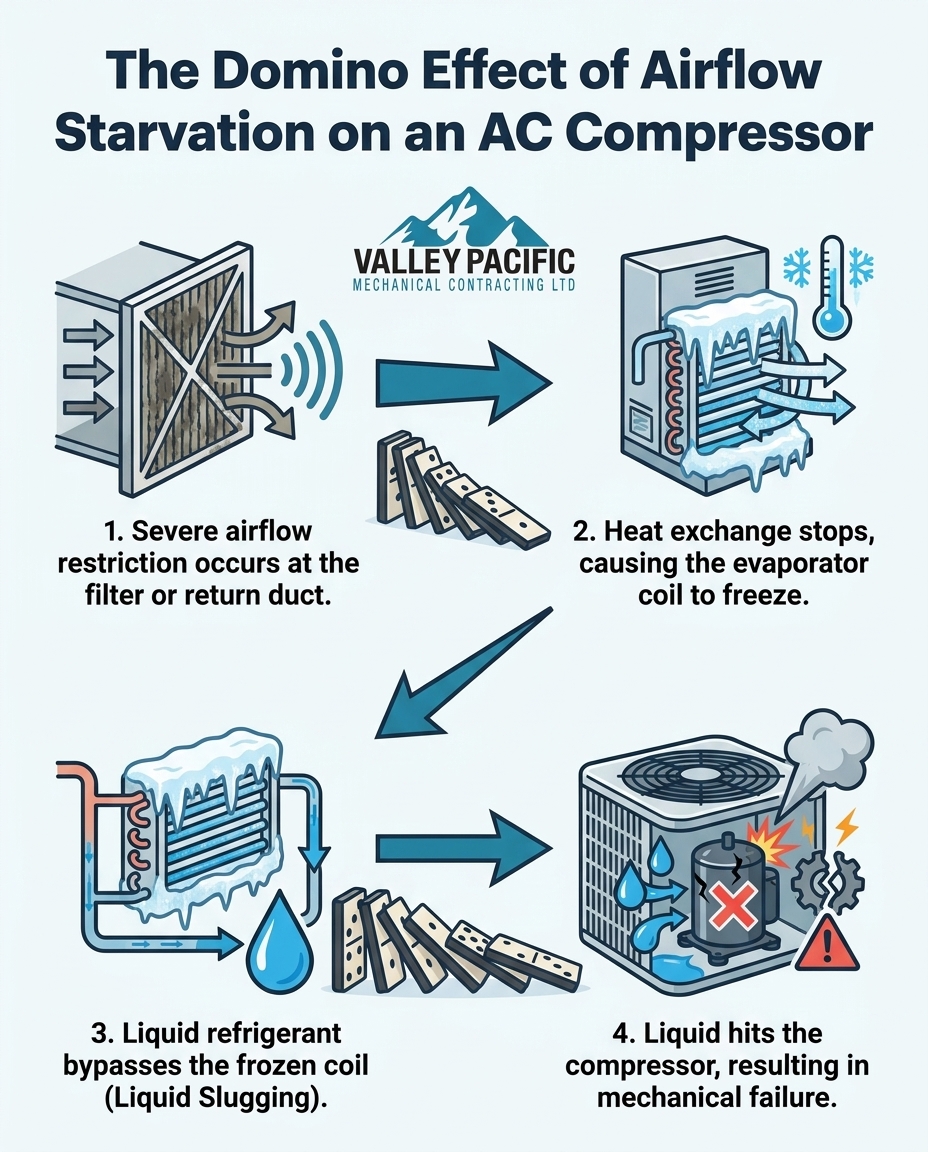
The Domino Effect: How the Whistle Leads to Compressor Death
If you hear a whistling sound and choose to ignore it, you are setting off a destructive chain reaction inside your HVAC system. The physics of compressor failure are well documented, and leaving a restricted system running is the fastest way to destroy it.
Air conditioning compressors rely entirely on returning cold, low-pressure refrigerant gas to cool the compressor motor during operation. When airflow is restricted, that cooling process breaks down entirely.
1. Loss of Heat Exchange: Severe airflow restriction means there is no warm indoor air blowing over the indoor evaporator coil. Without warm air, the liquid refrigerant inside the coil cannot absorb heat and boil into a gas.
2. The Coil Freezes: Because the refrigerant stays cold, the condensation on the outside of the coil freezes solid, encasing the entire component in a block of ice and completely blocking any remaining airflow.
3. Liquid Slugging Occurs: Compressors are designed to pump gas, not liquid. Because the refrigerant never absorbed heat, it travels back to the outdoor unit as a liquid. This is known as "liquid slugging."
4. Mechanical Failure: When liquid refrigerant hits the compressor's internal valves and pistons, it acts like a hydraulic hammer. The liquid cannot be compressed, causing immediate mechanical failure, shattered valves, and a seized motor.
During a recent summer, our team at Valley Pacific Mechanical Contracting Ltd. responded to a local commercial building that experienced this exact domino effect when their AC unit seized up unexpectedly. Because the system was left running while starved for air, the compressor suffered total mechanical failure. Following our prompt emergency response to get the building cooled down, the property management contracted out all ongoing HVAC services to our experts to ensure preventative maintenance would stop this type of catastrophic failure from happening again. Whether you rely on a traditional air conditioner or need Heat Pump Installation and Repair, the physics of compressor failure remain exactly the same.
Why Unexpected Heatwaves Accelerate the Danger
The timeline for compressor failure shrinks drastically depending on the weather outside. Maple Ridge, BC summers can bring unexpected heatwaves, causing ACs to run continuously to try and meet the thermostat demand. During these temperature spikes, cooling systems often operate with near 100% duty cycles, meaning they rarely shut off.
Continuous operation under restricted airflow is a death sentence for a compressor. In milder weather, an air conditioner might run for 15 minutes and then rest, allowing the compressor motor to cool down and preventing the indoor coil from completely freezing over. But during a heatwave, that rest period disappears.
Furthermore, heavy seasonal usage exacerbates existing airflow restrictions. The same spring and summer conditions that bring the heat also bring heavy pollen and dust, which clog filters at an accelerated rate. If a whistling sound is ignored during these high-demand periods, the risk of permanent compressor damage increases exponentially. The system simply does not have the downtime required to recover from the massive mechanical strain.
The Immediate Action Plan: Shut Down and Diagnose
If you hear a high-pitched whistle coming from your vents, your return grille, or your outdoor unit, you need to take immediate action to protect the equipment. Do not wait for a scheduled repair appointment while leaving the system running.
• Turn off the thermostat immediately: Switch your thermostat from "Cool" to "Off." This stops the compressor and the blower motor, instantly removing the mechanical strain and preventing liquid slugging.
• Inspect your air filter: Pull out the primary air filter and hold it up to a light. If you cannot see light passing through it, the filter is completely blocked and must be replaced.
• Check your return vents: Ensure no furniture, rugs, or heavy curtains are blocking the large return grilles in your hallways or main living areas.
• Do not force a restart: If you change the filter and turn the unit back on, but the noise persists—or if the system has already been running with a severe restriction for several hours—shut it back down immediately. The internal thermal overloads may be tripped, or ice may be blocking the coil.
• Schedule a professional evaluation: A technician needs to verify that the compressor hasn't suffered internal damage and ensure there are no hidden duct blockages or refrigerant leaks.
To prevent these emergencies from happening in the first place, enrolling in a comprehensive HVAC Maintenance Plan ensures your system's airflow, ductwork, and refrigerant levels are thoroughly checked before the heavy cooling season begins.
Frequently Asked Questions About Whistling AC Units
Is it safe to run a whistling AC?
No, a whistling AC should be turned off immediately. Running the system in this state risks severe compressor damage due to airflow starvation or refrigerant loss. The sound is a clear indicator that the system is operating under extreme mechanical strain and pressure imbalances.
What happens if you ignore a whistling air conditioner?
Ignoring the sound can lead to a frozen evaporator coil inside your home. Once the coil freezes, it frequently results in liquid refrigerant slugging the outdoor compressor. Because compressors cannot pump liquid, this leads to total mechanical failure and requires a costly system replacement.
Can a dirty filter cause a whistling sound?
Yes, a severely clogged filter creates a massive vacuum effect inside your ductwork. The blower motor strains heavily to pull air through the restricted filter media, causing air to aggressively squeeze through tiny gaps. This high-velocity air movement creates the high-pitched whistle you hear.
How do you fix a high-pitched noise on an AC?
Start by turning off the system entirely and checking the indoor air filter for severe blockages. If replacing a dirty filter does not stop the noise upon restarting, you must leave the system off. A professional must then diagnose the system for refrigerant leaks or internal duct blockages.
Why does my AC whistle only when it first turns on?
Initial whistling can indicate a brief pressure equalization issue as the refrigerant begins to circulate, or it may point to a failing blower motor bearing that squeals until it warms up. Even if the sound is temporary, it warrants a professional inspection to prevent long-term wear and tear on the motor.
Protect Your Compressor With Professional Diagnostics
A high-pitched whistling from the air conditioner is a mechanical alarm that demands respect. Whether it is caused by severe airflow starvation choking your blower motor or a high-pressure refrigerant leak threatening your outdoor unit, ignoring the sound will inevitably lead to expensive consequences. Assure the safety of your equipment by shutting the system down at the first sign of distress. A prompt, professional response can save your compressor from premature death. Reach out to a local expert to properly diagnose the root cause and restore your home's comfort safely.


