


Upgrading Your Maple Ridge Home's Boiler Expansion Tank Before Heating Season


Why the Transition to Winter Demands Immediate Boiler Attention
With autumn temperatures rapidly dropping across the Fraser Valley, our team at Valley Pacific Mechanical Contracting Ltd. knows that upgrading your Maple Ridge home's boiler expansion tank before heating season is the single most effective step you can take to prevent a sudden mechanical room flood. The transition from mild late-summer days to chilly, damp weather places an immediate and heavy burden on your home heating system. When your boiler fires up to combat the cold, the water inside expands. If the expansion tank is compromised, that excess pressure has nowhere to go but out through the safety relief valve.
For comprehensive residential heating systems care and expert boiler services, we always remind our clients that proactive diagnosis is better than an emergency rescue.
Ignoring early warning signs of a failing tank often leads to a catastrophic pressure relief valve blowoff. This is not just a minor leak; it is a rapid discharge of hot water that can cause extensive property damage. By prioritizing a pre-heating season (Fall) inspection, you protect your mechanical room from flooding and ensure your heating system remains reliable when the temperature drops below freezing. Understanding how this small but vital component protects your entire system is the first step in responsible home maintenance.
Understanding the Role of an Expansion Tank for a Boiler
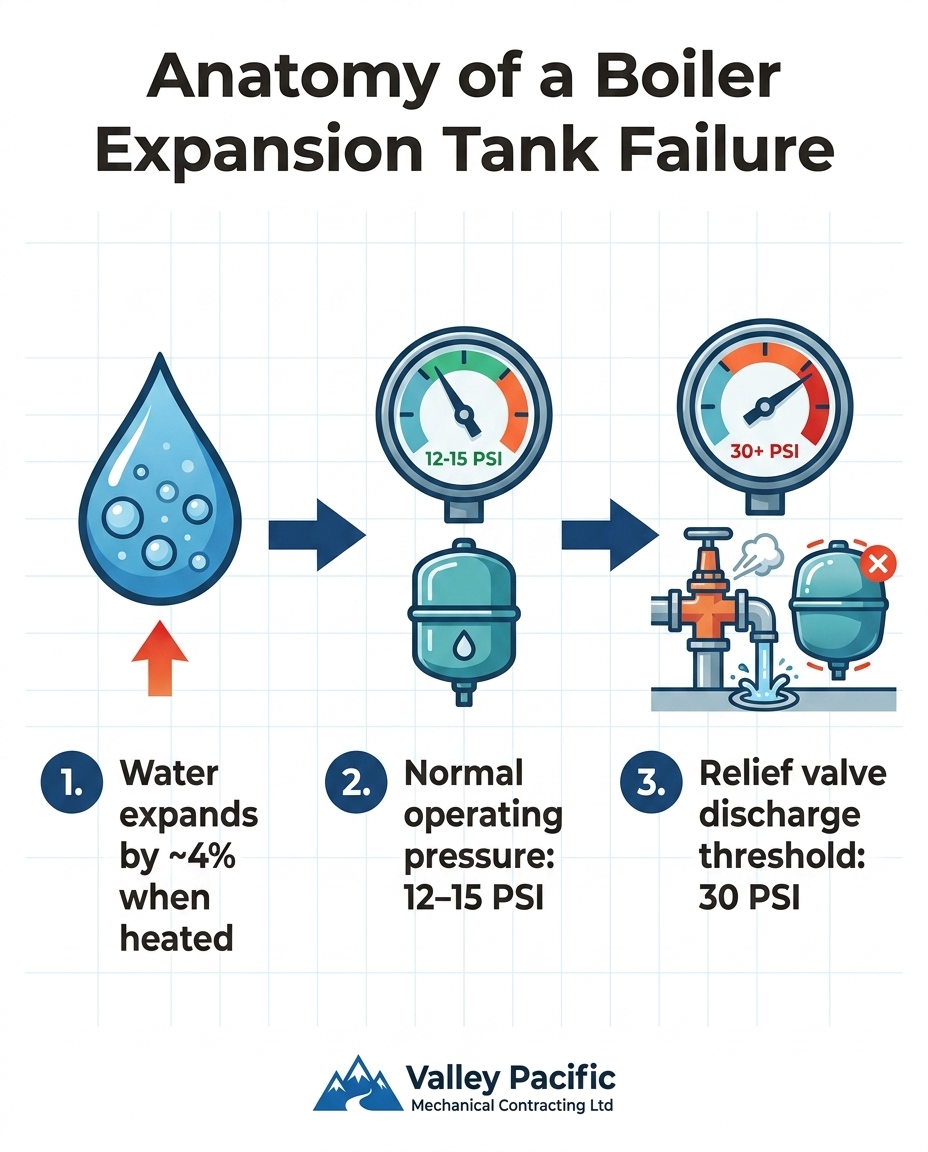
To appreciate why a failing tank is so dangerous, you first need to understand the basic physics of thermal expansion. A hydronic heating system is a closed loop, meaning the water inside is sealed off from the outside atmosphere. When your boiler heats that sealed water, the liquid physically expands. In fact, water expands by approximately 4% when heated from room temperature to standard boiler operating temperatures. In a system holding dozens of gallons of water, that 4% translates to a significant volume increase.
The Mechanics of Pressure Management
Closed-loop hydronic systems typically operate between 12-15 PSI (pounds per square inch) under normal conditions. As the water heats and expands, the pressure naturally rises. The expansion tank is designed to absorb this excess volume to keep the overall system pressure stable. Inside a modern expansion tank, a flexible rubber diaphragm separates the tank into two halves: one side connects to the boiler water, and the other side contains a pre-charged cushion of air.
Because air is compressible and water is not, the expanding hot water pushes against the rubber diaphragm, compressing the air cushion. This simple mechanical action gives the expanding water a place to go, preventing the pressure from spiking to dangerous levels. Without this critical absorption, the system experiences severe pressure fluctuations. When a tank fails—usually because the internal diaphragm ruptures and the air side fills with water—you will quickly notice pressure gauge spikes during heating cycles.
How Maple Ridge's Climate Accelerates System Wear
In our years of servicing local homes, we've seen firsthand how the local climate plays a massive role in how quickly heating components wear out. Maple Ridge is known for its chilly, damp winters, where the cold seems to seep right through the walls. This specific type of weather forces residential boilers into high gear. Unlike a dry cold where a house might hold its heat well, damp cold pulls heat away from the structure rapidly, requiring constant, heavy heating cycles to maintain a comfortable indoor temperature.
The Toll of Continuous Cycling
Every single time the boiler fires up to meet the thermostat's demand, the water heats, expands, and pushes against the expansion tank's diaphragm. When the cycle ends, the water cools, contracts, and the diaphragm relaxes. This continuous cycling puts immense, repetitive stress on the internal rubber components. Over several seasons, this constant flexing can cause the rubber to weaken, become brittle, and eventually tear.
If you are scheduling routine plumbing services in Maple Ridge, having one of our technicians assess the boiler's expansion system is a smart move. Early identification of a weakened or ruptured diaphragm prevents mid-winter breakdowns when the system is working its hardest. Because localized weather patterns dictate how hard your equipment works, localized, proactive maintenance strategies are required to keep everything running smoothly. A pre-heating season (Fall) check ensures that the heavy thermal expansion loads placed on the boiler system won't result in a sudden failure on the coldest night of the year.
Visual Warning Signs of a Waterlogged Expansion Tank
Homeowners can often spot a failing expansion tank long before it causes a complete system shutdown. While we strongly advise that you never attempt to repair or replace pressurized boiler components yourself, performing safe visual inspections is highly encouraged. Knowing what to look for allows you to call our professionals for help before a minor issue becomes a major emergency.
Safe Visual Inspections for Homeowners
1. Monitor the pressure gauge: Locate the tridicator gauge on your boiler (which displays both temperature and pressure). A healthy system rests at 12-15 PSI and may rise slightly during operation. If you see erratic pressure gauge spikes during heating cycles—often jumping close to 30 PSI—the tank is no longer absorbing the expansion.
2. Inspect the pressure relief valve: Look at the brass safety valve near the boiler, which usually has a copper or PVC discharge pipe pointing toward the floor. If this valve is weeping, actively dripping, or shows crusty mineral deposits around the opening, it means the system is regularly over-pressurizing.
3. Perform a simple tap test: Carefully tap the outside of the expansion tank with a metallic object, like a coin. The bottom half (connected to the pipe) should sound solid, while the top half (containing the air cushion) should have a hollow, ringing sound. A dull, solid 'thud' sound on the top half indicates the diaphragm has failed and the tank is completely full of water.
4. Watch for frequent boiler lockouts: Modern boilers have built-in safety switches that shut the system down if pressure exceeds safe limits. If your boiler frequently locks out and requires a manual reset, over-pressurization is a likely culprit.
Recognizing the signs of a failing boiler expansion tank early gives you the runway to schedule a planned replacement rather than dealing with an emergency.
The Domino Effect of Ignoring Pressure Spikes
When an expansion tank becomes completely waterlogged, the system loses its shock absorber. Because water cannot be compressed, the expanding volume immediately drives the system pressure upward. Boilers are built with a fail-safe mechanism to prevent the cast iron or steel heat exchanger from literally bursting under this stress: the pressure relief valve.
When the Pressure Relief Valve Blows
Relief valves on residential boilers are strictly set to discharge at 30 PSI. If the pressure hits this threshold, the valve springs open, dumping scalding hot water onto the mechanical room floor until the pressure drops back to a safe level. This is not a gentle leak. A blown relief valve can discharge gallons of water in minutes, causing severe damage to drywall, flooring, and any stored items nearby. Furthermore, once a relief valve blows, it rarely seats perfectly again, leading to a continuous, chronic drip that drains system water and introduces fresh, oxygen-rich water into the loop (which causes internal corrosion).
• Healthy Tank — Pressure Behavior: Stable at 12-15 PSI — Relief Valve Status: Completely dry — Risk Level: Low
• Failing Diaphragm — Pressure Behavior: Pressure gauge spikes during heating cycles — Relief Valve Status: Occasional weeping or mineral buildup — Risk Level: Moderate (Requires attention)
• Waterlogged Tank — Pressure Behavior: Rapid spikes to 30 PSI — Relief Valve Status: Actively discharging water — Risk Level: High (Emergency)
The consequences extend beyond water damage. Our service crews frequently see the aftermath of delayed maintenance. For instance, we recently assisted a local homeowner who experienced a complete boiler breakdown that left them with no hot water during the middle of winter. Because the issue had escalated to a full system failure, it required an urgent response. We dispatched a technician within a day and managed to repair the entire system within hours, restoring their hot water service. However, emergency situations like this are highly stressful. A blown valve leads to an immediate loss of heat during freezing weather, and the compounding costs of emergency water cleanup combined with urgent mechanical repair are entirely preventable.
Why Expansion Tank Replacement Requires a Licensed Professional
With the rise of internet tutorials, it can be tempting to view a boiler expansion tank as a simple DIY swap. This is a dangerous misconception. Closed-loop boilers are pressurized vessels governed by strict BC Safety Authority regulations. Tampering with these systems without proper licensing, training, and specialized tools poses a significant risk to your property and personal safety.
The Dangers of Pressurized Vessels
A waterlogged expansion tank is deceptively heavy. A standard residential tank that holds 4.4 gallons can weigh nearly 40 pounds when completely full of water. These tanks are often suspended in the air, hanging by a single threaded pipe connection. Attempting to unscrew a heavy, pressurized tank without properly isolating the system and draining the pressure can result in the pipe snapping, scalding water spraying across the room, or the heavy steel tank dropping and causing injury.
The professional replacement process is meticulous. A licensed technician will first isolate the boiler from the rest of the house piping. They will safely drain the pressure from the system, support the heavy waterlogged tank, and carefully unthread it. Before installing the new unit, they must calibrate the new tank's pre-charge pressure to perfectly match the baseline pressure of your specific home's system. At Valley Pacific Mechanical, our deep local expertise and proactive approach to preventing catastrophic winter heating emergencies safely and efficiently ensures the job is done right the first time. Re-pressurizing the system, bleeding out trapped air, and verifying that the system is balanced correctly for winter requires professional knowledge. A pre-heating season (Fall) replacement by our licensed experts guarantees peace of mind.
Integrating Tank Checks into Your Annual Heating System Prep
While the expansion tank is a critical safety feature, it is only one component of a much larger hydronic ecosystem. Checking the expansion tank should never be an isolated task; it is just one part of a comprehensive pre-winter boiler service. Approaching your home's heating system holistically ensures that every valve, pump, and sensor is ready for the rigorous months ahead.
A Comprehensive Approach to Hydronic Health
During a professional inspection, a technician will assess the entire hydronic system. They will check the circulation pumps for proper flow and listen for bearing wear. They will test the aquastat and high-limit safety controls to ensure the boiler fires and shuts down at the correct temperatures. They will also inspect the zone valves and bleed any trapped air from the radiators or baseboards, which can cause cold spots in the house.
Routine checks provide peace of mind and reliable performance throughout the coldest months. Another homeowner recently reached out to our team for routine maintenance on their essential home systems, including their boiler and heaters. By having our professionals thoroughly service the equipment before the cold weather set in, they noted feeling completely reassured that their systems would run reliably all winter long. Compare the simplicity of scheduling furnace maintenance and boiler checks during the mild pre-heating season (Fall) to the immense stress of dealing with an emergency winter repair. Preventive care is always the smarter, safer route.
Take Action Before the Maple Ridge Winter Arrives
Catching pressure issues early is the key to maintaining a safe, reliable, and efficient home heating system. A waterlogged expansion tank will quietly stress your boiler right up until the moment the relief valve blows. By knowing the warning signs—like a weeping valve or an erratic gauge—you can stay one step ahead of a breakdown.
If you have noticed any of the symptoms discussed above, or if your system hasn't been serviced since last winter, do not wait for the first freeze. Schedule a professional inspection with Valley Pacific Mechanical during the pre-heating season (Fall) to ensure your equipment is balanced, safe, and ready to keep your family warm all season long.
Frequently Asked Questions
What are the signs of a waterlogged boiler expansion tank?
The most common signs include a weeping or dripping pressure relief valve, erratic swings on the pressure gauge, and a dull, solid sound when you tap the top half of the tank. If the tank is functioning normally, the top half should sound hollow due to the air cushion inside. Recognizing these physical signs early allows you to call a professional before a major leak occurs.
Why does my boiler pressure gauge spike during heating cycles?
Your pressure gauge spikes because the expansion tank is no longer absorbing the increased volume of heated water. As water heats up, it expands by about 4%, and without a working air cushion in the tank to absorb that expansion, the pressure inside the closed loop rises rapidly. This spike is a clear indicator that the internal diaphragm of the tank has failed.
How do I know if my boiler expansion tank is bad?
You can tell the tank is bad if the system pressure frequently approaches or exceeds 30 PSI, causing the safety relief valve to discharge water. Additionally, if the tank feels excessively heavy or sounds completely solid when tapped lightly with a metal object, it has likely lost its air charge and filled entirely with water. A licensed technician can confirm this by testing the Schrader valve on the tank.
What happens if a boiler expansion tank fails?
If the tank fails, the expanding hot water has nowhere to go, causing the system pressure to rise until the pressure relief valve forcefully opens. This results in scalding water dumping onto your mechanical room floor, potentially causing severe water damage to your home. It also forces the boiler to shut down or lock out, leaving you without heat until repairs are made.
Why is my boiler pressure relief valve leaking?
A leaking or weeping pressure relief valve is almost always a symptom of a waterlogged expansion tank that can no longer manage system pressure. The valve is designed to open at 30 PSI to prevent the boiler from rupturing, so a leak means the system is regularly hitting that dangerous threshold. It is a critical safety warning that requires immediate professional attention.
How often should a boiler expansion tank be replaced in BC?
While there is no strict expiration date, our team typically sees most residential boiler expansion tanks last between 5 and 10 years depending on water quality and system cycling frequency. We highly recommend having the tank inspected annually during your pre-winter maintenance check. Proactive replacement at the first sign of diaphragm wear is the best way to prevent emergency failures.


