


The Real Difference Between Boiler and Forced Air Heating for BC Winters


Navigating the Choice Between Hydronic and Ducted Heat
Are you trying to figure out the real difference between boiler and forced air heating for BC winters because your home never quite feels comfortable during the damp, cold months? It is a common frustration for homeowners in the region. You adjust the thermostat, yet the air either feels too dry, too drafty, or simply inconsistent. Choosing the right whole-home heating method is about much more than just picking a box that generates warmth. You have to select a system that actively manages the unique environmental challenges of living on the coast.
If you are weighing your options, learning how boiler systems compare to traditional ducted setups is the best place to start. The two primary contenders for whole-home heating are hydronic radiant systems (boilers) and ducted forced-air systems (furnaces). Most generic heating advice you find online assumes you live in a dry, freezing climate. That advice often fails to account for the specific humidity and temperature fluctuations of coastal environments.
To make the best upgrade decision for your property, you need to understand how each system impacts your daily life. This means looking closely at indoor air quality, heating speed, and moisture retention. The right choice will transform how your home feels from October through April.
How the Damp Coastal Climate Shapes Indoor Comfort
Before comparing the equipment, you have to understand the environment it operates in. The damp coastal cold of BC winters requires a nuanced approach to managing indoor comfort. Standard dry-cold heating comparisons simply do not apply to local homes, because our outdoor air carries a massive amount of moisture even when temperatures drop near freezing.
Here is the thing about heating outdoor air: as the temperature of the air increases, its capacity to hold moisture expands. When your heating system pulls in cold, damp outdoor air and heats it to 70°F, the relative humidity of that air plummets. This physical reaction is exactly why indoor air can feel incredibly dry, even when it is pouring rain outside. This sudden drop in relative humidity can exacerbate dry skin, cause static electricity, and lead to respiratory irritation.
This creates a unique balancing act for homeowners facing damp BC winters. You need a system powerful enough to keep the cold at bay, but you also need to prevent your indoor air from becoming excessively dry. Perceived indoor comfort relies on both ambient temperature and proper moisture levels. If your air is too dry, your sweat evaporates faster, making you feel colder even if the thermostat reads 72°F. Understanding this dynamic is the first step in deciding which heating method will serve your household best.
Understanding Your Boiler Heating System's Radiant Warmth
Hydronic heating operates on a completely different principle than blowing hot air through a room. If you want a deep dive into understanding your boiler heating system, the core concept comes down to the exceptional thermal conductivity of water.
Here is how a standard hydronic system operates to keep your home warm:
1. Water Heating: The boiler unit heats water to a specific temperature using natural gas, propane, or electricity.
2. Circulation: A specialized pump pushes this heated water through a closed loop of pipes hidden in your floors or along your walls.
3. Radiant Transfer: The hot water travels through baseboard radiators or in-floor tubing, releasing thermal energy into the room.
4. Return Cycle: As the water cools, it returns to the boiler to be reheated and circulated again.
Water conducts thermal energy significantly better than air. This means a boiler provides consistent, draft-free ambient heat. Instead of blowing heated air into the space, radiant heat warms objects and people directly. Think of it like standing in direct sunlight on a cool day; the air around you might be crisp, but the radiant energy warms you to the bone.
These systems are renowned for their long-term reliability. However, when they do experience a failure in the middle of winter, prompt professional repair is critical. One local homeowner experienced this firsthand when their system broke down while they were on a winter vacation, resulting in no hot water or heat during a cold snap. A technician arrived within a day and repaired the entire system within hours, quickly restoring the essential hot water supply and bringing the house back to a safe temperature.
The Advantage of Humidity Retention
One of the biggest benefits of hydronic heating is how it interacts with your indoor air. Boilers do not actively strip moisture from the air or rely on rapid air turnover. This passive heating style helps your home maintain the optimal 30-50% indoor humidity range naturally.
This natural moisture balance is crucial for comfort during long, cold months. Because the system does not dry out the air, you rarely need to run a whole-home humidifier to keep your skin from drying out or your hardwood floors from shrinking.
The Mechanics of Forced-Air Furnace Heating
While boilers use water, ducted systems rely entirely on air movement. The mechanics of forced-air furnace heating involve rapidly raising the temperature of the air and distributing it forcefully throughout the house.
When your thermostat calls for heat, the furnace ignites its burners to warm a metal component called the heat exchanger. The blower motor then pulls cold air from your home through the return ducts, pushes it across the hot heat exchanger, and forces the newly heated air out through the supply vents. This process cycles the entire volume of a home's air multiple times per hour.
Because the system constantly pulls air in, heats it rapidly, and blows it back out, this rapid air turnover can quickly deplete indoor humidity. If this setup is not supplemented by an integrated whole-home humidifier, the continuous cycling can leave the house feeling uncomfortably dry during peak winter months.
Furthermore, aging furnaces can struggle to keep up during the coldest days, working overtime to maintain the set temperature. This constant strain can lead to unexpected breakdowns. One local homeowner discovered this during a routine spring service, which revealed a dangerous cracked heat exchanger in their older unit. The situation was resolved quickly by replacing the furnace at a competitive price, ensuring safe, reliable heating well before the next winter hit.
Indoor Air Quality (IAQ) and Humidity Control Head-to-Head
When comparing these two methods, indoor air quality (IAQ) is often the deciding factor for families with allergies, asthma, or respiratory sensitivities. Tightly sealed modern homes trap pollutants inside, making your choice of heating system a major factor in your daily health.
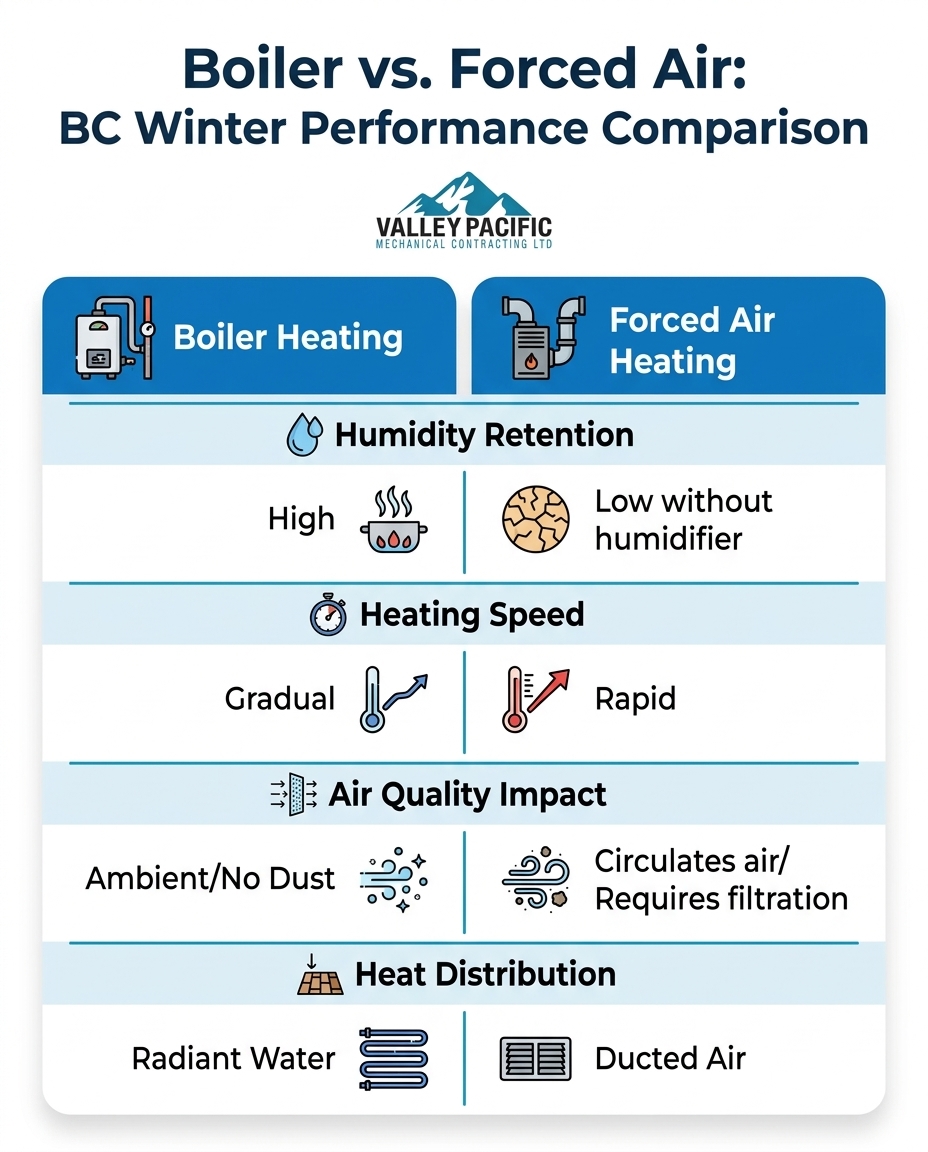
• Air Movement — Boiler (Hydronic Radiant): Ambient and draft-free. Does not blow air around the room. — Furnace (Forced-Air Ducted): High velocity. Actively blows air through vents into every room.
• Dust & Allergens — Boiler (Hydronic Radiant): Does not stir up settled dust, pet dander, or airborne allergens. — Furnace (Forced-Air Ducted): Can circulate dust and dander if filters are not changed frequently.
• Humidity Impact — Boiler (Hydronic Radiant): Retains natural indoor moisture levels easily. — Furnace (Forced-Air Ducted): Can deplete humidity rapidly, often requiring a humidifier add-on.
• IAQ Maintenance — Boiler (Hydronic Radiant): Minimal impact on IAQ; no filters to change for air quality. — Furnace (Forced-Air Ducted): Requires diligent, regular filter replacements to maintain healthy air.
ASHRAE (the American Society of Heating, Refrigerating and Air-Conditioning Engineers) provides strict guidelines on thermal comfort. Their standards indicate that keeping indoor humidity between 30% and 50% is optimal for human health and minimizing viral transmission. Boiler systems naturally align with these guidelines because they do not alter the moisture content of the air.
Forced-air systems, on the other hand, have the advantage of being able to filter the air. By installing high-MERV filters or UV purifiers in the ductwork, a furnace can actively clean the air as it heats. However, this requires diligent filter maintenance. If a furnace filter gets clogged, the system will not only struggle to heat the home, but it will also begin circulating trapped pollutants. Because radiant heat does not move air at all, it is often preferred for households with severe allergies.
Heating Speed and Thermal Dynamics Compared
How quickly do you want your house to warm up after you turn up the thermostat? The thermal dynamics of water versus air create vastly different heating experiences.
Forced-air systems excel at rapid temperature recovery. If you turn your thermostat down to 60°F while you are at work and bump it up to 70°F when you get home, a furnace will quickly blast hot air into the rooms, warming the house in a matter of minutes. This makes forced air ideal for households that rely heavily on aggressive programmable thermostat setbacks to save energy while the house is empty.
Contrast this with boiler systems, which take significantly longer to reach the desired temperature. Water takes time to heat up, and the radiant energy takes time to transfer into the room's objects and flooring. However, once a hydronic system reaches the target temperature, it holds that heat much longer due to thermal mass. Even after the boiler stops firing, the hot water in the pipes continues to radiate warmth for quite a while.
Your lifestyle factors heavily into which dynamic is better. If you prefer consistent, all-day warmth without the noise of a blower motor kicking on and off, a boiler is superior. Additionally, the lack of drafts with radiant heat often makes a room feel warmer at a lower thermostat setting. Moving air creates a slight wind-chill effect on human skin, meaning furnace users often have to set their thermostats a degree or two higher to achieve the same perceived comfort level as a boiler user.
Space Requirements and Retrofitting Realities
When you are upgrading an existing home, the physical footprint of the equipment plays a massive role in your decision. The installation requirements for these two systems could not be more different.
Forced-air systems require a massive network of ductwork. These bulky sheet metal trunks and branches take up significant space in basements, attics, and wall cavities. If you are building a custom home, designing space for ductwork is easy. But if you are dealing with the challenges of retrofitting ductwork into an older home that currently relies on radiant heat, the project can be highly disruptive. You often have to build dropped ceilings or sacrifice closet space to hide the new ducts.
Boiler systems, conversely, have a minimal footprint. The piping required to move hot water is small—often less than an inch in diameter. This flexible tubing can easily be snaked through existing floor joists and wall spaces without tearing the house apart. The boiler unit itself is also quite compact, with modern wall-hung units taking up no floor space at all.
If your home lacks ductwork and installing it is impractical, but you still want forced-air benefits (like the ability to add air conditioning), you might want to explore heat pump options. Ductless mini-split heat pumps provide targeted forced-air heating and cooling without requiring a massive network of sheet metal. Ultimately, modernizing either system requires a professional assessing your home's existing infrastructure to see what makes the most structural sense.
Evaluating the Best Fit for Maple Ridge and Fraser Valley Homes
Reaching a final decision requires looking at your specific property and personal preferences. The choice between a boiler and forced air is not just about energy efficiency; it is about actively managing air quality, humidity, and comfort throughout the long winter.
For Maple Ridge and Fraser Valley homes, the damp climate means you have to think carefully about how your heating system handles moisture. If your family struggles with dry winter skin, asthma, or allergies, the draft-free, humidity-retaining warmth of a hydronic system is tough to beat. On the other hand, if you want rapid heating, the ability to easily add central air conditioning in the summer, and active air filtration, a forced-air furnace is likely the better path.
Because Valley Pacific Mechanical Contracting Ltd. has deep expertise in both hydronic and ducted systems, we can objectively evaluate your home without bias. We focus strictly on the comfort, indoor air quality, and humidity outcomes that make sense for the Lower Mainland. We encourage homeowners to evaluate their current ductwork, insulation levels, and their family's respiratory needs before making a commitment. The right system will perfectly balance heating speed, humidity retention, and long-term reliability for your specific lifestyle.
Take the Guesswork Out of Your Home Heating Decision
Choosing the right heating system ensures a comfortable, healthy home all winter long. You do not have to figure out the complex thermal dynamics or retrofitting requirements on your own. Local expertise is available to evaluate your specific property layout, listen to your family's comfort goals, and provide clear, objective guidance.
If you are ready to upgrade your comfort, it is time to talk to an expert who understands both sides of the equation. Reach out to schedule a professional inspection and let us help you weigh your options so you can enjoy a warmer, healthier home this season.
Frequently Asked Questions
Does forced air heat dry out the house during a BC winter?
Yes, forced air can significantly drop indoor humidity levels. As the system continuously pulls in damp, cold outdoor air and heats it rapidly, the relative humidity plummets. This continuous air turnover often requires an integrated humidifier to prevent dry skin and static electricity during the coldest months.
Is a boiler heating system better for allergies than a furnace?
Boiler systems are generally better for severe allergies because they provide radiant heat. They do not use blowers or ductwork, which means they do not stir up settled dust, pet dander, or airborne allergens. Furnaces can filter the air, but they will circulate pollutants if the filters are not changed regularly.
Which heating system is best for damp BC winters?
The best system depends entirely on your home's infrastructure and your comfort preferences. Boilers excel at maintaining natural humidity and providing draft-free warmth, which is ideal for damp climates. Furnaces offer rapid heating and the ability to easily integrate central air conditioning for the summer months.
What is the main downside to a boiler heating system?
The primary downside is that boilers cannot provide air conditioning, as they only circulate hot water. Additionally, they take longer to raise the temperature of a cold room compared to the rapid blast of hot air from a furnace. Installing a new boiler system can also have a higher initial setup cost.
Is radiant boiler heat more energy-efficient than a forced-air furnace?
Radiant heat is often more efficient because water is a superior conductor of thermal energy compared to air. Furthermore, boilers do not suffer from the duct leaks that plague many forced-air systems, which can lose a significant amount of heat before the air even reaches the room.
Can I easily switch from forced air to a boiler heating system?
Switching from forced air to a boiler requires a significant retrofit. A professional will need to install a network of pipes and baseboard radiators or in-floor tubing throughout your home. While the piping is much smaller than ductwork, running it through finished walls and floors requires careful planning and professional execution.


