


When to Repair vs. Replace a Failing Furnace Control Board in Maple Ridge


Is It Worth Soldering a New Relay on a Failing Furnace Control Board?
Are you wondering when to repair vs. replace a failing furnace control board in Maple Ridge after your heating system suddenly stops responding to the thermostat? When a specific component, like a blower relay, burns out, our team at Valley Pacific Mechanical often sees homeowners with older generation furnace control units face a difficult decision. The temptation to simply desolder the damaged component and attach a new relay is strong, especially when you are looking for a quick fix to get the warm air flowing again. However, modern HVAC safety standards dictate a much different, more comprehensive approach to restoring your home's heat.
While a localized, component-level repair might seem like a clever shortcut, it often introduces hidden dangers and long-term reliability issues. The circuit board acts as the central command center for all your furnace systems, managing high-voltage electricity and critical safety mechanisms. Attempting to bypass a full replacement by micro-soldering a single relay is rarely the permanent solution it appears to be.
The core dilemma: Should you attempt a micro-solder repair on a degraded circuit board, or is it safer and more practical to replace the entire control unit? This objective, safety-first technical evaluation will break down the mechanics of furnace control boards, the severe risks associated with component-level soldering, and why our industry professionals strongly advocate for full board replacement to ensure your home remains safe and consistently warm.
Understanding the Role of the Control Board and Relay
To understand why a simple solder job is problematic, you first need to understand how the internal components of your heating system communicate. The furnace control board is essentially the brain of your HVAC equipment. It receives signals from your thermostat and translates those commands into a precise sequence of operations. It directs power to the draft inducer motor, the igniter, the gas valve, and finally, the main blower motor. Every step must happen in exact order for the furnace to operate safely.
The relays on this board act as mechanical switches. They physically open and close to allow electrical current to pass through to the heavy-duty components. Over a typical lifespan of 10 to 15 years, these relays endure thousands of heat cycles and constant vibration. The internal metal contacts begin to pit, carbon builds up, and the internal magnetic coils weaken. When our technicians diagnose a system and homeowners start researching furnace control board repair, we find the underlying culprit is almost always a worn-out relay that has finally fused shut or burnt out completely.
This degradation is especially common in older generation furnace control units with accessible relays. Because these older boards feature larger, distinct components, they look deceptively easy to repair. However, a burnt relay is usually a symptom of overall board fatigue rather than an isolated incident.
Common Symptoms of a Bad Relay
If you suspect your control board is failing, the relays will usually give you a few warning signs before they give out entirely. Catching these early can prevent a sudden breakdown during a cold snap.
• Continuous blower operation: The furnace blower runs nonstop because the relay contacts have fused closed, preventing the fan from shutting off.
• Complete lack of response: The system fails to turn on at all, ignoring commands from the thermostat because the relay coil has broken.
• Intermittent ignition failures: The furnace starts the heating sequence but abruptly shuts down before the gas ignites.
• Rapid clicking noises: You hear a distinct, fast clicking sound coming from the furnace panel, indicating a relay is struggling to maintain an electrical connection.
Recognizing these symptoms early is critical. If you notice these red flags, they are strong signs your HVAC system is about to break down, requiring immediate professional diagnostics from our team.
The Hidden Risks of Component-Level Soldering
When an older generation furnace control unit with accessible relays fails, some DIY enthusiasts or unqualified handymen might suggest desoldering the burnt relay and attaching a replacement part sourced online. While this is technically possible, our certified HVAC professionals universally refuse to perform micro-soldering on circuit boards. The reasons go far beyond simple preference; they are rooted in strict safety standards and liability concerns.
Fire hazards and electrical shorts: Furnace control boards manage 120-volt electricity. A poorly executed solder joint, or one that lacks the precise factory-applied conformal coating, creates high electrical resistance. This resistance generates excess heat, which can quickly lead to an electrical short or, in worst-case scenarios, an active fire inside the furnace cabinet. HVAC technicians carry strict liability for the safety of the equipment they service, and altering a factory-certified board violates manufacturer safety standards.
The false economy of labor time: From a practical standpoint, the labor time involved in safely removing the board, meticulously desoldering the damaged relay, cleaning the contacts, soldering a new component, and testing the circuit is extensive. When you compare that intensive labor time against the relative investment of simply installing a brand-new, guaranteed board, component-level repair quickly becomes a false economy. You end up paying significant labor costs for a patchwork fix.
Voided warranties and cascading failures: Performing unauthorized electrical repairs on HVAC equipment instantly voids any remaining manufacturer warranties. Furthermore, if one relay has failed after 15 years of use, every other capacitor, resistor, and relay on that same board has endured the exact same wear and tear. Replacing one component leaves you with a board full of aging parts that are equally close to failure. For reliable HVAC repair in Maple Ridge, our professionals focus on comprehensive solutions that restore the entire system's integrity.
How Coastal Moisture Impacts Repaired Circuit Boards
The geographical environment where your furnace operates plays a massive role in the lifespan of its electronic components. In our years of servicing HVAC systems across the Lower Mainland, we've found that the cold and damp Maple Ridge winter heating season introduces a specific set of challenges that make component-level circuit board repairs exceptionally risky.
The problem of relative humidity: Our region is known for its high relative humidity, even during the colder months. Utility rooms, basements, and crawlspaces where furnaces are typically installed are prone to subtle moisture buildup and condensation. Every time the furnace cycles on and off, the temperature fluctuations in the metal cabinet can cause microscopic water droplets to form on internal surfaces.
The cause of accelerated corrosion: To combat this moisture, factory-new furnace control boards are coated in a specialized, protective sealant called conformal coating. This clear layer completely seals the delicate copper traces and solder joints away from the damp air. When someone attempts to solder a new relay onto a board, they must scrape away this protective seal to access the metal beneath. Once the new relay is attached, that joint remains exposed to the environment.
The inevitable solution: Damp coastal moisture interacts aggressively with these compromised, unsealed solder joints. The exposure accelerates galvanic corrosion, leading to rapid secondary electrical faults. A repaired board in this specific climate is essentially a ticking clock for another breakdown. We always advise that the only definitive solution to protect your heating equipment from coastal humidity is utilizing a factory-sealed board that can withstand the environmental demands of the region.
The Advantages of Full Control Board Replacement
Given the severe safety risks and the environmental vulnerabilities of a soldered board, the counter-option—a full control board replacement—stands as the definitive, safe, and reliable choice for homeowners. Upgrading the entire unit provides comprehensive benefits that far outweigh the perceived savings of a localized repair.
Restoring factory safety standards: A brand-new control board is manufactured in a controlled environment, rigorously tested for electrical continuity, and fully sealed against moisture. When one of our certified technicians installs a new board, they are restoring your furnace to its original factory safety specifications. This eliminates the anxiety of electrical shorts, fire hazards, and liability issues associated with tampered equipment.
Resetting the lifespan of the system: Replacing the entire board means you are getting a fresh start for the "brain" of your heating system. You are not just fixing one broken relay; you are replacing every aging capacitor, microchip, and switch on that circuit. This comprehensive approach provides long-term peace of mind and typically comes with a fresh manufacturer warranty on the part.
Avoiding secondary failures during cold snaps: The last thing you want is for a different component on a patched-up board to fail when you need heat the most. Our real-world experiences highlight the importance of decisive action. Recently, our team helped a local homeowner who faced a severe situation when their old forced air furnace broke down during the coldest days of the year. After a thorough consultation and quotation, a complete, reliable installation was performed within a few days. Their heating was restored quickly, ensuring their home remained safe during the freezing weather. This level of reliability is what you get when you choose proper residential heating services over temporary fixes.
During the cold and damp Maple Ridge winter heating season, professional installation of a new board is a straightforward, safe process that guarantees your home stays warm when it matters most.
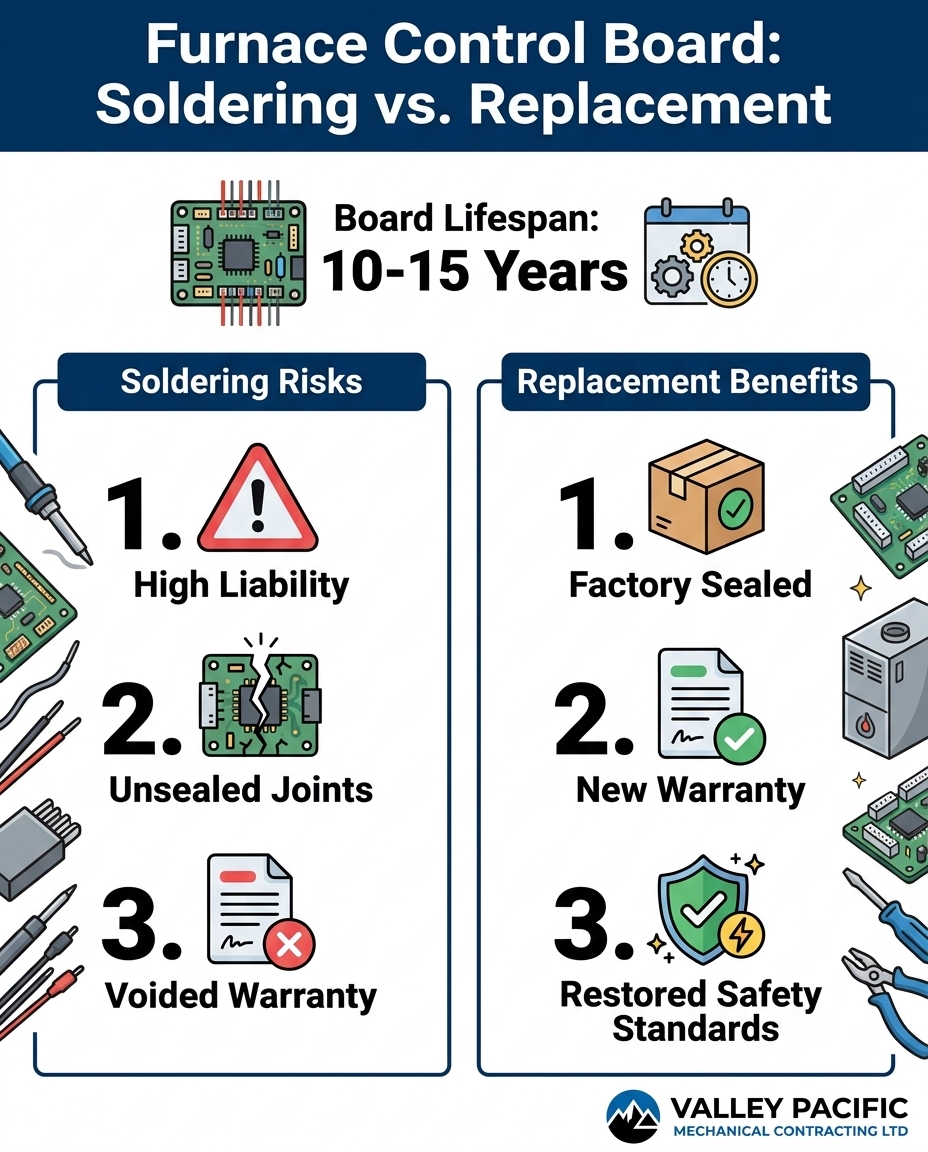
Side-by-Side Comparison: Soldering a Relay vs. Replacing the Board
To help clarify the decision-making process regarding older generation furnace control units with accessible relays, here is a definitive side-by-side comparison of your two options. This breakdown highlights why full replacement is the industry standard for safety and reliability.
• Safety & Liability — Soldering a New Relay (Component Repair): High risk of electrical shorts and fire hazards. Voids manufacturer warranties and violates professional safety standards. — Full Control Board Replacement: Meets all strict HVAC safety standards. Restores the system to factory specifications with zero liability concerns.
• Long-Term Reliability — Soldering a New Relay (Component Repair): Poor. Leaves dozens of other 10-15 year old electronic components on the board highly vulnerable to imminent failure. — Full Control Board Replacement: Excellent. Provides a 100% new, comprehensively tested "brain" for the furnace, resetting the lifespan of the control unit.
• Relative Investment — Soldering a New Relay (Component Repair): High labor time required for a temporary, patchwork fix that offers very little long-term value. — Full Control Board Replacement: Provides superior long-term value, comprehensive warranty protection, and efficient, straightforward installation labor.
• Climate Resilience — Soldering a New Relay (Component Repair): Unsealed, repaired joints are highly vulnerable to accelerated corrosion from coastal moisture and condensation. — Full Control Board Replacement: Factory-sealed with conformal coating, specifically designed to resist damp environments and high relative humidity.
Making the Right Call for Your Heating System
When you are dealing with older generation furnace control units with accessible relays, it is easy to be tempted by band-aid fixes. A burnt relay looks like a simple mechanical failure, but as we have explored, the risks associated with tampering with high-voltage circuit boards far outweigh the perceived benefits. Choosing to solder a component places your home at risk of electrical fires, voids your warranties, and leaves your system vulnerable to our damp coastal environment.
This is where the value of an honest diagnostic approach truly shines. At Valley Pacific Mechanical, our priority is always system safety and long-term reliability over temporary, high-risk fixes. For us, an honest assessment means looking at the entire health of your furnace, not just the single component that failed today. By recommending the most reliable path forward—a full board replacement—our technicians save homeowners from the frustration and danger of repeated breakdowns during peak cold snaps.
The best way to prevent sudden board failures is through proactive care. Regular inspections allow our certified local technicians to catch degrading components, test electrical draw, and monitor the health of your system before it results in a complete shutdown. Enrolling in a comprehensive HVAC maintenance plan ensures that experts who understand the specific demands of the regional climate are keeping a watchful eye on your equipment year-round.
Frequently Asked Questions About Furnace Control Boards
Can a furnace control board be repaired?
Technically yes, a furnace control board can be repaired by micro-soldering new components, but our HVAC professionals strongly advise against it. Repairing a board introduces severe electrical fire hazards, strict liability issues, and voids manufacturer warranties. Furthermore, the process compromises the factory moisture seals, making the board highly susceptible to corrosion in damp environments.
Why do HVAC professionals recommend replacing the whole board instead of a relay?
Replacing the whole board guarantees that all internal components are brand new and factory-sealed, ensuring maximum safety. If one relay has failed after 10 to 15 years, the other components on that same circuit are likely close to failing as well. A full replacement prevents rapid secondary failures and restores the furnace to its original safety standards.
What causes a furnace control board to fail?
Natural wear and tear is the primary cause of control board failure. Continuous heat cycling, constant mechanical vibration, and the simple passage of time degrade internal components like relays and capacitors. In our experience, external factors like severe power surges or exposure to coastal moisture and condensation can also accelerate a board's demise.
Is it worth replacing a furnace control board on an older unit?
It depends entirely on the overall condition of the furnace's major components. If the heat exchanger is intact, the blower motor is healthy, and the unit has been well-maintained, a board replacement is a very sound investment. However, if our technicians find that the furnace is nearing the end of its life and showing signs of major mechanical fatigue, a full system upgrade might be a better long-term choice.
How does coastal humidity affect furnace electronics?
High humidity during the cold and damp Maple Ridge winter heating season can cause microscopic condensation to form on unsealed or repaired circuit boards. This moisture interacts with exposed metal and compromised solder joints, leading to rapid corrosion. Factory-new boards are coated with a special sealant specifically designed to protect the electronics from these damp environmental conditions.
Secure Your Comfort with a Reliable Furnace Repair
Choosing a full board replacement over a risky component-level repair is the only way to guarantee your heating system operates safely and efficiently. By opting for a factory-sealed unit, you eliminate the anxiety of secondary breakdowns and protect your home from the hidden dangers of compromised electrical components. As the cold and damp Maple Ridge winter heating season approaches, ensuring your furnace is equipped with a reliable, fully functional control board is essential for your family's comfort.
Do not wait for a patched-up relay to fail during the next deep freeze. Act now to secure a permanent, professional solution. Reach out to our team today to schedule an honest, expert diagnostic assessment for dependable HVAC repair in Maple Ridge, and enjoy the peace of mind that comes with a safely operating heating system.


