


The Role of Your Boiler's Expansion Tank in Preventing Pipe Bursts


The Hidden Threat of Rising Boiler Pressure
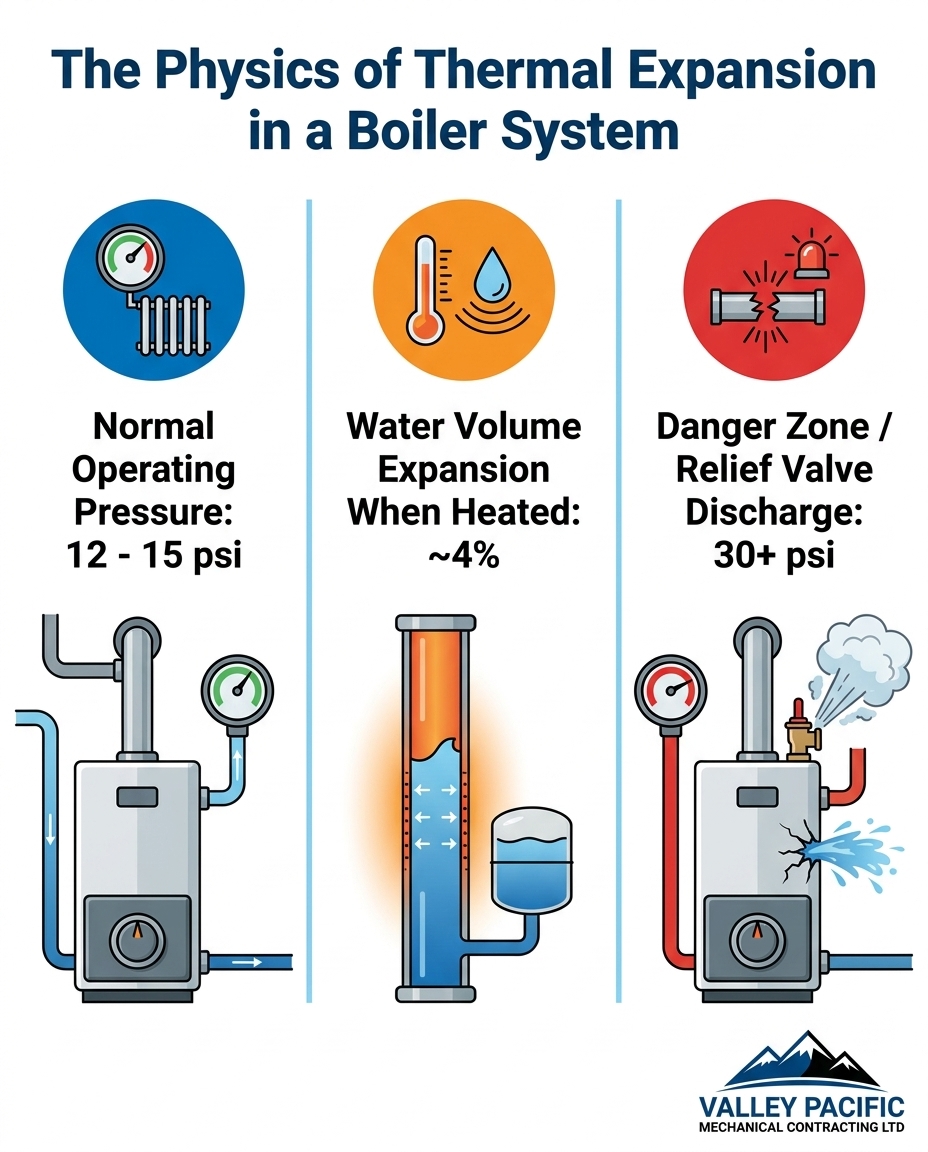
Nearly every standard residential closed-loop heating system is designed to operate safely between 12 and 15 psi. When that delicate equilibrium is maintained, your home stays comfortably warm without placing undue stress on the plumbing infrastructure. However, when that balance is lost, the internal forces can escalate rapidly. Understanding the role of your boiler's expansion tank in preventing pipe bursts is the key to catching dangerous pressure spikes before they cause severe property damage.
If you are experiencing sudden pressure issues or noticing leaks around your heating equipment, prompt professional intervention is critical. In our years of servicing heating systems throughout Maple Ridge, our team has found that addressing these early warning signs is the best way to prevent catastrophic damage. For expert assistance, explore our Boiler Services to ensure your system is operating within safe parameters.
Many homeowners assume that a boiler simply heats water and circulates it through radiators or baseboards without much physical change to the fluid itself. In reality, the heating process creates a significant physical transformation. As the water temperature rises, the volume of that water expands. Because modern residential heating relies on a closed-loop system, this newly expanded volume has absolutely nowhere to go. Without a dedicated mechanism to absorb this expansion, the internal pressure of the boiler heating system will rise uncontrollably, rapidly approaching the 30+ psi danger zone.
The unnoticed failure of the expansion tank bladder is a primary culprit behind catastrophic pipe bursts in residential heating systems. When this unassuming metal cylinder stops functioning correctly, the entire plumbing network absorbs the shock of thermal expansion. Recognizing the early warning signs, such as weeping valves or bouncing pressure gauges, is a critical decision point that can prevent costly water damage and system replacement costs.
Understanding Thermal Expansion in Closed-Loop Heating Systems
To fully grasp why a specialized tank is necessary, it is essential to understand the underlying physics of thermal expansion in closed-loop heating systems. When water is heated, the kinetic energy of its molecules increases, causing them to move further apart. This physical reaction is unavoidable and exerts immense force on whatever container holds the fluid.
Here is the sequential process of how thermal expansion impacts your heating infrastructure:
1. Initial Cold State: When the boiler is dormant, the system rests at a baseline pressure, typically sitting right at the 12 to 15 psi standard operating pressure mark. The water is dense and occupies a specific volume within the pipes.
2. The Heating Cycle Begins: The burner ignites, and the heat exchanger begins transferring thermal energy into the circulating water.
3. Volumetric Expansion: As the water temperature climbs from room temperature to its target heating point (often between 160°F and 180°F), the water expands in volume by roughly 4%.
4. Pressure Accumulation: In a closed-loop system—meaning there is no open vent to the atmosphere and check valves prevent water from pushing back into the municipal supply—this 4% increase in volume acts like forcing a larger object into a rigid, unyielding box.
If you compare a closed-loop boiler to your domestic hot water lines, the difference in pressure management becomes clear. In an open system, excess pressure can sometimes push back into the city water main or be absorbed by other avenues. A closed-loop boiler is entirely sealed off. Without an expansion tank to act as a shock absorber, that 4% volumetric increase translates directly into a massive spike in pressure, turning a safe 12-15 psi standard operating pressure into a 30+ psi danger zone in a matter of minutes.
Inside the Expansion Tank: How the Bladder Absorbs Pressure
Bypassing the basic definitions of what a boiler does, we must look closely at the mechanical operation of the expansion tank itself. From the outside, it looks like a simple steel cylinder, often suspended above or mounted near the boiler. Internally, however, it is a precisely engineered device designed to manage the physics of heated water.
The Internal Anatomy
The interior of an expansion tank is divided into two distinct chambers separated by a flexible, heavy-duty rubber bladder (sometimes called a diaphragm). This physical barrier is the most critical component of the entire pressure management system.
• The Hydronic Chamber: The top half of the tank (or the side connected directly to the system piping) is open to the boiler water. As water expands, it enters this chamber.
• The Pneumatic Chamber: The bottom half of the tank is sealed and pre-charged with a cushion of compressed air. This air pressure is carefully calibrated to match the system's baseline fill pressure.
The Mechanical Action
Water is virtually incompressible, but air can be compressed easily. This principle is the secret to understanding your boiler expansion tank. When the boiler fires up and the water expands by 4%, that extra volume pushes into the hydronic chamber of the tank. The flexible rubber bladder flexes downward, compressing the air cushion in the pneumatic chamber.
Because the air compresses, it makes room for the expanded water without allowing the overall system pressure to spike. Once the heating cycle ends and the water cools and contracts, the compressed air pushes the bladder back to original resting position, returning the water to the main system piping. This simple, elegant physical reaction protects the entire plumbing infrastructure from stress, keeping the gauge locked safely at 12 to 15 psi.
The 30 PSI Danger Zone: What Happens When the Bladder Fails
The expansion tank is a wear-and-tear component. Over years of constant thermal cycling, the heavy-duty rubber bladder inside the steel shell degrades. It can become brittle, develop pinhole leaks, or rupture entirely. When this happens, the tank becomes "waterlogged"—meaning the pneumatic chamber fills with system water, completely displacing the essential air cushion.
The Immediate Consequence of Bladder Failure
Once the air cushion is lost, the system loses its shock absorber. The next time the boiler fires up, that 4% volumetric expansion has nowhere to go. Because water cannot be compressed, the pressure inside the rigid copper or PEX piping spikes dramatically. Within a single heating cycle, the system will blow past the 12-15 psi standard operating pressure and rocket straight into the 30+ psi danger zone.
At Valley Pacific Mechanical, our team prioritizes customer education by explaining the exact "why" behind the 30+ psi danger zone. Having repaired countless blown fittings and ruptured pipes across Maple Ridge, we want to empower homeowners to understand their systems rather than just telling them to call for repairs. When pressure hits this critical threshold, the system relies on its final safety mechanism: the pressure relief valve (PRV).
The Role of the Pressure Relief Valve
The PRV is a spring-loaded brass valve designed to open automatically when internal pressure reaches 30 psi. When the expansion tank fails and pressure spikes, the PRV opens to discharge water, venting the excess pressure onto the floor (or down a drain pipe) to prevent the boiler from bursting.
• Normal Operation — Expansion Tank Condition: Bladder intact, air cushion present — System Pressure: 12 - 15 psi — PRV Activity: Closed and dry
• Early Bladder Fatigue — Expansion Tank Condition: Bladder losing flexibility — System Pressure: 15 - 25 psi — PRV Activity: Closed, occasional drips
• Total Bladder Failure — Expansion Tank Condition: Waterlogged, air cushion lost — System Pressure: 30+ psi — PRV Activity: Actively discharging water
If the PRV is overwhelmed by a rapid pressure spike, completely faulty due to mineral buildup, or dangerously capped off by an uneducated handyman, the immense pressure seeks the weakest point in the system. This often results in a catastrophic pipe burst, blown fittings, or a cracked heat exchanger. If you suspect your tank has failed, scheduling professional HVAC Repair in Maple Ridge is the only safe way to depressurize and resolve the issue.
Why Continuous Winter Boiler Operation Accelerates Bladder Wear
Expansion tank bladders do not fail overnight; they succumb to mechanical fatigue over thousands of heating cycles. Every time the boiler fires up and the water expands, the rubber bladder stretches. Every time the system cools, it relaxes. This constant flexing and thermal cycling takes a toll on the material.
During the peak winter heating season in Maple Ridge, the demand on residential boiler systems is relentless. Maple Ridge experiences cold, wet winters that require constant boiler operation to maintain indoor comfort. This relentless, round-the-clock operation maximizes thermal expansion stress. The bladder is forced to expand and contract multiple times an hour, day after day, week after week, in freezing temperatures.
Older tanks are particularly susceptible to bladder fatigue and rupture during these periods of heavy usage. The rubber loses its elasticity over the years, and the intense workload of a prolonged cold snap is often the final straw that causes a rupture. Sudden winter boiler breakdowns frequently trace back to these underlying pressure failures. For example, our emergency response team recently helped a local homeowner during a freezing winter stretch when their boiler unexpectedly broke down, leaving the house entirely without hot water. Because they reached out to us promptly, our technicians were able to diagnose the pressure and mechanical failures, repairing the entire system within hours and restoring heat before the home's internal temperature dropped dangerously low.
Early Warning Signs: Weeping Valves and Spiking Gauges
Because the expansion tank is a sealed steel cylinder, you cannot visually inspect the rubber bladder to see if it is intact. However, the boiler system provides clear, external indicators when the tank is failing. Educating yourself on how to visually identify a failing expansion tank before a catastrophic burst occurs is a vital part of homeownership.
Here are the visual checks you can safely perform:
• Observe the pressure gauge: Safely monitor the boiler's pressure gauge while the system is actively heating. In a healthy system, the needle should sit steadily between 12 and 15 psi, perhaps rising just a fraction of a degree during a heating cycle.
• Watch for wild fluctuations: If the needle bounces rapidly from 12 psi up to 25 or near 30 psi while the burner is running, this indicates a total lack of expansion cushioning. The water is expanding, and the pressure is spiking because the tank is waterlogged.
• Inspect the pressure relief valve (PRV): Look at the copper discharge pipe connected to the brass PRV. If you see a weeping valve, active dripping, or a puddle forming on the floor beneath it, this is a critical, undeniable symptom of a waterlogged tank. The valve is doing its job by venting the 30+ psi danger zone pressure.
A critical safety note: These visual checks are completely safe for homeowners to perform. However, physical testing of the tank—such as pressing the Schrader air valve to see if water comes out, or attempting to tap the side of the tank to gauge its hollowness—requires professional expertise. Releasing pressure improperly or tampering with a highly pressurized waterlogged tank can result in severe scalding or system damage.
Preventing Catastrophe with Professional Boiler Maintenance
Transitioning from understanding the physics of thermal expansion to taking the correct, safe action is how you protect your property. Replacing an expansion tank, repressurizing a system, or diagnosing a weeping relief valve is strictly a job for licensed professionals. Modern closed-loop heating systems contain scalding hot water under high pressure, making DIY repairs highly dangerous.
Routine maintenance is the most effective way to prevent bladder failure from causing an emergency. During a comprehensive tune-up, a technician will safely isolate the expansion tank from the rest of the heating system. Once isolated, they use a specialized gauge to test the bladder's pre-charge pressure through the air valve. If the pressure is low but the bladder is intact, they can recharge it. If the bladder has ruptured, they can replace the tank safely.
Proactive servicing catches bladder fatigue well before the peak winter heating season in Maple Ridge begins. Catching hidden dangers early is the hallmark of professional maintenance. In one recent instance during a routine service appointment, our maintenance team discovered a cracked heat exchanger—a highly dangerous situation that the homeowner was completely unaware of. Because it was caught during a scheduled check rather than an emergency breakdown, the equipment was replaced safely and affordably.
Maintaining proper system pressure extends the lifespan of the entire boiler heating system, protecting the heat exchanger, the circulator pumps, and the zone valves from undue stress. To keep your system running safely year-round, consider enrolling in an HVAC Preventative Maintenance Plan.
Frequently Asked Questions About Boiler Expansion Tanks
What happens if an expansion tank for a boiler fails?
When an expansion tank fails, the heating system loses its ability to absorb thermal expansion, causing pressure to spike rapidly beyond safe operating limits. Because the water has nowhere to expand as it heats up, the internal pressure will quickly exceed the 30 psi safety threshold. This triggers the pressure relief valve to leak or discharge water. If the relief valve is faulty or overwhelmed, the excess pressure seeks the weakest point in the plumbing, which can result in a catastrophic pipe burst or a cracked boiler heat exchanger.
Why is my boiler heating system pressure relief valve leaking?
A leaking pressure relief valve usually indicates that the system pressure has exceeded its maximum safe limit of 30 psi. This is most commonly caused by a waterlogged or failed expansion tank that can no longer absorb the expanding volume of heated water. The valve weeping or dripping is actually a critical safety mechanism doing its exact job—venting pressure to prevent an explosion or pipe burst. However, it is a clear symptom of an underlying pressure issue that requires immediate professional diagnosis.
How does an expansion tank prevent pipe bursts?
An expansion tank prevents pipe bursts by providing a pre-charged air cushion that compresses as heated water expands inside the closed-loop system. Because water cannot be compressed, its 4% volumetric expansion during heating would otherwise cause immense strain on rigid pipes. By absorbing this extra volume, the expansion tank keeps the overall system pressure stable between 12 and 15 psi, preventing the immense pressure from rupturing weak points, fittings, or valves in the plumbing infrastructure.
How do I know if my expansion tank is bad?
The most obvious signs of a bad expansion tank are a wildly fluctuating pressure gauge during heating cycles and a weeping pressure relief valve. If you notice the system pressure rapidly climbing from 12 psi toward 30 psi while the boiler is running, the tank is likely waterlogged. A professional HVAC technician can definitively determine if the tank is bad by isolating it and checking the air valve; if water comes out of the air valve, the internal bladder has completely ruptured.
What pressure should a boiler expansion tank be at?
The standard operating pressure for a residential boiler system is generally between 12 and 15 psi. The expansion tank's internal air pre-charge is typically set by a professional to match the system's baseline fill pressure before it is installed. This ensures that the air cushion provides the exact amount of resistance needed to absorb thermal expansion without allowing the system to drop below minimum operating pressure or spike into the danger zone.
Secure Your Heating System Against Dangerous Pressure Spikes
Understanding the physics of your boiler's thermal expansion is the first and most important step in protecting your property from water damage. Your expansion tank may be small, but it carries the massive responsibility of absorbing the immense forces generated during every single heating cycle. Recognizing the difference between a 12-15 psi standard operating pressure and the 30+ psi danger zone empowers you to monitor your system's health accurately.
If you have noticed a weeping pressure relief valve, a rapidly spiking pressure gauge, or water pooling near your boiler equipment, that is a clear and urgent signal to act. Do not wait for a minor leak to turn into a major pipe burst during the coldest week of the year. We encourage you to schedule a professional assessment to verify your expansion tank's integrity. To secure your heating system and gain complete peace of mind, reach out for expert Plumbing Services in Maple Ridge today.


