


Why Your AC Struggles During BC Heatwaves and How to Fix the Airflow


Surviving the Swelter: When the Thermostat Won't Budge
Nearly 80% of the service calls we receive regarding why your AC struggles during BC heatwaves and how to fix the airflow come down to a system hitting its physical limits, rather than an actual mechanical failure. It is incredibly frustrating to sit in your living room sweating while your air conditioner runs constantly in the background. You check the thermostat, and you see that it is set to a comfortable 22°C, but the indoor temperature stubbornly refuses to drop below 26°C. That physical discomfort often leads to immediate panic that the system is completely broken and requires an expensive emergency repair.
If you need professional help assessing your system, learn more about our air conditioning services to see how we can restore your home's comfort.
During a severe summer heatwave, especially with the specific intensity of recent Lower Mainland weather events pushing temperatures well past historical norms, a continuously running system is not automatically a sign of a broken unit. In many cases, the equipment is actually doing exactly what it was designed to do, but it is fighting a losing battle against the outdoor climate. The missing key to surviving a severe heat dome often comes down to optimizing your return airflow. Before you assume the worst, understanding how your system breathes and learning how to maximize its efficiency can make a massive difference in your indoor comfort.
The 20-Degree Rule: Understanding Your AC's Physical Limits
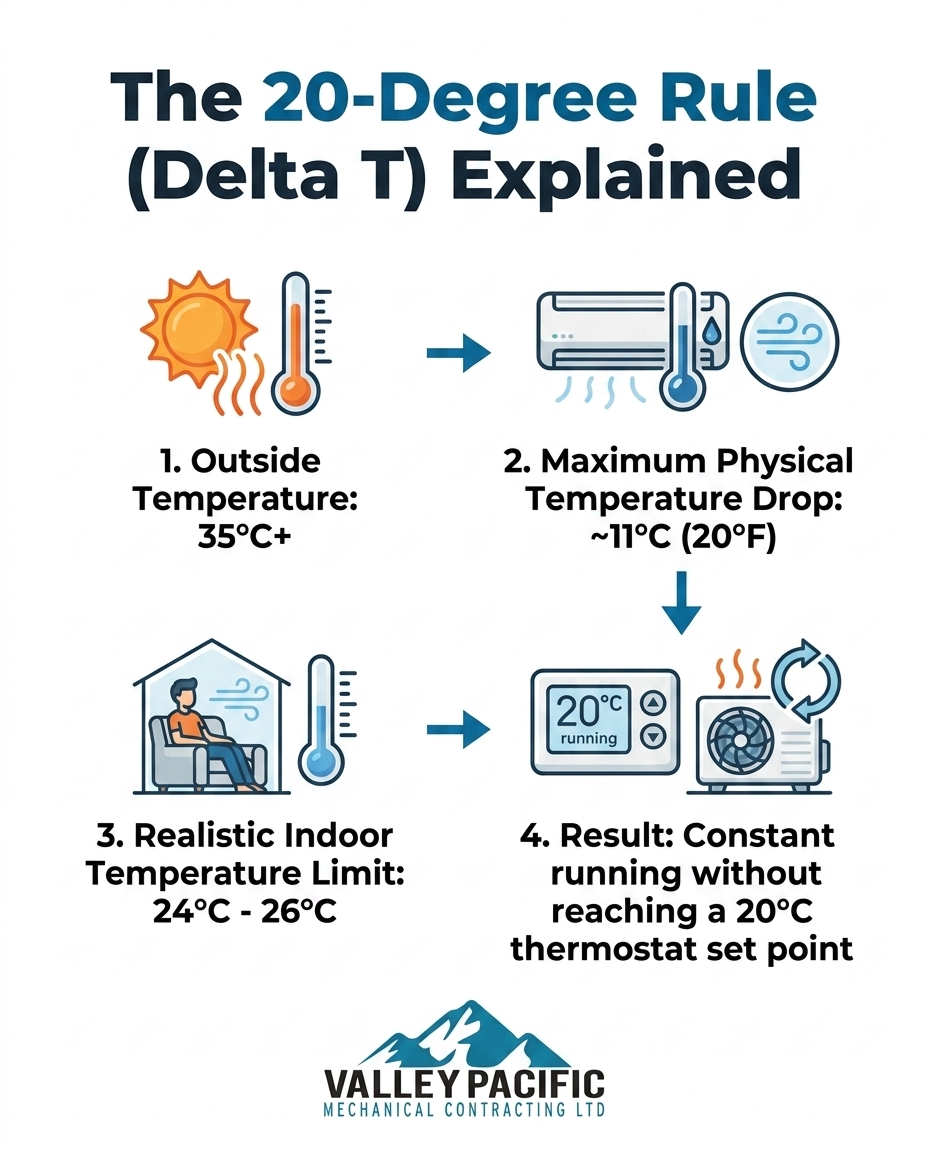
To understand why your home feels warm despite the equipment running, you need to understand a basic principle of thermodynamics known as "Delta T" (temperature differential). In simple, non-technical terms, Delta T refers to the difference in temperature between the air entering your system and the air leaving it. Standard residential air conditioners are engineered with specific physical limits based on this concept.
Most central cooling systems are designed to provide a maximum temperature drop of roughly 20°F (which translates to about 11°C) between the return air and the supply air. This is a hard physical limit based on the size of the evaporator coil, the volume of refrigerant, and the speed of the blower motor. The math becomes very clear when extreme weather hits. If the outdoor temperature spikes to 35°C+, getting the inside of your home down to 20°C defies the physical capabilities of standard residential equipment. An 11-degree drop from 37°C means your indoor temperature will likely hover around 26°C, no matter how long the unit runs.
The thermostat trap: Many homeowners react to a warm house by aggressively lowering the thermostat setting. They drop it to 18°C, hoping the air coming out of the vents will suddenly become colder. However, setting the thermostat lower does not change the temperature of the air the unit produces; it simply tells the system to keep running until it reaches that target. Because the target is physically impossible during extreme heat, the system runs nonstop, wasting energy and accelerating wear and tear. Finding the best thermostat settings for summer savings involves setting realistic expectations that align with your equipment's actual capacity.
Why Older Ductwork Chokes During Extreme Heat Spikes
The architecture and infrastructure of your home play a massive role in how well your cooling system performs. Many homes built in the Lower Mainland / Maple Ridge area before the widespread adoption of central air conditioning were designed primarily with heating in mind. Historically, BC home construction focused on surviving cold, wet winters and enjoying relatively mild summers. Because of this, the ductwork hidden behind your walls was sized for a furnace, not a modern central air conditioner.
Heating vs. Cooling Airflow: Heating a home requires significantly less airflow volume than cooling it. Hot air naturally rises and expands, making it relatively easy for a furnace blower to push warm air through small ducts and into your living spaces. Cooling, however, is a different story. Cold air is dense and heavy. To effectively cool a home, the blower motor must move a much larger volume of air (measured in cubic feet per minute, or CFM) through the system.
When you attach a modern, high-capacity air conditioner to ductwork originally sized for a 1980s furnace, you create a massive bottleneck. The undersized ducts restrict the volume of return air, effectively starving the air conditioner of the warm air it desperately needs to remove from the home. If the system cannot pull enough warm air across the indoor coil, it cannot cool the house efficiently. For homes where the existing ductwork simply cannot handle central AC demands, exploring alternative solutions like ductless mini-split systems is often the most effective way to guarantee comfort during severe heat domes.
Return Air: The Most Overlooked Factor in AC Performance
When a home feels uncomfortably warm, most people immediately check the supply vents—the grilles where the cold air blows out. If the airflow feels weak, they assume the fan is broken. However, the root cause of poor cooling performance is almost always found at the return vents—the larger grilles that pull warm air out of your rooms and back to the equipment.
It is important to clarify a fundamental concept: air conditioners do not actually "create" cold air. Instead, they remove heat and humidity from the existing indoor air. The return air vents pull the warm air from your living space and drag it across the indoor evaporator coil. The cold refrigerant inside that coil absorbs the heat, and the newly cooled air is pushed back into your rooms.
The freezing coil chain reaction: When return air is restricted during a summer heatwave, disaster strikes inside the unit. Because there isn't enough warm house air blowing across the extremely cold evaporator coil, the refrigerant absorbs too much heat too quickly, causing the coil's temperature to drop below freezing. The natural humidity in the air condenses on the freezing metal and turns to solid ice. Within a few hours, the entire coil can become encased in a block of ice, completely blocking airflow and causing the system to lose its cooling capacity entirely. Emphasizing and maximizing your return air is the single most effective way to help a maxed-out system maintain your comfort without causing catastrophic equipment damage.
4 Safe Ways to Optimize Your Airflow Immediately
When the outdoor temperature hits 35°C+ and your system is struggling to keep up, there are several safe, non-technical steps you can take to help it breathe easier. You do not need specialized tools or training to perform these basic airflow optimizations.
1. Check and replace the return air filter: A dirty, clogged air filter is the number one cause of restricted airflow. During a heatwave, your system is running constantly, meaning the filter is trapping dust, pet dander, and debris at an accelerated rate. Pull the filter out and hold it up to a light; if you cannot see light shining through it, replace it immediately. Avoid ultra-high MERV rating filters (like MERV 13+) unless your system was specifically designed for them, as they restrict airflow even when brand new.
2. Unblock all return grilles: Walk through your home and locate every return vent. Ensure that heavy furniture, thick area rugs, and long curtains are moved at least a foot away from the grilles. Blocking a return vent is like putting a hand over a vacuum cleaner hose—the motor has to work twice as hard to pull a fraction of the air.
3. Keep interior doors open: Many homes have only one or two large, central return vents located in a hallway. If you close the bedroom doors to "trap" the cold air inside those rooms, you create a pressure imbalance. The supply vents pump cold air in, but the warm air cannot escape back to the central return. Keeping interior doors open at least a few inches ensures air can freely circulate back to the equipment.
4. Clear debris around the outdoor unit: The outdoor condenser unit needs to exhaust the heat it absorbed from inside your house. If the metal fins are choked by overgrown bushes, tall grass, or accumulated leaves, the heat cannot escape. Ensure there is a minimum of two feet of clear space around all sides of the outdoor unit to guarantee proper exhaust airflow.
Bonus Tip: Reduce the Heat Load
Optimizing airflow helps the equipment, but you also need to reduce the amount of heat entering your home. Closing blinds and thick curtains on south and west-facing windows blocks solar heat gain, which acts like a magnifying glass heating up your rooms. Additionally, avoid using heat-generating appliances like ovens, stoves, and clothes dryers during the peak afternoon heat. Run these appliances early in the morning or late at night when the outdoor temperatures are lower.
Maxed Out vs. Broken: When to Call for Emergency Service
As transparent local educators, we want to help you avoid panic-calling for emergency service if your unit is simply doing its best against extreme weather. A system that is running constantly but maintaining an indoor temperature roughly 10-11°C cooler than the outdoor heat is maxed out, but it is not broken. However, there are clear signs that indicate a genuine mechanical failure requiring professional intervention.
• Maxed Out (Normal) — Common Symptoms: Running constantly; indoor temp stuck at 25-26°C; air coming from vents is cool but not freezing; outdoor temp is 35°C+. — Recommended Action: Optimize airflow (change filters, open vents). Wait for evening temperatures to drop.
• Restricted Airflow — Common Symptoms: Weak airflow from vents; ice forming on indoor coil or outdoor refrigerant lines; system runs but doesn't cool. — Recommended Action: Turn thermostat to "Off" and fan to "On" to thaw ice. Replace filter. Call for service if it freezes again.
• Genuinely Broken — Common Symptoms: Blowing warm air; strange grinding or squealing noises; outdoor fan not spinning; sudden complete shutdown. — Recommended Action: Turn off system immediately at the thermostat to prevent further damage. Call for emergency repair.
Ignoring a system that has actually seized up unexpectedly can lead to severe compressor damage. One local homeowner called us during a recent summer heatwave when their AC unit seized up unexpectedly. Because it was an emergency situation with a genuinely failed component, our team provided a prompt emergency response and attentive follow-up service to get the unit functioning again safely. To avoid these mid-summer emergencies entirely, the best defense is enrolling in an HVAC maintenance plan to ensure your system is operating at peak efficiency before the worst of the heat arrives.
Frequently Asked Questions About Summer AC Struggles
Why is my AC running but not cooling the house?
The short answer is that your system may be dealing with restricted airflow or it has hit its physical temperature limit. If the outdoor temperature is extreme, the unit might be running constantly just to maintain a 10-11°C drop. If the air coming from the vents is warm, however, you likely have a dirty filter, a frozen evaporator coil, or low refrigerant levels that require a technician's attention.
At what outside temperature does an AC stop working?
Most standard residential air conditioners are designed to operate efficiently in outdoor temperatures up to roughly 35°C. Beyond that point, the system doesn't necessarily "stop working," but it loses its ability to effectively transfer heat to the outside air. The unit will continue to run, but the indoor temperature will slowly rise as the equipment struggles against the extreme ambient heat.
How can I increase airflow to my AC?
You can increase airflow by removing physical blockages in the system's breathing path. Start by replacing your return air filter with a fresh, standard-pleated filter. Next, move all furniture, rugs, and curtains away from the return and supply vents. Finally, leave interior doors open so air can circulate freely back to the central return grilles.
Is it bad if my AC runs constantly during a heatwave?
It is perfectly normal for a properly sized air conditioner to run constantly during the hottest part of the day when outdoor temperatures exceed 35°C+. The system is designed for continuous operation under heavy load. The danger only arises if the system is running constantly because of a clogged filter or a frozen coil, which can damage the compressor.
Should I close vents in unused rooms to push more cold air elsewhere?
Closing vents in unused rooms doesn't save energy—it actually makes your system work harder. Modern duct systems are balanced to distribute a specific volume of air. Closing supply vents increases the static pressure inside the ductwork, which restricts the total airflow, stresses the blower motor, and dramatically increases the risk of your evaporator coil freezing over.
Keep Your Cool When the Next Heatwave Hits
Understanding your air conditioner's physical limits and taking proactive steps to optimize your airflow can make a massive difference in your comfort when the Lower Mainland / Maple Ridge area experiences extreme temperatures. By recognizing the 20-degree rule and keeping your return vents clear, you help your equipment operate at its absolute best. We highly encourage you to check your filters and clear your vents today, before the temperature spikes again.
However, if your system is showing signs of genuine mechanical failure—like blowing warm air or making grinding noises—rather than just heat exhaustion, do not wait for the problem to fix itself. Reach out to our team to schedule professional HVAC repair in Maple Ridge so we can restore your home's cooling safely and effectively.


