


Identifying the Source of Strange Boiler Noises in Older Pitt Meadows Homes


The Alarm of Banging Pipes in Your Historic Home
Identifying the source of strange boiler noises in older Pitt Meadows homes usually starts with a single, alarming moment: a sudden, aggressive clanking echoing from your basement just as the thermostat calls for heat. That deep rumble isn't just a quirky feature of your historic property settling into the evening. In our years of serving Maple Ridge and Pitt Meadows, our team at Valley Pacific Mechanical has found that a noisy heating system often serves as an urgent mechanical warning. You are faced with a critical decision point: assume these loud bangs are simply harmless quirks of an old house, or recognize them as a symptom of severe internal sediment buildup that threatens your equipment.
Ignoring these unsettling sounds rarely ends well. What begins as a faint tapping can quickly escalate into violent shaking, ultimately leading to sudden breakdowns during the coldest months of the year. Whether you are looking to upgrade your residential heating and cooling systems or you need immediate professional boiler repair services, understanding exactly what these noises mean is the first step toward protecting your home's infrastructure.
The Anatomy of "Kettling" in Legacy Heating Systems
If your basement sounds like a massive tea kettle about to boil over, you are experiencing a well-documented mechanical phenomenon appropriately named "kettling." We see this specific issue constantly in aging cast-iron radiators and traditional boiler systems throughout the area, and it is entirely distinct from the normal operational hum of a healthy heat exchanger.
The Physics Behind the Racket
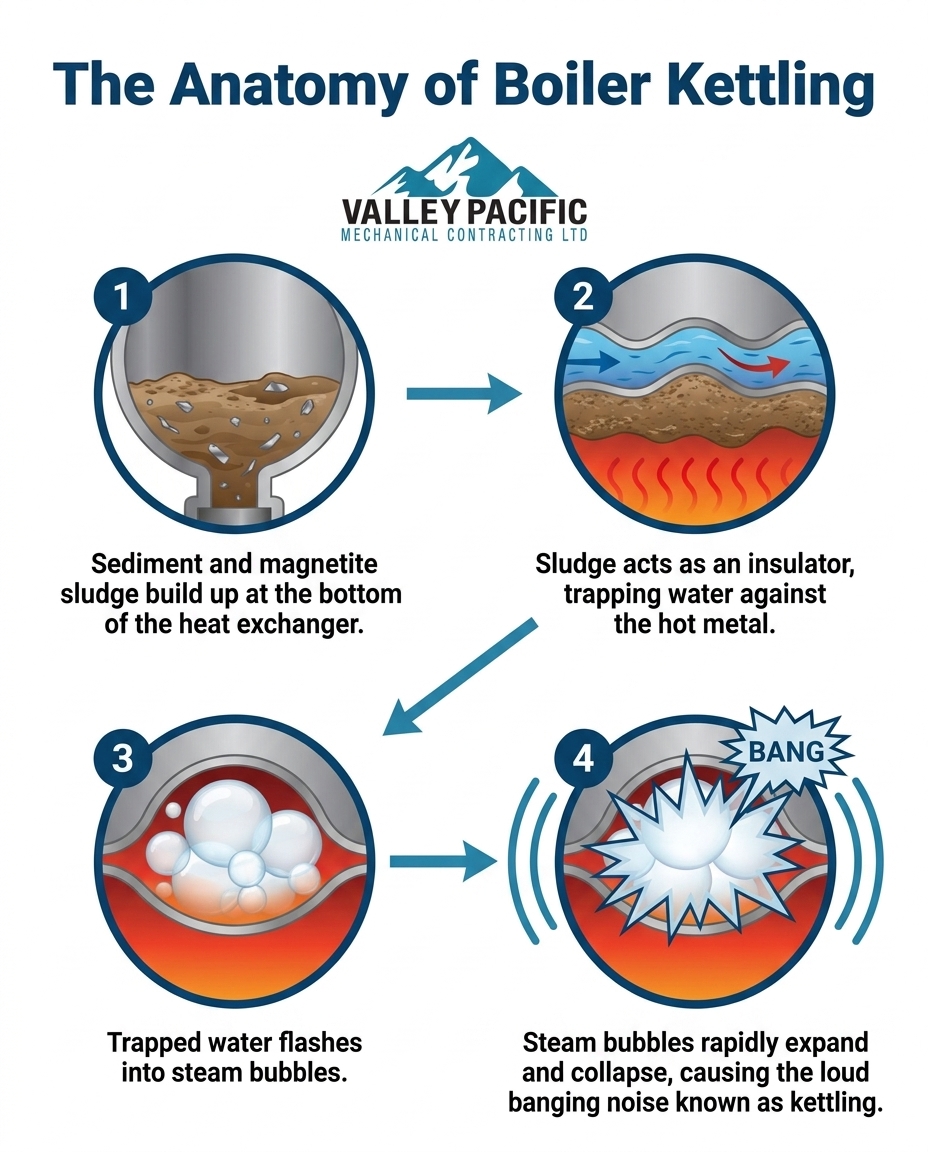
Kettling occurs when a thick layer of sediment and mineral scale accumulates along the bottom of the boiler's heat exchanger. This dense sludge acts as a powerful insulator. Instead of transferring heat evenly into the circulating water, the heat becomes trapped against the metal. The water trapped beneath or directly against this sediment layer rapidly overheats and flashes into steam.
Because steam expands to take up vastly more space than liquid water, these pressurized steam bubbles force their way up through the cooler water above them. As soon as they hit the cooler water, the bubbles collapse rapidly. This violent expansion and immediate collapse creates a localized shockwave inside the vessel, which you hear as a loud banging, popping, or rumbling sound.
Accelerated Wear in the Pacific Northwest
The local climate plays a massive role in how quickly this phenomenon develops. With the damp, chilly Pacific Northwest winters we experience locally, heating systems are frequently forced to run continuously at higher temperatures just to combat the bone-deep cold. Our technicians notice that this constant, high-temperature operation accelerates the rate at which minerals precipitate out of the water and harden onto the heat exchanger. The harder the system works during a prolonged cold snap, the faster that sediment hardens, increasing both the volume and frequency of the kettling noises echoing through your home.
This is a progressive mechanical failure, not a normal function of your heating equipment. The longer the steam bubbles are allowed to form and collapse, the more stress is placed on the metal components of your legacy system.
Why Sediment Sludge Targets Historic Infrastructure
To understand why your specific home is suffering from these aggressive noises, you have to look at the water circulating through your pipes. Decades of continuous use lead to the inevitable accumulation of mineral deposits and a highly destructive substance known as magnetite sludge. Magnetite is essentially dissolved black iron oxide—rust—that mixes with hard water minerals to form a thick, heavy mud inside your hydronic system.
The Magnetite Problem in Older Neighborhoods
Older Pitt Meadows neighborhoods are particularly vulnerable to this sludge buildup. Our crews frequently service historic properties that still rely on original or heavily aged infrastructure. The older the pipes and the older the cast-iron components, the more internal corrosion has taken place over the decades. This continuous shedding of iron particles creates a rich environment for magnetite to form. Once it forms, it settles in the lowest, hottest parts of the system—usually right on top of the primary heat exchanger.
The cascading effects of sludge we typically observe include:
• Localized boiling: As discussed, the sludge creates hot spots that boil water instantly.
• Flow restrictions: Thick mud clogs narrow waterways, forcing the circulator pump to work twice as hard to move water through the house.
• Pressure imbalances: Sludge can migrate into sensitive valves and safety mechanisms, drastically altering the internal pressure of the system.
Navigating Legacy Cast-Iron Setups
Because aging pipes and hard water fundamentally alter the pressure and flow of a hydronic loop, diagnosing the root cause requires specialized knowledge. Working with Valley Pacific Mechanical means you benefit from our deep local expertise in navigating the specific quirks of legacy cast-iron setups unique to the area. We understand how these older loops were originally piped and how decades of modifications have impacted their flow rates. For instance, understanding the role of your boiler's expansion tank can help you see how critical proper pressure management is when dealing with restricted, sludge-filled lines. If the expansion tank is waterlogged due to sediment intrusion, the kettling sounds will only amplify as the pressure has nowhere to safely go.
Differentiating Normal Settling from Impending Failure
One of the most common challenges for homeowners in historic properties is distinguishing between the charming, normal sounds of an old house and the warning cries of progressive mechanical failure. Aging cast-iron radiators and traditional boiler systems certainly have their own distinct vocabulary of sounds, but our team advises that not all of them indicate an emergency.
Listening to Your System
Normal sounds usually occur as the system first wakes up or right after it shuts down. These are the sounds of thermal expansion—metal heating up and cooling down. Warning sounds, on the other hand, are aggressive, disruptive, and usually occur while the system is actively firing and trying to heat the water.
• Soft clicking or ticking — Likely Cause: Normal thermal expansion of pipes against floor joists — Action Required: None; normal operation
• Gentle water flow or trickling — Likely Cause: Normal circulation, though may indicate minor trapped air — Action Required: Monitor; bleed radiators if heat is uneven
• Aggressive banging or hammering — Likely Cause: Kettling from severe sediment buildup or water hammer — Action Required: Immediate professional diagnosis
• High-pitched whistling — Likely Cause: Trapped air pressure or failing circulator pump bearings — Action Required: Professional inspection required
While old homes undoubtedly have character, aggressive pipe banging is a definitive warning sign of pressure and temperature issues. If you find yourself turning up the television to drown out the sound of your radiators, you are no longer dealing with normal house settling. You are listening to your heat exchanger struggling to survive under a blanket of insulating sludge.
The Hidden Dangers of Ignoring Boiler Noises
Choosing to ignore the deep rumbling of kettling is a gamble that rarely pays off, especially in older Pitt Meadows neighborhoods where the housing infrastructure demands reliable heat. The consequences of letting sediment sludge dictate your system's performance go far beyond a noisy living room.
Efficiency Loss and Thermal Stress
The most immediate hidden danger we warn customers about is a drastic reduction in heating efficiency. Because the sludge acts as an insulator, the burner has to run significantly longer to transfer the required amount of heat into the water. Your system is forced to work harder, consuming vastly more energy to produce the exact same amount of warmth. This constant overworking accelerates wear and tear on every moving part, from the gas valve to the circulator pump. If this efficiency loss eventually prompts a system replacement, generic provincial or federal energy rebates may apply to qualifying high-efficiency boiler or heat pump upgrades, though we always recommend verifying current programs with your utility provider or a tax professional.
More critically, kettling introduces severe thermal stress to the metal itself. The localized boiling creates extreme temperature differentials across the surface of the heat exchanger. Metal expands when hot and contracts when cool; when different parts of the same cast-iron block are experiencing vastly different temperatures simultaneously, the metal fatigues. Over time, this thermal stress can cause the heat exchanger to crack, leading to water leaks, carbon monoxide risks, and total, irreversible system failure.
The Threat of Mid-Winter Breakdowns
When a heat exchanger finally cracks or a system completely clogs with sludge, it never happens on a mild autumn afternoon. It happens when the system is under maximum load. One winter, our team responded to a local homeowner who was away on vacation when their aging boiler completely broke down due to neglected maintenance, leaving the property with absolutely no hot water and freezing interior temperatures. Fortunately, a Valley Pacific Mechanical technician was able to arrive within a day and repair the entire system within hours. However, this situation highlights the extreme inconvenience and risk of a total system breakdown during a cold snap. Catching the warning sounds early prevents these emergency scenarios.
Professional Diagnostics for Legacy Radiator Systems
When aging cast-iron radiators and traditional boiler systems begin to exhibit signs of severe kettling, the solution requires professional intervention. The internal pressures, temperatures, and chemical balances involved in hydronic heating make this equipment highly sensitive, and improper handling can cause catastrophic damage.
The Safety Protocol for Sludge Removal
A professional diagnostic process begins with a comprehensive assessment of the system's current state. When a Valley Pacific Mechanical technician arrives, they will first check the internal pressure levels to ensure the expansion tank and pressure relief valves are operating safely. Next, they will identify the extent of the sludge buildup by testing the water quality and assessing the temperature differentials across the heat exchanger and the supply lines.
What our team checks during a diagnostic visit:
• Burner alignment and ignition: Ensuring the fuel is burning cleanly and not contributing to localized overheating.
• Circulator pump performance: Verifying that the pump has the strength to push water through partially restricted legacy pipes.
• Water chemistry: Testing for high levels of dissolved iron and hard minerals that accelerate sludge formation.
• Heat exchanger integrity: Inspecting the metal for hairline cracks caused by prolonged thermal stress.
Why Power Flushing is a Professional Job
If severe magnetite sludge is confirmed, the system will likely require a professional power flush. This process uses specialized chemicals and high-velocity water pumps to break down decades of hardened sludge and safely remove it from the system. This is absolutely not a DIY project. We strongly advise homeowners against attempting to drain, flush, or chemically treat their boilers themselves. Introducing the wrong chemicals, failing to properly bleed the air out afterward, or shocking the system with cold water can instantly crack a hot cast-iron heat exchanger, turning a maintenance visit into a mandatory replacement.
In some cases, the damage from prolonged kettling is too severe to reverse. In another instance during a harsh winter, our team helped a customer realize their failing system couldn't be saved and needed a new boiler with a hot-water-on-demand system installed. Our technician, Cody, completed the installation in a timely manner, checking in throughout the process to ensure the customer was completely satisfied with their modernized setup. Whether you need a safe power flush or a complete system overhaul, enrolling in a preventative boiler maintenance plan ensures these issues are caught long before they leave you in the cold.
Frequently Asked Questions
Why is my boiler making a loud banging noise?
A loud banging noise is usually caused by a phenomenon called kettling, where sediment buildup insulates the heat exchanger. This trapped heat causes the water to boil instantly, creating steam bubbles that violently expand and collapse. It is a sign that your system is struggling with hard mineral scale or magnetite sludge.
Is a noisy boiler dangerous?
While a noisy boiler isn't usually an immediate explosion risk, it is a serious warning sign of progressive mechanical failure. The thermal stress caused by kettling can eventually crack the heat exchanger, which can lead to severe water damage or dangerous carbon monoxide leaks if left unresolved.
What does kettling sound like in a boiler?
Kettling sounds very similar to a large tea kettle boiling on a stove, often characterized by a deep rumbling, popping, or aggressive clanking noise. The sound typically starts shortly after the burner ignites and stops a few minutes after the heating cycle ends.
Can a boiler explode from kettling?
Modern boilers are equipped with multiple safety mechanisms, including pressure relief valves, that prevent explosive pressure buildup. However, severe kettling can cause the heat exchanger to crack and fail completely, requiring an expensive full-system replacement.
Are banging pipes in an old house dangerous?
Banging pipes can be a sign of water hammer or severe pressure imbalances caused by internal sludge. While the pipes themselves may not pose an immediate danger, the aggressive vibrations can loosen fittings, cause hidden leaks behind walls, and damage sensitive heating components over time.
How often should aging cast-iron radiators be flushed?
Our team recommends that aging cast-iron systems generally be professionally inspected annually and flushed every three to five years, depending on your local water hardness. A licensed Valley Pacific Mechanical technician can test your water quality during a routine maintenance visit to determine exactly when a power flush is necessary.
If you are tired of listening to your heating system struggle and want to protect your home from unexpected mid-winter breakdowns, it is time to take action. Providing you with a clear, localized explanation and professional diagnostics is how we at Valley Pacific Mechanical ensure your historic home remains comfortable and safe all season long.


