


Why Your Air Conditioner Vents Are Suddenly Blowing Warm Air in Late August


The Late-Summer Cooling Crisis: Why Your Air Conditioner Vents Are Suddenly Blowing Warm Air in Late August
Summer in the Fraser Valley is far from over, but if you are trying to figure out exactly why your air conditioner vents are suddenly blowing warm air in late August, your cooling system might have just hit its breaking point. At Valley Pacific Mechanical, our team sees this specific scenario play out year after year. It is incredibly frustrating to walk into your home expecting a rush of cold relief, only to feel a lukewarm breeze pushing out of your registers while the outdoor unit hums along as if everything is fine. This specific symptom—the system actively running but failing to condition the air—is a major red flag that something within the refrigeration cycle has failed.
The most important decision you can make in this exact moment is to stop asking the system to cool your home. Forcing a struggling air conditioner to keep running when it is only producing warm air can quickly turn a manageable repair into catastrophic equipment damage. If you need immediate help, reaching out for professional air conditioning services is the safest way to properly diagnose the underlying issue without putting your equipment at further risk.
The Tipping Point: Cumulative Summer Wear on Your AC
To understand why this breakdown happens right at the end of the season, you have to look at the sheer workload your cooling system has handled over the past few months. In our years of servicing Maple Ridge homes, we've seen firsthand how central air conditioners operate under immense physical stress. By the time late August arrives, your system has likely been cycling on and off thousands of times since the early days of June.
The Marathon of July and August
Continuous operation creates cumulative fatigue on every mechanical component inside your HVAC system. Lingering late-August heatwaves in the Fraser Valley maximize this stress on residential cooling systems right when they are most fatigued. When the ambient outdoor temperature stays high for days on end, the compressor is forced to work overtime, pushing its internal operating temperatures and pressures to their absolute limits.
This end-of-season fatigue brings hidden vulnerabilities to the surface. Minor issues that the system could easily compensate for in milder spring weather suddenly become unmanageable. Based on our field experience, the most common cumulative wear factors include:
• Vibrating copper lines: Months of continuous motor vibration can cause copper refrigerant lines to rub against the cabinet, slowly wearing thin.
• Degrading valve seals: The constant pressure shifts inside the system can cause aging rubber seals on access valves to lose their airtight integrity.
• Overworked blower motors: Pushing air through progressively dirtier filters all summer long strains the indoor blower, reducing overall airflow.
When these slow, unnoticed issues finally reach critical thresholds, the system crosses a tipping point, resulting in the sudden loss of cold air just as the summer heat makes its final push.
The Mechanics of a Frozen Evaporator Coil
When we receive a frantic call from a homeowner in Maple Ridge noticing warm air coming from their vents despite the AC running, our technicians know the physical culprit is almost always a frozen evaporator coil. To understand how an air conditioner can freeze solid in the middle of a hot summer day, you have to look at the basic physics of the refrigeration cycle.
The evaporator coil, located inside your home near the furnace or air handler, is responsible for removing heat and humidity from your indoor air. Cold liquid refrigerant flows through this coil, absorbing the heat from the warm air blowing over it. Under normal conditions, the coil gets very cold, causing moisture in the air to condense on the metal fins and drip safely down the drain pan.
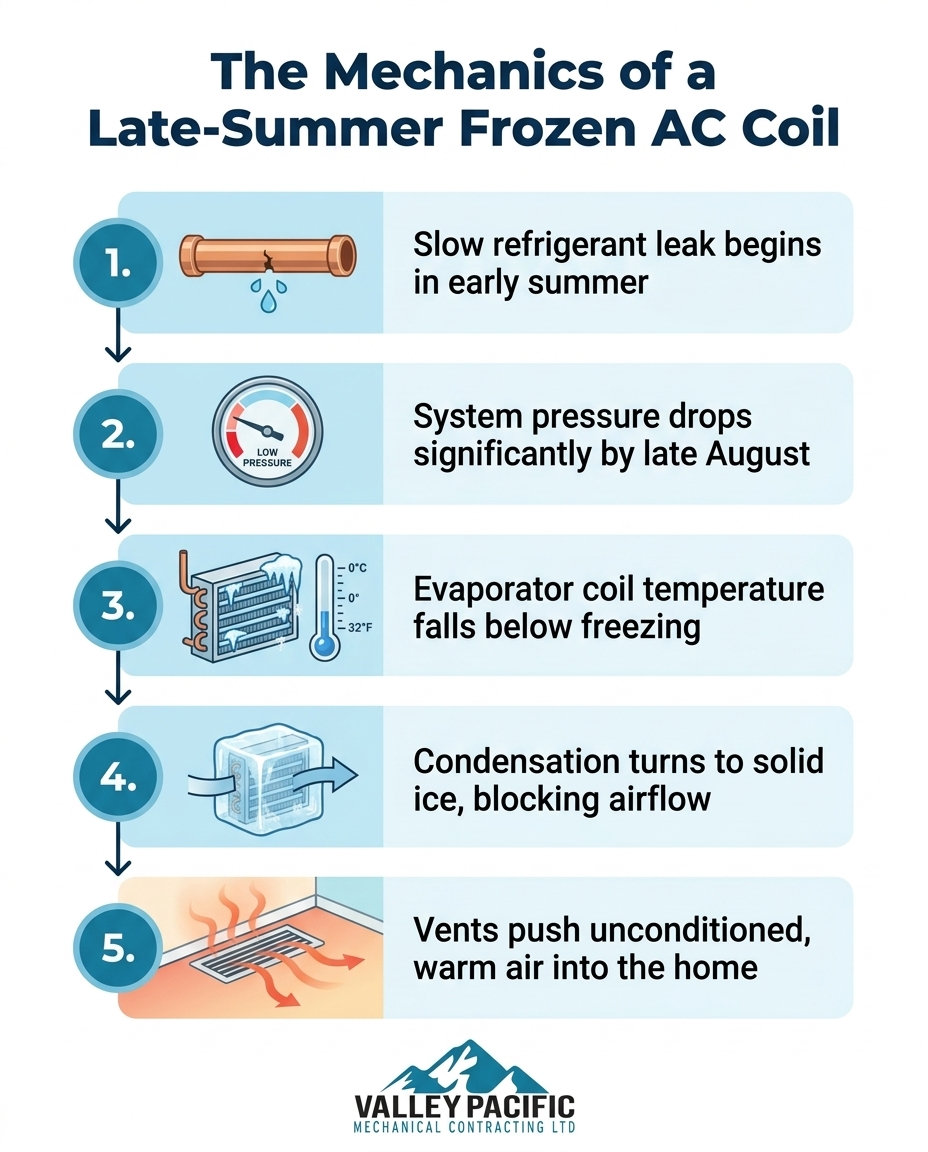
However, when the system is low on refrigerant, the pressure inside the evaporator coil drops significantly. According to the laws of thermodynamics, a drop in pressure causes a corresponding drop in temperature. The coil's surface temperature plummets below the freezing point of water. Instead of dripping away, the normal condensation instantly turns into solid ice.
How Ice Blocks Cold Airflow
Once the freezing process begins, it cascades quickly. A thin layer of frost turns into a thick block of solid ice, completely encasing the evaporator coil. The indoor blower motor continues to push air toward the coil, but the ice barrier prevents the air from making contact with the cold metal fins.
Because the air cannot transfer its heat to the refrigerant, it simply bypasses the blocked coil and travels up into your ductwork completely unconditioned. This is why the air coming out of your vents feels warm—it is just the ambient air from inside your house being recirculated without any heat being removed.
• Normal Operation — Refrigerant Pressure: Standard / Balanced — Coil Temperature: Above Freezing (approx. 40°F) — Condensation State: Liquid Water (Drips away) — Resulting Airflow: Cold, conditioned air
• Frozen Coil — Refrigerant Pressure: Critically Low — Coil Temperature: Below Freezing (Under 32°F) — Condensation State: Solid Ice (Blocks fins) — Resulting Airflow: Warm, unconditioned air
The Hidden Culprit: Slow Refrigerant Leaks
If a frozen coil is the physical reason your vents are blowing warm air, a slow refrigerant leak is almost always the root cause of that freeze. One of the most common misconceptions our technicians encounter is that air conditioners "use up" or "burn off" refrigerant over time. Central cooling systems operate on a closed-loop circuit. The exact amount of refrigerant put into the system on the day it was installed should remain inside the system for its entire lifespan.
If your system is low on refrigerant, it means there is a leak somewhere in the closed loop. The timeline of a slow leak perfectly explains why these breakdowns happen in late August rather than early June. A microscopic hole might develop in the spring, allowing a tiny amount of refrigerant to escape each week. For the first two months of summer, the system has enough charge left to keep cooling your home, even though it is working harder to do so.
By the time late summer arrives, enough refrigerant has escaped to drop the internal pressure past the critical freezing point. Common areas where our team finds these slow leaks developing include:
• Schrader valves: The small service ports used by technicians can develop worn rubber seals over time, allowing gas to slowly seep out.
• Evaporator coil joints: The continuous expansion and contraction of the indoor coil can weaken the brazed joints, especially in older units.
• Condenser line sets: Copper lines running outside the home can vibrate against brick or metal siding, eventually wearing a pinhole through the metal.
The Danger Zone: Why You Must Shut the System Off Immediately
When the house starts getting uncomfortably warm, the immediate instinct for most homeowners is to walk over to the thermostat and lower the temperature setting, hoping to force the system to blow colder air. If your vents are already blowing warm air due to a frozen coil, lowering the thermostat is the absolute worst thing you can do.
Continuing to run an air conditioner with a frozen evaporator coil puts the outdoor compressor in extreme danger. Compressors are designed to pump refrigerant in its gaseous state. Because the thick block of ice prevents the refrigerant from absorbing heat inside the house, the refrigerant never boils off into a gas. Instead, it travels back out to the compressor as a cold liquid.
This phenomenon is known as "liquid slugging." When liquid refrigerant hits the internal valves of a compressor, it can instantly shatter them, leading to total mechanical failure. What started as a repairable refrigerant leak suddenly turns into a massive expense requiring a complete unit replacement.
We recently had a Maple Ridge homeowner reach out to our team for help during a late-summer heatwave when their AC unit seized up unexpectedly after pushing warm air for several hours. They required an emergency response to prevent further property damage. Fortunately, swift and attentive service allowed our technicians to shut the system down, safely thaw the unit, and properly diagnose the underlying issue before the compressor was completely destroyed. The homeowner was so relieved by the prompt resolution that they contracted Valley Pacific Mechanical for all their ongoing HVAC services.
To protect your equipment, we recommend taking these exact steps the moment you notice warm air:
Step 1: Turn the cooling off. Switch your thermostat from "Cool" to "Off" immediately to stop the outdoor compressor from running.
Step 2: Turn the fan on. Switch the thermostat fan setting from "Auto" to "On." This keeps the indoor blower running, pushing warm ambient air over the frozen coil to help melt the ice safely.
Safe Troubleshooting: What Homeowners Can Check
While you wait for the solid block of ice to melt—which can take anywhere from a few hours to a full day depending on the severity of the freeze—there are a few safe, non-technical steps you can take to rule out basic airflow issues. While handling refrigerant requires specialized training, our technicians encourage homeowners to safely inspect the external factors that contribute to late-August system stress.
1. Verify the thermostat settings: Double-check that the thermostat wasn't accidentally bumped from "Cool" to "Heat," or that the fan wasn't left in the "On" position while the AC was turned off. For more tips on optimizing your system, review the best thermostat settings for summer savings.
2. Inspect the indoor air filter: A severely clogged air filter restricts the amount of warm air passing over the evaporator coil. Without enough warm air to absorb the cooling energy, the coil can freeze over even if the refrigerant levels are perfectly fine. If the filter is visibly caked in dust, replace it immediately.
3. Check the outdoor condenser unit: Walk outside and look at the metal cabinet. Ensure there are no heavy layers of cottonwood, leaves, or debris blocking the metal fins. The system needs clear airflow on the outside to release the heat it absorbed from the inside.
It is critical to remember that opening the sealed system, handling chemical refrigerants, or attempting to scrape ice off the delicate metal fins is strictly off-limits for DIY troubleshooting. Scraping the ice will almost certainly puncture the pressurized coil, causing a massive leak and ruining the component entirely.
Why Late-Summer Diagnostics Require a Professional
Once the system is completely thawed and you have ruled out a dirty air filter, a licensed professional must step in to address the underlying pressure issue. Handling, recovering, and charging chemical refrigerants requires specialized licensing, expensive recovery equipment, and strict adherence to environmental regulations.
The professional diagnostic process goes far beyond simply adding more gas to the system. A technician will first verify that the coil is fully thawed and dry. Next, they will connect digital gauges to measure the exact operating pressures and subcooling temperatures. If the system is low on charge, the technician must locate the exact source of the micro-leak using electronic leak detectors or ultrasonic tools. Once the leak is found, the damaged section of copper is repaired or brazed, the system is pressure-tested with nitrogen, and a deep vacuum is pulled to remove any moisture before recharging the system to exact ASHRAE standards.
Valley Pacific Mechanical's deep local expertise in the Lower Mainland means our technicians understand exactly how the regional climate impacts residential equipment. We can rapidly diagnose late-summer system fatigue and implement reliable repairs that hold up against the lingering heat. Furthermore, investing in a preventative maintenance plan ensures that a professional inspects your system every spring, catching these microscopic leaks and airflow restrictions long before they can freeze your coil in late August.
Frequently Asked Questions: Why Your Air Conditioner Vents Are Suddenly Blowing Warm Air in Late August
Why is my AC running but blowing warm air?
The short answer is that your system is actively circulating indoor air, but it has lost the ability to remove heat. This usually happens when the indoor evaporator coil freezes solid due to low refrigerant pressure or severe airflow restriction. The blower motor pushes air past the block of ice without cooling it, resulting in warm air at the vents.
How do you fix an AC that is blowing warm air?
The first step is always to turn the thermostat to "Off" to protect the outdoor compressor from permanent damage. Once the system is off, check your air filter and replace it if it is dirty. If the filter is clean and the coil is frozen, you must call a licensed HVAC technician to locate and repair the underlying refrigerant leak.
Can a dirty filter cause an AC to blow warm air?
Yes, a severely restricted air filter can absolutely lead to warm air at the vents. When a dirty filter blocks air from moving across the indoor coil, the coil cannot absorb enough heat from the house. The temperature of the coil drops below freezing, ice forms over the fins, and the system eventually stops producing cold air entirely.
What should I do if my AC coil is frozen?
You must immediately turn the cooling function off at the thermostat and turn the fan setting to "On." This stops the outdoor unit from running while keeping the indoor fan blowing ambient air over the ice to help it melt safely. Never attempt to chip or scrape the ice away, as this will puncture the delicate copper tubing.
How long does it take for an AC coil to thaw completely?
A frozen evaporator coil typically takes anywhere from 4 to 24 hours to thaw completely, depending on the thickness of the ice and the temperature inside the home. Leaving the indoor fan running speeds up the process significantly. A technician cannot accurately test the refrigerant pressures or locate a leak until the ice has completely melted.
Can a slow refrigerant leak cause sudden AC failure?
Yes, a slow leak is often the primary reason for a sudden breakdown late in the summer season. The system slowly loses refrigerant over several months, gradually dropping the internal pressure. Once the pressure drops past a specific critical threshold, the coil freezes rapidly, making the failure feel sudden even though the leak started weeks earlier.
Restoring Your Home's Comfort Before the Heat Fades
A frozen evaporator coil is rarely an isolated event; it is almost always a symptom of a larger, cumulative issue that has been building since the beginning of summer. When the internal pressure drops too low, the physics of the refrigeration cycle break down, turning normal condensation into a solid block of ice that completely suffocates your home's airflow.
While discovering a warm breeze coming from your vents is stressful, taking prompt and correct action can save your system from permanent damage. By shutting the unit down immediately, allowing it to thaw safely, and relying on a licensed professional to locate the hidden leak, you can avoid a catastrophic compressor failure. Reach out to our team for professional HVAC repair to get your system back on track. A clear diagnosis will quickly resolve exactly why your air conditioner vents are suddenly blowing warm air in late August, restoring your home's comfort reliably for the rest of the season.


