


Why a Boiler Heating System Makes Sense for Large Multi-Story Homes in Mission


Battling the Chill: The Challenge of Heating Large, Multi-Story Homes
If you are constantly dealing with an icy main floor while the upstairs bedrooms feel like a sauna, you are likely wondering why a boiler heating system makes sense for large multi-story homes in Mission. At Valley Pacific Mechanical Contracting Ltd., our team hears this exact complaint every winter. You are not alone in this frustration. Many homeowners find themselves trapped in a daily cycle of adjusting the thermostat, hoping to finally force some warmth into the living room, only to overheat the second or third floors. It is a common struggle that makes enjoying your home during the colder months incredibly difficult.
When you are ready to upgrade your comfort, we highly recommend exploring tailored residential heating solutions and professional boiler installation and service as the most effective way to address these structural temperature imbalances.
The limitations of standard systems: Traditional heating methods often fall short when tasked with pushing warmth across multiple levels. The core issue we typically see is not necessarily that your current equipment is broken; rather, it is fighting a losing battle against the fundamental laws of physics. Large, vertical spaces present unique architectural challenges, including expansive main floors, high ceilings, and open staircases that act as funnels for thermal movement.
Making an informed decision: To truly solve the problem of cold spots and drafts in Mission multi-story homes, you have to look beyond simply buying a larger unit. You need to understand how heat naturally moves through a building. By examining the physics of heat distribution, you can make an educated choice about whether a radiant hydronic upgrade is the right path to achieving consistent, draft-free comfort throughout your entire living space.
The Physics of Heat Stratification and the Stack Effect
The Problem: You set your thermostat to a comfortable 21 degrees, but the ground floor remains stubbornly chilly while the upper levels become stifling. Your heating equipment runs continuously, driving up utility bills without ever achieving a balanced temperature across the house.
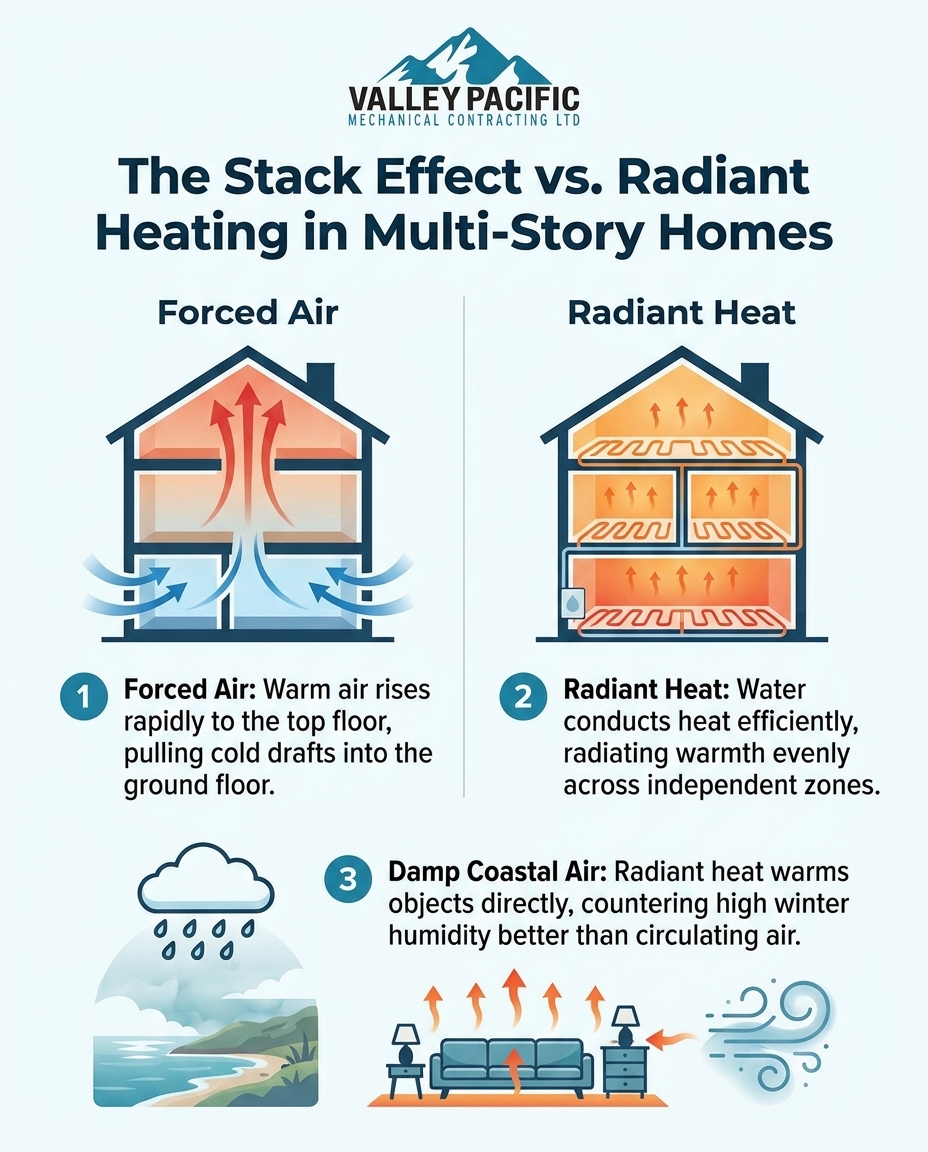
The Cause: This frustrating imbalance is driven by a scientific phenomenon known as the stack effect, combined with the natural process of heat stratification. Because warm air is less dense than cold air, it naturally and rapidly rises to the highest point of a structure. In a tall house, heated air rushes up the stairwells and settles near the ceiling of the top floor. As this buoyant warm air escapes upward, it creates a zone of negative pressure on the lower levels. This vacuum effect actively pulls cold, unconditioned air into the ground floor through microscopic gaps around doors, windows, and the foundation.
In our experience servicing homes throughout the Lower Mainland, relying solely on forced air furnace systems often exacerbates this cycle. When blowers push heated air into a room, that air immediately wants to rise. The system has to work incredibly hard, fighting against thermodynamic inefficiency, trying to force warm air down against its natural upward trajectory.
The Solution: By switching the delivery method from blowing air to radiating warmth through hydronics, you bypass the stack effect entirely, keeping the thermal energy exactly where you need it.
Why the Second Floor is Always Hotter
• Uncontrolled convection currents: Heated air acts like a hot air balloon, using hallways and staircases as chimneys to travel directly to the upper levels.
• Lack of independent zoning: Standard setups force the entire system to run just to warm the ground floor, inadvertently blasting the already-warm upstairs bedrooms with even more heat.
• Thermal accumulation: Once the warm air reaches the top floor, it has nowhere else to go, pooling near the ceiling and creating a heavy, uncomfortable environment.
Combating the Coastal Dampness of Pacific Northwest Winters
Understanding the local climate: Living and working in the Lower Mainland means our team deals with a very specific type of winter weather alongside you. With average lows hovering around 1 degree Celsius combined with notoriously high humidity, Mission experiences a "wet cold" that cuts right to the bone. Damp air actually feels significantly colder than dry air at the exact same temperature because moisture conducts heat away from your skin much faster than dry air does.
The forced-air wind chill: When you use a blower-based system during Pacific Northwest winters, you are circulating that damp, chilly air throughout your home. Even when the air is heated, the physical act of blowing it across your skin accelerates the evaporation of natural moisture, creating an indoor wind-chill effect. You might find yourself turning the thermostat up to 23 or 24 degrees just to stop shivering, simply because the moving air makes the room feel drafty and unsettled.
The radiant advantage: Hydronic systems take a completely different approach. Instead of trying to heat the damp air itself, radiant energy warms the physical objects in the room—the floors, the furniture, and the people. Think of how the sun can make you feel warm on a crisp, chilly day; the ambient air might be cold, but the radiant energy directly warms your body. This direct transfer of thermal energy penetrates the damp coastal cold, allowing you to experience a deep, comfortable warmth even at much lower thermostat settings.
Radiant Heat vs. Convection: Why Water Wins in Large Homes
To truly understand why a structural upgrade makes sense, you have to look at the fundamental difference between heating air (convection) and heating water (hydronics). The scientific principle is straightforward: water conducts heat significantly more efficiently than air. In fact, water can hold thousands of times more thermal energy per unit of volume than air can. When we walk our clients through how a boiler heating system works, it quickly becomes clear why we recommend it as the superior choice for sprawling, multi-story layouts.
Instead of relying on a blower motor to push lightweight, easily displaced hot air through long runs of ductwork, a hydronic setup uses a circulator pump to move hot water through a closed loop of pipes. This water travels to baseboard radiators, wall panels, or in-floor tubing, where it steadily releases its stored energy into the room. The result is a consistent, draft-free warmth that radiates outward, blanketing the space without stirring up dust or creating pressure imbalances.
• Heat Transfer Medium — Radiant Hydronic Heating (Water): Water (exceptionally high thermal mass) — Forced-Air Convection (Air): Air (very low thermal mass)
• Drafts & Circulation — Radiant Hydronic Heating (Water): Heats objects directly; zero drafts created — Forced-Air Convection (Air): Blows air constantly; creates noticeable indoor drafts
• Temperature Consistency — Radiant Hydronic Heating (Water): Even, steady warmth from floor to ceiling — Forced-Air Convection (Air): Highly stratified heat (hot ceilings, cold floors)
• Delivery Efficiency — Radiant Hydronic Heating (Water): Near 100% of generated heat reaches the room — Forced-Air Convection (Air): Significant heat loss through leaky ductwork
For Mission multi-story homes, this means the heat stays exactly where it is delivered. The ground floor remains cozy and inviting, and the upper floors do not become suffocatingly hot, because the thermal energy is not aggressively rising through the air column.
True Zoning: Eliminating Cold Spots Floor by Floor
One of the most powerful advantages of modern hydronic technology is the ability to establish true, independent heating zones. In a large house, treating the basement, the main living area, and the upper bedrooms as a single thermal space is a recipe for discomfort. Hydronics solve this by dividing the home's piping into separate loops, each controlled by its own thermostat and motorized valve.
Here is how true zoning transforms the comfort of a multi-story property:
1. Targeted thermal delivery: When the basement thermostat calls for heat, the system directs hot water only to the basement loop. The boiler fires up to satisfy that specific area without sending a single drop of hot water to the already-warm upper bedrooms.
2. Eliminating ductwork heat loss: Because water travels through insulated pipes rather than wide sheet-metal ducts, there is virtually zero energy lost in transit. Every unit of heat generated reaches its intended destination.
3. Domestic hot water integration: Modern installations can easily integrate an indirect water heater or a combi-unit, providing endless hot water on demand using the same highly efficient burner that heats the home.
4. Precision control: You can maintain a cozy 22 degrees in the family room where you spend your evenings, while keeping the unused guest rooms at a highly efficient 16 degrees.
Customizing Comfort by Level
Setting independent temperatures for living spaces versus sleeping quarters is the ultimate goal for multi-story comfort. Most people prefer cooler temperatures for sleeping, but want a warm kitchen for breakfast. Zoning allows you to schedule these variations perfectly, drastically reducing energy waste by only heating occupied zones. A pattern we see often is homeowners struggling with these variations. When one local homeowner reached out to us during the fall needing a reliable service provider for their essential heating equipment, our team at Valley Pacific Mechanical stepped in. After setting up routine equipment maintenance for their boilers and heaters, the customer felt completely reassured by the reliable, professional care that kept their complex, zoned system running flawlessly day in and day out.
A Structural Approach to Heating Diagnostics
Moving beyond one-size-fits-all: When it comes to residential comfort, heating solutions should never be a generic, out-of-the-box prescription. The reality is that the physical characteristics of your property dictate the ideal heat delivery method. A sprawling rancher has completely different thermal needs than a tall, narrow three-story build.
Evaluating the home's physics: A proper diagnostic approach requires a deep understanding of Lower Mainland housing structures. Factors like the age of the building, the quality of the insulation, the placement of the windows, and the vertical layout all play a critical role in how heat moves—and escapes. Our team's commitment at Valley Pacific Mechanical to physics-based, tailored heating solutions ensures that these architectural variables are thoroughly assessed before we recommend any equipment.
Preventing decades of discomfort: If a contractor simply swaps out an old unit for a new one without addressing the structural reasons why the house is heating unevenly, the core problem will persist. Taking the time to evaluate the building envelope and calculate accurate heat loss prevents homeowners from enduring decades of drafts, cold spots, and high utility bills. A tailored, structural approach guarantees that the system is designed to work in harmony with the building, not against it.
Protecting Your Investment with Proactive Care
The Problem: Even the most advanced heating equipment will degrade over time if left neglected. Without regular attention, efficiency drops, components wear out prematurely, and you risk a sudden breakdown right in the middle of a freezing cold snap.
The Cause: While hydronic systems are incredibly durable, they still rely on critical components like circulator pumps, expansion tanks, and pressure relief valves. Over time, water pressure can fluctuate, small amounts of air can become trapped in the lines, and mineral deposits can begin to form, forcing the boiler to work harder to push water through the zones.
The Solution: The best way to protect your comfort is through routine check-ups. Because these systems have fewer moving parts than traditional furnaces—lacking the blower motors and large fans that suffer heavy mechanical wear—they operate quietly and boast exceptional longevity when properly maintained. For example, when another homeowner required a new boiler with a hot water on demand system installed during the winter, our technicians arrived promptly and installed the system in a timely manner while keeping the customer informed at every step, resulting in a highly satisfactory upgrade. To keep a new installation like that running perfectly through harsh Pacific Northwest winters, we strongly advise enrolling in a comprehensive preventative maintenance plan. Regular service ensures water pressure remains optimal, valves are functioning correctly, and the system delivers peak efficiency year after year.
Frequently Asked Questions About Multi-Story Heating
How do you heat a multi-story house evenly?
The most effective way to heat a multi-story house evenly is by implementing a zoned heating system. By separating the home into distinct thermal areas, you can direct warmth specifically to the colder lower levels without overheating the upper floors. Hydronic radiant heating is particularly adept at this, as it uses motorized valves to send hot water only to the zones that currently require heat, completely bypassing the natural stack effect.
Why is radiant heat better than forced air?
Radiant heat is generally superior to forced air because it warms objects and people directly, rather than simply blowing heated air into a room. Water is a much more efficient conductor of thermal energy than air, meaning it retains and delivers warmth more effectively. Additionally, radiant systems operate silently and do not create the uncomfortable indoor drafts or dust circulation commonly associated with blower-driven systems.
Why is my downstairs so cold and upstairs so hot?
This common issue is caused by the stack effect and heat stratification. Warm air is naturally buoyant and will rapidly rise through open stairwells and hallways to the highest point in the house. As that warm air pools on the second floor, it creates a negative pressure zone below, which pulls cold, drafty air into your main floor from the outside, resulting in a severe temperature imbalance.
Are boilers better for large houses?
Yes, boilers are exceptionally well-suited for large, sprawling, or multi-story houses. Because they use water to transport heat, they can push thermal energy over long distances without the significant heat loss that occurs in extensive ductwork. Furthermore, their ability to easily divide a large floor plan into micro-managed heating zones makes them incredibly efficient for vast square footages.
Can a boiler system be retrofitted into an older multi-story home?
Absolutely. While installing in-floor radiant tubing might require significant renovation, older multi-story homes can easily be retrofitted with sleek, modern baseboard radiators or elegant wall-mounted panel radiators. The flexible PEX piping used in modern hydronic installations can be snaked through existing walls and joist spaces much more easily than bulky sheet-metal ductwork, making it an excellent upgrade for heritage properties.
Achieve True Thermal Comfort in Your Mission Home
Understanding the physics of your property is the crucial first step to solving the chronic cold spots and drafts that plague so many Mission multi-story homes. You do not have to settle for a freezing main floor and an uncomfortably hot second story. By recognizing how the stack effect sabotages traditional forced-air setups, you can take control of your indoor climate.
The clear choice for large spaces: Radiant heat offers a scientifically superior method for warming large, vertically expansive spaces. By utilizing the incredible thermal capacity of water and the precision of independent zoning, a hydronic upgrade eliminates indoor wind-chill and delivers steady, even warmth exactly where you need it.
Take the next step: If you are tired of battling the thermostat all winter long, it is time to explore how a tailored, physics-based solution can transform your daily comfort. Reach out to our structural heating experts at Valley Pacific Mechanical to evaluate your home's unique architecture, explore your hydronic options, and finally achieve the consistent, draft-free warmth you deserve.


