


Why Langley Residents Should Consider Dual-Fuel Heat Pump Systems


The Hidden Vulnerability of Standard Heating During Coastal Cold Snaps
Your standard heat pump runs constantly, yet the house still feels chilly when the temperature suddenly plummets. Why Langley, BC residents should consider dual-fuel heat pump systems comes down to this exact problem: the hidden vulnerability of standalone heating during severe weather shifts. British Columbia's mild shoulder seasons are the perfect environment for a standard heat pump to operate efficiently, extracting ambient warmth from the outside air to keep your home comfortable. However, when those mild days give way to sudden winter deep freezes, the limitations of a standalone electric system become glaringly obvious.
As the mercury drops toward freezing, a standard heat pump loses its ability to extract heat efficiently. To compensate, these systems rely on electric resistance heating strips—often called auxiliary or emergency heat. Heat Pump Services professionals know that relying solely on electric resistance heating during extreme cold leads to massive energy consumption, sluggish heating performance, and significant discomfort. The system works overtime, drawing immense amounts of electricity, while the air coming through your vents feels lukewarm at best.
This creates a critical decision point for homeowners evaluating their heating infrastructure. You must decide whether a standalone electric system is truly enough for the local climate, or if a hybrid approach is necessary for complete peace of mind. A dual-fuel system—pairing an electric heat pump with a gas furnace—emerges as the definitive solution for reliable winter heating, eliminating the vulnerability of electric resistance strips and ensuring your home stays warm regardless of what the coastal weather dictates.
The Anatomy of a Dual-Fuel Heating System
Understanding how a hybrid setup solves this heating dilemma requires looking under the hood. A dual-fuel heating system pairs a high-efficiency electric heat pump with a robust gas furnace, utilizing the same ductwork to distribute air throughout your home. Rather than relying on a single technology to handle every weather condition, this setup leverages the distinct strengths of two different fuel sources.
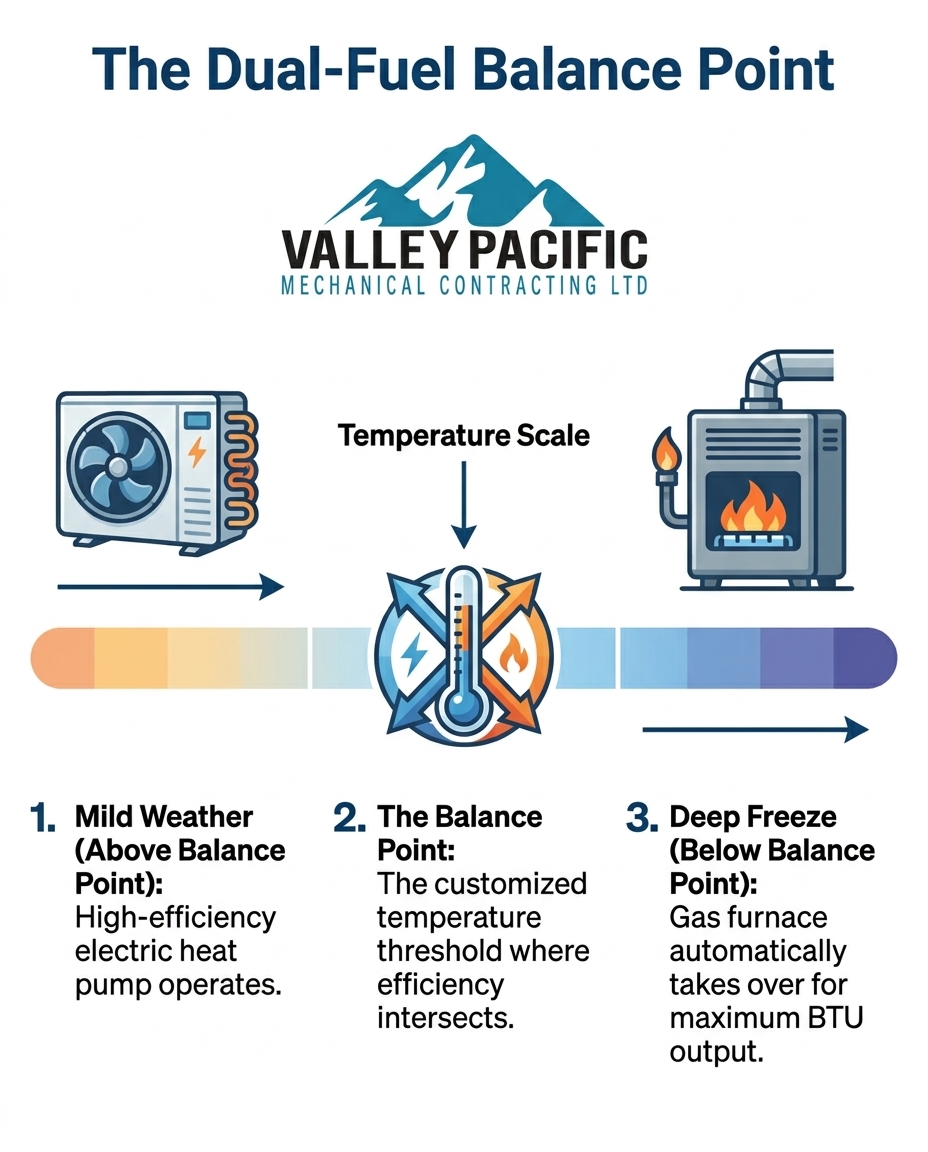
For roughly 80% of the winter season in Langley, the weather remains relatively mild and damp. During these moderate conditions, the electric heat pump does all the heavy lifting. It operates at peak efficiency, transferring ambient heat from the outdoors inside, which is significantly more cost-effective than burning fossil fuels. However, when the temperature drops below the heat pump's optimal operating range, the system initiates an automatic transition mechanism. The heat pump shuts down, and the gas furnace takes over.
This transition requires absolutely no manual intervention from the homeowner. The smart thermostat constantly monitors both indoor and outdoor temperatures, making real-time decisions about which fuel source is the most efficient and effective at that exact moment. If you are considering Heat Pump Installation in Langley, understanding this automatic handoff is crucial to seeing the value of a hybrid system.
How the Two Systems Work in Harmony
A dual-fuel system is not simply two independent heaters fighting for control; it is a synchronized mechanical partnership. Here is how the responsibilities are divided:
• Electric Heat Pump — Primary Role in a Dual-Fuel Setup: Acts as the primary heating source, extracting heat from outdoor air. Provides air conditioning in the summer. — Ideal Weather Conditions: Mild to moderate cold, typical coastal dampness, temperatures above freezing.
• Gas Furnace — Primary Role in a Dual-Fuel Setup: Sits in reserve as a heavy-duty secondary stage. Takes over entirely when high BTU output is required. — Ideal Weather Conditions: Winter deep freezes, extreme cold snaps, and during the heat pump's defrost cycle.
By utilizing the furnace as a heavy-duty secondary stage rather than a primary runner, the system ensures you are never wasting gas on mild days, nor are you freezing while an electric heat pump struggles against sub-zero temperatures.
Mastering the 'Balance Point' for Optimal Comfort
The secret to a successful dual-fuel system lies in a technical concept known as the "thermal balance point." This is the exact outdoor temperature at which the electric heat pump begins to lose its efficiency advantage, and the gas furnace becomes the better option for heating your home. If this point is calibrated incorrectly, the entire purpose of the hybrid system is defeated.
Many standard installations rely on a factory-default switch-over temperature—often set generically around 2°C or 3°C. However, a generic setting is often inadequate for specific microclimates. A home exposed to harsh coastal winds will lose heat much faster than a well-insulated home sheltered by trees in a suburban neighborhood. Therefore, the balance point must be calculated and customized for your specific property.
The calculation process involves balancing three distinct factors:
1. The Home's Thermal Envelope: Assessing how quickly your specific house loses heat based on insulation, window quality, and square footage.
2. The Heat Pump's Capacity: Evaluating the specific BTU output of the heat pump model at various declining temperature intervals.
3. Local Climate Data: Factoring in Langley's specific humidity levels and historical winter deep freezes to anticipate real-world performance.
Precise calibration prevents the system from short-cycling (rapidly turning on and off) or relying on expensive electric emergency heat. Valley Pacific Mechanical's deep understanding of local climate zones ensures the balance point is customized for each specific home, ensuring maximum reliability. This meticulous attention to detail is why having a properly integrated Gas Furnace Backup is far superior to an out-of-the-box installation.
Conquering Damp Coastal Cold and Defrost Cycles
One of the most misunderstood aspects of heat pump operation in the Pacific Northwest is how the machinery handles high humidity combined with near-freezing temperatures. Langley experiences predominantly mild, damp coastal winters. When the air is heavy with moisture and temperatures hover just above freezing, rapid frost buildup occurs on the outdoor heat pump coils. If left unchecked, this ice would eventually crush the delicate aluminum fins and destroy the compressor.
To protect itself, the system initiates a standard heat pump defrost cycle. The unit temporarily reverses its operation, essentially switching into air conditioning mode. It takes heat from inside your house and sends it to the outdoor coils to melt the accumulated ice. In a standalone heat pump system, this process means the indoor vents will blow cool air into your living space while the unit defrosts. To counteract this cold draft, standalone systems activate their electric resistance backup strips—which, as established, are slow to heat and incredibly expensive to run.
A dual-fuel system entirely eliminates this comfort gap. When the heat pump enters its defrost cycle, the system automatically utilizes the gas furnace to provide the indoor heat. This ensures that even while the outdoor unit is melting off ice, the home receives continuous, robustly warm air.
Why Gas Backup Outperforms Electric Resistance
The difference in indoor comfort during the coldest days of the year is profound. A typical pattern we see involves older, standalone systems failing when they are needed most. For example, one local homeowner's 20-year-old forced air furnace broke down entirely during the coldest days of the year. After a rapid consultation and quote, a new high-efficiency system was installed within days, restoring heat quickly and even qualifying for generic energy rebates. Upgrading to a system with gas backup provides distinct advantages:
• Immediate BTU Output: Gas backup provides immediate, high-capacity heat to rapidly recover indoor temperatures, unlike electric strips that take time to glow hot.
• Energy Efficiency: Electric resistance strips consume massive amounts of energy, whereas a gas furnace operates with a much lower electrical draw.
• Consistent Comfort: You will never feel a cold draft during a defrost cycle when a gas furnace is supplying the backup heat.
Navigating Local Power Grid Realities During Storms
Beyond personal comfort, dual-fuel systems address a broader community vulnerability: the local power grid. During severe winter deep freezes, thousands of homes across Langley simultaneously experience increased heating demands. If a neighborhood is saturated with standalone electric heat pumps, the sudden, simultaneous activation of thousands of electric resistance heating strips places an immense, crippling strain on the local power grid.
Electric emergency heat requires massive amperage to operate. When the grid is already vulnerable due to winter storms, high winds, or falling branches, this massive spike in electrical demand can lead to localized brownouts or exacerbate power failures. This is When a Heat Pump Makes More Sense Than a Furnace—when it is paired intelligently with a gas backup to mitigate grid reliance.
Gas furnaces require significantly less electricity to operate. They only need enough electrical power to run the indoor blower motor and the electronic ignition sequence—a fraction of the amperage required by electric heat strips. By utilizing a dual-fuel setup, you are implementing a personal resilience strategy. Your home stays warmer, recovers faster, and actively reduces your neighborhood's grid demand during critical weather events. For families concerned about winter storm impacts, this setup provides a crucial layer of security.
Efficiency, Carbon Footprints, and System Longevity
The long-term benefits of hybrid heating extend well beyond winter resilience. A dual-fuel system is an investment in the longevity of your HVAC equipment and a practical step toward environmental responsibility. By alternating between two distinct fuel sources, you fundamentally change the wear-and-tear patterns on your machinery.
In a standard setup, a single unit runs continuously to meet all heating demands. In a hybrid system, the electric heat pump handles the mild days, and the gas furnace handles the extremes. This division of labor prevents either unit from being overworked. The heat pump's compressor is spared the agonizing strain of trying to operate in sub-zero temperatures, while the gas furnace's heat exchanger is saved from constantly cycling on and off during mild autumn afternoons. This shared workload significantly extends the operational lifespan of both components.
Furthermore, this setup offers an excellent balance for environmentally conscious homeowners. Because the electric heat pump is utilized for the vast majority of the heating season, the overall reduction in your home's carbon footprint is substantial. You are only burning fossil fuels when it is absolutely mechanically necessary.
Long-Term Financial and Environmental Benefits:
1. Reduced Carbon Emissions: Operating an electric heat pump for 80% of the winter drastically cuts down on household greenhouse gas emissions compared to running a gas furnace full-time.
2. Extended Equipment Life: Preventing overwork means fewer emergency breakdowns and a longer timeline before full system replacement is necessary.
3. Incentive Opportunities: Upgrading to high-efficiency hybrid systems often qualifies homeowners for various provincial and federal tax credits (always verify current generic energy rebates with local authorities).
4. Optimized Utility Bills: By automatically switching to the cheapest fuel source for the given outdoor temperature, a dual-fuel system optimizes monthly operational costs.
It is no surprise that when researching heat pumps langley homeowners consistently find that hybrid systems offer the highest return on comfort and reliability. Partnering with professionals for Heat Pump Service in Langley ensures these systems are maintained to deliver these benefits year after year.
Answering Common Questions About Dual-Fuel Upgrades
At what temperature does a dual fuel heat pump switch to gas?
The exact switch-over temperature, known as the balance point, is typically customized between 0°C and 4°C. This calculation depends on your home's thermal envelope, the heat pump's capacity, and local microclimates. A professional technician will calibrate this setting so the gas furnace takes over the exact moment the heat pump loses its efficiency advantage.
Are dual fuel heat pumps worth it in BC?
Yes, they are highly recommended for regions in British Columbia that experience damp coastal winters and occasional deep freezes. While a standard heat pump is excellent for mild weather, the addition of a gas furnace ensures you have reliable, high-capacity heat when the temperature suddenly plummets, preventing the high costs associated with electric backup heat.
What is the downside of a dual fuel heat pump?
The primary consideration is the initial installation complexity, as the system requires both electrical upgrades for the heat pump and an active gas line for the furnace. Additionally, you are maintaining two different types of heating equipment, which requires a technician skilled in both refrigeration cycles and gas combustion during annual tune-ups.
How does a dual-fuel heat pump automatically switch to gas?
The system relies on an advanced smart thermostat equipped with an outdoor temperature sensor. The thermostat constantly monitors the ambient weather outside and the heating demand inside. When the outdoor temperature drops below the pre-programmed balance point, the thermostat automatically shuts down the heat pump compressor and ignites the gas furnace, requiring no manual input.
Why do Langley homes need a gas backup for heat pumps?
Langley frequently experiences high humidity paired with near-freezing temperatures, which causes rapid frost buildup on outdoor heat pump coils. During the necessary defrost cycle, a gas backup provides immediate, warm indoor air. Furthermore, gas backup prevents heavy reliance on the local power grid during winter storms, offering superior resilience compared to electric resistance heating.
Can I add a heat pump to my existing gas furnace?
In many cases, yes, provided your existing gas furnace and ductwork are compatible and in good condition. An HVAC professional can install a heat pump coil above your current furnace, allowing the two systems to work in tandem. However, the furnace's blower motor must be capable of handling the specific airflow requirements of the new heat pump.
Securing Your Home's Comfort Before the Next Cold Snap
Navigating winter weather requires a heating system that can adapt to changing conditions without compromising your comfort or draining your wallet. A dual-fuel system offers the perfect balance: the everyday, low-carbon efficiency of an electric heat pump, backed by the heavy-duty reliability of a gas furnace during winter deep freezes. By eliminating the reliance on weak, expensive electric resistance heating, you protect your home from grid vulnerabilities and ensure consistent warmth.
Remember that the true value of these systems lies in precise sizing and expert balance-point calibration. A hybrid system is only as smart as the technician who programs it. Before the next coastal cold snap arrives, consult with a local expert to evaluate your home's specific heating needs, thermal envelope, and grid resilience. Securing a customized dual-fuel setup ensures that you will enjoy a clear, localized solution that balances efficiency with unwavering reliability for years to come.


