


Cheat Sheet to Diagnosing AC Noises



Why Understanding What Your AC Making Strange Noises What They Mean Could Save You a Costly Repair
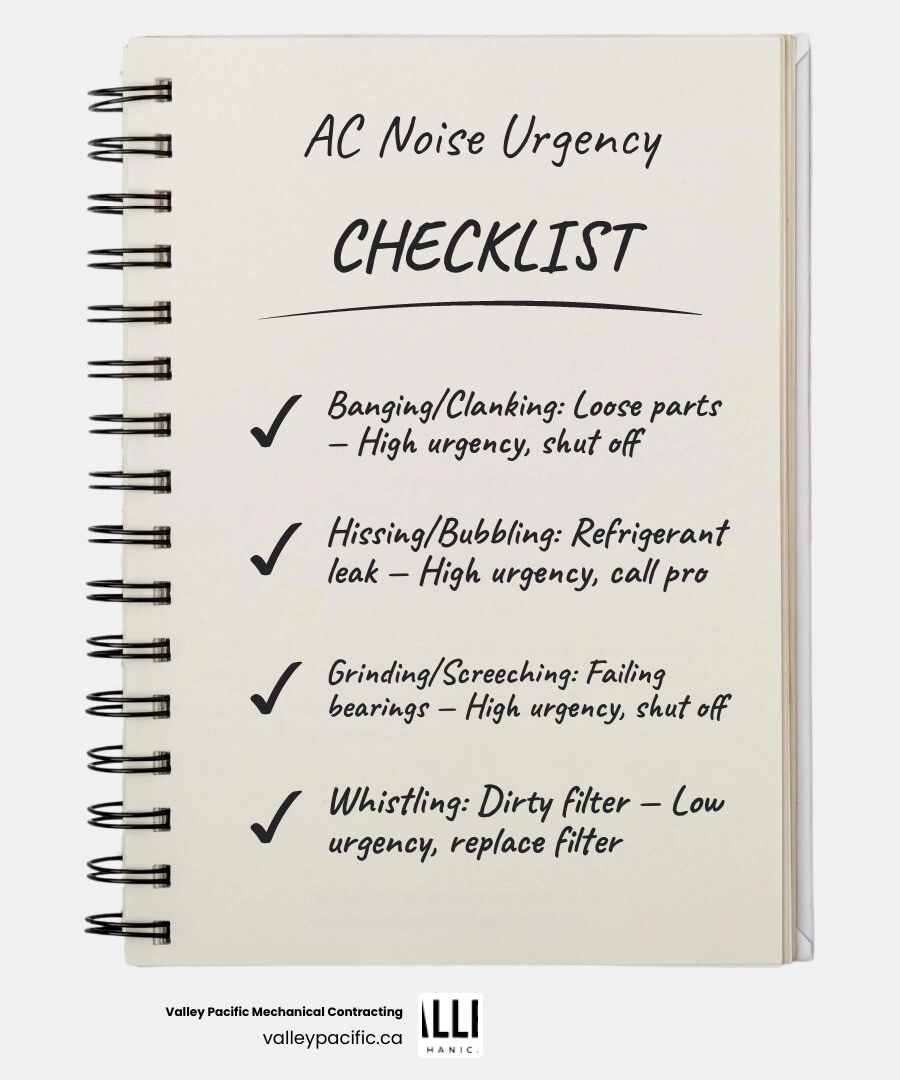
If your ac is making strange noises, here's a quick breakdown of what each sound typically means:
| Sound | Most Likely Cause | Urgency |
|---|---|---|
| Banging / Clanking | Loose or broken internal component | High — shut off system |
| Hissing | Refrigerant leak or duct air escape | High — call a pro |
| Bubbling / Gurgling | Refrigerant leak or clogged drain line | High — call a pro |
| Screeching / Squealing | Worn motor bearings or slipped belt | High — shut off system |
| Grinding | Failing motor bearings | High — shut off system |
| Buzzing | Electrical issue, debris, or frozen coils | Medium-High — inspect soon |
| Rattling | Loose panels, debris, or fan blade | Medium — inspect soon |
| Clicking (repeated) | Capacitor or contactor failure | Medium — call a pro |
| Whistling | Dirty filter or blocked airflow | Low-Medium — check filter |
| Soft hum | Normal motor operation | Normal |
| Single click at startup/shutdown | Thermostat relay — normal | Normal |
Your air conditioner is not supposed to be silent — but it is supposed to sound predictable. Modern high-efficiency AC units can run as quietly as 19 decibels, which is softer than a whisper. So when something new and unfamiliar starts coming from your system — a clank, a squeal, a hiss — that change in sound is your AC's way of flagging a problem before it becomes a much bigger one.
Here in the Lower Mainland, where summers are getting warmer every year, an air conditioner working overtime is also one under more stress. Small issues that might go unnoticed in mild weather can escalate quickly when your system is running hard through a BC heat stretch. Catching a strange noise early can be the difference between a straightforward repair and a full system replacement.
This guide from Valley Pacific Mechanical Contracting walks you through exactly what each sound means, where it's coming from, and what to do next.
Deciphering the Symphony: AC Making Strange Noises What They Mean
When your cooling system kicks on, it triggers a complex sequence of mechanical, electrical, and thermodynamic processes. A healthy system handles this with a steady, uniform hum and the gentle whoosh of air moving through your vents. However, when parts begin to wear out, loosen, or fail, that uniform hum breaks down into a variety of distinct, problematic noises.
Understanding Strange Noises Coming From AC Unit is your first line of defense against system failure. An air conditioner is a major investment, and ignoring these acoustic warning signs can lead to cascading mechanical damage. For instance, a small loose component rattling inside the cabinet might seem like a minor nuisance, but left unaddressed, it can vibrate free, strike other delicate parts, and lead to catastrophic damage to your coils or compressor.
By learning to identify these sounds, you can communicate more effectively with your HVAC technician, helping them pinpoint the issue quickly and keep your home comfortable.
Banging and Clanking: Loose Internal Components
If you hear a heavy banging or rhythmic clanking sound coming from your unit, this is a clear indication of a mechanical issue that requires immediate attention. These sounds are typically caused by loose, unbalanced, or broken parts inside the system's sealed components or fan assemblies.
Inside the compressor—the heart of your outdoor unit—there are connecting rods, pistons, and crankshafts constantly in motion. Over years of operation, these parts can wear down, break loose, and begin slamming against the compressor's outer casing. Because the compressor is a hermetically sealed unit, a banging compressor usually cannot be repaired internally and will require a full replacement.
Alternatively, banging can occur in the indoor or outdoor fan assemblies. If a fan blade becomes bent, loose, or out of balance, it will wobble during operation, repeatedly striking the surrounding metal shroud or cage. In the indoor air handler, a loose blower wheel can slide along its shaft, clanking loudly against the blower housing. If you hear these heavy, metallic impacts, shut down your system immediately and schedule AC Repair Maple Ridge BC to prevent the loose parts from destroying the fan motor or puncturing your delicate coils.
Hissing and Bubbling: Refrigerant Leaks and Pressure Issues
Hissing and bubbling are almost always related to the closed-loop refrigerant system. Your air conditioner relies on a precise charge of chemical refrigerant to absorb heat from your indoor air and transfer it outside. Because this system is completely sealed and pressurized, any breach will produce distinct sounds.
A steady, persistent hissing noise—similar to air escaping from a tire—indicates that refrigerant is leaking out under high pressure. This leak often occurs at joint connections, within the copper tubing, or inside the evaporator and condenser coils. If the leak is near the indoor evaporator coil, you may also hear a bubbling or gurgling sound. This happens as gas bubbles mix with the remaining liquid refrigerant inside the lines, or when the system struggles to pump an insufficient volume of refrigerant through the expansion valve.
Ignoring a refrigerant leak is highly risky. Not only does it cause your system to work harder, leading to a situation where you notice your AC Not Cooling Properly What to Check, but escaping refrigerant also poses serious health hazards. Inhaling refrigerant fumes can cause dizziness, headaches, nausea, and respiratory irritation. Furthermore, running an AC with low refrigerant levels places extreme stress on the compressor, which can quickly overheat and fail.
Screeching and Grinding: Motor Bearings and Belts
A high-pitched screeching or a harsh, metallic grinding sound is one of the most painful noises a homeowner can hear. It is also one of the most urgent.
Screeching is commonly associated with a failing motor or, in older air conditioning systems, a worn-out fan belt. In systems that utilize a belt-driven blower motor, the rubber belt can stretch, dry out, and slip along the metal pulleys, creating a loud squealing sound similar to a slipping serpentine belt in a car. If your system is newer, it likely uses a direct-drive motor, meaning a screeching sound points directly to dry, worn-out bearings inside the blower motor or the outdoor condenser fan motor.
Grinding, on the other hand, is almost always a sign of severe mechanical wear. When the internal bearings of a motor lose their lubrication and begin to fail, the metal-on-metal friction produces a harsh grinding noise. If you continue to run the system, the friction will generate intense heat, eventually seizing the motor entirely. Catching this sound early allows a technician to replace the failing motor bearings or the motor itself before the heat damages surrounding electrical wiring or causes a system-wide breakdown. For prompt assistance in the Fraser Valley, contact our team for expert AC Repair Langley BC.
Indoor vs. Outdoor Unit Sounds: Pinpointing the Source

When diagnosing an air conditioning issue, the location of the sound is just as important as the sound itself. A modern split-system air conditioner consists of two primary parts: the indoor air handler (which houses the evaporator coil and blower fan) and the outdoor condenser unit (which houses the compressor and condenser fan).
Determining where the sound originates helps narrow down which components are failing and allows you to provide crucial details when booking a diagnostic visit. For homeowners in the Fraser Valley, consulting a local guide like our AC Service Pitt Meadows BC Guide can help you understand how our local climate—with its high humidity and seasonal debris like cottonwood fluff—can impact both your indoor and outdoor units.
Indoor Air Handler Noises and Airflow Restrictions
The indoor air handler is responsible for circulating conditioned air throughout your home. Because it is located inside your living space—often in a closet, utility room, or attic—any noise it makes will be highly noticeable.
One of the most common indoor noises is a high-pitched whistling or rushing sound coming from your vents. If you are wondering about AC Whistling Sound Reasons, the culprit is almost always restricted airflow. When your system cannot pull enough air through the return grilles, it creates a high-velocity vacuum effect, forcing air through tiny gaps and seams in your ductwork or around the edges of a clogged air filter.
A severely dirty air filter restricts airflow so much that the evaporator coil cannot absorb enough heat. This causes the moisture on the coil to freeze, leading to your AC Freezing Up. As ice builds up on the coil, it can block the fan blades, resulting in a rapid thumping or buzzing sound as the blades strike the ice.
Outdoor Condenser Noises and Compressor Strain
The outdoor condenser unit is exposed to the elements year-round, making it susceptible to dirt, weather debris, and mechanical wear. Because the compressor is located here, outdoor noises are often louder and carry a higher risk of system damage.
A normal outdoor unit produces a steady, low-pitched compressor hum and the smooth whoosh of the condenser fan. However, if you hear a loud rattling or buzzing, it could be due to debris—such as twigs, leaves, or gravel—falling through the top grate and getting struck by the spinning fan blades. Over time, this debris can bend the fan blades or damage the fan motor.
Additionally, the extreme heat of Lower Mainland summers can place immense strain on the compressor. If the condenser coils are caked with dirt, dust, or pollen, the system cannot release heat efficiently. This causes the compressor to run at dangerously high temperatures and pressures, leading to a loud, metallic knocking or a strained, high-pitched hum. Keeping these coils clean through regular maintenance is essential, as detailed in our AC Service Mission BC Complete Guide.
High-Urgency Sounds: When to Shut Down Your System Immediately
While some air conditioner noises can wait for a scheduled maintenance visit, others are clear indicators of an active emergency. Running your system when certain sounds are present can cause irreparable damage to expensive components or, worse, create safety hazards like electrical fires or toxic refrigerant exposure.
If you hear any of the high-urgency sounds detailed below, walk to your thermostat, switch the system to "OFF," and turn off the dedicated circuit breaker in your electrical panel. Taking this quick action can prevent a simple repair from turning into a situation where your AC Suddenly Stops Working entirely, leaving you stranded in the heat.
Electrical Buzzing and Rapid Clicking
Electrical components are the brain and nervous system of your air conditioner. When they begin to fail, they often emit distinct acoustic warnings that should never be ignored.
A loud, persistent buzzing noise from either the indoor or outdoor unit often indicates an electrical issue. This can be caused by:
- A malfunctioning contactor relay switch: This switch controls the flow of electricity to the compressor and fan. If the electrical contacts become pitted, dirty, or worn, they will chatter and buzz as they struggle to hold the circuit closed.
- A failing capacitor: Capacitors store electrical energy to start and run the motors. When a capacitor begins to bulge or lose its charge, the motor it powers will hum or buzz loudly because it cannot get enough torque to spin.
- Loose or damaged wiring: Loose electrical connections can cause electrical arcing, where current jumps across gaps, creating a crackling or buzzing sound and posing a severe fire risk.
If your system clicks rapidly when attempting to start but fails to turn on, this indicates that the control board is trying to send power, but a failed capacitor or seized motor is blocking the cycle. Running the system in this state can cause electrical overloads, leading to your AC Circuit Breaker Tripping repeatedly.
High-Pitched Screaming and Compressor Pressure
If your outdoor unit begins to emit a loud, high-pitched screaming or whistling sound that sounds like a jet engine taking off, you must act immediately.
This terrifying sound is usually caused by dangerously high pressure building up inside the AC compressor. Modern air conditioners are equipped with high-pressure safety switch shut-offs designed to cut power to the system if internal pressures reach unsafe levels. However, if these safety switches fail, or if the pressure rises too rapidly, the compressor will emit a loud, high-pitched scream.
This is a critical emergency. Running a compressor under extreme pressure can cause it to rupture, destroying the outdoor unit and releasing a large volume of hot, pressurized refrigerant. If you hear this sound, turn off the system immediately and call for emergency AC Repair Pitt Meadows BC to have a licensed technician safely discharge and repair the system.
DIY Troubleshooting vs. Professional HVAC Service
When your air conditioner starts making strange noises, it is natural to want a quick, simple fix. While some minor noise issues can be resolved with basic homeowner maintenance, the vast majority of AC noises point to complex mechanical or electrical problems that require professional expertise.
Attempting to repair advanced components yourself can void your manufacturer's warranty, damage the system further, and expose you to high-voltage electricity and pressurized chemicals. For a complete understanding of what tasks are safe for homeowners versus what requires a certified technician, consult our AC Service Langley BC Complete Guide.
Simple Maintenance Steps for Homeowners
Before calling in the professionals, there are a few safe, non-invasive troubleshooting steps you can take to see if the noise is caused by a simple maintenance issue:
- Check and Replace the Air Filter: A dirty, clogged air filter restricts airflow, causing whistling noises in your vents and placing strain on your blower motor. Replace your filter every 1 to 3 months, especially during heavy summer use.
- Clear Outdoor Debris: Turn off the power to your outdoor unit at the thermostat and the outdoor disconnect box. Inspect the top grate and sides of the condenser. Carefully remove any accumulated leaves, twigs, grass clippings, or dirt that might be contacting the fan blades.
- Tighten Loose Cabinet Panels: Sometimes, a loud rattling sound is simply a loose screw on the metal cabinet panels vibrating against the frame. Grab a screwdriver and check that all exterior screws on both the indoor and outdoor units are snug.
- Inspect the Condensate Drain Line: If you hear a gurgling sound near your indoor unit, check your condensate drain line. If you suspect a minor clog is trapping water and causing air to bubble through, you can use a wet/dry vacuum to gently clear the drain line. For more detailed steps, see our guide on AC Water Leaking Troubleshooting.
When to Call a Professional for AC Repair
If your DIY troubleshooting does not resolve the noise, or if the sound is mechanical, electrical, or chemical in nature, you must call a professional.
Licensed HVAC technicians undergo extensive training to handle the specialized tools and hazardous materials found inside air conditioning systems. For example, handling refrigerant requires specialized certification, as these chemicals are tightly regulated and hazardous to the environment and human health. A professional technician has the manifold gauges, leak detectors, and recovery equipment needed to safely find and seal leaks.
Similarly, diagnosing electrical buzzing or rapid clicking requires advanced multimeters to test capacitors, contactors, and control boards without risk of electrocution. If your system requires motor replacement, bearing lubrication, or compressor diagnostics, our experienced team providing AC Repair Mission BC has the expertise to perform these repairs safely, quickly, and in compliance with your equipment's warranty.
Frequently Asked Questions About AC Noises
Why is my ac making strange noises what they mean when it clicks repeatedly?
If your air conditioner clicks repeatedly when it tries to turn on, it typically points to an electrical communication issue between your thermostat, control board, and outdoor unit. A single click at the start and end of a cooling cycle is perfectly normal—that is the sound of the thermostat relay opening or closing to signal the system.
However, rapid or continuous clicking indicates that the electrical contactor in the outdoor unit is trying to close but cannot maintain the connection. This is often caused by a failing capacitor that cannot supply enough starting voltage, a faulty contactor coil, or loose wiring connections. Running the system while it is clicking repeatedly can burn out the compressor's starting windings, so it is best to have an HVAC professional inspect the electrical controls promptly.
Can a dirty air filter cause my ac making strange noises what they mean?
Yes, a dirty air filter is one of the most common causes of unusual AC noises. When a filter becomes caked with dust, pet hair, and debris, it severely restricts the volume of air entering the system. This restriction forces the blower fan to work much harder, creating a high-pitched whistling or whining sound as air is sucked through tiny gaps in the filter frame or ductwork joints.
Furthermore, the lack of warm airflow across the indoor evaporator coil causes its temperature to drop below freezing, leading to ice buildup. This ice can block the blower fan, resulting in a loud thumping or buzzing noise as the fan blades hit the frost. If left unaddressed, this restricted airflow can cause your system to short-cycle and blow warm air, which is why understanding these symptoms and their solutions, as detailed in our guide on AC Vents Warm Air Causes Solutions, is so important.
Is it safe to run my air conditioner if it is making a loud grinding sound?
No, it is highly unsafe to run your air conditioner if it is making a loud grinding sound. A grinding noise is a clear indicator of metal-on-metal friction, usually caused by completely worn-out bearings inside the blower motor or the outdoor condenser fan motor.
If you continue to run the system, the friction will generate extreme heat, which can melt the motor's internal wiring insulation, cause an electrical short, or even spark a fire. Additionally, the heat can cause the motor shaft to seize entirely, which can overload your electrical circuits and damage other expensive components, including the compressor. If you hear grinding, shut down the system immediately and call a certified technician to inspect and replace the failing motor or bearings.
Conclusion
Your air conditioner is your home's primary defense against summer heat, and keeping it running quietly and efficiently is essential for your comfort and peace of mind. When your ac is making strange noises, listening closely and acting quickly can prevent minor issues from turning into major, expensive breakdowns.
At Valley Pacific Mechanical Contracting, we have spent over 30 years providing headache-free mechanical solutions to homeowners and light commercial clients throughout the Lower Mainland—including Maple Ridge, Pitt Meadows, Langley, Surrey, and Vancouver. As an Indigenous-owned business, we pride ourselves on our customer-first approach, fast response times, and transparent service.
Our team of fully licensed technicians is trained to service all major air conditioning brands. As part of our commitment to quality, we proudly back our work with the Daikin Comfort Promise, ensuring you receive the highest standard of indoor comfort and reliability. Whether you need a routine seasonal tune-up, a complex repair, or a complete system replacement, we are here to help.
Don't let a strange noise ruin your home's peace and quiet. If your air conditioner is acting up, contact us today to schedule your professional AC Service. We offer 24/7 emergency service to keep your home cool and comfortable when you need it most.


