


Assessing Your Abbotsford Home's Electrical Panel Before a Mini-Split Install


Why Your Home's Electrical Capacity Dictates Your HVAC Options
Your old baseboard heaters or failing furnace aren't cutting it anymore, but as we often tell our clients at Valley Pacific Mechanical Contracting Ltd., assessing your Abbotsford home's electrical panel before a mini-split install is the critical first step you must take before choosing any new equipment. Many homeowners are eager to upgrade their climate control, focusing entirely on the sleek indoor units and the promise of better energy efficiency. However, they often overlook the electrical infrastructure required to power those modern systems safely.
Determining whether your home has the physical space in the breaker box and the total amperage capacity to support a new multi-zone system is not just a technicality. It is the foundation of your entire project. If you live in one of the older Abbotsford or Maple Ridge residential neighborhoods, your home was likely built with electrical standards that simply did not anticipate the heavy draw of modern appliances and whole-home heat pump systems running simultaneously.
The core decision point for your project is determining whether an electrical heavy-up or a complete panel upgrade is required to proceed safely. Without this assessment, you risk overloading your current service, facing frequent breaker trips, or encountering unexpected delays right in the middle of your ductless mini-split installation. Understanding your home's electrical capacity right from the start ensures that your transition to a more comfortable home is smooth, predictable, and entirely safe.
The Demands of Modern Multi-Zone HVAC Systems
The problem: You want to heat and cool multiple rooms independently, but your existing electrical setup was designed for a much simpler era of home energy use.
The cause: Multi-zone ductless systems operate differently than a single plug-in space heater or a basic window unit. A multi-zone system requires power for a large outdoor compressor as well as multiple indoor air handling units distributed throughout your home. In our years of servicing the Fraser Valley, we know that Abbotsford's damp, chilly winters require sustained, robust heating loads from these multi-zone systems, making adequate electrical capacity critical for reliable winter performance. When temperatures drop, the system works harder to extract heat from the outside air, drawing more current to keep your family comfortable.
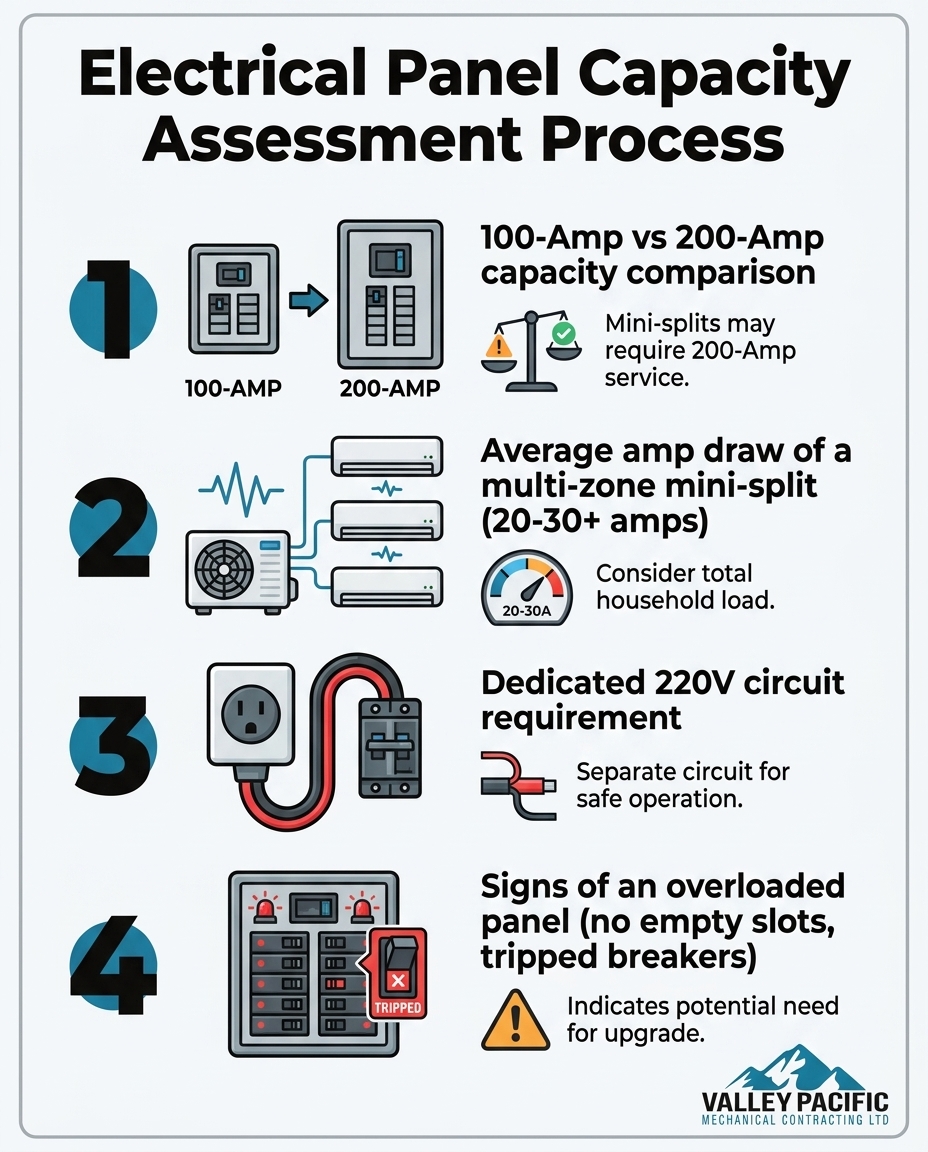
The solution: These robust systems typically require a dedicated 220V circuit and can draw anywhere from 20 to 30 or more amps, depending on the total tonnage of the equipment. As our technicians explain when you look at mini splits vs central AC compared, both systems demand a significant, sustained electrical draw that older panels simply cannot support alongside electric ranges, dryers, and modern electronics.
Understanding Amperage and Tonnage
To fully grasp why a mini split heat pump install requires so much power, it helps to understand the relationship between cooling or heating capacity (measured in tonnage) and electrical load (measured in amps). Tonnage does not refer to the physical weight of the equipment; it refers to the unit's ability to move heat. A larger home requires a higher tonnage system to maintain comfortable temperatures.
Here is how the demands scale up as our team adds more zones to your home:
• Single-Zone Systems: Often require a 15-amp or 20-amp dedicated circuit. They provide targeted comfort for one specific room or open area.
• Dual-Zone Systems: Typically require a 20-amp to 25-amp circuit, as the outdoor compressor must be larger to supply two separate indoor air handlers.
• Three-to-Four Zone Systems: Generally demand a 30-amp to 40-amp dedicated circuit. Adding more zones increases the total power requirement exponentially, as the outdoor unit must manage multiple refrigerant lines and higher sustained loads.
As the tonnage increases to accommodate more indoor zones, the electrical draw rises directly in tandem. This is why a simple swap from an old system to a modern multi-zone setup is rarely just a "plug and play" scenario.
Evaluating Your Current Electrical Infrastructure
When evaluating your home's readiness for a new HVAC system, our professionals at Valley Pacific look at two distinct factors: the physical space for new breakers and the total overall capacity of the panel. It is entirely possible to have empty slots in your breaker box but lack the total amperage capacity to safely add a new 30-amp circuit. Conversely, you might have the total capacity available, but the box is physically full of tandem breakers with no room to add the required dedicated 220V double-pole breaker.
Mid-century housing stock often lacks the infrastructure for modern high-draw appliances. An overloaded panel functions under immense stress. When a panel is pushed beyond its intended limits, the internal bus bars can overheat, wire insulation can degrade, and the risk of an electrical fire increases significantly. Adding heavy HVAC loads without a proper, professional assessment is a major safety hazard. Remember that opening, testing, or modifying an electrical panel is strictly non-DIY and requires licensed professional expertise.
The Limitations of 100-Amp Panels
Understanding the difference between 100-amp vs 200-amp service capacity is vital for any major home upgrade. Many older homes were built with 100-amp service, which was perfectly adequate decades ago. Today, our technicians see that capacity max out incredibly fast.
• Electric Range / Oven — Typical Electrical Draw: 40 to 50 Amps — Impact on a 100-Amp Panel: Consumes nearly half of the total available capacity when in use.
• Electric Clothes Dryer — Typical Electrical Draw: 30 Amps — Impact on a 100-Amp Panel: Creates a heavy load that limits what else can run simultaneously.
• Electric Vehicle (EV) Charger — Typical Electrical Draw: 30 to 50 Amps — Impact on a 100-Amp Panel: Often pushes a 100-amp panel to its absolute limit overnight.
• Multi-Zone Mini-Split — Typical Electrical Draw: 20 to 40 Amps — Impact on a 100-Amp Panel: Frequently requires an immediate panel upgrade if the home has other heavy electric appliances.
Upgrading to a 200-amp service is often the most viable solution for future-proofing your home. It provides the necessary headroom to safely operate your new climate control system, charge an electric vehicle, and run your daily appliances without constantly tripping the main breaker.
BC Electrical Code and Dedicated Circuit Requirements
Treating an electrical panel upgrade as a safety and code-compliance necessity—rather than an unexpected hidden cost—changes how you plan your home improvement project. The BC Electrical Code is designed to protect your home, your family, and your property investment from the severe risks of electrical fires and equipment failure.
The code sets strict rules for fixed space heating and cooling equipment. Following these regulations is not optional, and the process generally involves these critical steps:
1. Mandatory Dedicated Circuits: The code requires that your new multi-zone system operates on its own dedicated circuit. This prevents overloads and nuisance tripping that occur when heavy-draw equipment shares a circuit with lights or outlets.
2. Proper Wire Sizing: The wiring running from your panel to the outdoor unit must be precisely sized to handle the maximum ampacity of the equipment. Undersized wires will overheat and create a severe fire hazard.
3. Permitting Requirements: Any modifications to your electrical panel, including adding a new 220V circuit or performing a heavy-up, require a permit from the local authority.
4. Professional Inspections: Once the electrical work is completed, it must pass a rigorous inspection to ensure it meets all BC Electrical Code standards before the system is officially commissioned.
Frame code compliance as a protective measure for your home. If an electrical fire occurs due to unpermitted, non-compliant DIY work, your homeowner's insurance may void your coverage. Relying on our licensed professionals ensures your installation is safe, legal, and fully insured.
Recognizing When a Panel Upgrade is Inevitable
The problem: You are ready to schedule your installation, but you aren't sure if your current electrical setup will stall the project.
The cause: Adding high-draw systems during peak seasons exposes underlying electrical insufficiencies. A panel that seemed "fine" during mild weather will quickly show its limits when a heatwave or a cold snap forces your equipment to run at maximum capacity.
The solution: Knowing the signs of an inadequate panel allows you to plan the electrical upgrade concurrently with the HVAC project, preventing frustrating delays. Common indicators that a heavy-up is inevitable include having no empty breaker slots, experiencing frequently tripped breakers when multiple appliances run, or looking at your main breaker and seeing it rated for only 60 or 100 amps.
A pattern we see often is homeowners waiting until extreme weather hits. Recently, a local homeowner reached out to our team at Valley Pacific during a summer heatwave, needing to add cooling right after a furnace replacement. Before providing quotes for the new equipment, our technician confirmed that the existing power panel had sufficient capacity to handle the extra load safely. Because the panel assessment was done upfront, the AC unit was installed just before the worst of the heatwave hit, providing a comfortable home without any last-minute electrical surprises.
When planning mechanical system upgrades, keep in mind that generic energy rebates or utility incentive programs may sometimes apply to necessary electrical upgrades tied to heat pump installations. While you should always verify current programs with your utility provider, bundling the electrical work with the HVAC installation is often the most efficient and cost-effective approach.
What to Expect During a Professional HVAC Consultation
Assessing the panel should always happen before equipment selection. This approach positions the electrical assessment as a core customer service benefit rather than an afterthought. When you schedule a consultation with the Valley Pacific team across our HVAC service areas, the process is thorough and transparent.
During the initial walkthrough, our professionals will evaluate your home's layout, inspect any existing ductwork (or confirm the need for a ductless approach), and closely examine the electrical panel. Our licensed technicians walk homeowners through the 'why' of electrical capacity upfront, ensuring no surprises and transparent professional guidance.
The Load Calculation Process:
We do not guess what size system you need. Our team performs detailed load calculations to determine the exact equipment size required to heat and cool your specific square footage, accounting for insulation levels, window quality, and local climate. Once the exact equipment size is determined, the corresponding electrical requirements are finalized.
Emphasizing a transparent consultation prevents surprise costs halfway through the project. If you need a panel upgrade, you will know exactly why it is required, how it ensures your safety, and how it fits into the overall timeline of your project. Reiterate to yourself that only licensed professionals should perform these technical assessments and the subsequent electrical work.
Planning Your Next Steps for a Safe, Code-Compliant Installation
A successful multi-zone ductless system relies heavily on a robust, capable electrical foundation. You cannot build a modern, high-efficiency climate control system on top of an outdated, overloaded breaker box. Understanding the transition from 100-amp to 200-amp service ensures that your new equipment will operate safely, efficiently, and in full compliance with local electrical codes.
Taking the time to evaluate your home's infrastructure before falling in love with a specific piece of equipment protects your investment and your family. At Valley Pacific Mechanical Contracting Ltd., we encourage homeowners to schedule a comprehensive assessment to understand their specific infrastructure needs long before the extreme weather arrives. If you are ready to explore your options and want a clear, honest evaluation of your home's readiness, reach out to our local experts to start planning your upgrade the right way.
Frequently Asked Questions
Do I need to upgrade my electrical panel for a mini split installation?
It depends entirely on your current panel's total capacity and available physical space. If you have an older 100-amp service and already run heavy electric appliances like a dryer or an EV charger, an upgrade is highly likely. A licensed professional must calculate your home's total electrical load to determine if your existing panel can safely handle the additional 20 to 40 amps required by a new multi-zone system.
Does a mini split need a dedicated circuit?
Yes, modern multi-zone systems require their own dedicated 220V circuit. Sharing a circuit with other outlets or appliances violates electrical codes and creates a significant risk of overloading the wiring. A dedicated circuit ensures the system receives steady, uninterrupted power, which is essential for protecting the compressor from voltage drops and preventing nuisance breaker trips.
How many amps does a 3-zone mini split use?
A typical 3-zone system usually requires a dedicated 30-amp or 40-amp circuit, depending on the total tonnage of the outdoor compressor. While the system may not draw that maximum amperage constantly, the circuit must be sized to handle the peak startup surge and the sustained load during extreme weather. Always refer to the manufacturer's specific electrical requirements for your exact model.
Why do older homes need an electrical panel upgrade for HVAC?
Older homes were frequently built with 60-amp or 100-amp electrical panels, which were sufficient for the lighting and basic appliances of the time. Today's modern households consume significantly more electricity, and adding a high-draw multi-zone HVAC system often pushes these older panels past their safe operating limits. Upgrading the panel ensures compliance with current safety codes and prevents dangerous electrical overloads.
Can I assess my own electrical panel capacity before calling a professional?
While you can visually check if your main breaker is labeled 100 or 200 amps, a true capacity assessment requires professional expertise. Determining the actual load on your panel involves complex calculations and opening the panel to inspect the bus bars and wiring, which is extremely dangerous for an untrained homeowner. Always rely on a licensed professional to perform a safe and accurate load calculation.


