


The Real Cost of Cooling: Mini Splits vs Central AC Compared


The Real Cost of Cooling: What BC Homeowners Need to Know Before Choosing
Mini split vs central AC cost comparison is one of the most common questions homeowners in the Lower Mainland ask when it's time to upgrade their home comfort system — and for good reason. The answer isn't as simple as one system being "cheaper" than the other. The right choice depends on your home's existing setup, your heating and cooling goals, and how long you plan to stay in the property.
Here's a quick breakdown to help you orient yourself:
| Factor | Mini Split (Ductless) | Central AC |
|---|---|---|
| Best for | Homes without ducts, additions, zoned comfort | Homes with existing ductwork, whole-home cooling |
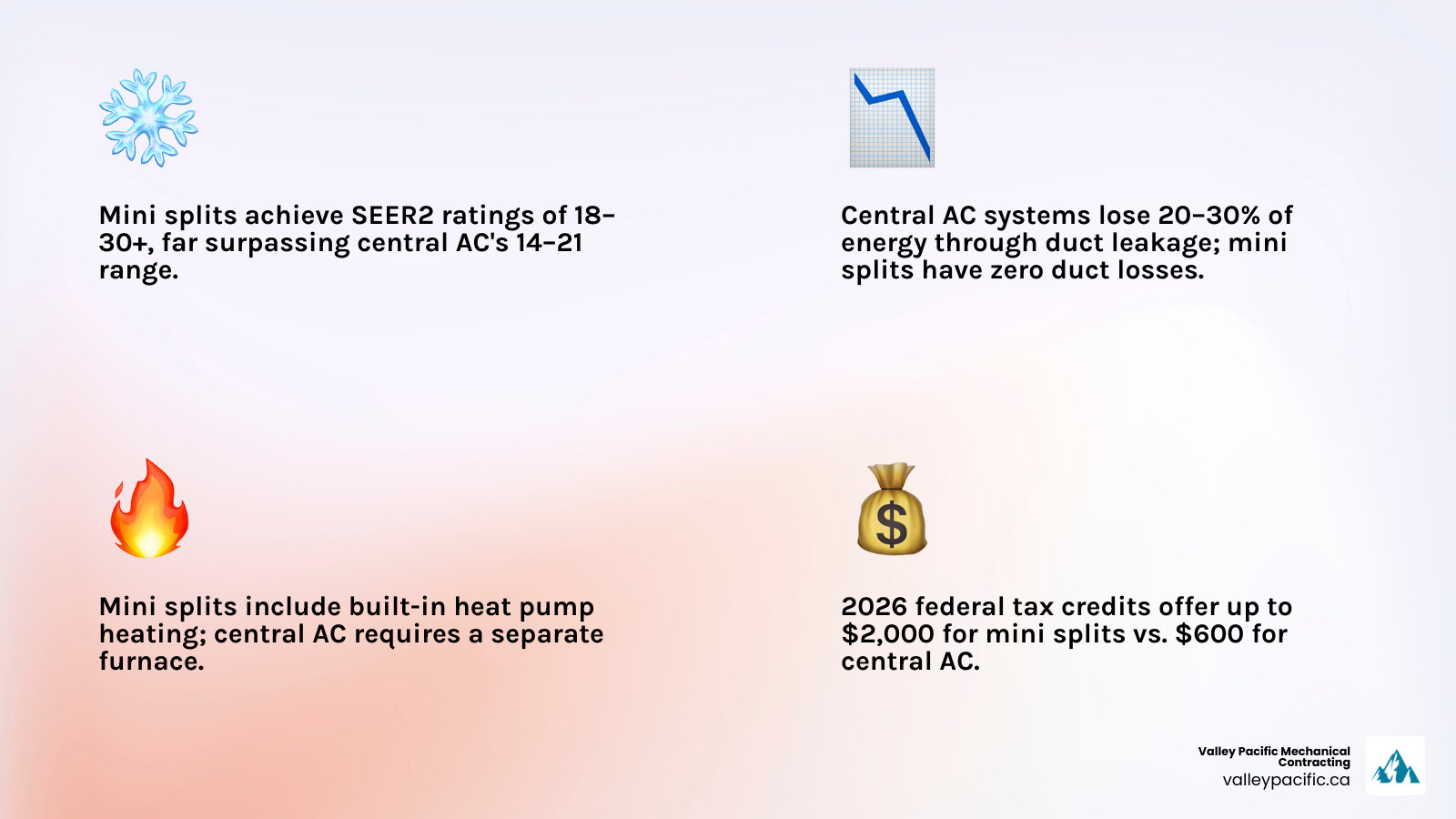
| Energy efficiency (SEER2) | 18–30+ | 14–21 |
| Duct energy loss | None | 20–30% |
| Heating capability | Built-in heat pump | Requires separate furnace |
| Installation disruption | Minimal | Moderate to high |
| Lifespan | 15–20 years | 12–15 years |
| Federal tax credit (2026) | Up to $2,000 | Up to $600 |
Both systems can cool your home effectively. But they work differently, cost differently to run, and suit different types of homes. In the Lower Mainland's mild but variable climate, that distinction matters — especially if your home is older, has a room addition, or was built without central ductwork.
This guide walks you through every major cost factor so you can make a confident, informed decision.
Understanding the Mini Split vs Central AC Cost Comparison for BC Homeowners
When we look at the financial side of home cooling, we have to look past the initial price tag. For families in Langley, Maple Ridge, and surrounding areas, the total investment is shaped by several moving parts: equipment, labor, and the specific needs of your floor plan.
A central air conditioning system relies on a large outdoor condenser and an indoor evaporator coil, usually paired with your existing furnace. It pushes air through a network of ducts. In contrast, a mini split system (often called ductless) consists of an outdoor compressor connected to one or more indoor "heads" mounted on walls or ceilings. Because these systems function so differently, their labor requirements vary significantly.
Central AC often requires more intensive labor if the existing furnace or ductwork needs modifications to handle the new cooling load. Meanwhile, mini splits require specialized refrigerant line work and electrical connections for each indoor unit. When we perform an AC Installation, we take into account the system capacity—measured in BTUs—to ensure the unit isn't overworking itself, which would lead to higher long-term repair needs.
How Ductwork Influences Your Mini Split vs Central AC Cost Comparison
Ductwork is often the "hidden" variable that tips the scales. If your home in Pitt Meadows or Mission was built with a forced-air furnace and healthy ducts, central AC can be a very straightforward addition. However, if those ducts are old, leaky, or undersized, you might be losing 20% to 30% of your cooled air before it even reaches your living room.
For homes without existing ducts—such as those with baseboard heaters or older boiler systems—the comparison changes entirely. Retrofitting a whole house with new ductwork is a massive undertaking that involves cutting into walls and ceilings, which adds substantial labor and renovation expenses. This is where Ductless AC Installation shines. By bypassing the need for ducts, mini splits avoid the "renovation tax" and deliver air directly to the rooms where you need it most.
Factors Influencing the Upfront Investment
Several key factors will determine where your specific project falls on the spectrum:
- BTU Capacity: The larger your home, the more cooling power (BTUs) you need. Sizing the system correctly is vital; an oversized unit will cycle on and off too frequently, while an undersized one will never stop running.
- Number of Zones: Mini splits allow for "zoning." You might want one head in the master bedroom and another in the main living area. Each additional zone increases the equipment and labor requirements.
- Brand Reliability: We often point toward manufacturers with strong track records, like those backed by the Daikin Comfort Promise, to ensure that the parts and support are available for years to come.
- Electrical Upgrades: Older homes in the Lower Mainland may need a panel upgrade to handle the electrical load of a modern cooling system. This is a common step in a professional Mini Split Installation.
Energy Efficiency and Monthly Operating Factors
In 2026, energy efficiency is measured by the SEER2 rating (Seasonal Energy Efficiency Ratio). The higher the number, the less electricity the system uses to cool your home. Generally, mini splits offer significantly higher SEER2 ratings than central AC systems. While a high-efficiency central unit might reach a SEER2 of 21, premium mini splits can soar past 30.
The secret to this efficiency lies in inverter technology. Traditional central AC units are often "all or nothing"—they turn on at full blast until the house reaches the set temperature, then shut off. Mini splits use variable-speed compressors that "sip" energy, slowing down or speeding up just enough to maintain a consistent temperature. This prevents the energy spikes associated with frequent startups.
Furthermore, central systems suffer from "duct loss." Even well-maintained ducts lose energy through the material of the pipes or small leaks. Because mini splits deliver air directly into the room, they have zero duct loss. Regular Ductless AC Service ensures these high-tech components stay clean and efficient.
| System Type | Typical SEER2 Range | Energy Loss Percentage |
|---|---|---|
| Standard Central AC | 14 – 16 | 20–30% (Duct Loss) |
| High-Efficiency Central | 18 – 21 | 15–25% (Duct Loss) |
| Ductless Mini Split | 18 – 30+ | 0% (Ductless) |
Operating Expenses: A Mini Split vs Central AC Cost Comparison Over Time
When we look at the mini split vs central ac cost comparison over a 10-to-15-year period, the monthly savings can be substantial. Homeowners using mini splits often see cooling bill reductions of 25% to 40% compared to central air.
The primary reason for this is zoned cooling. With central AC, you are cooling the entire house, including the guest room you haven't stepped into all week. With a mini split, you can turn down the cooling in unused areas, focusing your energy dollars only on the rooms you are actually occupying. Over a decade of Lower Mainland summers, those savings add up. To keep these savings consistent, we recommend an annual AC Service to keep the coils clean and the refrigerant levels optimized.
Year-Round Comfort: Heating Capabilities and Performance
One of the biggest advantages of modern mini splits is that they aren't just air conditioners—they are heat pumps. This means they can reverse their operation to provide highly efficient heating during our BC winters. For homes in Langley or Maple Ridge that currently rely on expensive electric baseboards, switching to a mini split heat pump can drastically lower year-round energy bills.
Central AC units are typically cooling-only. To get heat, you still need a furnace. While you can install a central heat pump that works with your ducts, mini splits offer the most flexibility for "problem rooms" that stay cold in the winter. Modern "Hyper-Heat" technology allows these systems to provide reliable warmth even when the outdoor temperature drops significantly. If you are looking at a Mini Split Installation Replacement, you are essentially buying a two-for-one system that handles both July heatwaves and January frosts.
Maintenance and Long-Term Reliability
Every mechanical system needs a little love to last. For central AC, maintenance involves changing the furnace filter regularly and having the ducts cleaned every few years. For mini splits, the maintenance is more "hands-on" but simpler: you should wash the reusable filters in the indoor heads every month during heavy use.
In terms of repairs, central AC systems are mechanically simpler in some ways, but a major failure in the ductwork or a buried refrigerant line can be a nightmare to fix. Mini splits have more electronic components and "brains" inside each head, which requires a technician familiar with inverter technology. Whether it's a Mini Split Repair or a central AC tune-up, keeping the system clean is the best way to ensure it reaches its full 15-to-20-year lifespan.
Choosing the Best System for Your Lower Mainland Property
The "best" system often depends on the architecture of your home. The Lower Mainland is full of diverse housing, from heritage homes in Maple Ridge to modern builds in Langley.
If you own a heritage home with lath-and-plaster walls, installing ducts for central AC would be incredibly invasive and could ruin the home's historic character. In this case, mini splits are the clear winner. They only require a small three-inch hole in the wall to connect the indoor and outdoor units. On the other hand, if you have a large, open-concept home that already has a modern duct system in place, a central AC unit might be the most cost-effective way to achieve uniform cooling. If your current system is acting up, you might just need an AC Repair Langley BC to get things back on track.
When to Choose a Ductless Solution
Ductless is the way to go if:
- You have an older home without ductwork.
- You’ve built a room addition, sunroom, or finished a garage.
- Certain rooms in your house are always hotter than others.
- You want the highest possible energy efficiency and lower monthly bills.
- You want independent temperature control for different family members.
For those in Pitt Meadows, our Ductless AC Service Guide Pitt Meadows BC offers more localized tips on keeping these units running perfectly.
When Central Air Makes Sense
Central air is often the better choice if:
- Your home already has a high-quality duct system in good condition.
- You prefer a "hidden" look with only floor or ceiling vents visible.
- You want a uniform temperature throughout every square inch of the house.
- You have a very large home where installing 6 or 7 mini split heads would be less practical than one central unit.
Residents in Mission can benefit from our AC Service Mission BC to evaluate if their current ducts are ready for a central AC upgrade.
Frequently Asked Questions about Cooling Systems
How long do mini splits and central AC systems typically last?
With professional installation and regular maintenance, both systems are designed to last between 15 and 20 years. Central AC units often lean toward the 12-to-15-year mark because they work harder to push air through ducts. Mini splits, thanks to their inverter technology and lack of duct resistance, frequently reach 20 years. Consistent Mini Split Service is the key to longevity.
Do these systems qualify for federal tax credits or rebates in 2026?
Yes! As of April 2026, there are significant incentives for homeowners who choose energy-efficient heat pump technology. Because most mini splits are high-efficiency heat pumps, they often qualify for federal tax credits of up to $2,000. Central AC units that meet Energy Star criteria may also qualify, though usually for a lower amount (around $600). These programs are designed to encourage the move away from less efficient fossil fuel heating. For more details on navigating these, check our Ductless AC Service Guide Mission BC.
Which system is quieter for residential neighborhoods?
Mini splits are remarkably quiet. The indoor heads often operate at decibel levels as low as 19 dB—which is quieter than a whisper. The outdoor units are also designed to be much quieter than traditional central AC condensers, making them ideal for homes with close neighbors in Langley or Maple Ridge. Proper placement is important, and our Ductless AC Service Langley BC Guide highlights how to maintain that whisper-quiet operation.
Conclusion
Choosing between a mini split and central AC is a significant decision for any Lower Mainland homeowner. While the mini split vs central ac cost comparison involves many variables—from existing ductwork to your long-term energy goals—the goal is always the same: a comfortable, efficient home where you don't have to worry about the "headache" of a failing system.
At Valley Pacific Mechanical Contracting, we bring over 30 years of expertise to every project. As an Indigenous-owned business based in Maple Ridge, we take pride in serving our neighbors across Langley, Pitt Meadows, and Mission with a customer-first approach. Whether you need a brand-new installation or a simple tune-up, we are here to ensure your home stays perfectly conditioned all year round.
Contact us for expert air conditioning solutions and let us help you find the cooling system that fits your home and your budget perfectly.


