


Balancing Comfort and Affordability When Upgrading to a Heat Pump


The Myth That You Must Buy the Most Expensive System to Stay Warm
It is a common misconception that you must purchase the absolute highest-priced equipment on the market to stay comfortable through the colder months. When it comes to balancing comfort and affordability when upgrading to a heat pump, many homeowners assume that only the most advanced, top-tier models can handle our local climate. The truth is, achieving reliable winter heating does not require emptying your savings account for premium features you might not actually need. A typical pattern we see is homeowners feeling overwhelmed by massive, single-option quotes that push the most expensive variable-capacity units, leaving them unsure of how to proceed or whether an upgrade is even financially viable.
If you are exploring your options, understanding the different heat pump systems available is the first step toward making an informed, confident choice.
Homeowners in Maple Ridge BC frequently want to transition away from inefficient electric baseboards or aging fossil fuel furnaces to take advantage of modern energy efficiency. However, the initial investment can seem daunting. The core problem is finding a way to balance that upfront cost with the absolute necessity of reliable heating. The decision point usually comes down to choosing between different equipment tiers—single-stage, two-stage, or variable-capacity. Our team's methodology focuses heavily on matching the right technology to the specific home, rather than upselling unnecessary features. You deserve a system that keeps your family safe and warm without stretching your household budget beyond its limits.
Our Methodology: Matching Equipment Tiers to Your Real Needs
At Valley Pacific Mechanical, we believe that pushing the highest-end unit to every single customer simply does not align with our commitment to honest, transparent service. Our methodology is built around providing transparent, tiered heat pump installation packages tailored to different budgets without upselling. We want you to see exactly what you are getting at different investment levels, knowing that every single tier we offer guarantees a baseline of reliable, safe heating for your home.
When our team approaches a new installation, we follow a strict process to ensure the equipment matches your reality. For example, when our technician Cody recently handled a complex boiler and hot water system upgrade, the priority was checking in with the homeowner at every stage to ensure the selected equipment aligned perfectly with both their daily routine and their budget. We apply this same rigorous, communicative approach to every heat pump consultation.
1. Initial Consultation: We sit down to understand your primary goals—whether that is lowering monthly utility bills, improving indoor air quality, or simply replacing a broken system quickly.
2. Technical Evaluation: We inspect the physical constraints of your property, looking at electrical capacity and structural layout.
3. Tiered Proposal: We present multiple options—typically a baseline, a mid-range, and a premium choice—clearly outlining the performance differences and efficiency ratings of each.
4. Collaborative Selection: We help you weigh the upfront investment against long-term energy savings to find the exact right fit.
Assessing the Home's Baseline Requirements
Before we even discuss specific equipment brands or tiers, we have to determine what your house actually needs to stay warm. This involves evaluating your existing ductwork and insulation levels. If your home has leaky ducts or poor attic insulation, installing a premium, ultra-efficient heat pump will not deliver the expected results because the conditioned air will simply escape. We also perform a detailed load calculation to determine the exact minimum output needed to maintain safe indoor temperatures during the coldest nights. Proper sizing is critical; a system that is too small will run constantly and fail to keep you warm, while a system that is too large will short-cycle, leading to premature wear and tear.
Single-Stage Heat Pumps: Baseline Comfort on a Budget
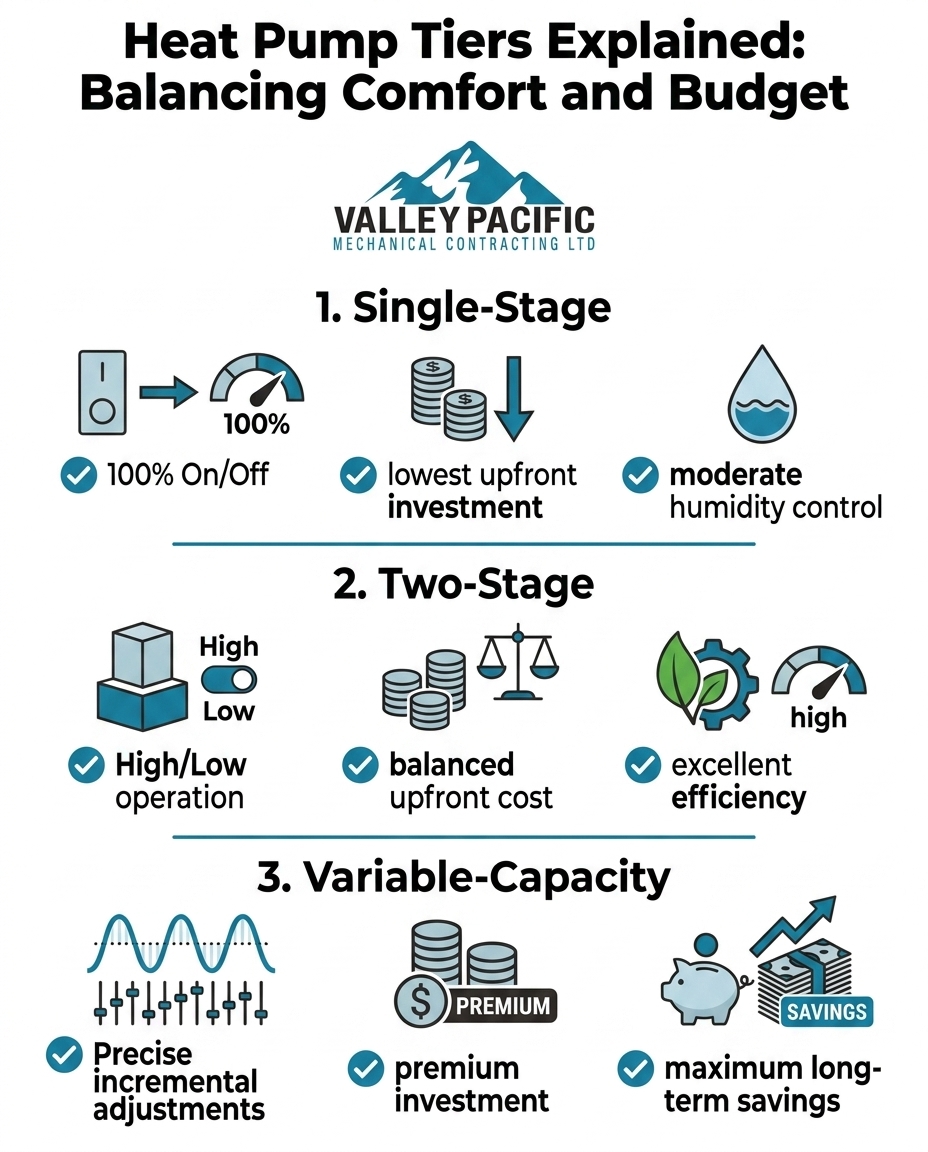
For many homeowners, the entry-level tier provides exactly what they need: a massive leap in efficiency over older heating methods without the premium price tag. Single-stage heat pumps operate on a very simple principle. The compressor has only one speed: 100% capacity. When your thermostat detects that the house has dropped below the set temperature, the unit kicks on at full blast. It runs until the desired temperature is reached, and then it shuts off completely. It is similar to driving a car where the only options are pressing the gas pedal to the floor or turning the engine off entirely.
If you are comparing mini-splits and central AC costs alongside heating options, you will find that single-stage heat pumps offer the most accessible initial investment. This tier is highly popular for budget-conscious homeowners who prioritize an immediate, reliable upgrade over luxury features.
• Lowest Upfront Investment — What It Means for You: Makes upgrading from baseboards or old furnaces highly accessible for most household budgets.
• 100% On/Off Operation — What It Means for You: Provides robust, powerful heating, though it can result in slight temperature swings of a degree or two between cycles.
• Proven Reliability — What It Means for You: Utilizes straightforward, time-tested technology with fewer complex electronic components to maintain over the years.
• Moderate Dehumidification — What It Means for You: Because it runs in shorter, powerful bursts, it removes less moisture from the air than advanced models that run continuously.
While single-stage units handle moderate cold exceptionally well, it is important to note that they may run more frequently and noticeably during a damp, chilly Pacific Northwest winter. Because the air here holds so much moisture, the system has to work steadily to combat the cold. However, for a homeowner looking for a massive upgrade in efficiency over traditional electric heat without breaking the bank, a single-stage system remains a fantastic, budget-friendly choice.
Two-Stage Heat Pumps: The Middle Ground for Coastal Winters
If a single-stage unit is like a car with one speed, a two-stage heat pump introduces a second, lower gear. This mid-tier option represents the optimal balance between upfront affordability and significantly enhanced indoor comfort. Two-stage technology allows the compressor to operate at a lower capacity—typically around 65% to 70%—for milder days, and ramp up to 100% capacity only when the temperature drops drastically.
This tier is often considered the "sweet spot" for many local homes. It offers substantial efficiency gains and better comfort without the premium cost associated with the absolute highest-tier units. Our team frequently recommends this tier to homeowners who want to balance strong performance with reasonable upfront costs.
• More Even Heating: Because the system runs at a lower speed for longer periods, it mixes the air in your home more thoroughly, eliminating hot and cold spots.
• Quieter Operation: Running at 70% capacity generates significantly less noise than a system blasting at full power, making it much less intrusive when you are trying to sleep or watch television.
• Fewer On/Off Cycles: Starting up is the most energy-intensive part of an HVAC system's operation. By running longer at a lower speed, a two-stage unit reduces wear and tear on the compressor.
• Superior Humidity Control: This is a massive benefit for our region. The lower stage is highly effective at quietly maintaining temperatures and removing humidity during the long, damp stretches of a coastal winter. Longer run times mean more air passes over the coils, pulling more moisture out of your indoor environment.
Variable-Capacity Heat Pumps: Maximum Efficiency and Precision
At the top of the equipment hierarchy sits the variable-capacity, or inverter-driven, heat pump. Instead of having just one or two speeds, these advanced compressors can adjust their output in tiny increments—sometimes as small as 1% at a time—to perfectly match the exact heating demand of your home at any given moment. If your home needs 43% capacity to maintain a steady 70 degrees, the variable-capacity unit will run at exactly 43%. It operates much like the cruise control in a modern vehicle, constantly making microscopic adjustments to maintain a perfect, unwavering speed.
This premium tier offers ultra-quiet operation, absolute temperature precision, and the highest long-term energy savings available on the market today. However, we always acknowledge the higher upfront investment required for this technology. While it undeniably offers the absolute best comfort and efficiency, it is not strictly mandatory for winter survival in Maple Ridge BC. We typically recommend this tier for homeowners who are in their "forever homes" and want to maximize their long-term utility savings and indoor air quality over the next fifteen to twenty years.
• Compressor Speeds — Single-Stage: One (100%) — Two-Stage: Two (Typically 70% & 100%) — Variable-Capacity: Infinite (Variable from ~25% to 100%)
• Temperature Precision — Single-Stage: Good (1-2 degree swings) — Two-Stage: Better (Minimal swings) — Variable-Capacity: Best (Exact temperature maintained)
• Upfront Investment — Single-Stage: Lowest — Two-Stage: Moderate — Variable-Capacity: Highest
• Energy Efficiency — Single-Stage: High — Two-Stage: Higher — Variable-Capacity: Maximum
Long-Term Energy Savings vs. Upfront Investment
When evaluating variable-capacity systems, it is essential to look at the maximum efficiency ratings, known as SEER (Seasonal Energy Efficiency Ratio) for cooling and HSPF (Heating Seasonal Performance Factor) for heating. Higher-tier units boast significantly higher HSPF ratings, which translates directly to lower monthly utility bills. When we consult with you, we help calculate the estimated break-even point—the amount of time it will take for the monthly energy savings to offset the higher initial purchase price. If you plan to stay in your home for decades, the premium equipment often pays for itself. If you plan to move in five years, a mid-tier option might make more financial sense.
Factoring in Humidity and Defrost Cycles
One of the most critical factors we consider when recommending a heat pump tier is the specific environmental challenge of our region. A damp, chilly Pacific Northwest winter presents a unique hurdle for HVAC equipment. The coastal cold is heavily moisture-laden. When a heat pump operates in heating mode, the outdoor coil gets very cold as it absorbs ambient heat from the outside air. Because the surrounding air is so humid, condensation forms on the coil and quickly freezes into a layer of frost or ice.
To combat this, all modern heat pumps feature a defrost cycle. When the system detects ice buildup, it temporarily reverses its operation. It briefly switches into cooling mode, sending hot refrigerant out to the outdoor coil to melt the ice, while electric backup heaters ensure cold air isn't blown into your home. This cycle is absolutely critical for maintaining efficiency, as a coil choked with ice cannot absorb heat.
The difference in tiers: Lower-tier, single-stage systems often use a timed defrost cycle, meaning the unit will automatically initiate a defrost sequence every 30, 60, or 90 minutes of run time, regardless of whether there is actual frost on the coil. Higher-tier, variable-capacity systems utilize demand-based defrost. They use advanced sensors to monitor coil temperatures and only initiate a defrost cycle when it is physically necessary. This saves energy and prevents unnecessary interruptions to your heating. However, we always reassure our customers that regardless of which tier fits your budget, every system we install is fully capable of managing these regional conditions safely and effectively.
Navigating Upfront Costs: Generic Rebates and Financing
Finding the right equipment tier is only half the battle; making that tier fit comfortably into your household finances is just as important. In a recent project, our team prepared comprehensive quotes for a homeowner's upgrade, confirmed their existing electrical power panel was sufficient, and successfully installed the system right before a major seasonal weather shift, ensuring they were fully prepared. A key part of that preparation was helping them navigate the financial aspect of the upgrade.
There are several strategies to make any chosen tier more affordable. By layering qualifying utility rebates and available tax incentives, you can significantly offset the initial installation costs. We highly recommend reviewing current HVAC promotions and rebates to see what generic incentives might apply to your project.
• Explore Utility Incentives: Many local utilities offer substantial generic rebates for upgrading from fossil fuels or baseboards to high-efficiency heat pumps.
• Look at Tier Benefits: Higher-tier, high-efficiency models often qualify for more substantial generic incentives, which can actually close the price gap between a mid-tier and a premium system.
• Consider Payment Plans: Breaking the remaining balance into manageable monthly payments makes upgrading highly feasible without depleting your savings. Exploring flexible financing options allows you to enjoy the comfort and efficiency of a new system immediately while paying for it over time.
Maximizing Available Incentives
Our team is committed to helping you find the most cost-effective path to a reliable system. We work closely with you to identify qualifying equipment that meets the generic efficiency standards required for local incentives. We ensure all installations are performed strictly to code and manufacturer specifications, which is often a prerequisite for claiming any available rebates or tax credits. You do not have to navigate the complex world of efficiency ratings and incentive eligibility alone.
Ready to Find the Right Heat Pump for Your Home?
Upgrading your heating system should never mean choosing between staying warm and breaking the bank. Whether a robust single-stage unit fits your immediate needs, or a variable-capacity system aligns with your long-term goals, the most important factor is finding a solution that matches your unique home and financial reality.
Our transparent, professional assessment process is designed to match you with the perfect tier for your budget, providing peace of mind and reliable comfort through the coldest months. If you are ready to explore your options with a team that prioritizes your needs over upselling, request an installation quote today for a personalized, no-pressure evaluation.
Frequently Asked Questions
What is the difference between single-stage and variable-speed heat pumps?
The primary difference lies in how the compressor operates to heat or cool your home. A single-stage heat pump runs at 100% capacity until the desired temperature is reached, then shuts off completely. A variable-speed (or variable-capacity) heat pump continuously adjusts its output in tiny increments to perfectly match the home's heating demand, resulting in quieter operation, exact temperature control, and superior energy efficiency.
How do I choose a heat pump for my budget?
Choosing the right system requires balancing the initial installation cost with projected long-term energy savings. Start by having a professional perform a load calculation to determine the exact size your home needs. From there, compare tiered options—such as entry-level single-stage units versus high-efficiency models—to see which aligns best with your current finances and your long-term plans for the property.
Is a mid-tier heat pump good enough for winter?
Yes, a mid-tier, two-stage heat pump is more than capable of providing reliable winter heating. These systems are highly effective at maintaining steady temperatures and offer excellent dehumidification, making them a fantastic fit for damp, chilly coastal winters. They provide a significant comfort upgrade over single-stage units without the premium price tag of top-tier models.
Do heat pumps save money in winter?
Heat pumps are highly efficient because they transfer existing heat from the outside air rather than generating heat by burning fuel or using electrical resistance. Upgrading from older electric baseboards or an aging fossil fuel furnace to a modern heat pump will generally result in a noticeable reduction in monthly energy consumption, leading to long-term utility savings.
How do generic utility rebates affect the final cost of a heat pump upgrade?
Qualifying utility rebates and tax incentives can significantly reduce the out-of-pocket expense of a new installation. Because higher-efficiency systems often qualify for larger incentive amounts, applying these rebates can sometimes make a mid-tier or premium system nearly as affordable as an entry-level model. Always verify current generic programs with your utility provider or a tax professional.
Will a more affordable heat pump still manage high coastal humidity?
Yes, even entry-level single-stage heat pumps are designed to manage humidity as part of the conditioning process. While higher-tier variable-capacity systems run longer and remove moisture more continuously, a properly sized single-stage unit will still effectively control indoor humidity and keep your home comfortable during damp weather.


