


Navigating the BC Hydro Heat Pump Rebate Requirements for Coquitlam Properties


Overcoming Administrative Hurdles for Heat Pump Upgrades
If your current HVAC setup is failing and you are planning an upgrade, navigating the BC Hydro Heat Pump Rebate Requirements for Coquitlam Properties can quickly feel like an overwhelming administrative puzzle. Many homeowners assume that simply purchasing an energy-efficient unit is enough to secure provincial incentives. However, the reality is that the paperwork process is just as rigorous as the technical installation itself. A single missing document, an out-of-order application step, or a vaguely worded invoice can result in immediate disqualification.
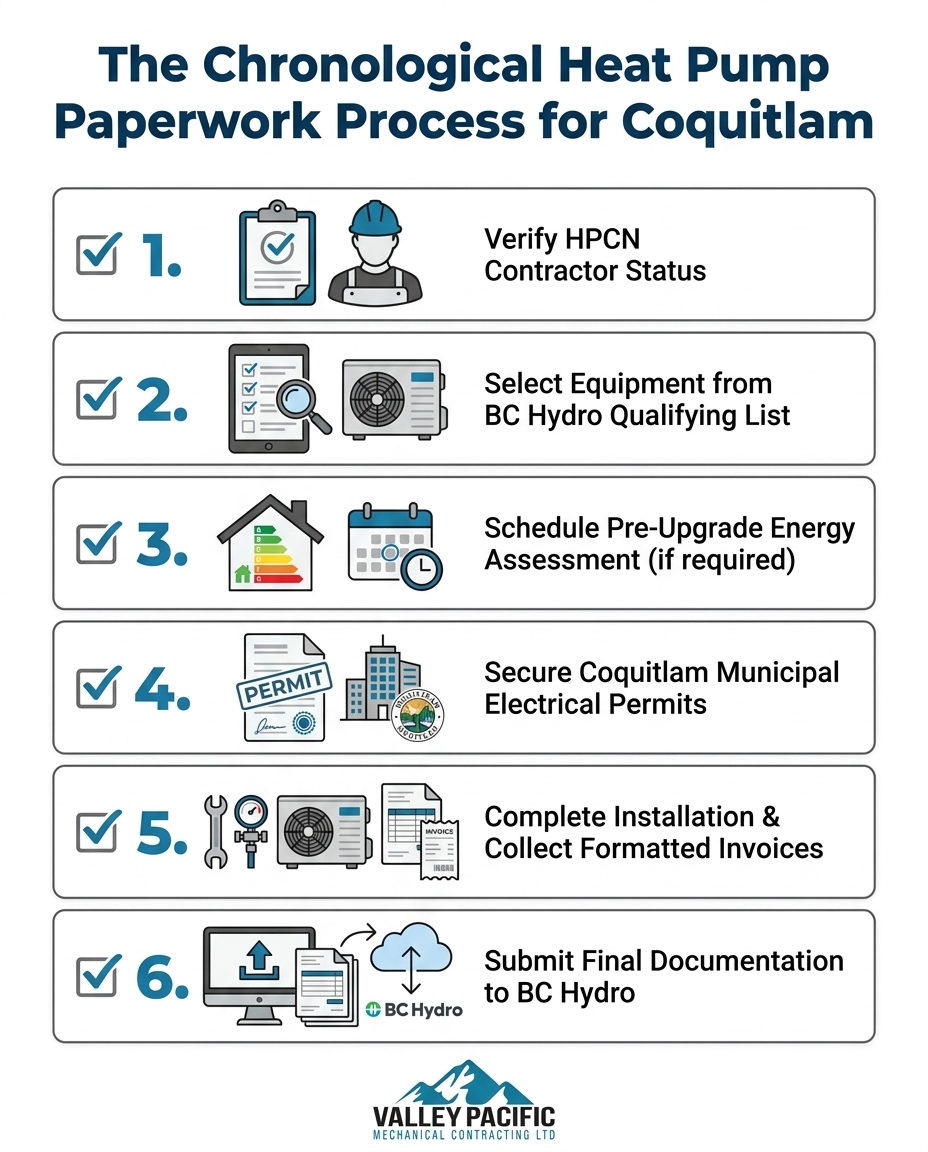
When you start looking into heat pump systems, the first thing you realize is that securing your incentives requires a strict, chronological sequence of approvals. You cannot simply install a system and figure out the paperwork later. The critical decision point for any Coquitlam homeowner is verifying all pre-installation documentation, equipment criteria, and contractor qualifications long before the physical work begins.
The Cost of Administrative Errors:
• Out-of-sequence upgrades: Purchasing equipment before confirming program eligibility often voids your application entirely.
• Incomplete documentation: Missing AHRI (Air-Conditioning, Heating, and Refrigeration Institute) certificates or municipal permit numbers will stall the review process.
• Unverified contractors: Using an installer who lacks the specific provincial registrations mandated by BC Hydro guarantees a rejected claim.
Partnering with knowledgeable professionals is the most effective way to prevent these administrative roadblocks. A licensed HVAC contractor who understands the local landscape will guide you through the mandatory sequence, ensuring that every form, permit, and equipment specification aligns perfectly with current provincial guidelines. By treating the paperwork with the same precision as the installation, you protect your investment and eliminate the stress of navigating utility bureaucracy alone.
Selecting Equipment from the BC Hydro Qualifying List
Not all modern heating and cooling units are eligible for provincial incentives, even if they boast high energy-efficiency ratings on the box. BC Hydro and CleanBC maintain a highly specific, strictly enforced qualifying equipment list. If your chosen model is not explicitly named on this registry, your application will be denied, regardless of how well the system performs in your home.
This requirement is particularly important when selecting a ductless mini-split or central system. The provincial guidelines mandate that both the indoor air handler and the outdoor compressor must be a verified, matching set. You cannot pair a new high-efficiency outdoor unit with an older indoor coil and expect to meet the program's strict energy performance metrics.
Furthermore, the equipment must be properly sized for the specific climate challenges of the Lower Mainland. Coquitlam experiences wet, mild winters and progressively warm summers. The dual-function equipment you select must be explicitly rated to provide efficient heating during damp January nights while possessing the cooling capacity to handle July heat waves. BC Hydro's qualifying list ensures that the approved units have the correct Seasonal Energy Efficiency Ratio (SEER) and Heating Seasonal Performance Factor (HSPF) to operate efficiently year-round in this specific climate zone.
Why Exact Specifications Matter
Even a one-character deviation in a model number on your final invoice can result in a rejected application. Utility reviewers cross-reference your submitted paperwork against their database with absolute precision.
• Model Matching — Compliant Approach: Indoor and outdoor units are an AHRI-certified matched set. — Common Disqualifier: Mixing brands or pairing a new outdoor unit with an old indoor coil.
• System Sizing — Compliant Approach: Contractor performs a formal heat load calculation for the home. — Common Disqualifier: Guessing the size based on the square footage or the old unit's capacity.
• List Verification — Compliant Approach: Confirming the exact model number is currently active on the BC Hydro list. — Common Disqualifier: Assuming all "high-efficiency" or "Energy Star" units automatically qualify.
Proper load calculations performed by a licensed HVAC contractor ensure the system meets both your home's comfort needs and the utility's stringent requirements. Always consult with your installer to verify your chosen model's active eligibility before making any financial commitments.
Verifying Home Performance Contractor Network (HPCN) Status
One of the most rigid requirements of the CleanBC and BC Hydro rebate programs is the mandate regarding who actually performs the work. To remain eligible for primary provincial incentives, your installation must be completed by a registered member of the Home Performance Contractor Network (HPCN). This is a non-negotiable compliance step.
The HPCN is a database of vetted professionals who have completed specific training regarding energy-efficient installations and provincial program standards. Hiring an unverified installer, a general handyman, or attempting a DIY installation instantly disqualifies your property from receiving utility program benefits. The province uses this network to ensure that public funds are only allocated to projects that meet the highest standards of safety, performance, and energy conservation.
Working with an HPCN-registered professional provides significant advantages beyond mere compliance. Consider a typical pattern we see in the Lower Mainland: one local homeowner reached out during the coldest days of winter when their old furnace completely broke down. Because they worked with a registered contractor, they received an immediate consultation and a new system installation within days. More importantly, their heating was restored quickly and all the exact rebate documents were provided by the installer, keeping their application perfectly on track despite the emergency timeline.
An HPCN-registered licensed HVAC contractor handles the complex technical documentation required during the installation phase. They know exactly how to document the decommissioning of your old system, how to record the new system's specifications, and how to structure the paperwork to satisfy utility reviewers. This level of expertise is crucial when coordinating FortisBC and provincial rebates, giving you the peace of mind that comes from working with professionals who understand the administrative landscape just as well as the mechanical one.
Navigating Coquitlam Municipal Permits and Bylaws
A frequent oversight in the upgrade process is neglecting local municipal regulations. Provincial utility programs require proof of local municipal compliance before they will issue final approval for your incentives. If your project violates a city bylaw or fails a local inspection, your BC Hydro application will remain stalled until the municipal issues are resolved.
The City of Coquitlam has specific requirements that must be met whenever new heating and cooling equipment is installed. Because heat pumps require dedicated electrical circuits, a municipal electrical permit is almost always mandatory. The city inspector must verify that your home's electrical panel can safely handle the increased load and that all wiring meets current safety codes.
Beyond electrical safety, Coquitlam enforces strict exterior noise bylaws and property line setbacks. Outdoor compressor units generate operational noise, and the municipality dictates exactly how close these units can be placed to your neighbor's property line. Failing to account for these setbacks during the planning phase can result in failed inspections, costly equipment relocations, and a voided provincial application.
Coordinating Electrical and Building Approvals
Your contractor must navigate these local hurdles seamlessly to protect your eligibility.
• Electrical Documentation: Electrical upgrades often require separate documentation and permits distinct from the mechanical installation.
• Placement Planning: A licensed professional will measure property setbacks and review manufacturer decibel ratings to ensure the outdoor unit's location is fully compliant with Coquitlam bylaws.
• Final Sign-Off: The final municipal inspection sign-off must be included in your final utility submission. BC Hydro will look for this specific document to confirm the installation is legally recognized by the city.
Coordinating Energy Assessments for Program Compliance
Depending on the specific upgrade pathway you choose, CleanBC and BC Hydro programs often mandate formal energy evaluations. These assessments establish a verified baseline for your home's current energy efficiency and measure the exact improvements achieved by your new equipment.
Understanding the sequence of these evaluations is critical to avoiding administrative bottlenecks. Failing to schedule a required pre-upgrade assessment is a common administrative error that can end up delaying your BC heat pump rebate application indefinitely.
The Chronological Assessment Process:
1. Confirming Assessment Requirements: Before making any purchases, confirm whether your specific upgrade path requires an EnerGuide evaluation. Some primary incentives require both pre- and post-upgrade assessments, while others only require post-upgrade verification. Always check current requirements directly with your utility provider.
2. Scheduling the Pre-Upgrade Evaluation: If required, a registered energy advisor must inspect your home before any old equipment is removed. They will evaluate your insulation, air leakage, and current HVAC system to generate a baseline EnerGuide rating.
3. Executing the Upgrades: Once the baseline is established, your licensed HVAC contractor can safely remove the old equipment and install the new, qualifying system according to HPCN standards.
4. Booking the Post-Upgrade Assessment: After the installation is complete and municipal permits are closed, the energy advisor returns to verify the new equipment. They generate an updated EnerGuide rating, which serves as the final proof of energy improvement for your utility application.
Because energy advisors are frequently booked weeks in advance, it is vital to schedule these evaluations early in your project timeline to keep the entire process moving smoothly.
Structuring Invoices and Final Documentation for Approval
The leading cause of application rejection is not a technical failure, but rather generic or vaguely worded invoicing. BC Hydro and CleanBC require highly specific, itemized data on the final contractor invoice. If your invoice simply reads "Installed new heat pump" with a total price at the bottom, it will be immediately flagged and returned.
To avoid application disqualification, your final documentation must be meticulously structured. A proactive contractor understands this and will pre-format their invoices to align perfectly with utility reviewer expectations.
Mandatory Invoice Details for Compliance:
• Contractor Information: The invoice must clearly display the company name, address, contact information, and valid GST number.
• HPCN Verification: The contractor's Home Performance Contractor Network registration details must be visible.
• Exact Equipment Specifications: The make, and the exact model numbers for both the indoor and outdoor units must be listed, matching the AHRI certificate perfectly.
• Installation Dates: The exact date the installation was completed must be documented to prove it falls within the program's active window.
• Itemized Labor and Materials: The costs for equipment, labor, and necessary electrical upgrades must be clearly separated.
Valley Pacific Mechanical takes the guesswork out of compliance by ensuring exact system specifications and proper documentation are seamlessly prepared for Lower Mainland homeowners. Submitting all forms chronologically and keeping copies of every piece of correspondence ensures that if a utility reviewer has a question, the answer is readily available in your file.
Frequently Asked Questions About Coquitlam Heat Pump Rebates
How do I claim my BC Hydro heat pump rebate?
To claim your incentive, you must submit an online application through the provincial utility portal after your installation is fully complete. You will need to upload all chronological documentation, including your properly formatted final invoice and proof of closed municipal permits. It is highly recommended to have your licensed HVAC contractor review these documents before submission to ensure no mandatory fields are left blank. Always verify current submission portals directly with BC Hydro.
What documentation is needed for heat pump rebates in BC?
The required documentation includes a detailed contractor invoice, the AHRI certificate for your matched system, and proof of your contractor's HPCN registration. You will also need to provide your municipal electrical permit number and, if applicable, the reports from your pre- and post-upgrade EnerGuide evaluations. Gathering these documents in a dedicated file throughout the project prevents last-minute scrambles during the application process.
What are the requirements for a heat pump in BC?
A qualifying system must be explicitly listed on the BC Hydro approved equipment list and must serve as the primary heating source for the home. The indoor and outdoor units must be an AHRI-certified matched set that meets specific seasonal performance ratings for the region. Furthermore, the installation must be performed by a registered HPCN contractor to ensure all safety and efficiency standards are met.
Do I need an energy assessment for BC rebates?
Many provincial upgrade pathways do require a formal EnerGuide evaluation, though the exact requirements depend on the specific program you are applying for. Some incentives mandate both a pre-upgrade baseline assessment and a post-upgrade verification, while others only require the latter. You should always confirm the current assessment requirements with CleanBC or BC Hydro before removing your old heating system.
Who qualifies for the BC Hydro rebate?
Eligibility is generally open to residential utility account holders who live in an eligible property type, such as a detached single-family home or a side-by-side duplex. The home must currently be heated by a qualifying primary fuel source, and the upgrades must meet all provincial energy efficiency criteria. Property owners must ensure their utility accounts are in good standing before initiating the application process.
How do Coquitlam municipal permits affect provincial rebate eligibility?
Provincial utility programs require proof that your installation complies with all local laws, meaning a failed or missing municipal permit will stall your rebate application. In Coquitlam, this typically involves securing an electrical permit and adhering to strict exterior noise and property line setback bylaws. If the city inspector does not sign off on the final installation, BC Hydro will not process your incentive claim.
Streamline Your Upgrade with a Qualified Local Expert
Successfully upgrading your home comfort system requires more than just excellent mechanical work; it requires a disciplined, chronological approach to paperwork. From verifying HPCN contractor status to ensuring every model number on your invoice matches the provincial qualifying lists, attention to administrative detail is what ultimately secures your incentives. While the process may seem daunting, navigating these hurdles is straightforward when you are guided by experienced professionals who understand the specific requirements of Coquitlam properties.
You do not have to manage municipal bylaws, energy assessments, and utility portals entirely on your own. A clear explanation of the paperwork hurdles and contractor requirements is the first step toward a successful application. Reach out to a local, licensed HVAC expert to review your specific property requirements, verify current program details, and ensure your next home upgrade is fully compliant from day one.


