


The Hidden Costs of Delaying Your BC Heat Pump Rebate Application Until 2026


Why Waiting for 2026 Heat Pump Incentives Could Cost Maple Ridge Homeowners More
Your heating and cooling system is showing its age, the utility bills are creeping up, and you know a replacement is on the horizon. But if you are holding off on an upgrade, hoping for better provincial incentives down the road, you are not alone. The hidden costs of delaying your BC heat pump rebate application until 2026 are rarely discussed, yet they can completely wipe out any potential financial gains you might be waiting for. At Valley Pacific Mechanical, our team speaks with homeowners across Maple Ridge, BC, every week who find themselves stuck in this exact dilemma, weighing the decision to act now versus waiting for speculative future rebates.
To make the best financial choice for your home, you have to look beyond the sticker price of a future rebate and consider the total lifecycle return on investment. This requires evaluating your residential heating and cooling services as an ongoing operational cost. Every month you run an aging, inefficient system, you are paying a hidden penalty. When you factor in rising equipment prices, month-over-month energy waste, and the unpredictable nature of government funding pools, the math heavily favors taking action today. If you are considering a heat pump installation in Maple Ridge, understanding the concept of opportunity cost is the key to maximizing your savings.
The Opportunity Cost of Hesitation
Opportunity cost is a simple financial principle: it is the benefit you lose by choosing one path over another. In the world of residential HVAC, a pattern we see often is that the true opportunity cost of waiting for 2026 is the immediate energy savings, improved comfort, and warranty protection you sacrifice by keeping your old system running for another one to two years.
Most homeowners assume that if a rebate increases in the future, their out-of-pocket expense will naturally decrease. However, this assumes that all other variables—like the cost of the equipment and the cost of your monthly utilities—remain frozen in time. As we will explore, those variables are constantly shifting, and they rarely shift in favor of the consumer who waits.
The Reality of HVAC Equipment Inflation Versus Future Rebates
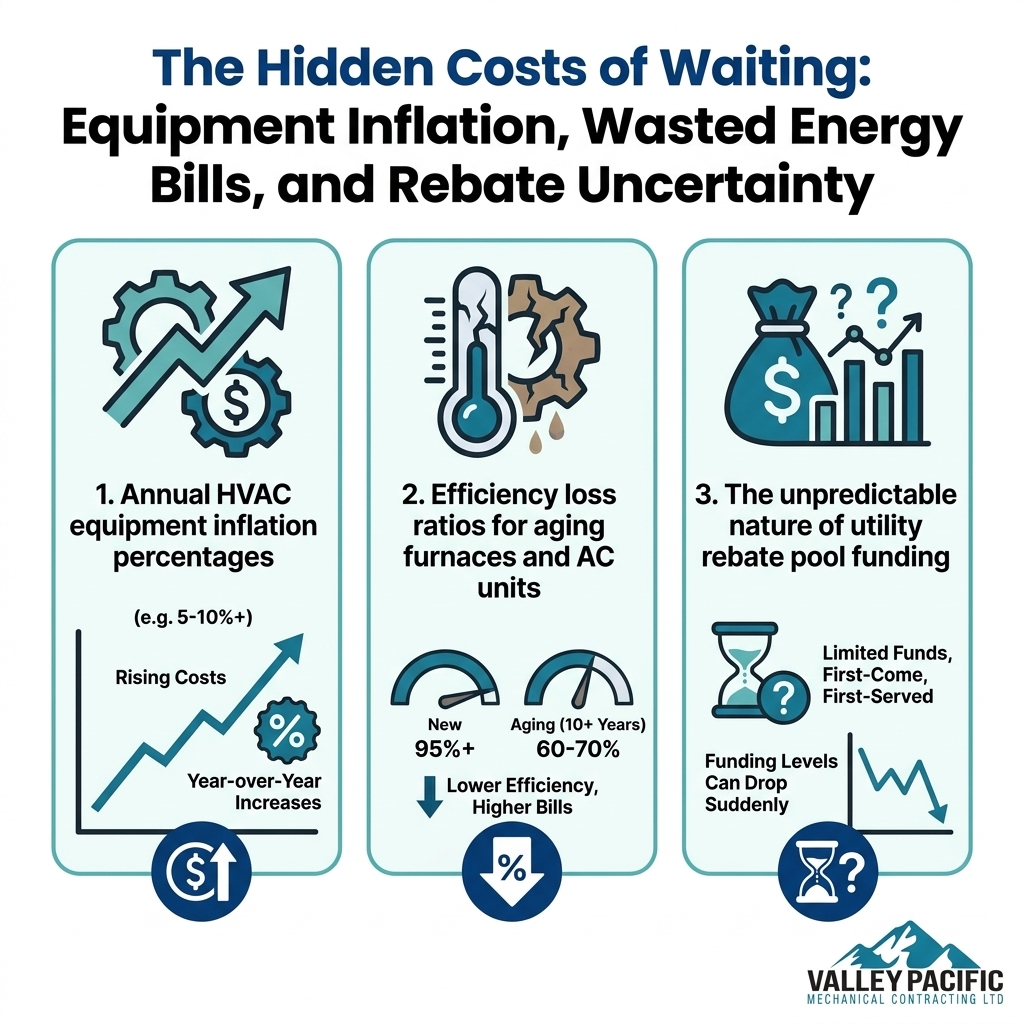
The global manufacturing and supply chain landscape directly impacts the price you pay for home comfort systems. HVAC equipment costs historically rise by a steady percentage annually. Manufacturers adjust their pricing to account for the increased costs of raw materials like copper, steel, and aluminum, as well as rising labor and transportation expenses. This means the baseline price of a new heat pump increases predictably every single year.
When you compare the guaranteed yearly inflation rate of equipment against the speculative hope of increased future rebates, the financial picture becomes much clearer. In our years of providing HVAC solutions throughout the region, we have consistently noticed that if you wait until 2026, the baseline cost of the equipment will almost certainly be higher than it is today. In many cases, paying tomorrow's inflated prices entirely erases the value of a slightly higher future rebate.
Current vs Projected Local Installation Costs
To understand how this impacts your wallet without looking at specific dollar amounts, it helps to look at the historical trends of current vs projected local installation costs. If a provincial rebate increases by a small percentage in 2026, but the manufacturing cost of the heat pump has increased by a larger percentage over that same two-year period, your net out-of-pocket expense is actually higher than if you had purchased the system today.
The key factors driving equipment inflation include:
• Raw material scarcity: The metals and components used in high-efficiency heat pumps are in high demand globally, driving up base manufacturing costs.
• Refrigerant phase-outs: As the industry transitions to newer, more environmentally friendly refrigerants, the technology required to compress and cycle these fluids becomes more advanced, adjusting the baseline cost of new units.
• Labor and logistics: The cost to transport heavy equipment from manufacturing facilities to local distributors continues to rise annually.
Rather than gambling on future pricing, taking advantage of current HVAC promotions allows you to lock in today's equipment rates while still benefiting from currently available provincial and federal grants.
The Daily Penalty of Running an Inefficient System Through Lower Mainland Winters
The financial impact of delaying your upgrade is not limited to future equipment prices. There is a daily penalty incurred by running an aging system, and it shows up on every single utility bill. Aging furnaces and AC units lose efficiency annually, meaning they require more energy to produce the exact same amount of heating or cooling as they did when they were new.
This efficiency loss is particularly punishing given our local climate. As local heating experts, we know firsthand that the Lower Mainland's damp, chilly winters and increasingly hot summers accelerate wear and tear on aging systems, worsening the financial penalty of delaying an upgrade. When a system has to fight against high humidity and near-freezing temperatures, an older compressor or cracked heat exchanger has to run significantly longer cycles just to maintain a baseline level of comfort.
The Risk of Emergency Breakdowns
Beyond the slow drain of energy waste, waiting until 2026 drastically increases the risk of a catastrophic system failure during a peak weather event. When a system fails completely, you lose the luxury of time. You cannot carefully research rebate tiers, schedule multiple assessments, or wait weeks for program approvals when your home is freezing.
Our Valley Pacific Mechanical technicians recently helped a Maple Ridge homeowner who experienced this exact situation when their old furnace broke down during the coldest days of the winter. Instead of carefully planning their upgrade, they needed immediate action. We rerouted a technician, provided a quick consultation and quotation, and completed the installation within days, including handling the rebate documents so heating was restored quickly. While this outcome was successful, relying on emergency replacements often limits your equipment choices and makes navigating complex rebate applications much more stressful.
Calculating the Wasted Utility Expenses
If you delay an upgrade by 12 to 24 months, you are paying for energy you do not actually get to use. Consider these efficiency realities:
• Annual degradation: An older system can lose a notable percentage of its operating efficiency each year if it has not been meticulously maintained.
• SEER and HSPF gaps: Modern heat pumps operate at efficiency ratios that are exponentially higher than systems built ten or fifteen years ago. A new system might use half the electrical input to generate the same heat output.
• The 24-month penalty: If your current system is operating at a heavily reduced efficiency ratio, running it for two more years means you are overpaying your utility provider by a significant margin every single month. That wasted energy expense is money that could have been applied directly to the cost of a new, efficient system.
Understanding BC Hydro Program Changes and Funding Limits
One of the biggest misconceptions about provincial and federal energy incentives is that they are permanent, guaranteed entitlements. In reality, utility programs operate on fixed budgets. BC Hydro periodically updates, adjusts, or phases out rebate tiers based on available funding pools and shifting provincial energy goals.
When a program reaches its funding capacity, the administrators have to make adjustments. This might mean lowering the rebate amounts, changing the eligibility requirements, or pausing the program entirely until new budgets are approved. If you are waiting for 2026, you are assuming that the current highly favorable income-qualified tiers and specific equipment incentives will remain fully funded and available. That is a significant gamble.
The Danger of Timing the Market
Timing the market with government grants is inherently risky compared to acting when funding is confirmed and available right now. Historically, our team has observed that when a new, higher rebate tier is announced, it creates a massive surge in demand. This demand puts strain on local contractors, increases wait times for installation, and rapidly depletes the newly announced funding pool.
Instead of hoping the landscape improves, homeowners who act on confirmed information secure their financial advantage immediately. Navigating the differences between various grants can be complex, but understanding BC and federal energy rebates for HVAC upgrades ensures you are making decisions based on today's guaranteed facts, rather than tomorrow's unpredictable political and budgetary shifts.
Calculating Your True Return on Investment Today
Evaluating a heat pump upgrade requires a math-based framework that looks at the true cost of waiting. When you combine the three hidden costs—annual equipment inflation, month-over-month energy waste, and the risk of program depletion—the argument for delaying action quickly falls apart.
The Problem: You have an aging system that is costing you extra on your utility bills, but you want to maximize your financial return by securing the best possible rebate.
The Cause: Misunderstanding how inflation and energy waste counteract future rebate gains leads to hesitation, keeping you trapped in a cycle of high utility costs and decreasing home comfort.
The Solution: Locking in a high-efficiency system now immediately halts your energy waste and starts your payback period early, utilizing current vs projected local installation costs to your advantage.
Maximizing Your ROI with Expert Guidance
Our installation crews recently worked with another Maple Ridge customer who tackled this proactively in the spring when they needed new heat pumps installed. By acting before the peak summer season and utilizing current incentives, the installation was performed excellently, keeping their overall costs highly affordable while securing top-tier work before the busy season rush.
At Valley Pacific Mechanical, we provide transparent, expert guidance on navigating current BC Hydro rebate programs to help homeowners maximize their ROI today. We do not just look at the installation; we look at the total lifecycle cost of your home comfort. By combining current, confirmed rebates with flexible financing options, you can often achieve a much better long-term financial position than you would by waiting for 2026. Flexible payment structures allow you to start saving on your monthly utility bills immediately, using those energy savings to offset the cost of the upgrade.
Frequently Asked Questions About BC Heat Pump Rebates and Timing
Will BC heat pump rebates increase in 2026?
There is no guarantee that BC heat pump rebates will increase in 2026. Utility and provincial programs operate on strict budgets and adjust their tiers based on current adoption rates and available funding. While new programs are occasionally introduced, banking on an increase is speculative and risks missing out on currently available, well-funded incentives.
Are there still heat pump rebates in BC?
Yes, there are robust heat pump rebates currently available in BC through programs like the CleanBC Better Homes and BC Hydro initiatives. These programs offer substantial incentives for upgrading from fossil fuel heating or inefficient electric systems to high-efficiency heat pumps. Eligibility depends on your current heating system, your municipality, and the specific equipment you choose to install.
Is it worth waiting to buy a heat pump in BC?
Waiting to buy a heat pump in BC is generally not recommended if your current system is aging or inefficient. The monthly energy waste of running an old system, combined with the steady annual inflation of HVAC equipment prices, typically outpaces any speculative gains from future rebate adjustments. Acting now locks in your equipment price and starts your energy savings immediately.
How long does it take to get a BC Hydro rebate?
The processing time for a BC Hydro rebate can vary, but it generally takes several weeks to a few months from the time your application is submitted and approved. Working with an experienced local contractor like Valley Pacific Mechanical ensures that your documentation is filed correctly the first time, which helps prevent administrative delays and keeps the process moving as quickly as possible.
How does equipment inflation impact my overall rebate savings?
Equipment inflation directly reduces the net value of your rebate savings over time. If a heat pump's manufacturing and installation costs rise by a certain percentage each year, those increases eat into the financial benefit of the rebate. Paying tomorrow's inflated prices often completely cancels out the advantage of waiting for a potentially higher rebate tier.
Stop Guessing on Future Incentives—Maximize Your Home's Efficiency Now
A clear, math-based evaluation shows that acting on current incentives is generally much safer than waiting for 2026. The combined forces of equipment inflation, compounding energy waste, and unpredictable utility budgets mean that delaying your upgrade often results in a net financial loss. By addressing the situation today, you halt the daily penalty of an inefficient system and lock in pricing before the next round of manufacturing increases hits the market.
You do not have to navigate this complex landscape alone. Get an accurate, localized assessment of your home's needs and discover exactly what current rebate programs you qualify for right now. If you are a homeowner in Maple Ridge, BC, looking to stop guessing and start saving, reach out to our team of local experts at Valley Pacific Mechanical for a clear, transparent breakdown of your options today.


