


Fixing a Bathroom Exhaust Fan That Vents Warm Air Into Your Attic


Is Your Bathroom Fan Hiding a Moisture Problem Above Your Ceiling?
Are you looking into fixing a bathroom exhaust fan that vents warm air into your attic? If you recently popped your head through the attic hatch and noticed damp insulation, a musty smell, or a duct pipe that simply ends in the open space, you have uncovered a serious issue. Many homeowners assume that as long as the fan pulls steam out of the bathroom, it is doing its job. However, simply relocating that moisture to an unconditioned space above your ceiling creates a dangerous environment for your home's structural integrity.
An average family generates a massive amount of water vapor every single day just from taking showers. When that thick, humid air is dumped directly into your attic, it has nowhere to go. It settles into your insulation, clings to the wooden rafters, and creates the perfect breeding ground for severe secondary damage. Addressing this issue promptly is the only way to protect your home from hidden rot. If you are dealing with this common but risky building flaw across Maple Ridge and the Lower Mainland, you need professional mechanical services to evaluate the space and correctly route the exhaust to the exterior.
The Science of Attic Condensation: What Happens When Warm Air Meets Cold Space
To understand why this venting setup is so destructive, we have to look at the building science behind temperature differentials. When you take a hot shower, the air pulled into your exhaust fan is incredibly warm and heavily saturated with moisture. Your attic, on the other hand, is an unconditioned space. This means its temperature closely mirrors the weather outside. When that humid exhaust air collides with the freezing environment of your attic, the moisture cannot remain in a vapor state.
Rapid condensation occurs instantly. The water vapor hits the cold underside of your roof decking and immediately turns into liquid droplets. This is a severe threat to your building envelope because water is the natural enemy of wood framing and fiberglass insulation. When your attic insulation becomes saturated with this condensation, it completely loses its R-value. Wet insulation cannot trap heat, which means your home's energy efficiency plummets, causing your heating system to work much harder to keep your living spaces comfortable.
The Frost and Thaw Cycle
During the wet, cool BC winters, this condensation problem escalates from dampness to active freezing. The cycle creates a compounding structural threat:
• Rapid freezing: Moisture from your bathroom fan freezes directly onto the exposed nails and the underside of the roof decking during cold snaps, creating a thick layer of frost.
• The false roof leak: When the weather warms up or the sun hits the roof, that accumulated frost thaws rapidly. The resulting dripping water mimics a major roof leak, staining your ceilings below.
• Accelerated wood rot: Consistent exposure to this wet-to-dry cycle breaks down the structural integrity of your roof trusses and decking, eventually requiring a complete roof replacement.
• Microbial growth: The dark, damp environment created by the thawing frost promotes rapid mold and mildew spread throughout the attic space.
Because the damp Pacific Northwest climate significantly accelerates this condensation and rot cycle during the winter months, getting professional HVAC repair in Maple Ridge is critical before the damage spreads beyond the immediate venting area.
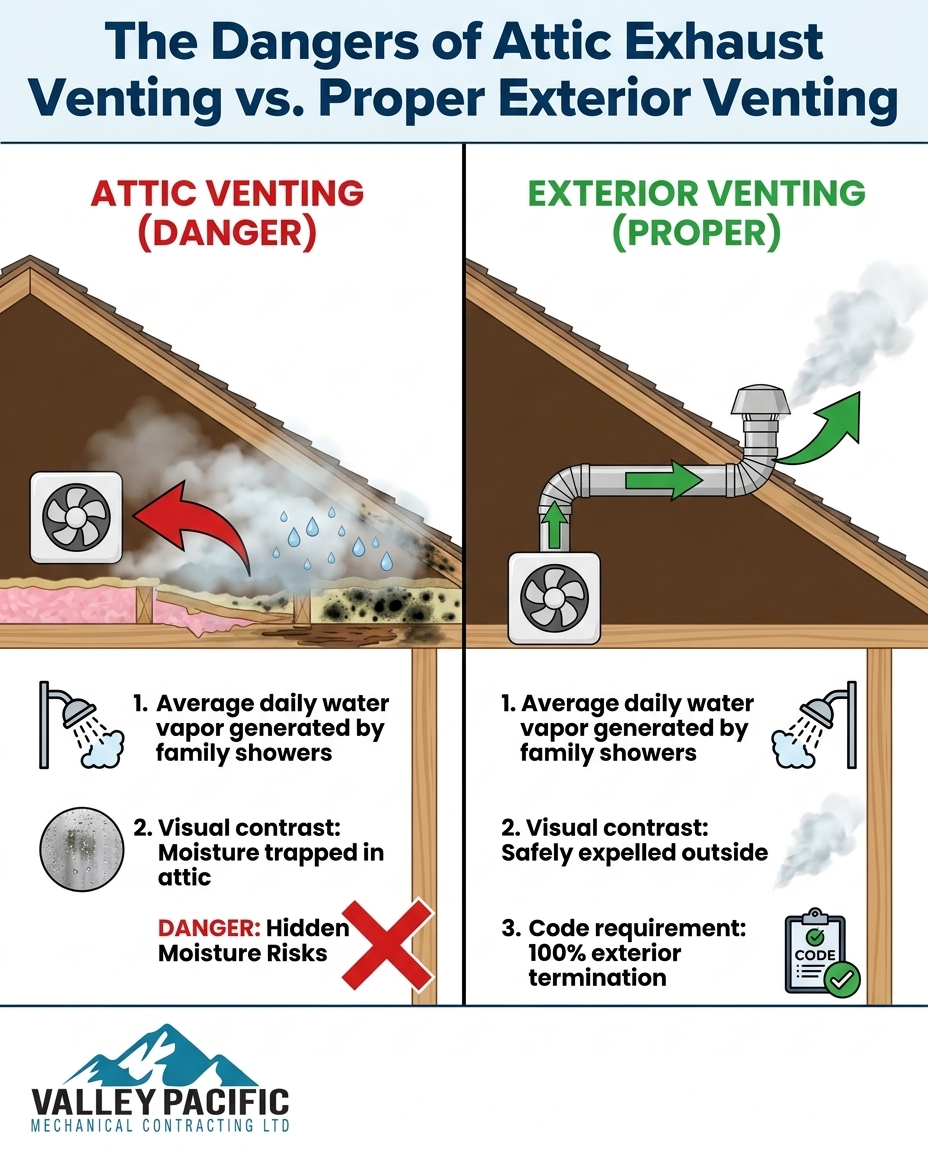
• Moisture is trapped inside the building envelope. — Proper Exterior Venting (The Solution): Moisture is completely expelled to the outdoors.
• Insulation becomes saturated and loses its thermal resistance. — Proper Exterior Venting (The Solution): Insulation remains dry, maintaining optimal home energy efficiency.
• High risk of mold, mildew, and structural wood rot. — Proper Exterior Venting (The Solution): Attic remains a dry, unconditioned space as designed.
• Frost accumulates on roof decking during freezing weather. — Proper Exterior Venting (The Solution): Roof decking stays protected from internal humidity changes.
Why Builder Shortcuts Fail Spectacularly in Damp Climates
If venting into an attic is so dangerous, why do so many homes have this problem? The short answer is that it was once a common builder shortcut. Decades ago, contractors would frequently point a fan duct toward a soffit vent, or simply leave the pipe open in the attic space, assuming the home's passive ventilation would carry the moisture away. Today, building codes consistently require all exhaust fans to terminate completely at the exterior of the building, but many older homes still harbor these outdated shortcuts.
One of the most frequent shortcuts is running the exhaust hose down into the eaves, aiming it at a soffit vent. This fails spectacularly in our region. When you push warm, moist air down toward the soffits, the natural airflow of the attic combined with exterior wind often blows that exhausted moisture right back into the attic space through the adjacent intake vents. The air simply loops back inside, creating a concentrated zone of moisture damage right at the edge of your roofline. If you have ever wondered why your bathroom exhaust fan sounds like an airplane engine, it is often because it is struggling to push air through a poorly routed, kinked, or blocked duct line left behind by one of these shortcuts.
In the past, homes were draftier, which sometimes allowed this excess moisture to escape before causing catastrophic damage. However, modern homes in Maple Ridge and the Lower Mainland are sealed tightly for energy efficiency. This tight envelope, combined with our high regional humidity, leaves absolutely no margin for error. A shortcut that might have survived in a dry, arid climate will quickly rot the roof framing in a damp coastal environment.
The Severe Risks of DIY Roof Penetrations and Duct Rerouting
When homeowners discover their bathroom fan is venting into the attic, the first instinct is often to head to the hardware store for a length of flexible ducting and a vent cap. However, correcting this issue is not a weekend DIY project. Rerouting an exhaust fan properly requires specialized mechanical knowledge, and penetrating a roof requires absolute precision.
Attempting to fix this yourself carries severe risks that can cost thousands of dollars in secondary damage. Here is why this work must be left to licensed professionals:
• Improper roof penetrations: Cutting a hole in your roof to install a termination cap requires knowing exactly how to layer shingles, underlayment, and flashing. A single mistake here creates an active roof leak that will dump rainwater directly into your home during the wet, cool BC winters.
• Voided warranties: Unauthorized or improper modifications to your roof will instantly void most existing manufacturer warranties on your shingles, leaving you financially responsible for any future failures.
• Incorrect duct sizing and materials: Using the wrong type of ducting, or failing to secure the joints properly, allows moisture to leak out along the route before it ever reaches the exterior vent.
• Backdrafting risks: A professional understands how to install and calibrate the dampers on a wall or roof cap. If these are installed incorrectly by a DIYer, freezing outside air will blow backward through the duct and straight into your bathroom.
Professional exhaust fan repair guarantees that the building envelope remains completely watertight. Technicians understand the precise mechanical requirements for moving air efficiently, ensuring the moisture actually leaves the house without compromising your roof.
How Professional Mechanical Duct Routing Protects Your Home
Fixing an improperly vented bathroom fan requires a systematic, professional approach. When you hire qualified technicians to resolve this issue, they are not just connecting a hose; they are engineering a safe pathway for moisture to exit your home. Valley Pacific Mechanical Contracting Ltd.'s expertise in proper mechanical duct routing ensures that your home receives professional venting solutions that secure the structural integrity without risking leaks.
The professional process involves several critical steps to ensure long-term reliability:
1. Assessing the shortest path: The technician will evaluate your attic space to determine the shortest, straightest path to the exterior. Minimizing bends and keeping the duct run as short as possible reduces air resistance, ensuring the fan motor can easily push the heavy, humid air all the way outside.
2. Installing the exterior termination point: Depending on your home's architecture, the technician will install a weatherproof cap on either the roof or a vertical gable wall. This cap includes a built-in damper that opens when the fan runs and seals shut when it turns off, preventing pests and cold drafts from entering.
3. Securing the connections: Every joint in the ductwork is mechanically fastened and sealed with specialized foil tape or mastic to ensure zero moisture escapes into the attic along the journey.
4. Testing the airflow: Finally, the system is tested to ensure the fan is drawing sufficient air and that the damper opens fully at the termination point.
The Importance of Insulated Ductwork
One of the most critical components of professional mechanical installations in unconditioned spaces is the use of insulated ducting. If you run a plain, thin metal or plastic pipe through a freezing attic, the warm exhaust air will cool down too rapidly while it is still inside the pipe.
When this happens, condensation forms on the inner walls of the duct. Gravity then pulls that liquid water back down the pipe, where it drips out of the fan grille and onto your bathroom floor. Insulated ductwork prevents this rapid cooling, keeping the air warm enough to carry the moisture vapor all the way outside. For homes in Maple Ridge and the Lower Mainland, this step is non-negotiable for a successful installation.
Frequently Asked Questions About Bathroom Exhaust Fan Venting
Is it OK to vent bathroom exhaust into the attic?
No, it is never acceptable to vent bathroom exhaust into the attic. Doing so violates modern building codes and introduces massive amounts of moisture into a space that needs to remain bone dry. Over time, this trapped humidity leads directly to mold growth, mildew, and severe wood rot that compromises the structural integrity of your roof.
What happens when warm air vents into a cold attic?
When warm, moist air from your bathroom hits the freezing environment of an unconditioned attic, rapid condensation occurs. The water vapor instantly turns into liquid droplets or freezes into frost on the underside of your roof decking. During the wet, cool BC winters, this frost eventually thaws, dripping down to ruin your insulation and mimicking a severe roof leak.
Where should a bathroom exhaust fan be vented?
A bathroom exhaust fan must be vented directly to the exterior of your home. This is typically achieved by routing an insulated duct through the attic and out through a dedicated roof vent cap or a specialized vent on an exterior gable wall. The duct should never be pointed at soffits, ridge vents, or left open in the attic space.
How do professionals route bathroom exhaust fans through the roof?
Professionals route exhaust fans by finding the shortest, straightest path from the bathroom ceiling to the roof deck to minimize air resistance. They carefully cut a precise hole in the roof, install a weatherproof termination cap with a built-in damper, and integrate it flawlessly with the existing shingles and flashing. They then connect the fan to the cap using heavily insulated ducting to prevent internal condensation.
Why does my bathroom exhaust fan drip water during the winter?
If your bathroom fan drips water, it usually means the ductwork running through your cold attic is uninsulated or improperly routed. The warm shower steam cools down and condenses into liquid water while still inside the pipe, and gravity pulls that water back down through the fan grille. Upgrading to insulated ducting and ensuring a straight path to the exterior resolves this issue.
What are the early signs of attic moisture damage from an improperly vented fan?
Early signs of moisture damage include damp or matted fiberglass insulation immediately surrounding the fan housing. You may also notice dark water stains on the wooden rafters, a strong musty odor when you open the attic hatch, or visible frost accumulation on the roofing nails protruding through the deck during cold weather.
Protect Your Roof and Attic from Unseen Moisture Damage
Fixing a bathroom exhaust fan that vents warm air into your attic is not just a minor home improvement task; it is a critical structural necessity. Allowing gallons of humid air to dump into your unconditioned space creates a ticking time bomb of mold, ruined insulation, and wood rot. Fortunately, resolving this issue is a straightforward process when handled by qualified technicians who understand the precise mechanics of air movement and roof penetration.
You do not have to wait until water stains appear on your ceiling to take action. By scheduling a professional inspection and having your ductwork properly rerouted to the exterior, you can secure your building envelope. Protect your home in Maple Ridge and the Lower Mainland before the wet season compounds the damage, and enjoy the peace of mind that comes with a safe, dry, and efficient attic space.


