


Why Your Bathroom Exhaust Fan Sounds Like an Airplane Engine


When Your Bathroom Fan Roars to Life: Diagnosing the Noise
You flip the switch for your morning shower, and instead of a quiet hum, a violent vibration shakes the ceiling. Your exhaust fan is rattling so heavily it feels like it might tear itself right out of the drywall. If you are wondering why your bathroom exhaust fan sounds like an airplane engine, you are dealing with a severe mechanical stress issue. That deafening noise is typically a combination of heavy structural vibration and failing motor bearings inside the unit.
For comprehensive solutions to home ventilation, airflow, and complex system setups, learn more about our mechanical installations.
Right now, you face a critical decision point: determining if a deep clean will resolve the issue or if the motor is completely beyond saving. A bathroom fan that suddenly roars to life is experiencing physical resistance that forces the motor to work far harder than its design allows. Understanding the physical causes of the noise is the first step toward restoring proper ventilation to your home.
A standard exhaust fan consists of three main parts: the metal or plastic housing secured to your ceiling joists, the electric motor, and the blower wheel (or fan blade). Under normal conditions, the motor spins the wheel smoothly, pulling damp air up through the grille and pushing it out through your ductwork. However, when the delicate balance of that blower wheel is disrupted, the entire assembly begins to shake. This shaking transfers directly into the housing, amplifying the sound through your ceiling cavity until it echoes loudly throughout the house.
The Physics of the Noise: How Moisture and Dust Create Mechanical Imbalance
Bathroom exhaust fans operate in one of the harshest environments inside your home. They are constantly exposed to high levels of airborne moisture, heat, and particulate matter like lint from towels and dust from toilet paper. In areas like Maple Ridge BC, where high ambient humidity and damp winters are the norm, this combination creates a unique mechanical problem.
If your system is beyond a simple cleaning, professional HVAC repair in Maple Ridge ensures safe, effective ventilation.
At Valley Pacific Mechanical, a pattern we see often during our service calls is that damp dust settles on the fan blades and does not just blow away. The excess moisture turns that airborne dust into a heavy, sticky sludge. This sludge clings to the edges of the blower wheel, rapidly accelerating mechanical imbalance. This forces the motor to work harder, placing immense strain on the internal bearings.
The Sticky Sludge Effect on Fan Blades
Dry dust alone is easily cleared. A quick pass with a vacuum attachment usually removes it from a dry surface. However, when our technicians inspect these roaring units, we frequently find that the steam from your shower acts as a binding agent. It forces the dust to stick tightly to the plastic or metal fan blades. Because this resulting sludge is heavy and adhesive, it cannot be spun off by the centrifugal force of the spinning fan. Instead, it bakes onto the blades, growing thicker with every shower you take.
Uneven Load Distribution
The accumulation of sludge rarely happens perfectly evenly across every blade. Even a few grams of uneven weight can cause a high-RPM (revolutions per minute) fan to wobble violently. Think of a washing machine during a spin cycle with all the heavy wet towels piled on one side; the entire machine shakes. The same physics apply to your exhaust fan. This wobbling is the primary catalyst for premature mechanical wear. It forces the motor to fight against its own momentum, placing immense, uneven strain on the internal bearings until they begin to grind and roar.
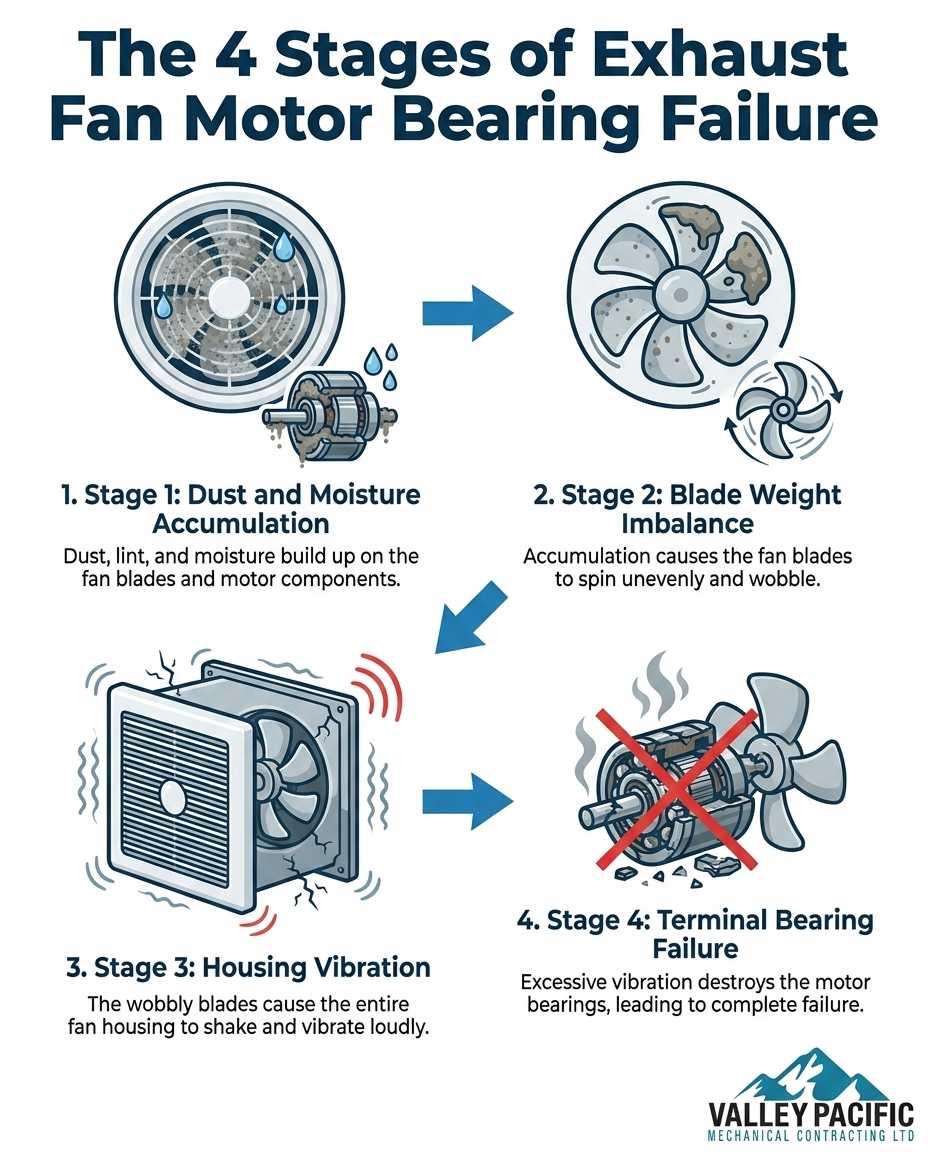
The Four Stages of Exhaust Fan Motor Bearing Failure
In our experience servicing residential ventilation systems, motor bearing failure does not happen overnight. Understanding the progression of mechanical wear helps explain why your bathroom exhaust fan sounds like an airplane engine today, even if it was only humming slightly a few months ago. It follows a predictable, four-stage physical breakdown.
1. Stage 1: Dust and moisture accumulation on the fan assembly. Long before you hear any noise, steam and airborne lint begin coating the blower wheel and the internal motor housing. The fan still operates quietly, but the added weight is slowly building up on the blades.
2. Stage 2: Blade weight imbalance causing a slight wobble. As the sludge thickens unevenly, the fan loses its perfect center of gravity. You might notice a very faint ticking sound or a slight hum that is slightly louder than usual. The motor bearings are now taking uneven pressure with every rotation.
3. Stage 3: Housing vibration resulting in a noticeable rattling sound. The wobble becomes severe enough that the metal motor bracket begins shaking against the outer housing. The plastic ceiling grille may start to rattle audibly. At this stage, the fan is actively struggling to spin, and the bearings are losing their factory lubrication due to excess friction and heat.
4. Stage 4: Motor bearing failure characterized by a loud grinding or airplane-like roar. The internal bearings have physically worn down or seized entirely. Metal is grinding directly against metal. The fan is now drawing excessive electrical current just to turn the blades, and the deafening roar indicates terminal mechanical failure.
By the time you reach the fourth stage, the physical damage to the motor components is usually irreversible. The metal tracks that hold the bearings are scarred, and the motor will never spin smoothly again.
Diagnostic Criteria: Separating a Fixable Rattle from a Doomed Motor
Not every loud fan requires a full replacement. Sometimes, the issue is entirely external to the motor. Before our team arrives for a service call, homeowners in Maple Ridge BC can perform a few basic, safe diagnostic checks to separate a cleanable housing rattle from terminal bearing failure.
Just like diagnosing strange noises coming from your AC, identifying the exact sound your exhaust fan makes determines the correct next step. A simple rattle might just be loose mounting screws or a vibrating plastic grille. However, a high-pitched squeal or a deep, grinding roar indicates the motor bearings have physically worn down.
• Light buzzing or rattling noise — Likely Cause: Loose plastic grille or mounting screws — Diagnostic Action: Press firmly against the plastic cover — Potential Resolution: Tighten screws or secure the grille cover
• Heavy vibration and shaking — Likely Cause: Dust sludge causing blade imbalance — Diagnostic Action: Inspect blades for thick dust buildup — Potential Resolution: Thoroughly clean blades with a damp cloth
• High-pitched squealing — Likely Cause: Bearings losing factory lubrication — Diagnostic Action: Listen for metallic friction sounds — Potential Resolution: Motor replacement is usually required soon
• Deep grinding or airplane roar — Likely Cause: Terminal motor bearing failure — Diagnostic Action: Spin blade manually (power off) to check for stiffness — Potential Resolution: Full motor or unit replacement required
Signs of a Loose Housing
If the noise stops completely when you press a hand firmly against the plastic ceiling grille, the motor itself might still be healthy. This indicates that the vibration is transferring to a loose component. A visual inspection often reveals a heavy buildup of dry dust around the grille edges that is easily vacuumed away. Tightening the mounting screws that hold the fan assembly to the ceiling joists can often resolve this surface-level rattling.
Identifying Grinding Bearings
If the noise sounds metallic and grinding, regardless of whether you apply pressure to the grille, the issue is internal. Another clear sign of bearing failure is a stiff blower wheel. If you safely turn off the power at the breaker panel and attempt to spin the fan blade manually, it should rotate freely and smoothly. If the blade is stiff, resistant, or grinds when spun by hand, the bearings are destroyed. Once bearings are compromised, spraying them with lubrication is only a temporary band-aid, not a permanent fix.
The Cascading Risks of Ignoring a Roaring Exhaust Fan
Ignoring a fan that sounds like a jet engine is not just an annoyance; it is a structural and safety risk. A failing motor draws significantly more electrical current as it struggles to turn the seized bearings. This excess electrical draw generates excess heat. While most modern fans have thermal overload protectors that shut the motor off before it catches fire, relying on this fail-safe is a serious safety concern.
Furthermore, an imbalanced, failing fan operates highly inefficiently. It fails to move the required volume of air out of the room. The American Society of Heating, Refrigerating and Air-Conditioning Engineers (ASHRAE) Standard 62.2 requires a minimum of 50 CFM (Cubic Feet per Minute) to effectively remove moisture from a standard bathroom. A fan struggling against destroyed bearings moves only a fraction of that air, leaving your home vulnerable.
In regions like Maple Ridge BC, functional mechanical ventilation is absolutely critical. Damp winters mean that any moisture trapped inside your home stays inside your home. Prolonged runtime on a failing motor not only accelerates the mechanical wear on the fan itself, but it leaves the entire bathroom vulnerable. Without proper airflow pulling steam out through the roof cap, condensation settles on the drywall, peeling paint, warping doors, and eventually leading to structural rot and indoor mold growth.
Why Exhaust Fan Repair Often Means Professional Replacement
While homeowners can safely clean plastic grilles, vacuum dry dust, and tighten visible mounting screws, dealing with a seized motor is a different reality. Replacing a dead motor involves handling electrical wiring, ensuring proper venting alignment, and verifying that the entire system meets local building codes.
Installing a new motor or a complete replacement unit requires verifying that the housing, ductwork, and roof cap are all properly sized and entirely unobstructed. A common mistake our technicians see is a homeowner installing a powerful new motor into an old housing connected to a clogged or undersized duct. The new fan will immediately experience intense static pressure, causing it to burn out just as quickly as the old one.
This is where professional expertise matters. Over our years of serving Maple Ridge BC, we've seen countless homeowners attempt complex fixes only to end up right back where they started. They trust the team at Valley Pacific Mechanical because our deep expertise in complex mechanical systems ensures accurate diagnosis of bearing issues and safe, code-compliant installations. We do not just swap a part; we verify the entire airflow path.
Our team provides complete residential mechanical services to keep your home safe and compliant. Expert diagnosis prevents the frustrating cycle of repeatedly replacing cheap fans that fail prematurely due to underlying duct restrictions or improper roof venting.
Frequently Asked Questions About Loud Bathroom Exhaust Fans
Why is my bathroom fan suddenly so loud?
Sudden noise usually indicates a rapid shift in blade balance or a bearing that has finally given out after months of silent wear. If you are wondering why your bathroom exhaust fan sounds like an airplane engine out of nowhere, it is often because a large clump of damp dust suddenly dislodged, throwing the high-speed blades entirely out of balance. This immediate wobble causes the motor to vibrate violently against its metal housing.
Can a loud bathroom fan cause a fire?
While rare, a seized motor that continues to receive power can overheat significantly. Most modern fans are equipped with built-in thermal overload protection designed to cut power if the temperature rises too high. However, extreme overheating is a valid safety concern, especially in older homes where thermal protectors may be degraded or entirely absent, meaning a grinding fan should always be turned off until repaired.
How do you fix a noisy exhaust fan?
Start by safely turning off the power at the breaker panel and cleaning the grille and blades with a vacuum and a damp cloth. Check for and tighten any loose mounting screws that might be causing the housing to rattle. If the noise persists after a thorough cleaning, the internal motor bearings are likely worn out, and the motor or the entire unit will need professional replacement.
Is it normal for a bathroom fan to be loud?
No, a properly functioning exhaust fan should never roar or rattle. Older fans may have a gentle, consistent hum as the motor operates, but roaring, rattling, or deep grinding noises are clear, undeniable signs of mechanical failure. Modern exhaust fans are actually rated by "sones" (a measurement of sound) and are designed to operate almost silently.
Can I just lubricate the exhaust fan motor?
Lubrication may temporarily quiet a squeaking bearing, but it cannot reverse the physical wear that causes heavy vibration. Once the metal tracks inside the bearing assembly are scarred or warped from running off-balance, adding oil is only a temporary band-aid. The heavy vibration will quickly return as the compromised bearings continue to degrade under the stress of the spinning fan.
Restoring Quiet and Efficient Ventilation to Your Bathroom
Understanding the mechanical realities of blade imbalance and bearing failure empowers you to make smart maintenance decisions for your home. You now know that a quiet exhaust fan is not just a luxury; it is absolutely essential for comfortable and effective moisture control.
If cleaning the housing and wiping down the blades does not stop the airplane engine roar, it is time to consult a professional. Worn bearings will not heal themselves, and ignoring the noise only leads to poor indoor air quality and potential moisture damage to your ceiling.
For homeowners in Maple Ridge BC, resolving ventilation issues quickly protects your property from the damp climate. Explore your options with the experts at Valley Pacific Mechanical to ensure your home's mechanical ventilation is safe, reliable, and up to code. Understanding exactly why the noise is happening mechanically allows you to confidently choose a full replacement when necessary, restoring peace, quiet, and proper airflow to your daily routine.


