


Navigating FortisBC Rebates for Commercial Tankless Water Heating Retrofits


Are You Risking Your Rebate Before Installation Even Begins?
Are you assuming that upgrading your facility's water heating system automatically guarantees a utility incentive? At Valley Pacific, we routinely see facility managers make a critical mistake long before a wrench is ever turned. When it comes to navigating FortisBC rebates for commercial tankless water heating retrofits, commercial facilities often face immediate rebate denial when replacing old tank heaters because they select non-compliant equipment or fail to gather the necessary documentation upfront. Securing these incentives requires critical pre-installation planning to ensure your chosen commercial high-efficiency tankless water heaters align perfectly with rigorous utility efficiency standards. Proactive strategy and careful compliance prevent costly administrative failures and keep your operational upgrades on track.
To ensure your facility's upgrade strategy aligns with current funding requirements, explore how FortisBC rebate programs can support your next major retrofit.
The reality of commercial utility incentives is that they are designed to reward verified, high-level energy performance, not just the act of purchasing new equipment. Many business owners approach a commercial retrofit with a residential mindset, assuming they can simply install a new unit and file the paperwork later. In the commercial sector, this approach almost guarantees that you will miss out on available funding. Utility programs have strictly defined tiers of eligibility, and your pre-installation planning phase is where the success or failure of your application is determined.
The critical decision point: You must evaluate your facility's specific hot water demands, cross-reference those demands with eligible equipment lists, and structure your project around compliance from day one. Failing to establish this alignment means you are risking your rebate before the installation even begins.
Why Equipment Matching Must Happen Before Purchase
Commercial rebate pathways differ drastically from residential programs. Through our Valley Pacific Community Energy Retrofit Program (VCERP), our team has seen firsthand how purchasing equipment before verifying its eligibility with the utility provider is a trap that leads to immediate disqualification. While a homeowner might select a unit off the shelf and apply for a standard incentive post-installation, commercial facilities operate under far stricter guidelines. Utility programs require exact equipment matching, meaning the specific make and model you install must be actively listed on their approved registry at the time of purchase.
When you rush into procurement without a compliant strategy, you risk stalling your facility's operations. If the newly purchased system fails to meet the required efficiency tier, you are left with two bad options: absorb the full capital cost of the non-compliant equipment, or delay the project to source an approved alternative. This is why partnering with a mechanical expert who has deep expertise in FortisBC funding pathways prevents compliance failures and operational downtime.
To protect your capital investment and ensure flawless execution from procurement to commissioning, you need professional commercial mechanical and HVAC services that prioritize upfront strategy.
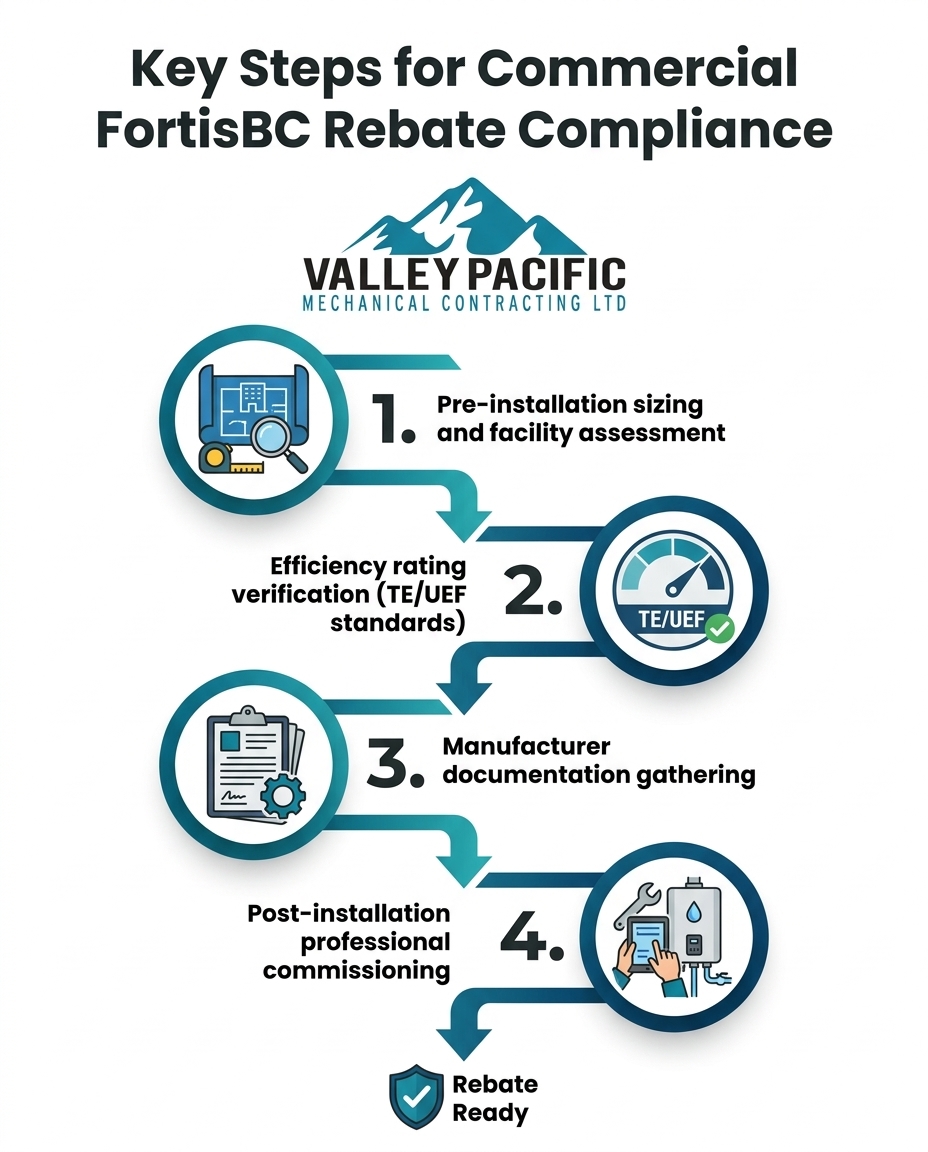
The phases of a compliant commercial retrofit strategy:
• Phase 1: Facility Load Assessment. Accurately measuring the peak hot water demand of your specific operation, whether it is a multi-family building, a restaurant, or an industrial processing facility.
• Phase 2: Utility Alignment. Cross-referencing the required capacity with the utility provider's current list of approved, high-efficiency models.
• Phase 3: Administrative Pre-Check. Verifying that your commercial utility accounts are active, in good standing, and match the physical address of the proposed installation.
• Phase 4: Compliant Procurement. Sourcing the exact approved equipment only after the compliance pathway is fully mapped out.
The right upfront strategy ensures that the chosen system meets your facility's heavy demands while easily clearing the utility's administrative hurdles.
Meeting Efficiency Standards for Commercial Retrofits
Securing utility funding requires proving that your new system operates at a significantly higher efficiency level than the equipment it replaces. Having managed large-scale mechanical upgrades—including over 410 installations for the Squamish Nation—our team knows that for commercial tankless water heaters, this proof relies on two primary metrics: Thermal Efficiency (TE) and the Uniform Energy Factor (UEF). Understanding these standards is non-negotiable for funding approval, as utility providers strictly mandate these minimum thresholds to qualify for their commercial programs.
Thermal Efficiency (TE) measures how effectively a commercial water heater transfers heat from the combustion process into the water itself. A higher TE percentage means less energy is wasted as exhaust. The Uniform Energy Factor (UEF) is a comprehensive metric that accounts for overall operational efficiency, including standby losses and cycling efficiency. To meet the high tiers required by commercial utility programs, your selected equipment must excel in both categories. If you are comparing tankless and traditional water heating options, you will quickly find that modern tankless technology is engineered specifically to hit these rigorous commercial benchmarks.
• Thermal Efficiency (TE) — Traditional Commercial Tank: Typically 80% to 82% — High-Efficiency Tankless: Often 95% or higher — Utility Program Impact: High TE is mandatory for top-tier rebate eligibility.
• Standby Heat Loss — Traditional Commercial Tank: High (constantly heating stored water) — High-Efficiency Tankless: Zero (heats water only on demand) — Utility Program Impact: Eliminating standby loss heavily improves overall site efficiency.
• Operational Footprint — Traditional Commercial Tank: Large, requires significant mechanical room space — High-Efficiency Tankless: Compact, wall-mounted capability — Utility Program Impact: Frees up valuable facility square footage while meeting compliance.
These efficiency standards must be verified via official manufacturer specifications. Utility programs will not take a contractor's word for it; they require documented proof that the commercial high-efficiency tankless water heaters you are installing are independently rated to meet their exact program criteria.
Understanding Condensing vs. Non-Condensing Technology
To achieve the extreme efficiency ratings demanded by commercial rebate programs, the equipment generally must utilize condensing technology. Standard (non-condensing) tankless units vent their exhaust gases while they are still very hot, which means valuable energy is lost to the atmosphere. Condensing units feature a secondary heat exchanger designed to capture that exhaust heat and use it to pre-heat the incoming cold water.
By extracting this latent heat, condensing tankless water heaters push their Thermal Efficiency (TE) into the mid-to-high 90% range. Because utility programs are designed to incentivize maximum energy reduction, they heavily favor—and often strictly mandate—condensing models for commercial retrofits. Attempting to apply for a commercial rebate with a non-condensing unit will frequently result in a rejected application.
Gathering the Right Documentation for Approval
The administrative burden of a commercial retrofit is significant. Our team has successfully navigated fully funded pathways for communities like the Sts'ailes Nation (175 installations) by mastering this exact paperwork. Unlike simple residential upgrades, commercial rebate applications are heavily scrutinized and require a flawless paper trail. Missing a single document or providing an incorrect specification sheet can delay your funding by months or result in an outright denial.
As part of our commitment to your success, Valley Pacific walks commercial clients through every step of this complex documentation process, ensuring businesses maximize their return on investment without administrative headaches. We leverage our deep expertise in CleanBC and FortisBC funding pathways to manage the paperwork so your facility management team can stay focused on daily operations.
The essential commercial documentation checklist:
• Manufacturer Specification Sheets: You must provide the official, unedited spec sheets demonstrating the unit's exact TE and UEF ratings.
• Proof of Active Utility Accounts: Commercial programs require recent utility bills proving the business account is active and matches the installation address perfectly.
• Detailed Invoices: Invoices must clearly show the purchase date, the exact make and model numbers, and the itemized breakdown of labor and materials.
• Gas Fitting Permits: A copy of the finalized, approved gas permit from the local technical safety authority is mandatory to prove the installation is legal and safe.
• Professional Commissioning Reports: This is a critical commercial requirement. A commissioning report proves the system was properly calibrated, combustion was analyzed, and the unit is actually operating at its rated efficiency in the real world.
The requirement for a professional commissioning report highlights why DIY or uncertified work is never an option in commercial settings. Utility providers require proof that the system was set up by a qualified professional performing proper mechanical installations. Without this verified data, the utility cannot confirm that their investment in your facility's energy efficiency is actually yielding results.
Sizing Commercial Tankless Systems for Coastal BC Winters
Selecting compliant equipment is only half the battle; the equipment must also be capable of meeting your facility's operational demands year-round. Operating out of Maple Ridge and serving communities across the region, our mechanical experts know exactly how coastal BC winters demand reliable, high-volume hot water for commercial operations. Facility managers must understand that tankless systems must be sized correctly to handle lower incoming ground water temperatures efficiently during the coldest months.
Tankless water heaters operate based on "temperature rise" (or Delta-T). This is the difference between the temperature of the cold water entering the building and the target temperature required at your fixtures. During the summer, incoming ground water might be relatively mild. However, in the dead of winter, that incoming water temperature drops significantly. If a commercial kitchen requires 60°C water for sanitation, the tankless system has to work much harder to bridge that temperature gap in January than it does in July.
If you fail to account for this winter temperature drop during the sizing phase, your newly installed system will struggle to keep up. Undersized systems may fail to meet peak facility demands, causing disruptions in your daily operations. Furthermore, when an undersized system is pushed beyond its optimal capacity, it may operate outside of its peak efficiency zone, negating the energy savings you expected and potentially impacting your long-term operational costs.
Accurate sizing is a critical component of the pre-installation planning phase. It ensures that your commercial high-efficiency tankless water heaters deliver uninterrupted performance while remaining compliant with utility expectations. For facilities with massive, simultaneous hot water demands, a hybrid approach or integrating the domestic hot water load with commercial boiler systems may be the most strategic path forward.
Frequently Asked Questions About Commercial Water Heater Rebates
What documentation is required for FortisBC commercial water heater rebates?
Required documentation includes manufacturer specification sheets, proof of an active commercial utility account, detailed itemized invoices, finalized gas permits, and professional commissioning reports. These documents prove that the equipment meets efficiency standards and was installed legally. Accuracy is paramount; even minor discrepancies between the invoice and the spec sheet can cause severe processing delays or application denial. Working with a contractor who pre-compiles this package ensures a smooth submission.
How to select a rebate-eligible commercial tankless water heater?
You must select a unit that meets the specific Thermal Efficiency (TE) or Uniform Energy Factor (UEF) ratings mandated by your utility's current commercial program tier. These ratings are typically only achieved by utilizing condensing tankless technology. Because eligibility lists are updated frequently, our team strongly recommends utilizing our two-option approach to compare compliant models and consulting with a qualified mechanical contractor prior to purchase to verify that your chosen model is currently approved for funding.
Why do commercial rebate applications get denied?
Commercial applications are most frequently denied due to purchasing non-compliant equipment, submitting incomplete documentation, or a lack of pre-installation planning. Buying a unit before confirming its eligibility on the utility's approved product list is the most common fatal error. Professional oversight mitigates these risks by aligning the facility load assessment with the utility's exact administrative requirements before any capital is spent.
What efficiency rating is required for commercial tankless water heaters in BC?
The required efficiency rating depends on the current utility guidelines, but commercial programs generally require high-efficiency condensing technology with a Thermal Efficiency (TE) well into the 90% range. These benchmarks are significantly higher than standard residential requirements. Facility managers should always verify the latest, specific standards with their utility provider or their mechanical contractor during the project's planning phase.
Do I need pre-approval for FortisBC water heater rebates?
Whether you need pre-approval depends entirely on the specific commercial program tier you are applying under and the scale of your retrofit. Some standard equipment upgrades allow for post-installation claims, while larger, custom efficiency projects strictly require pre-approval before any equipment is purchased or installed. You must verify the specific program rules applicable to your project before initiating the retrofit to avoid disqualifying your facility.
How does contractor involvement impact the rebate process?
Professional contractor involvement is critical because utilities require proof of proper installation, safe gas fitting, and accurate system commissioning. A knowledgeable contractor doesn't just install the hardware; they provide the technical data, combustion analysis, and administrative support necessary to prove the system operates at the required efficiency. Attempting to navigate commercial compliance without an experienced mechanical partner drastically increases the risk of application failure.
Partner With an Indigenous-Owned Mechanical Expert for Rebate Success
Securing commercial utility incentives requires far more than just filling out a form after the fact. It demands precise upfront planning, accurate load sizing, exact equipment matching, and flawless documentation. When you are upgrading your facility's infrastructure, you need a clear path to modernizing your water heating while successfully navigating these complex funding pathways without disrupting your daily operations.
As a proudly Indigenous-owned mechanical partner in BC—guided by Métis leadership, Cree roots, and a deep respect for West Coast traditions—Valley Pacific brings proven, community-scale experience to every project. With over 700 community homes retrofitted and active initiatives like our Laxgalts'ap program, we have extensive expertise in managing VCERP, CleanBC, federal funding, and FortisBC funding pathways. We manage the entire retrofit process—from transparent pricing and useful maintenance plans to the final commissioning report—so you can upgrade with confidence. Reach out to our team today to utilize our easy online booking and evaluate your facility's specific mechanical needs.


