


The Economics of Upgrading Strata Housing to Centralized Heat Pump Systems


Shattering the Capital Barrier: The Strata HVAC Dilemma
When evaluating the economics of upgrading strata housing to centralized heat pump systems, a common myth among councils managing 1980s and 1990s-era complexes is that continuing to patch up aging decentralized electric baseboards is the most financially responsible path. Many strata councils look exclusively at the upfront capital required for a major mechanical overhaul and immediately hit the brakes. They assume that paying for minor, reactive repairs suite by suite is a safer way to protect the operating budget. In reality, our team at Valley Pacific consistently sees that this approach often masks a growing financial sinkhole that quietly drains community resources year after year.
If your board is wrestling with these decisions, you need to look at how modern commercial HVAC systems can completely restructure your long-term financial outlook.
The pivotal decision your board faces is no longer just about heating equipment. It is a choice between funding endless decentralized maintenance or restructuring your capital planning around a highly efficient centralized plant. In our experience as a proudly Indigenous-owned mechanical partner, true economic viability relies on strategic methodology, not just comparing raw equipment costs in a vacuum. When you map out the total lifecycle costs of a centralized heat pump plant vs decentralized electric baseboards, the narrative changes entirely.
You have to account for energy consumption, maintenance labor, equipment lifespan, and the hidden costs of emergency failures. A reactive repair strategy might keep strata fees artificially flat in the short term, but it virtually guarantees the need for emergency special levies when those fragmented systems inevitably fail en masse. By breaking down the capital barrier and looking at the holistic financial picture, strata councils can make decisions that actively protect the building's value and the community's financial health.
The Escalating Liability of Decentralized Electric Baseboards
To understand the true cost of your current heating infrastructure, you have to look past the monthly utility bill and examine the operational reality of maintaining it. Decentralized electric baseboards are inherently fragmented. If your building has a hundred units, you don't just have one heating system—you have hundreds of individual heating zones, each with its own 20- to 30-year-old aging components, thermostats, and wiring.
In our experience retrofitting 700+ community homes across BC, we consistently see the same pattern: aging baseboards become a compounding maintenance nightmare. Every single repair requires coordinating access with tenants or owners, dispatching technicians to individual suites, and diagnosing isolated issues. This fragmented approach drains strata operating budgets through constant, unpredictable repair cycles that are impossible to budget for accurately.
Operational Drain on Strata Resources
The hidden liabilities of these older systems almost always exceed the perceived savings of delaying an upgrade. When you rely on outdated baseboards, your property management team and strata council are burdened with several operational drains:
• Frequent emergency call-outs: When a baseboard fails in the middle of a winter cold snap, it becomes an immediate crisis for that specific suite, requiring urgent and costly dispatch.
• Zero centralized visibility: Facility managers have no way to centrally monitor, optimize, or troubleshoot building-wide energy consumption. You are completely blind to systemic inefficiencies.
• Tenant complaints and comfort issues: Aging elements lose their heating capacity unevenly, leading to cold spots, burnt dust smells, and endless comfort complaints that property managers must field daily.
• Electrical infrastructure strain: Older baseboards draw massive amounts of resistive electrical current, stressing the building's aging electrical panels and increasing the risk of localized breaker trips.
These hidden liabilities add up rapidly. The administrative time spent coordinating suite access alone is a massive hidden cost. When a board finally calculates the frequency of these repairs, the liability of maintaining the status quo becomes glaringly obvious.
Side-by-Side Economics: Centralized vs. Decentralized Performance
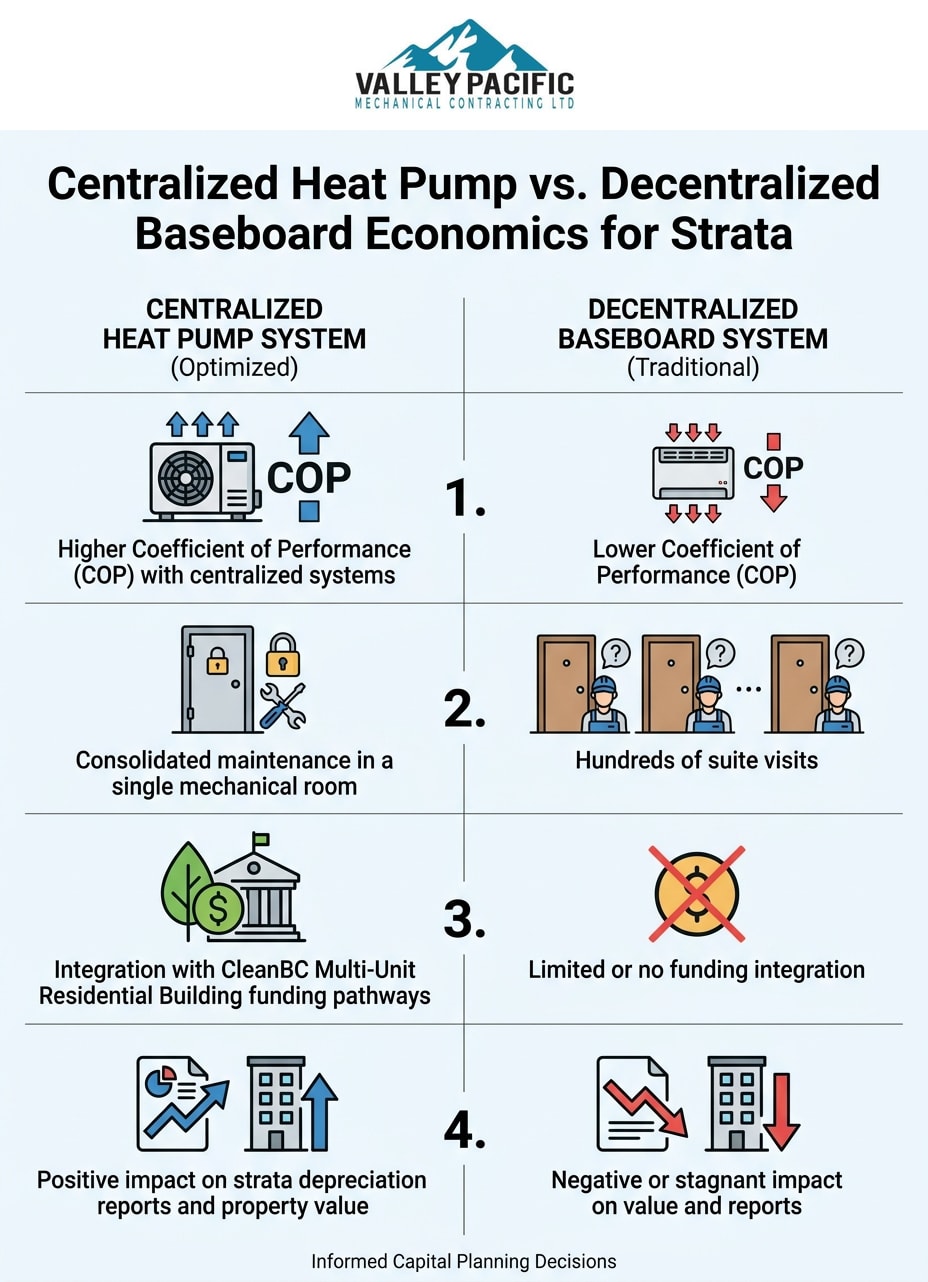
The most compelling argument for restructuring your capital plan lies in the sheer performance gap between old and new technologies. When you compare a centralized heat pump plant vs decentralized electric baseboards, the difference in operating efficiency is staggering. This is primarily measured by the Coefficient of Performance (COP). Traditional baseboards operate at a maximum COP of 1.0, meaning one unit of electrical energy produces exactly one unit of heat. Modern centralized heat pumps frequently operate at a COP of 3.0 or higher, extracting ambient heat from the air or ground to produce three times the heating energy for the same electrical input.
This efficiency is particularly critical given our regional weather patterns. When ambient temperatures drop to -10°C during a Maple Ridge January deep freeze, a centralized dual-purpose heat pump plant remains a highly efficient, year-round economic asset. Instead of running inefficient resistive heat in the winter and relying on window shakers in the summer, a centralized system provides comprehensive climate control that drastically reduces community-wide energy consumption.
Furthermore, evaluating heat pump installations at a centralized level means consolidating your maintenance footprint. Instead of chasing problems across hundreds of suites, your mechanical team services a single, accessible plant room.
• Energy Efficiency (COP) — Centralized Heat Pump Plant: High (Often 3.0 or greater, yielding significant energy reduction) — Decentralized Electric Baseboards: Low (Maximum 1.0, strictly 1:1 energy transfer)
• Maintenance Footprint — Centralized Heat Pump Plant: Consolidated in a single mechanical room; zero suite access needed for core plant maintenance — Decentralized Electric Baseboards: Fragmented across hundreds of individual suites; requires constant coordination
• Year-Round Utility — Centralized Heat Pump Plant: Dual-purpose: Provides both high-efficiency heating and building-wide cooling — Decentralized Electric Baseboards: Single-purpose: Heating only; offers no relief during summer heat waves
• Load Management — Centralized Heat Pump Plant: Centralized controls allow for building-wide optimization and peak load shedding — Decentralized Electric Baseboards: Uncontrolled individual usage leads to unpredictable electrical demand spikes
Integrating Mechanical Upgrades into Strata Depreciation Reports
Upgrading your building's mechanical infrastructure is not just an energy conservation measure; it is a strategic asset management move. In British Columbia, the Strata Property Act mandates that most stratas maintain a depreciation report to forecast future capital expenses. How your heating system is represented in this report directly impacts your contingency reserve fund (CRF) contributions and, ultimately, the resale value of every unit in the building.
When you rely on aging baseboards, your depreciation report reflects a high-risk, depreciating asset that will soon require massive capital to replace piecemeal. By contrast, integrating centralized mechanical installations into your long-term planning resets the lifecycle clock on your building's most critical infrastructure. Based on our extensive work delivering full-service HVAC, plumbing, and gas fitting solutions to communities, we know that proactive upgrades are the single best way to prevent the catastrophic special levies that inevitably follow decentralized system failures.
Here is how you effectively integrate this transition into your capital planning:
1. Conduct a Baseline Assessment: Work with a qualified mechanical contractor to assess the remaining useful life of your current baseboards and electrical infrastructure, documenting the escalating repair frequency.
2. Commission an Energy Model: Project the long-term operational savings of a centralized heat pump plant. This model provides the hard data your depreciation planner needs to adjust future CRF contribution requirements.
3. Update the Lifecycle Forecast: Have your depreciation report updated to reflect the new 15-to-20-year lifecycle of the centralized mechanical plant, replacing the imminent replacement costs of the old baseboards.
4. Communicate Value to Owners: Frame the economic benefit to your ownership group as long-term property value protection. A building with a modern, efficient, and fully funded mechanical system commands higher resale values than one facing imminent special levies.
Unlocking Project Viability Through Provincial Funding Pathways
The most significant hurdle for any strata council is the upfront capital required to initiate a community-scale retrofit. However, the economic landscape for these projects has shifted dramatically. By aligning your capital projects with multi-unit residential building energy guidelines, you can unlock substantial incentives that transform the return on investment timeline for your strata. Qualifying heat pump installations may be eligible for provincial and federal tax credits or utility incentives. We advise strata councils to verify current programs and eligibility with their utility provider or a tax professional.
Leveraging these incentives requires strategic planning. You cannot simply install equipment and ask for a rebate after the fact. The funding landscape demands pre-approval, stringent energy modeling to meet commercial-tier tonnage requirements, and precise administrative execution. This is why it is absolutely critical to partner with a contractor who understands the complexities of community-scale funding. With deep expertise in CleanBC, FortisBC, and federal funding pathways, the Valley Pacific team guides boards through the administrative maze, ensuring you capture every available incentive to offset the initial capital barrier.
Navigating Multi-Family Incentive Structures
If you are exploring navigating CleanBC and FortisBC rebates for multi-family community housing upgrades, you must understand how these programs are structured. They are distinctly different from single-family residential rebates.
Understanding centralized vs. individual funding: Multi-family incentive structures often separate funding for individual suite upgrades from funding designed for centralized mechanical plants. Centralized plant funding generally yields a much higher impact on the building's overall energy footprint and qualifies for specialized commercial-tier incentives.
The necessity of professional energy modeling: Provincial and federal programs require empirical proof that your proposed upgrade will reduce greenhouse gas emissions and electrical demand. Professional energy assessments and detailed engineering models are mandatory steps in the application process. Attempting to bypass this step will disqualify your project from the most significant funding tiers.
A Proven Methodology for Community-Scale Transitions
Executing a transition from decentralized baseboards to a centralized heat pump plant across an entire community requires more than just standard commercial HVAC skills. It requires a proven, structured methodology. At Valley Pacific, our proudly Indigenous-owned roots—guided by Métis leadership, Cree roots, and a deep respect for West Coast traditions—drive our commitment to building alongside communities. Through our Valley Pacific Community Energy Retrofit Program (VCERP) methodology, we have successfully navigated complex, community-scale projects—including 410+ installs for the Squamish Nation, 175 fully funded installs for the Sts'ailes Nation, and the active Laxgalts'ap program. These milestones prove that a structured approach guarantees long-term system health while fostering Indigenous youth mentorship and vital trades training.
In our experience retrofitting 700+ community homes, we have seen that successful deployment hinges on meticulous capital and maintenance planning. We do not just swap equipment; we guide boards through a comprehensive transition process.
Our methodology for community-scale transitions includes:
• Initial Board Consultation: We start by understanding your strata's specific financial constraints, reviewing your current depreciation report, and identifying immediate operational pain points.
• Funding Alignment and Feasibility: Before any physical work begins, we map out the applicable provincial and federal funding pathways, ensuring the project is financially viable and meets all pre-approval requirements.
• Strategic Project Phasing: We design the deployment to minimize disruption to residents. Because centralized plants consolidate the heavy mechanical work in designated utility areas, we can drastically reduce the chaos of suite-by-suite tear-downs.
• Long-Term Maintenance Planning: A new system is only as good as the plan to maintain it. We establish a proactive maintenance schedule for the new plant with transparent, two-option pricing, ensuring it hits its maximum lifecycle targets and continues to operate at peak COP.
This methodology ensures that your strata is not just buying a piece of equipment, but investing in a sustainable, fully supported infrastructure solution.
Frequently Asked Questions About Strata Heat Pump Economics
Are centralized heat pumps more efficient than decentralized baseboards for strata?
Yes, centralized heat pumps are significantly more efficient than decentralized baseboards. While baseboards operate at a 1-to-1 energy transfer ratio, modern heat pumps use a refrigeration cycle to move ambient heat, often producing three or more units of heat for every unit of electricity consumed. This massive increase in efficiency drastically lowers the overall energy footprint of a multi-family building.
How do strata councils fund heat pump retrofits in BC?
Strata councils typically fund retrofits through a combination of contingency reserve funds, specialized strata loans, and substantial provincial or federal incentives. Incentive pathways designed for multi-unit residential buildings provide specific funding streams to offset the upfront capital costs of transitioning away from inefficient electric heat. Partnering with an experienced contractor is essential to navigate these applications successfully.
What is the ROI timeline for strata heat pump upgrades?
The return on investment timeline depends heavily on your building's current energy usage, the specific equipment chosen, and the successful application of available funding pathways. By significantly reducing long-term maintenance liabilities and capturing multi-family incentives, strata councils often see a much faster ROI than traditional capital projects, while simultaneously protecting the building's overall property value.
What are the long-term maintenance savings of a centralized HVAC plant?
A centralized HVAC plant consolidates your maintenance footprint into a single mechanical room, eliminating the need to coordinate repairs across hundreds of individual suites. This drastically reduces the labor hours required for routine service and emergency troubleshooting. Over the 15-to-20-year lifespan of the equipment, avoiding constant suite-by-suite dispatch yields massive operational savings for the strata budget.
How does a centralized mechanical plant affect our strata depreciation report?
Transitioning to a centralized mechanical plant positively impacts your depreciation report by replacing aging, high-risk liabilities with a modern asset that has a predictable, extended lifecycle. This allows depreciation planners to forecast lower emergency repair costs and stabilizes the required contributions to your contingency reserve fund, ultimately protecting the resale value of the building.
Align Your Strata's Capital Plan with Proven Mechanical Expertise
Transitioning your community from aging decentralized baseboards to a modern centralized heating system does not have to be an overwhelming financial burden. By leveraging strategic capital planning and aligning with the right provincial funding pathways, strata councils can overcome the initial capital barrier and secure a highly efficient, reliable future for their buildings.
You do not have to navigate depreciation reports, energy modeling, and complex retrofits alone. Our team brings deep expertise in CleanBC, FortisBC, and federal funding pathways to ensure your transition is seamless and fully supported from consultation to final deployment. To begin mapping out a clear framework for comparing your long-term maintenance savings against capital costs, explore our comprehensive commercial project services and easy online booking options today, and take the first step toward a more sustainable community.


