


Navigating CleanBC and FortisBC Rebates for Multi-Family Community Housing Upgrades


The Administrative Complexity of Multi-Family Mechanical Upgrades
How do you plan to fund large-scale mechanical overhauls without getting bogged down in administrative red tape? At Valley Pacific, we hear this critical question constantly from property managers, strata councils, and First Nations housing directors when they approach us for building improvements. Navigating CleanBC and FortisBC Rebates for Multi-Family Community Housing Upgrades requires more than just filling out a single form. We often see property managers and housing directors stall out during capital planning because navigating the layered eligibility criteria for multiple provincial and utility programs is overwhelmingly complex.
The concrete problem is clear: the paperwork alone can delay critical upgrades, pushing projects past ideal installation windows and leaving residents with aging, inefficient systems. In our experience, the decision point occurs long before the first piece of equipment is ordered. Choosing to integrate rebate management directly into the capital planning and mechanical execution phases before breaking ground is the only way to keep large-scale projects on track. Approaching funding and execution as a single unified process prevents delays and ensures compliance with provincial energy efficiency goals.
If you are exploring FortisBC programs alongside provincial incentives, you need a methodology that handles both the application mechanics and the physical installation. Structured frameworks, such as our Valley Pacific Community Energy Retrofit Program (VCERP), are designed specifically by our team to eliminate these administrative bottlenecks.
The traditional versus unified approach:
• Capital Planning — Fragmented Approach: Funding applications are treated as an afterthought, leading to rejected claims. — Unified Methodology (VCERP): Energy modeling and funding eligibility are mapped out before equipment is selected.
• Execution — Fragmented Approach: Contractors wait on administrative approvals, delaying installation timelines. — Unified Methodology (VCERP): Procurement and pre-approvals are synchronized to ensure immediate rollout.
• Accountability — Fragmented Approach: Multiple parties point fingers when documentation falls short. — Unified Methodology (VCERP): A single point of accountability manages both the paperwork and the pipework.
By shifting away from a fragmented approach, we help housing directors focus on the long-term benefits of the mechanical upgrades rather than getting lost in the intricacies of program requirements.
Integrating Rebate Management into Early Capital Planning
Multi-family buildings require comprehensive capital planning and precise energy modeling to qualify for stacked provincial incentives. You cannot simply install new equipment and hope the paperwork aligns after the fact. We've found that successful funding acquisition requires a proactive methodology where rebate management is built directly into the initial planning phase.
When you incorporate structured funding pathways early in the project lifecycle, you ensure that every piece of selected equipment meets the stringent criteria set by provincial programs. This early integration prevents costly revisions later and ensures that your commercial HVAC solutions align perfectly with available incentives.
Why Early Energy Assessments Matter
Baseline energy assessments are often mandatory for commercial and multi-family funding. These assessments establish the current energy consumption of the building, providing the necessary data to prove projected energy efficiency gains. Without a verified baseline, proving the impact of your upgrades to program administrators becomes nearly impossible.
• Establishing a baseline: Energy modeling identifies exactly how much energy the current aging systems consume.
• Aligning with provincial targets: Early assessments ensure that the proposed mechanical upgrades actively contribute to provincial electrification targets.
• Validating equipment selection: Data from the assessment dictates which high-efficiency systems will qualify for the highest tiers of available funding.
• Preventing scope creep: Knowing exactly what is required for compliance keeps the project focused and within budget.
Through frameworks like our VCERP, we ensure these assessments are not treated as a separate administrative hurdle, but as the foundational step of the entire retrofit project.
Timing Your Capital Upgrades
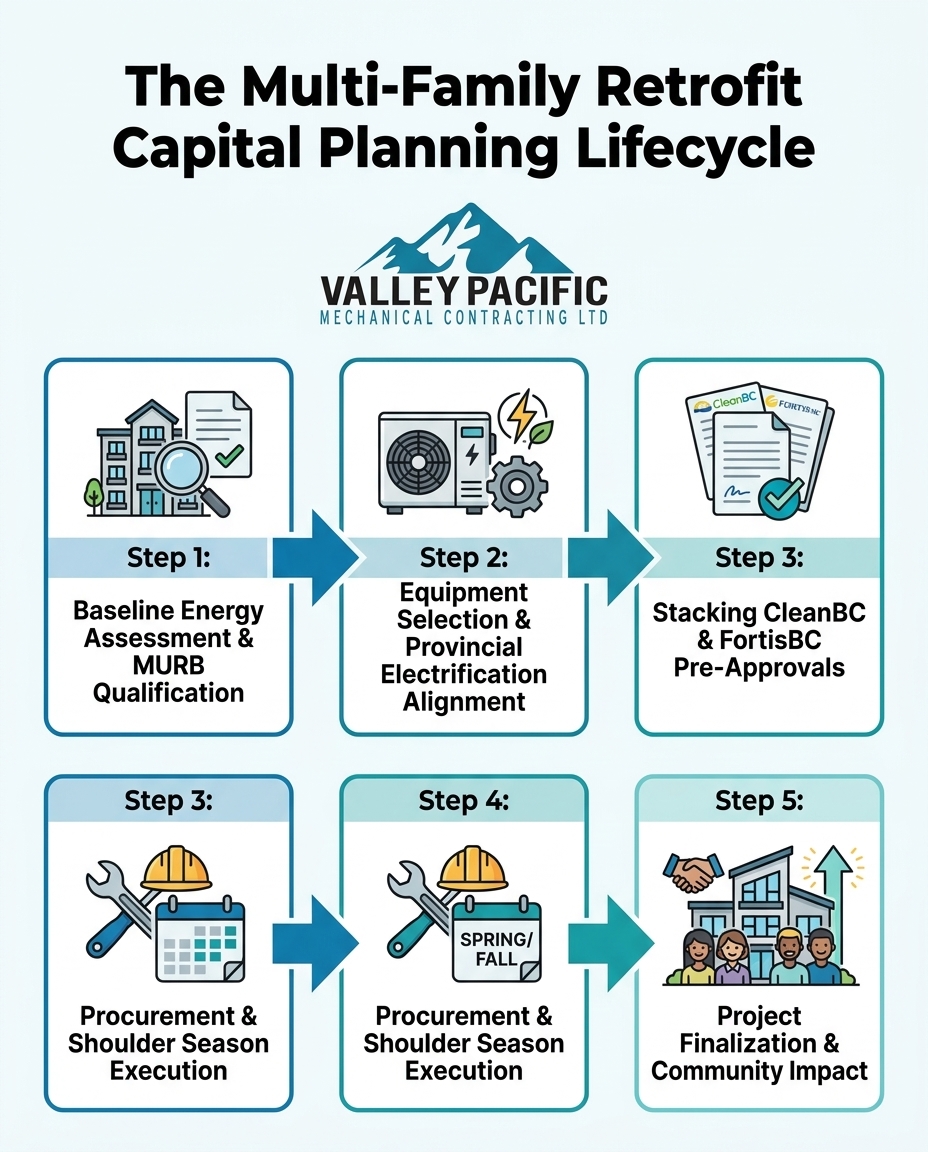
Timing is everything when coordinating large-scale multi-family upgrades. Our team always advises finalizing capital planning during the shoulder seasons—spring and fall—to secure funding approvals before peak seasonal demands hit. Submitting applications during these transitional periods allows property managers to align funding approvals with procurement schedules.
Mitigating the risk of supply chain delays requires this level of foresight. If you wait until the middle of winter to apply for heating upgrades, the administrative backlog and equipment lead times will almost certainly delay the project. Furthermore, assessing Multi-Unit Residential Building (MURB) eligibility criteria early in the project lifecycle ensures that the building classification aligns with the specific requirements of both CleanBC and FortisBC programs before any financial commitments are made.
Executing Community-Scale Retrofits with Proven Methodologies
Transitioning from planning to execution highlights the sheer scale and complexity of community housing upgrades. Large-scale mechanical installations require a project management lifecycle that handles funding and execution simultaneously. It is not enough to simply deliver the equipment; the installation must be carefully coordinated to minimize disruption across dozens or hundreds of dwelling units.
Executing at this level requires working with an experienced team capable of managing multi-layered logistics. With over 700+ community homes retrofitted, our proven methodologies at Valley Pacific ensure that the transition from approved paperwork to active construction is seamless. When you secure your funding, the execution phase must immediately follow with precision. This is where our large-scale mechanical installations are transformed from disruptive construction projects into streamlined community improvements.
Managing Complex Installations at Scale
The logistical coordination required for multi-unit retrofits is substantial. We utilize centralized project management to minimize disruptions for residents by ensuring that equipment, technicians, and safety protocols are perfectly synchronized.
1. Pre-installation site audits: Verifying the structural and electrical readiness of every unit before the main installation begins.
2. Phased rollout schedules: Grouping installations by building wing or floor to maintain essential services for the majority of residents at all times.
3. Real-time compliance tracking: Ensuring that every installed unit matches the exact specifications approved in the funding applications.
4. Post-installation commissioning: Testing the entire centralized system to guarantee it operates at the efficiency levels promised in the initial energy modeling.
Building Community Through Trades Training
For us, successful retrofits go beyond equipment installation to include community-building elements. As a proudly Indigenous-owned mechanical partner grounded in Métis leadership, Cree roots, and a deep respect for West Coast traditions, Valley Pacific approaches community-scale logistics differently. Large-scale retrofits provide unique opportunities for local workforce development.
By integrating trades training and Indigenous youth mentorship directly into the execution phase, we connect mechanical upgrades to long-term community empowerment. Through initiatives like our active Laxgalts'ap program, this approach ensures that the community not only benefits from improved energy efficiency and comfort but also gains the internal capacity and skills required for future maintenance and technical independence. The impact of retrofitting 700+ community homes extends far beyond the mechanical room when local youth are actively mentored throughout the process.
Overcoming Administrative Hurdles for Strata and First Nations Housing
The unique administrative burdens placed on housing directors and strata councils during the application process can be overwhelming. Each provincial and utility program has distinct requirements, and attempting to stack these incentives multiplies the paperwork. For the strata councils and First Nations housing directors we work with, navigating the documentation requirements for multi-family rebate stacking without violating generic program rules is a significant challenge.
Leveraging structured retrofit programs to shoulder the administrative load is the most effective strategy. By utilizing a comprehensive methodology, housing leaders can ensure all documentation is perfectly aligned with program expectations. This unified approach has been proven successful in our large-scale community funding achievements, such as those we executed for the Squamish Nation (410+ installs) and Sts'ailes Nation (175 fully funded homes). Understanding the broader landscape of BC and federal energy rebates for HVAC upgrades is essential, but having a partner to manage the specifics is what guarantees success.
Streamlining Documentation and Approvals
Organizing administrative workflows to satisfy provincial program requirements demands meticulous attention to detail. Our team ensures the common types of documentation required are gathered, verified, and submitted in a specific sequence.
• Comprehensive energy models: Detailed reports demonstrating the baseline consumption versus the projected efficiency of the new systems.
• Exact equipment specifications: Manufacturer data sheets proving that the selected HVAC units meet the required seasonal energy efficiency ratios.
• Proof of MURB qualification: Documentation verifying the building's classification, including the number of distinct dwelling units and centralized system architecture.
• Pre-approval confirmations: Official documentation from the funding bodies authorizing the commencement of the project.
When we manage these documents through a unified program, the risk of application rejection drops significantly.
Navigating Strata Council Approvals
Securing strata council buy-in is often as challenging as securing the funding itself. Councils are naturally risk-averse and require clear, transparent data before approving large capital expenditures. Presenting our transparent pricing, two-option approach, and a unified funding and execution plan helps secure this vital buy-in.
When a strata council sees that our project management lifecycle handles the funding applications, the energy modeling, and the physical installation under a single umbrella, their concerns are alleviated. Transparent project management, backed by our proven success in communities like the Squamish Nation and Sts'ailes Nation, provides the assurance councils need to move forward confidently.
Addressing BC's Dual Climate Challenge Through Upgraded Systems
British Columbia's provincial electrification goals are heavily driven by the need to adapt to changing climate realities. Our technicians see firsthand how aging multi-family mechanical systems simply struggle to handle the province's damp, cold, and coastal winters. When centralized heating fails during a January cold snap, the safety and comfort of hundreds of residents are immediately compromised.
Conversely, the increasing necessity for robust, energy-efficient cooling systems to manage hotter summer temperatures cannot be ignored. Multi-family buildings designed decades ago rarely accounted for the extreme heat waves that are now common across the region. This creates a dual climate challenge: buildings must stay warm and dry through long, damp winters, while also providing reliable cooling during intense summer heat.
Leveraging provincial rebates makes it feasible to install high-efficiency systems capable of handling this dual climate challenge. By upgrading to modern, climate-resilient HVAC technology alongside our useful maintenance plans, property managers protect their building infrastructure and their residents. Our experience upgrading over 700+ community homes demonstrates that when you align mechanical improvements with provincial electrification targets, you create living environments that are fundamentally safer, more comfortable, and significantly more energy-efficient year-round.
Frequently Asked Questions About Multi-Family HVAC Rebates in BC
How do you stack CleanBC and FortisBC rebates for multi-family buildings?
Stacking requires coordinating applications through both provincial and utility pathways simultaneously before any equipment is purchased. We find that comprehensive energy modeling is often the key to unlocking combined eligibility. By utilizing a structured framework like VCERP, property managers can ensure that the technical specifications of their chosen equipment meet the overlapping criteria of both programs without violating individual program rules.
What qualifies as a multi-unit residential building (MURB) in BC?
A multi-unit residential building typically features centralized mechanical systems serving multiple distinct dwelling units under a single roof. We recommend property managers verify specific property classifications during the early capital planning phase, as definitions can vary slightly between funding bodies. Confirming MURB status early prevents application delays and ensures you are targeting the correct funding streams.
Do I need an energy assessment for commercial HVAC rebates?
Yes, our team notes that baseline energy assessments are typically a mandatory first step for large-scale multi-family and commercial funding. These assessments provide the critical data necessary to prove the projected energy efficiency gains of your proposed upgrades. Without this baseline data, funding administrators cannot verify the environmental impact or eligibility of your project.
What is the process for integrating energy rebates into capital planning?
Our process follows a step-by-step approach: baseline assessment, precise equipment selection, application submission, and finally, procurement alignment. The greatest risk property managers face is purchasing equipment before securing official pre-approvals. Integrating the application process into your initial capital planning ensures that funding is locked in before any financial commitments are finalized.
How do structured retrofit programs simplify community-scale upgrades?
Programs that combine funding navigation with mechanical execution completely remove administrative bottlenecks for housing directors. Having a single point of accountability for both the paperwork and the pipework ensures that nothing is lost in translation between the application phase and the installation phase. Frameworks like our VCERP streamline the entire lifecycle, turning complex administrative hurdles into a manageable, unified process.
Streamline Your Next Community-Scale Retrofit Project
Navigating rebates doesn't have to stall your mechanical upgrades if you partner with an experienced team that understands the complete lifecycle of multi-family improvements. By integrating your funding strategy directly into your early capital planning, you gain a clear, experience-based roadmap to successfully execute community-scale retrofits without administrative roadblocks.
Whether you are managing a strata complex or directing First Nations housing initiatives, leveraging a unified methodology like VCERP ensures your project moves from planning to execution seamlessly. Take control of your building's energy future and schedule a consultation through our easy online booking to discuss your upcoming capital projects and commercial project services today. Partnering with a proudly Indigenous-owned team ensures your upgrades deliver lasting efficiency, reliable comfort, and meaningful community impact.


