


Troubleshooting a Leaky Faucet Cartridge in Your Langley Kitchen


Why Is Your Langley Kitchen Faucet Persistently Dripping?
Are you constantly tightening the handle on your sink, but you still find yourself troubleshooting a leaky faucet cartridge in your Langley kitchen? That rhythmic dripping sound is more than just a late-night annoyance; it is a clear indicator that something inside your plumbing fixture has structurally failed. In our years of providing mechanical services across the Lower Mainland, our team has seen that many homeowners assume a dripping spout simply means a handle has come loose or an exterior nut needs a quick turn with a wrench. In reality—especially in fixtures installed during the 2010–2015 housing boom—the vast majority of modern kitchen sink leaks stem from a failing internal cartridge buried deep inside the fixture housing.
Understanding the fundamental difference between cartridge types is the critical first step in stopping the leak and preventing water damage to your cabinets. What works for one style of sink will completely ruin another. Furthermore, regional factors play a huge role in why these internal components fail prematurely. If you are tired of dealing with persistent drips and water waste, reaching out for professional plumbing and mechanical services is the safest route to a permanent fix. Our team provides expert plumbing services to diagnose and resolve these frustrating leaks.
How Local Hard Water Accelerates Faucet Wear
To understand why your fixture is failing, you have to look closely at the water flowing through it. Hard water is defined by its high levels of dissolved minerals, primarily calcium and magnesium. As water travels through municipal systems or private wells, it picks up these naturally occurring minerals from the earth. When this mineral-heavy water flows through your home's plumbing fixtures, the dissolved solids do not simply pass through harmlessly. Instead, they precipitate out of the water, leaving behind a chalky, stubborn residue.
Our Valley Pacific Mechanical technicians frequently encounter localized hard water conditions in certain Langley neighborhoods, such as Brookswood and Walnut Grove, where mineral levels can exceed 7 grains per gallon (GPG) depending on the specific municipal or well water source. Because of this regional environmental factor, standard manufacturer lifespan estimates for plumbing fixtures rarely apply here. A fixture rated to last a decade in a laboratory setting might begin malfunctioning in just 3 to 5 years when subjected to continuous mineral scaling. This scaling specifically attacks the tight, precision-machined seals required to keep water from dripping when the handle is in the off position.
The Hidden Cost of Mineral Scaling
Invisible accumulation: Scale buildup is often completely invisible from the outside of the fixture until the faucet begins to noticeably malfunction. The exterior chrome or brushed nickel might look pristine, while the internal housing is caked in hardened calcium.
Abrasive action: Mineral deposits are not just unsightly; they are physically destructive. These microscopic deposits act exactly like sandpaper against the delicate internal mechanisms of your fixture. Every single time the faucet is turned on, rotated, or turned off, that abrasive scale grinds against the internal seals, slowly wearing away the watertight barrier.
Temperature acceleration: Scaling happens even faster on the hot water side of your plumbing. Heat—especially when domestic hot water is set above 120°F (49°C)—causes calcium to precipitate out of the water more rapidly, which is why the hot water valve or the hot-side inlet of a mixing valve is frequently the first component to fail and start dripping.
Identifying Your Faucet Mechanism: Ceramic Disk vs. Compression Cartridges
Modern kitchens typically use one of two main valve systems to control water flow and temperature. Knowing exactly which mechanism sits inside your housing dictates the entire troubleshooting approach. If you apply the diagnostic logic of an older 1990s-era fixture to a modern post-2015 model, you risk destroying the entire unit. When upgrading or replacing fixtures entirely, exploring reliable residential plumbing solutions ensures you select the most resilient hardware for your specific water conditions.
Below is a breakdown of the two primary systems you will encounter when dealing with ceramic disk and compression cartridges.
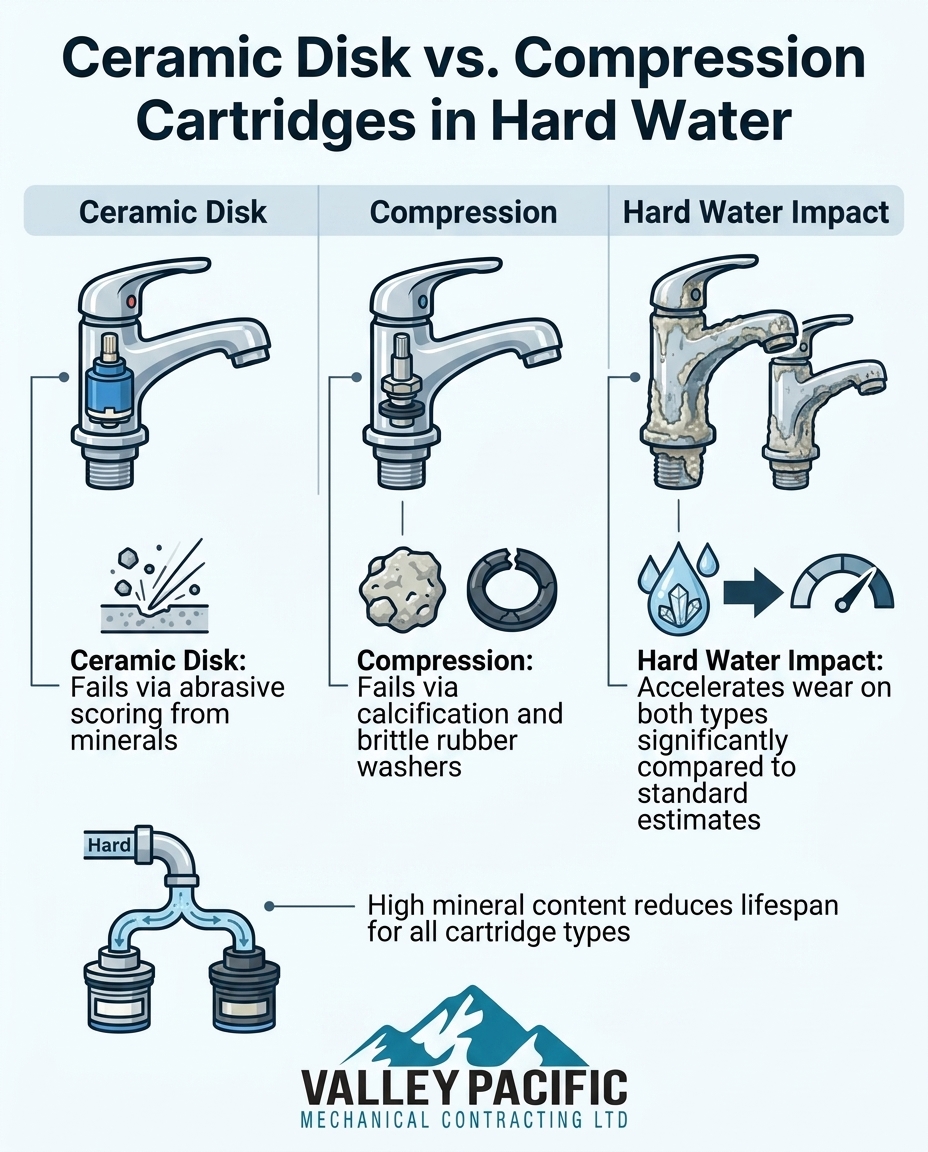
• Basic Mechanics — Compression Cartridge: Uses a threaded stem that presses a rubber washer down against a brass valve seat to stop water flow. — Ceramic Disk Cartridge: Uses two highly polished ceramic plates that slide over each other to align or block water ports.
• Handle Feel — Compression Cartridge: Requires multiple turns to fully open or close; resistance increases as you tighten it. — Ceramic Disk Cartridge: Operates with a smooth, quarter-turn or half-turn motion; stops abruptly at the off position.
• Common Leak Cause — Compression Cartridge: The rubber washer becomes brittle, flattened, or torn, failing to create a seal against the seat. — Ceramic Disk Cartridge: The polished plates become scratched by debris or minerals, allowing water to seep through the gouges.
• Repair Approach — Compression Cartridge: Historically involved replacing just the rubber washer, though modern iterations often require full replacement. — Ceramic Disk Cartridge: The entire enclosed cylinder must be swapped out, as the plates cannot be resurfaced or repaired.
Why Durable Ceramic Disks Still Fail in Hard Water Environments
In the plumbing industry, ceramic disk technology is heavily marketed as "drip-free" and highly durable under normal water conditions. Because ceramic is incredibly hard and resistant to typical wear and tear, these fixtures are often sold with lifetime warranties against dripping. However, the reality of operating these fixtures in environments with elevated mineral content tells a different story. We often have to explain to frustrated homeowners that the very precision that makes ceramic disk and compression cartridges different is what makes the ceramic variant vulnerable to environmental factors.
The mechanics of the seal: Inside the cylinder, two ceramic plates are polished to such an extreme degree of flatness—often with clearances of less than a fraction of a millimeter—that when they are pressed together, water cannot pass between them. There are no rubber gaskets needed between the plates themselves; their perfectly mated surfaces create the barrier. When you move the handle, the top plate slides across the bottom plate, aligning holes to let water through.
The impact of scaling: When hard water mineral deposits form inside the fixture housing, tiny, hardened granules of calcium can make their way between the plates. Because the plates slide against each other under pressure, these mineral granules score and scratch the polished surfaces of the ceramic.
The irreversible damage: Even a microscopic scratch on the disk compromises that perfect watertight seal, leading to a steady, unfixable drip. Once a ceramic disk is scored, it cannot be sanded down, filled, or repaired. The entire internal cylinder is permanently compromised and must be extracted and replaced with an identical manufacturer-specific part.
The Impact of Mineral Scaling on Compression Mechanisms
While ceramic technology dominates high-end modern fixtures, compression mechanisms are still widely used in utility sinks, pre-2000s builds, and outdoor spigots exposed to harsh BC winters. Understanding how mineral scaling impacts these older or different style faucets ensures complete coverage of the topic and helps homeowners recognize the distinct symptoms of failure.
Calcification of rubber components: Compression faucets rely on a pliable rubber washer to create a seal. Over time, calcium buildup heavily calcifies these rubber washers. The constant exposure to minerals strips the rubber of its elasticity, making it stiff, brittle, and prone to cracking. A brittle washer cannot compress effectively against the metal, allowing water to seep past.
Damage to the valve seat: Mineral scaling does not just attack the rubber; it also damages the brass valve seat over time. As water forcefully pushes past a failing washer, it carries abrasive minerals that slowly carve tiny channels into the brass seat—a process known as wire drawing. Once the seat is pitted or channeled, even a brand-new rubber washer will not stop the leak.
The trap of over-tightening: When a compression fixture starts to drip, a homeowner's natural instinct is to tighten the handle harder to force the flow to stop. We regularly see cases where homeowners tighten the handle with excessive force, which only crushes the already brittle washer further, warps the brass stem, and significantly worsens the leak.
Symptoms of failure: You can often identify a failing compression mechanism by how it feels. A stiff handle that is difficult to turn, a grinding sensation when rotating the knob, and an inconsistent, sputtering water flow are all classic signs that mineral scaling has overtaken the internal components of your ceramic disk and compression cartridges.
How to Fix a Leaky Faucet by Diagnosing the Root Cause
When you are trying to figure out how to fix a leaky faucet, the most important step is proper diagnosis, not immediately reaching for a wrench. Attempting to dismantle a calcified fixture without knowing exactly what you are dealing with often leads to broken pipes and flooded kitchens. One local homeowner reached out with general plumbing and heating service needs after noticing a persistent drip. Because our professional team provided prompt and excellent service, they avoided a much larger issue with a fused fixture and were very satisfied with the overall result.
To safely troubleshoot the issue and prepare for a service call, follow these observational diagnostic steps to identify the root cause:
1. Isolate the water supply: The absolute first step in any diagnostic process is turning off the water supply to the fixture. Locate the shut-off valves under the sink and turn them clockwise until they stop. If the valves are stuck due to their own mineral buildup after years of disuse, do not force them; this requires immediate professional attention to avoid a burst line.
2. Observe the leak origin: Before shutting the water off, pay close attention to where the water is escaping. A drip from the end of the spout indicates a failure of the internal valve mechanism. Water pooling around the base of the fixture usually points to worn O-rings or a compromised housing seal.
3. Identify the manufacturer: Fixing the leak requires matching the exact manufacturer specifications. Internal parts are rarely universal. A Moen part from 2012 will not fit a Delta fixture from 2018, and even within the same brand, dimensions vary wildly by year and model.
4. Assess the calcification level: Look closely at the handle seams and the base of the spout. If you see heavy white or green crusting, the internal components are likely fused together. We strongly warn against forcing calcified parts, which can easily crack the fragile brass fixture or severely damage the pressurized plumbing lines hidden behind the sink walls.
Emphasize that true troubleshooting is about identifying the environmental cause—such as aggressive hard water—rather than just swapping a part. If you simply replace a component without addressing the underlying water quality or understanding the extent of the scaling, the new part will fail just as quickly. For more complex issues, diagnosing a leaky faucet that wastes hot water requires a comprehensive look at your home's entire mechanical system.
Why Cartridge Replacement Often Requires Local Expertise
While hardware stores sell replacement kits, successfully extracting and replacing a fused component in a heavily scaled fixture is rarely a simple DIY task. Establishing authority over your home's plumbing means recognizing when professional intervention is safer, faster, and more effective than struggling with specialized parts.
When tackling various project needs including plumbing installation, having a reliable partner with an understanding and comforting approach to project challenges makes all the difference. One homeowner noted that professional intervention met their project schedules and delivered perfect results for plumbing work, turning a stressful leak into a seamlessly resolved issue.
Specialized extraction tools: In our experience, pulling a cartridge that has been seated for 5 to 10 years requires specific techniques. Professionals carry specialized puller tools required to safely extract a cylinder that has been chemically fused to the brass housing by years of mineral scaling. Attempting to pry a stuck part out with pliers usually results in shattered plastic and a ruined faucet body.
Protecting your warranty: High-end fixtures often carry lifetime warranties, but these warranties are strictly conditional. We constantly remind clients of the risks of invalidating manufacturer warranties through improper DIY removal or the use of aftermarket, non-OEM replacement parts.
Comprehensive water assessment: Highlight the benefit of having a professional assess the overall water quality. A licensed plumber can evaluate whether the hard water in your specific Langley neighborhood requires whole-home filtration or softening to prevent future premature failures across all your appliances.
Code compliance and peace of mind: Professional plumbing ensures the repair meets all local codes and standards. Valley Pacific Mechanical maintains a deep understanding of Lower Mainland and Langley-specific plumbing challenges, ensuring repairs address the root environmental causes—like local mineral content—rather than just temporarily masking the symptoms.
Frequently Asked Questions
How do I know if my faucet cartridge is bad?
The most obvious sign of a bad internal mechanism is a persistent drip from the spout even when the handle is firmly in the off position. You might also experience a stiff handle that is difficult to turn, water pooling around the base of the handle, or inconsistent water temperature mixing. If tightening the handle no longer stops the flow, the internal seals have structurally failed and require professional replacement.
Does hard water ruin faucet cartridges?
Yes, hard water is one of the leading causes of premature plumbing fixture failure. The high levels of dissolved calcium and magnesium in hard water precipitate out to form abrasive scale inside the housing. This scale grinds against delicate rubber seals and scratches highly polished ceramic disks, permanently destroying their ability to hold back water pressure.
Can you fix a leaky faucet cartridge without replacing it?
In most modern post-2000 fixtures, the internal cylinder cannot be repaired and must be replaced entirely. While older compression-style fixtures allowed you to swap out a single rubber washer, modern ceramic disk systems are sealed units. Once the internal ceramic plates are scratched by mineral debris, the damage is irreversible and a full part swap is required.
Why is my new faucet cartridge still leaking?
If a newly installed component is still leaking, it usually means the internal brass housing of the fixture itself was damaged by mineral scaling or wire drawing. It can also indicate that the replacement part was not the exact OEM specification, or that debris was left inside the valve body during installation, which immediately compromised the new seals.
How to fix a leaky faucet?
Fixing a leak requires first isolating the water supply and accurately diagnosing whether the failure is in the spout O-rings or the main control valve. Because modern fixtures are complex and easily damaged by incorrect tools, the safest fix is having a licensed professional extract the calcified components. They will ensure the exact manufacturer-specific part is installed without damaging the surrounding plumbing.
How long should a ceramic disk cartridge last in Langley?
While manufacturers often claim ceramic disks can last a lifetime under ideal laboratory conditions, regional water quality drastically alters this timeline. In areas of Langley with elevated hard water levels, aggressive mineral scaling can compromise a ceramic disk in just 3 to 5 years. Regular plumbing maintenance and water quality management are essential to extending the lifespan of these fixtures.
Stop the Drip and Protect Your Kitchen
Ignoring a persistent drip doesn't just waste hundreds of gallons of water; it allows abrasive mineral scaling to cause irreversible damage to your expensive fixtures. If you are dealing with a stubborn leak, trust a team that understands exactly how regional water conditions impact your hardware. Contact Valley Pacific Mechanical Contracting Ltd. today for professional troubleshooting a leaky faucet cartridge in your Langley kitchen and enjoy the peace of mind that comes with a permanent, expertly executed repair.


