


Diagnosing a Leaky Faucet That Wastes Hot Water from Your Boiler


Is That Constant Hot Water Drip Sabotaging Your Heating System?
Are you constantly topping up your heating system right as a persistent drip has developed in your bathroom or kitchen? Diagnosing a leaky faucet that wastes hot water from your boiler requires looking past the sink fixture itself and evaluating the entire mechanical loop. Most homeowners view a dripping tap as a minor annoyance that can be ignored for months. However, when that tap is connected to a central hydronic heating system, a slow drip transforms into a continuous mechanical drain. You are no longer just losing water; you are forcing an expensive piece of equipment to operate under conditions it was never designed to handle.
When our team at Valley Pacific Mechanical responds to calls for a boiler losing pressure hot water leak, we quickly help homeowners discover that interconnected home systems require a holistic diagnostic approach. The decision point often comes down to knowing whether you just need to swap out a worn ceramic cartridge in the sink or if the central unit has suffered secondary wear and tear from the continuous demand. A simple fixture repair might stop the sound of dripping water, but it will not magically restore the lost system equilibrium or reverse the strain placed on internal heating components.
In our experience servicing hydronic systems throughout Maple Ridge, signs your system is actively struggling include:
• Unusual noises: A humming or kettling sound originating from the utility room even when no one is actively using a tap.
• Inconsistent temperatures: Radiators or baseboards that fail to reach their normal operating warmth during regular cycles.
• Frequent cycling: The unit firing up for brief moments repeatedly throughout the day and night.
• Gauge fluctuations: A steady, noticeable decline on the unit's monitoring dial over a period of several days.
Before assuming that a quick DIY fix at the sink will solve everything, we highly recommend having a professional evaluate your boiler heating systems to ensure the mechanical loop remains secure and fully operational.
The Mechanical Link: Why Hot Water Leaks Trigger Boiler Short-Cycling
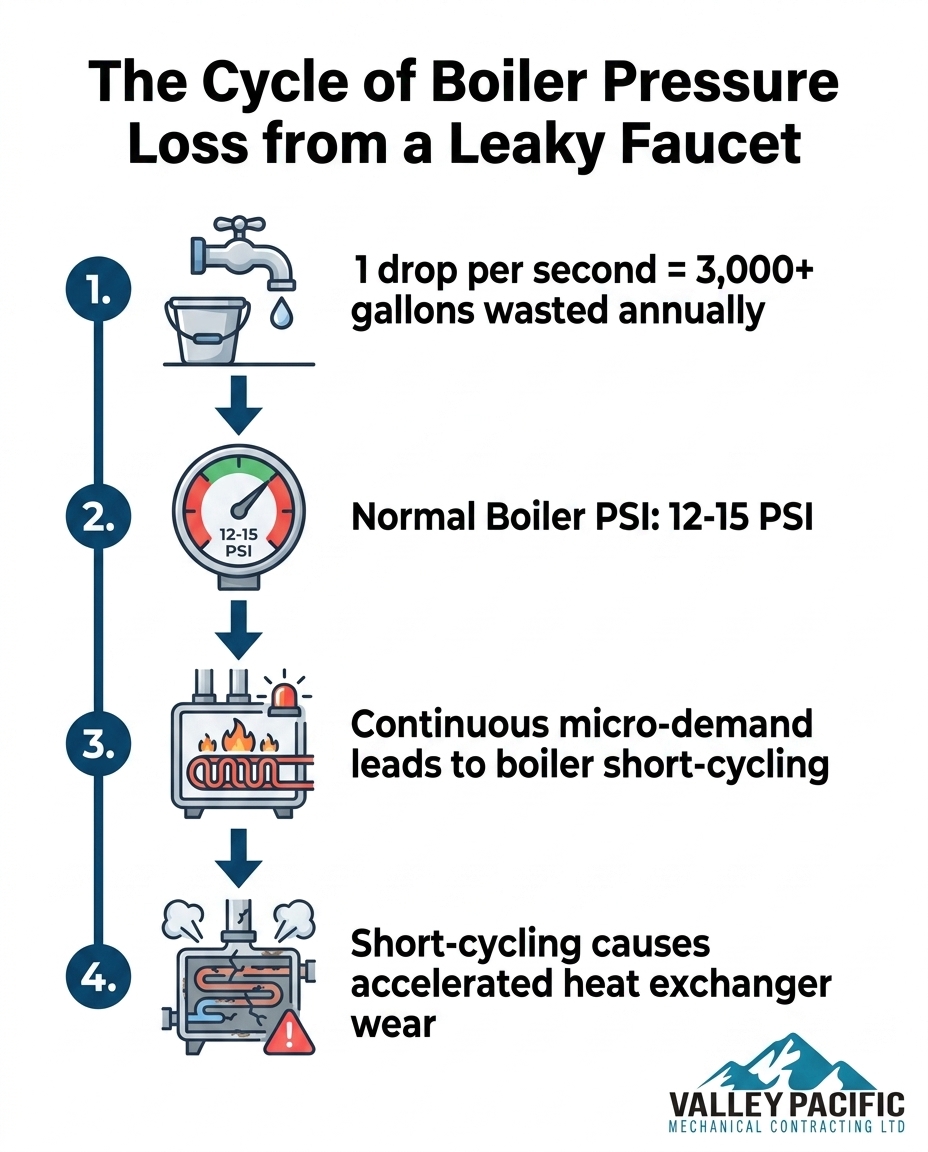
To understand why a dripping tap is so destructive to heating equipment, you have to look at how modern combi-boilers and indirect water heaters register demand. These systems are highly sensitive to flow rates. When a hot water valve fails to close completely, it creates a continuous micro-demand. The system's sensors detect this slow, steady loss of heated water and command the burner to fire up to compensate.
This continuous loop prevents the system from ever truly entering a restorative standby mode. Instead, it triggers a phenomenon known as short-cycling. The burner ignites, heats the small volume of water required to replace the drip, quickly reaches its target temperature, and shuts off—only to repeat the entire process a few minutes later as the drip continues. To protect your equipment, securing expert plumbing services in Maple Ridge is the most effective way to address the root cause and halt the cycle.
Understanding Continuous Micro-Demand
Modern flow sensors are designed to detect even the slightest movement of water through the pipes. When a faucet drips at a rate of just one drop per second, it wastes over 3,000 gallons of water annually. While that volume is staggering on its own, the mechanical impact is much worse. Because the water leaving the system is heated, the unit must constantly draw in cold municipal water to replace it. This cold water lowers the internal temperature of the holding tank or heat exchanger, forcing the sensors to trigger another heating cycle. A PSI drop on boiler pressure gauge is often the first visible confirmation that this micro-demand has compromised the closed-loop integrity of the system.
The Cost of an Overworked Heat Exchanger
The heat exchanger is the heart of your boiler, responsible for transferring thermal energy from the combustion chamber to the water. It is designed to handle long, steady heating cycles, not rapid-fire bursts of ignition and shutdown.
• Normal Operation — System Impact: Long, steady heating cycles followed by extended standby periods. — Long-Term Consequence: Expected component lifespan, stable energy bills, and consistent indoor comfort.
• Micro-Demand (Leak) — System Impact: Constant short-cycling, rapid temperature fluctuations, and continuous firing. — Long-Term Consequence: Accelerated metal fatigue, premature heat exchanger failure, and spiked utility costs.
The constant expansion and contraction of the metal components during short-cycling leads to premature fatigue. Over time, this thermal stress can cause the heat exchanger to crack, resulting in a catastrophic failure that requires a complete unit replacement. Furthermore, the constant firing spikes natural gas or electricity consumption, leading to unnecessarily high energy bills month after month.
Tracking the Symptoms: Reading Your System's Warning Signs
If you suspect a dripping fixture is affecting your heating equipment, the next step is to verify the mechanical impact. You do not need to be a certified technician to read the basic warning signs your system is broadcasting. By monitoring the unit's pressure, you can gather valuable information that will help our professionals determine the severity of the issue.
In our experience, a normal residential heating system typically operates between 12 to 15 PSI (pounds per square inch) when cold, and may rise slightly when actively heating. If you notice a continuous, systemic drop below this range, it strongly indicates that water is escaping the closed loop. Understanding these symptoms is a core part of diagnosing boiler pressure issues effectively.
Locating the Pressure Gauge
The first step in tracking a potential issue is finding the monitoring dial.
1. Locate the main unit: Go to your utility room, basement, or garage where the primary heating equipment is installed.
2. Identify the dial: Look for a circular gauge on the front panel or on the pipework immediately beneath the unit. It typically features numbers ranging from 0 to 4 (measured in bar) or 0 to 60 (measured in PSI).
3. Check the zones: Most modern gauges feature a green zone indicating safe operating pressure (usually 1 to 1.5 bar, or 12 to 15 PSI) and a red zone indicating dangerous over-pressurization or a severe lack of pressure.
Monitoring for Systemic Drops
Once you have located the gauge, you need to differentiate between normal operational fluctuations and a problematic continuous drop caused by a leak.
1. Take a baseline reading: Check the gauge when the system is completely cold (has not fired for at least an hour). Write down the exact PSI or bar reading.
2. Wait 24 to 48 hours: Allow the system to operate normally, while leaving the dripping faucet as is.
3. Take a secondary reading: Check the gauge again under the exact same cold conditions.
4. Compare the results: If the needle has noticeably dropped from your baseline reading, you have confirmed a systemic loss. A PSI drop on boiler pressure gauge over a short period is a definitive sign that the closed loop is compromised.
Beyond the Fixture: When Basic Plumbing Fixes Aren't Enough
It is a common misconception that simply tightening a packing nut or replacing a rubber O-ring will solve the entire problem. While addressing the fixture stops the immediate loss of water down the drain, it does absolutely nothing to restore the lost internal pressure within the heating loop. Assuming the system will self-correct once the tap is fixed is a risky gamble that often leads to unexpected breakdowns.
When a system operates below its minimum required pressure, it struggles to circulate water effectively. This low-pressure environment allows air to enter the hydronic loop. Air locks can form inside radiators or baseboard pipes, creating cold spots and preventing proper heat distribution. Furthermore, the internal pump must work significantly harder to push water through the aerated lines, leading to premature pump failure.
This is why dual-trade diagnostics are so critical. You need a professional who understands both the plumbing side (the fixture) and the mechanical side (the heating unit). Our dual expertise in plumbing and mechanical/boiler systems at Valley Pacific Mechanical ensures that our technicians can diagnose the root cause across the entire system, protecting both the fixture and the boiler.
Our team sees this pattern across all types of heating equipment in the Lower Mainland. Recently, a Maple Ridge homeowner reached out to us about a furnace that had a clogged and damaged valve; because our attending technician understood the entire mechanical system, they quickly serviced the unit and resolved the root cause rather than just treating a surface symptom. The exact same principle applies to your hydronic setup. A boiler losing pressure hot water leak requires a technician who looks past the sink and evaluates the expansion tank, the heat exchanger, and the internal circulation pump simultaneously.
Professional Diagnostic Steps for Systemic Pressure Loss
When our Valley Pacific Mechanical technicians arrive to address a systemic pressure loss, we follow a strict, methodical process to trace the fault safely. Because hydronic systems operate under pressure and utilize combustible fuels, DIY repairs on the mechanical components are highly discouraged. Instead, our team relies on rigorous testing to isolate the issue.
Our diagnostic process for mechanical installations and repairs involves several critical phases to ensure the entire loop is secure.
• 1. Isolation — Professional Action Taken: Closing specific isolation valves to cut off the hot water supply to individual zones or fixtures. — Why It Matters for System Health: Confirms whether the specific dripping faucet is the sole source of the leak or if there are hidden secondary breaches in the pipework.
• 2. Component Assessment — Professional Action Taken: Testing the expansion tank's internal diaphragm and inspecting the pressure relief valve (PRV) for signs of discharge. — Why It Matters for System Health: Determines if the continuous short-cycling has ruptured the expansion tank or forced the PRV to vent water unnecessarily.
• 3. Controlled Re-pressurization — Professional Action Taken: Utilizing the filling loop to slowly reintroduce water into the system, bringing it back to manufacturer specifications (typically 12-15 PSI). — Why It Matters for System Health: Restores the necessary baseline pressure required for the internal pump to circulate water without cavitation or air locks.
• 4. Cycle Testing — Professional Action Taken: Forcing the system to fire up and run through a complete heating cycle while actively monitoring the gauge. — Why It Matters for System Health: Verifies that the short-cycling has ceased, the burner operates smoothly, and the pressure remains stable under thermal expansion.
By following these exact steps, our technicians can confirm that a PSI drop on boiler pressure gauge has been fully resolved, ensuring the equipment is safe to operate through the upcoming heating season.
Protecting Your Heating Efficiency Before the Cold Sets In
Resolving a plumbing issue is ultimately about maintaining reliable home heating during peak demand. A boiler that has been compromised by a continuous hot water leak will struggle to provide adequate space heating when you need it most. Chilly Pacific Northwest winters in Maple Ridge and the Lower Mainland demand reliable boiler performance, making it critical to resolve pressure-draining leaks before the cold weather hits.
When system pressure is low, the water cannot absorb and transfer heat efficiently. This means your radiators may only get lukewarm, or your in-floor radiant heating may develop noticeable cold patches. The system will burn more fuel trying to reach the thermostat's setpoint, but the compromised heat transfer prevents the home from actually warming up.
We recently helped a local Maple Ridge family who learned this the hard way when their boiler broke down during a winter vacation, leaving the property with no hot water or heat. Fortunately, our Valley Pacific Mechanical crew arrived the next day and repaired the entire system within hours, but we always advise that proactive checks can often prevent these sudden mid-winter failures entirely. Addressing minor leaks early preserves the lifespan of expensive mechanical equipment.
Proactive steps we recommend for winter preparation include:
• Visual inspections: Checking all visible pipework, radiator valves, and under-sink connections for signs of moisture or corrosion.
• Auditory checks: Listening for hissing sounds near the heating unit or gurgling noises inside the baseboards.
• Gauge monitoring: Making it a habit to glance at the pressure dial once a month to catch a boiler losing pressure hot water leak early.
• Professional tune-ups: Scheduling an annual mechanical inspection to verify the expansion tank charge and clean the heat exchanger.
Frequently Asked Questions About Hot Water Leaks and Boiler Pressure
Why is my boiler losing pressure from a hot water leak?
A continuous hot water leak forces the boiler to constantly heat new, cold water entering the system, leading to systemic strain and a noticeable PSI drop on the pressure gauge. Because the system is a closed loop, losing heated water means the internal volume decreases. The unit attempts to compensate for this loss, but without manual re-pressurization, the overall system pressure will continue to fall. This constant influx of cold municipal water also dilutes the chemical inhibitors inside the system, increasing the risk of internal corrosion over time.
Can a dripping hot water faucet damage my boiler?
Yes, the continuous micro-demand causes short-cycling, which accelerates wear on the heat exchanger and other internal mechanical components over time. Boilers are engineered to run in long, efficient cycles. When a drip forces the burner to ignite for just a few seconds every few minutes, the metal components undergo rapid thermal expansion and contraction. This thermal shock significantly reduces the lifespan of the equipment and frequently leads to costly component failures, such as cracked heat exchangers or burnt-out circulation pumps.
Does a dripping faucet affect overall water pressure?
While a single drip may not noticeably drop the water pressure at other fixtures, it significantly impacts the closed-loop pressure of a boiler heating system. The municipal water line entering your home operates at a much higher pressure (typically 40 to 60 PSI) than your delicate hydronic heating loop (12 to 15 PSI). Therefore, while your shower might still feel powerful, the sensitive internal mechanisms of your heating equipment are actively suffering from the continuous drain of a PSI drop on boiler pressure gauge.
Why is my boiler losing pressure but there are no visible leaks?
In our field experience, pressure loss without a visible puddle near the boiler often points to a hidden plumbing leak, a dripping hot water faucet elsewhere in the house, or a failing pressure relief valve. Sometimes, the pressure relief valve (PRV) develops a fault and vents water directly to the outside of the property, meaning you will never see a puddle indoors. Alternatively, an internal leak within the heat exchanger can cause water to evaporate instantly upon contact with the burner, sending the lost moisture straight up the exhaust flue undetected.
How do technicians diagnose a boiler pressure drop?
Professionals isolate the plumbing fixtures, test the boiler's expansion tank, monitor the pressure gauge, and safely re-pressurize the system to identify the exact point of failure. We use specialized tools to check the pre-charge on the expansion tank diaphragm, ensuring it can properly absorb thermal expansion. If the tank is waterlogged, it is a clear indicator that short-cycling from a hot water leak has overwhelmed the system. Technicians also perform combustion analysis to ensure the burner has not been compromised by the constant cycling.
Can a leaky faucet increase my water and energy bills?
Absolutely. A drip of one drop per second wastes thousands of gallons of water annually, while the constant boiler firing spikes natural gas or electricity consumption. You pay for that water twice: once when it spins the municipal water meter, and again when your heating equipment burns fuel to warm it up before it goes straight down the drain. Fixing the leak and restoring the system's proper operating pressure is one of the most effective ways to lower your monthly utility costs.
Restore Your Boiler's Efficiency and Stop the Drip
Fixing a hot water leak is about much more than just stopping an annoying sound in the middle of the night. It is about protecting the heart of your home's heating infrastructure. A boiler losing pressure hot water leak is a clear signal that your mechanical systems are interconnected, and a failure in one area quickly cascades into unnecessary strain on another.
You do not have to live with rising energy bills, a short-cycling burner, or a home that refuses to stay warm. Professional diagnostics from our team at Valley Pacific Mechanical can resolve both the plumbing symptom at the sink and the mechanical consequence at the heating unit. By scheduling a comprehensive inspection, you can verify your system's health, restore optimal PSI, and enjoy the peace of mind that comes with a clear, step-by-step resolution to your pressure loss issues.


