


Why Routine Fall Maintenance is Crucial for Catching Cracked Heat Exchangers


Preparing for the Chill: The Hidden Risks Inside Your Heating System
Before the first major frost hits the Lower Mainland, understanding why routine fall maintenance is crucial for catching cracked heat exchangers can mean the difference between a safe, warm home and a potential safety hazard. Over our years of servicing HVAC units across Maple Ridge, our team has seen firsthand how rapidly the transition from a mild summer to a damp, freezing autumn happens in this region. Suddenly, a heating system that has sat idle for months is called upon to run for hours at a time. While many homeowners assume that swapping out the air filter is enough to prepare for the cold, we constantly remind our customers that the most dangerous threats inside your heating equipment are completely invisible to the naked eye.
To ensure your home is fully protected, scheduling a comprehensive inspection of your furnace heating systems as part of a routine HVAC maintenance plan is the most effective proactive step you can take.
The concrete problem with neglecting maintenance is that undetected cracks can form deep within the system over years of use. When these components fail, they do not just cause the system to stop producing heat; they can actively leak dangerous combustion gases into the breathing air of your home. The decision point for every homeowner is simple: schedule proactive maintenance now, during the fall pre-winter in British Columbia, or wait for an emergency system failure—or worse, a carbon monoxide alarm—in the dead of winter.
A thorough inspection goes far beyond a simple filter change or a quick wipe-down of the cabinet. It involves a deep diagnostic evaluation of the core components that keep the combustion process safely contained. Addressing this before the deep freeze sets in ensures you are not caught off guard when your system is under maximum stress.
Understanding the Heat Exchanger: The Heart of Your Furnace
The Problem: To understand why a failure is so dangerous, you first have to understand the mechanical role this component plays. The heat exchanger is essentially the heart of your furnace. It acts as an impenetrable metal wall that separates the toxic combustion process—where natural gas or propane is burned to create heat—from the clean air that gets blown through your ductwork. If that wall is compromised, the two air streams mix.
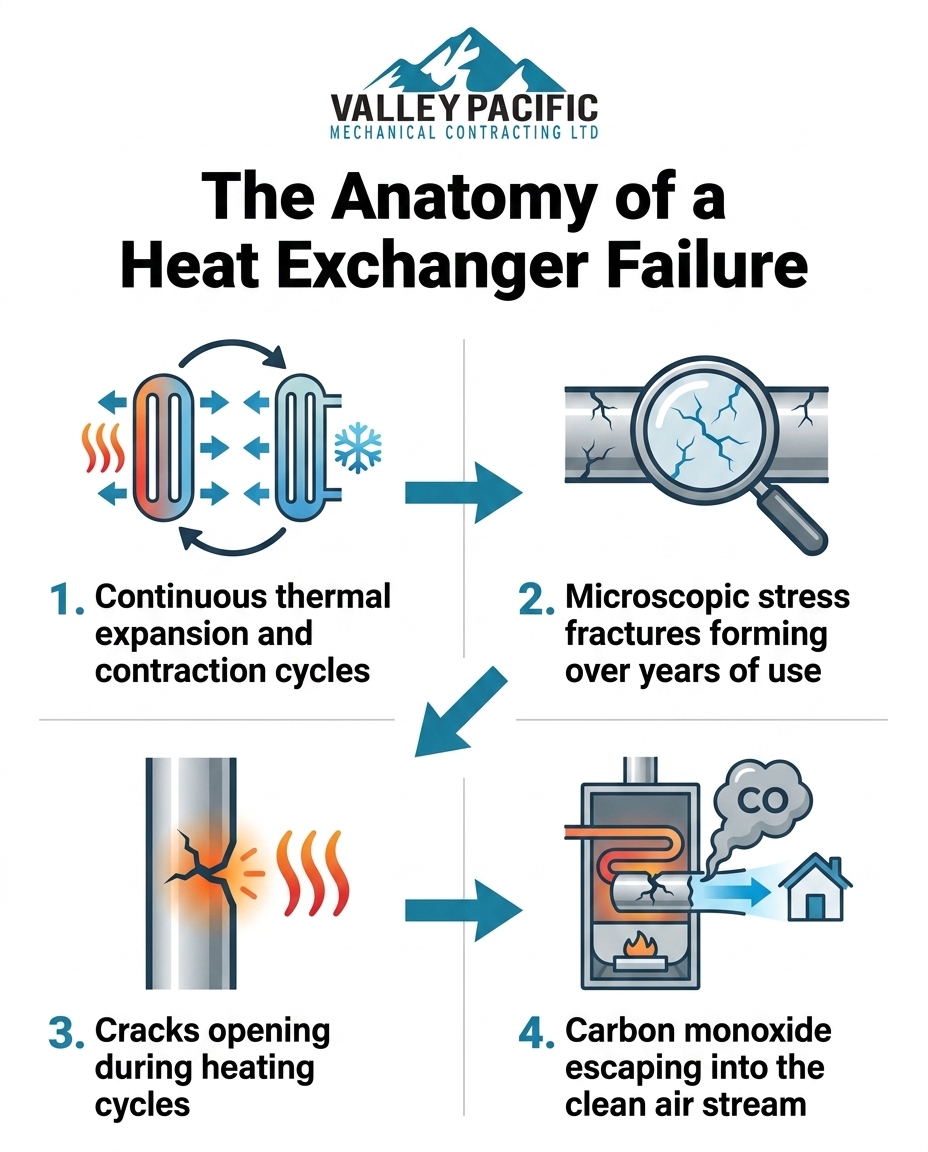
The Cause: The primary enemy of this metal wall is a process called thermal expansion and contraction. Every single time your thermostat calls for heat, the burners ignite, and the metal inside the furnace rapidly heats up, causing it to physically expand. Once the heating cycle finishes and the burners shut off, the metal cools down and contracts. Over thousands of cycles, this constant flexing takes a heavy toll.
The Solution: Regular professional monitoring is the only way to track this wear and tear. Because this degradation accelerates as the system ages, annual checks become absolutely non-negotiable for older units.
The Science of Metal Fatigue
Think of the metal inside your furnace like a paperclip. If you bend a paperclip back and forth once or twice, it holds its shape. If you bend it back and forth fifty times, the metal weakens, fatigues, and eventually snaps. The exact same principle applies to the heavy-duty steel or aluminized metal in your heating system.
• Microscopic stress fractures: Long before a crack is visible, microscopic stress fractures begin to form along the seams, curves, and weakest points of the metal.
• Temperature dependency: These fractures are often completely invisible to the naked eye when the furnace is cold. Because the metal has contracted, the microscopic cracks pull tightly shut, hiding the danger.
• Heat exposure: It is only when the metal heats up and expands that these fractures open wide enough to allow gases to escape.
The Silent Danger: How Cracks Lead to Carbon Monoxide Leaks
When a crack opens up during a heating cycle, the consequences are immediate and severe. The blower motor that pushes warm air into your living spaces creates a pressure difference. This pressure can actually pull toxic exhaust gases out of the combustion chamber, through the crack, and directly into your ductwork. From there, it is distributed into every room of your home.
The specific threat of carbon monoxide (CO) cannot be overstated. Carbon monoxide is a byproduct of incomplete combustion. It is a completely colorless, odorless, and tasteless gas, meaning human senses cannot detect it. You will not smell smoke, and you will not see soot in the air. The symptoms of low-level exposure—such as headaches, dizziness, and nausea—are frequently mistaken for the common winter flu.
Many homeowners rely entirely on standard, store-bought CO detectors to keep their families safe. While these devices are vital, they are a last resort, not a primary prevention strategy. Standard detectors are designed to sound an alarm only when carbon monoxide (CO) ppm levels reach a high, immediately life-threatening threshold. They often do not alert you to chronic, low-level leaks that can cause long-term health issues over weeks or months of continuous heating.
Even a microscopic breach in the metal can introduce dangerous levels of CO over prolonged periods. If your system is running constantly during a cold snap, that slow leak compounds, filling the home with toxic air while the standard detector remains silent.
Timing is Everything: The Stress of Rapid Temperature Drops
The urgency of fall maintenance is directly tied to the local climate. Maple Ridge and the broader Lower Mainland experience damp, chilly autumns that quickly transition into freezing, demanding winters. During the early fall, a heating system might only run for ten minutes at a time to take the chill out of the morning air. But as winter sets in, that same system is forced into sudden, heavy, and continuous usage to combat freezing outdoor temperatures.
Continuous heating cycles maximize the stress on aging metal components. A heat exchanger that has a minor, microscopic weakness in October can easily split into a dangerous, active crack by December when the unit is running non-stop. The rapid temperature drops leave no room for error.
Real-world reliability: Just last season, a local Maple Ridge homeowner reached out to our team at Valley Pacific Mechanical during the fall pre-winter in British Columbia because their equipment maintenance was overdue for both their boilers and heaters. We dispatched one of our experienced technicians to provide thorough, professional maintenance on the aging equipment. By having our team completely evaluate and verify the system before the freezing weather arrived, the homeowner gained the reassurance of knowing they had a reliable, safe setup ready to handle the heavy winter workload.
That peace of mind is exactly what professional fall maintenance delivers. It is about verifying the safety and integrity of the system before the extreme cold forces it to work at maximum capacity.
Beyond a Basic Tune-Up: Professional Diagnostic Techniques
It is important to clarify that a proper fall inspection is a critical life-safety measure, not just a mechanical tune-up to make the unit run a little quieter. Professionals do not simply glance at the metal and guess if it is safe; they use advanced diagnostic techniques to catch what the human eye cannot.
1. Visual Assessment and Cleaning: The process begins with clearing away soot and debris to get a clear view of the burner assembly and the exterior of the combustion chamber.
2. High-Definition Borescope Inspection: Because the heat exchanger is buried deep inside the furnace cabinet, technicians use flexible, high-definition inspection cameras (borescopes). These cameras snake through the narrow curves of the metal, looking for rust lines, stress marks, and hairline fractures that are otherwise impossible to see.
3. Combustion Analysis: This is the most crucial step. Technicians use a specialized tool to measure the exact exhaust gases inside the flue. By analyzing the carbon monoxide (CO) ppm levels and oxygen ratios, they can detect invisible breaches. If the oxygen levels fluctuate wildly when the blower fan turns on, it is a definitive sign that clean air is pushing through a crack and mixing with the exhaust.
In our experience working across the Lower Mainland, we have learned that homeowners value honesty over technical jargon. That is why at Valley Pacific Mechanical, our team believes in a fully transparent approach to this process. Our technicians walk customers through every step of the diagnostic evaluation. We show you the live camera feeds from the borescope and explain exactly what the gas readings mean. This ensures you fully understand the safety risks and the health of your system without ever feeling pressured or kept in the dark.
Routine service is often the only way these hidden dangers are uncovered before they cause harm. For example, during a routine service call, a technician discovered a severely cracked component in a customer's aging unit. Because it was caught proactively, the dangerous situation was resolved quickly, and the team replaced the furnace at a competitive cost, proving how we saved a customer from a cracked heat exchanger disaster before winter fully hit.
Why Visual Inspections Aren't Enough
A flashlight simply cannot do the job of a combustion analyzer. Because cracks only open when the metal is hot and expanded, a furnace that is turned off and cooled down will often look perfectly fine to the naked eye. Diagnostic tools bridge this gap, measuring the actual performance and exhaust output of the system while it is running under a full load, catching the invisible threats that visual inspections miss.
Why You Can't Rely on DIY Inspections
With the rise of online tutorials, our technicians frequently encounter well-meaning homeowners who attempt to inspect or diagnose their own heating equipment to save time. In our professional experience, when it comes to the combustion chamber, this is a dangerous mistake.
The risks of DIY: Accessing the internal components requires dismantling critical parts of the furnace cabinet, including gas lines, burner assemblies, and safety limit switches. This work should only ever be performed by licensed professionals. Untrained eyes cannot distinguish between normal surface wear, harmless rust, and dangerous, structural stress fractures.
Furthermore, tampering with combustion components can accidentally create new leaks, disrupt the carefully calibrated gas-to-air mixture, or instantly void your manufacturer warranties. Without a professional-grade combustion analyzer to measure the exact carbon monoxide (CO) ppm levels in the exhaust stream, you are essentially flying blind. There is no DIY substitute for professional, calibrated safety tools.
Navigating Repairs: What Happens When a Crack is Discovered?
The Problem: If our technicians discover a crack during your fall maintenance visit, the system will be shut down immediately for your safety. We often have to explain to customers that a cracked heat exchanger cannot be safely patched, welded, or repaired with high-heat tape. The structural integrity of the metal is permanently compromised, and it must be replaced.
The Cause for Decision: You will be faced with a critical decision matrix: do you replace just the broken component, or do you upgrade the entire furnace?
• Age of System — Replacing the Part Only: Best for units under 10 years old. — Replacing the Entire Furnace: Best for units over 12-15 years old.
• Warranty Status — Replacing the Part Only: Often covered by a 10-year or lifetime parts warranty. — Replacing the Entire Furnace: Labor costs for part replacement may exceed the value of an out-of-warranty unit.
• Future Reliability — Replacing the Part Only: Other aging parts (blowers, boards) may still fail soon. — Replacing the Entire Furnace: Resets the clock with full warranties and high-efficiency performance.
The Solution: Highlighting these issues during the fall pre-winter in British Columbia allows for planned, cost-effective solutions rather than panicked, emergency winter replacements when your house is freezing. Professionals will help you navigate your options, providing clear timelines for HVAC repair in Maple Ridge. They can also guide you toward potential generic energy rebates and utility incentives available for upgrading to safer, high-efficiency heating systems, making the transition as smooth as possible.
Frequently Asked Questions
Why is a cracked heat exchanger dangerous?
A cracked heat exchanger is dangerous because it allows toxic combustion gases to escape the sealed burner area. When a crack opens up, carbon monoxide and other exhaust fumes mix directly with the clean air being blown into your living spaces. This creates a severe life-safety risk, as carbon monoxide is a colorless, odorless gas that can cause serious health issues or fatalities if inhaled over time.
What causes a furnace heat exchanger to crack?
The primary cause of cracking is metal fatigue driven by continuous thermal expansion and contraction. Every time your furnace runs, the metal heats up and expands; when it shuts off, the metal cools and contracts. Over thousands of heating cycles, this constant flexing weakens the metal, eventually leading to microscopic stress fractures that grow into active cracks.
How do professionals check for a cracked heat exchanger?
Professionals use a combination of visual and diagnostic tools to thoroughly check the system. They use high-definition borescopes to inspect the deep, hidden curves of the metal for rust and stress marks. More importantly, they perform a combustion analysis to measure exact carbon monoxide levels and oxygen ratios in the exhaust, which reveals invisible leaks that cameras might miss.
Can a furnace run with a cracked heat exchanger?
Mechanically, a furnace might still turn on and produce heat with a cracked component, but it is incredibly dangerous to operate. Running a compromised system actively pumps toxic exhaust gases into your home's ductwork. If a professional discovers a crack, they are required to shut the system down immediately to protect the occupants from carbon monoxide exposure.
What are the symptoms of a cracked heat exchanger?
Common symptoms include soot buildup inside the furnace cabinet, strong formaldehyde-like odors near the vents, or a burner flame that flickers and turns yellow instead of burning a steady blue. You may also notice physical symptoms in your household, such as unexplained headaches, nausea, or dizziness while the heat is running, which are signs of low-level carbon monoxide exposure.
How long does a typical furnace heat exchanger last before cracking?
A well-maintained heat exchanger typically lasts between 15 and 20 years before the metal fatigue becomes severe enough to cause cracking. However, neglected systems that suffer from poor airflow, dirty filters, or frequent overheating can fail much sooner. Regular annual maintenance is the best way to ensure the component reaches its maximum lifespan safely.
Securing Your Home for the Winter
Catching a failing component before the freezing temperatures arrive is the smartest move a homeowner can make. By prioritizing a professional diagnostic inspection, you eliminate the guesswork and protect your household from invisible, dangerous gas leaks. Schedule your fall tune-up today to ensure you enjoy a clear, non-alarmist understanding of your system's health and the peace of mind that comes with safe, reliable winter heating.


