


Comparing Single-Zone vs. Multi-Zone Ductless Systems for Coquitlam Townhouses


The Townhouse Cooling Dilemma: Comfort vs. Strata Compliance
How do you upgrade your indoor climate control without running afoul of strict exterior property rules? When comparing single-zone vs. multi-zone ductless systems for Coquitlam townhouses, the decision often comes down to balancing your family's comfort with the rigid aesthetic bylaws of your strata council. At Valley Pacific Mechanical, a pattern we see often is homeowners struggling to adapt to our damp, chilly winters and increasingly hot BC summers. Year-round climate control is no longer just a luxury—it is essential for a livable home. However, introducing new mechanical equipment to a multi-family property requires careful planning.
The concrete problem for most townhouse owners is managing the upfront investment of a new system while adhering to rigorous exterior aesthetic guidelines. Because you share walls and property lines, you cannot simply place a compressor wherever it is most convenient. You face a primary decision point: choosing between one large multi-zone compressor to power your entire home, or installing multiple smaller single-zone units. Making the right choice ensures your new heat pump systems satisfy both your daily comfort needs and the strata council's strict requirements.
The core challenge:
• Shared aesthetics: Exterior walls are highly regulated to maintain a uniform look across the complex.
• Space limitations: Townhouse patios and balconies offer limited square footage for mechanical equipment.
• Acoustic boundaries: Close proximity to neighbors means noise levels are heavily scrutinized.
Understanding these unique constraints is the first step toward a successful, stress-free installation in Coquitlam strata townhomes.
Understanding BC Strata Constraints for HVAC Upgrades
Before selecting your equipment, you must understand the legal and structural framework that governs multi-family housing in British Columbia. In our years of providing residential heating and cooling services across Maple Ridge and Coquitlam, we've learned that standard installations must be carefully adapted for these specific environments, because the rules of ownership are fundamentally different than in a detached single-family home.
Under the BC Strata Property Act, the exterior walls, balconies, and roofs of your townhouse are typically classified as common property or limited common property. This means you do not have the unilateral right to alter them. Any modification—including drilling holes for refrigerant lines or placing a heavy compressor on a patio pad—requires formal, written approval from your strata council before work begins.
The strata approval process generally follows these sequential steps:
1. Review the bylaws: Obtain and review your specific strata corporation's current bylaws regarding exterior modifications and noise restrictions.
2. Submit a formal proposal: Prepare a detailed package outlining the proposed equipment, exact placement, noise ratings, and visual impact.
3. Council review: The strata council reviews the proposal at their monthly meeting to ensure it does not negatively impact neighboring units or the building's envelope.
4. Sign an indemnity agreement: If approved, you will likely need to sign an assumption of liability agreement, taking responsibility for any future maintenance or damage related to the installation.
The number of exterior units you propose directly impacts the complexity of this process. A proposal asking to install three separate compressors on the exterior of the building will face much harsher scrutiny than a proposal for a single, strategically hidden unit. Strata councils are primarily concerned with preserving the uniform appearance of the building exterior and preventing nuisance noise for your neighbors.
Single-Zone Configurations: Smaller Footprints, More Units
A single-zone system consists of one indoor air-handling head paired with one dedicated outdoor compressor. If you want to heat and cool three different rooms in your townhouse using single-zone systems, you will need to install three separate indoor heads and three separate outdoor compressors.
The primary advantage of a single-zone configuration is the physical size of the outdoor equipment. Because each compressor only powers one indoor unit, the exterior footprint is quite small. These compact units can often be tucked into tight patio corners, placed beneath stairwells, or hidden behind existing privacy screens. Furthermore, single-zone systems offer complete mechanical redundancy. If one compressor requires maintenance or encounters an issue, the other units in your home will continue operating normally, ensuring you are never left entirely without heating or cooling.
However, the major drawback in a townhouse environment is the sheer volume of equipment. Installing multiple units means placing more machinery on the exterior of the building. This requires more electrical disconnects, more concrete pads or wall brackets, and multiple penetration points through the building envelope. For a strata council focused on minimizing exterior clutter, our technicians frequently see requests for three or four separate compressors met with immediate pushback.
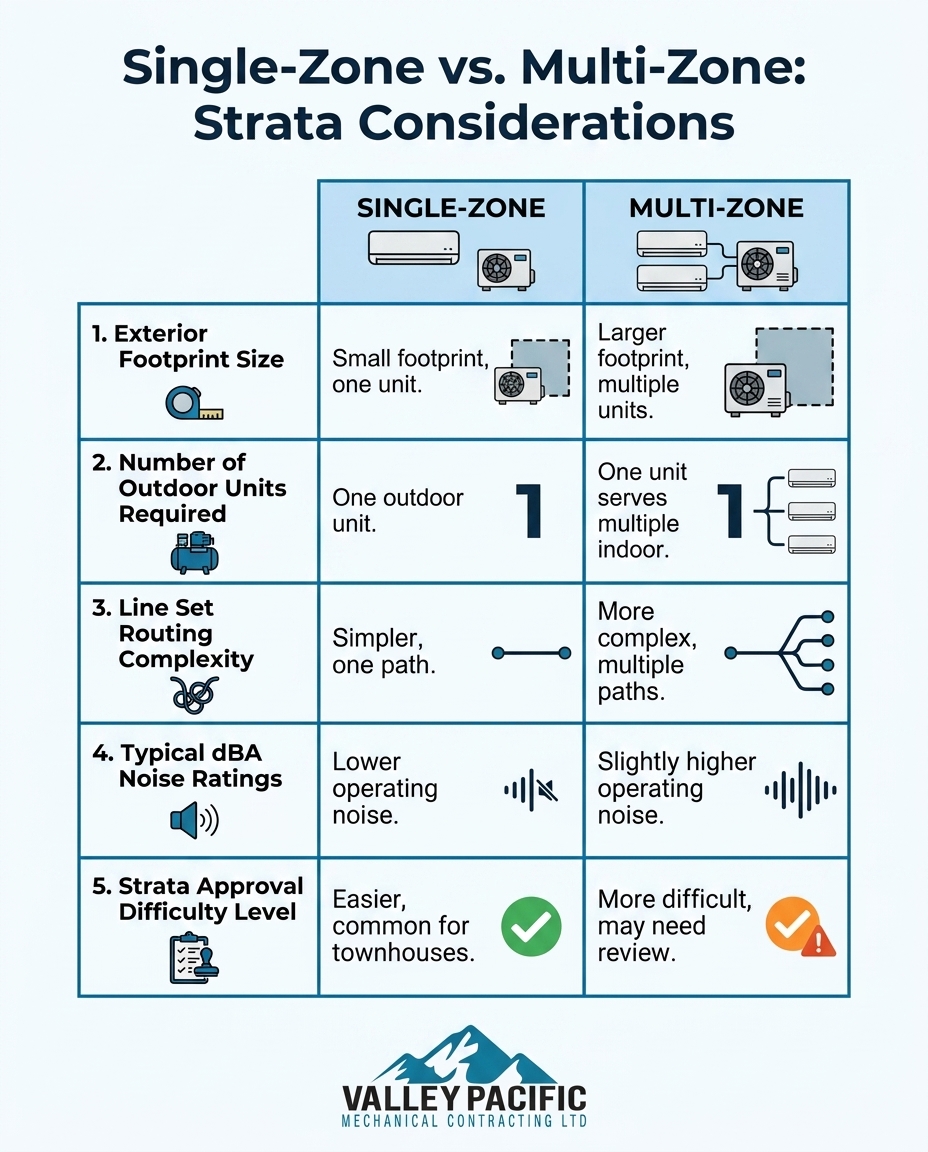
• Exterior Footprint — Single-Zone Advantages: Individual units are compact and easy to hide in tight spaces. — Single-Zone Disadvantages: Requires multiple outdoor units, cluttering patios or exterior walls.
• Strata Approval — Single-Zone Advantages: Smaller units may fall under specific size exemptions (rare). — Single-Zone Disadvantages: Multiple units often trigger aesthetic and noise rejections from councils.
• Redundancy — Single-Zone Advantages: High redundancy; if one unit fails, the others continue running. — Single-Zone Disadvantages: Requires multiple electrical circuits and disconnect switches.
• Line Set Routing — Single-Zone Advantages: Short, direct runs from the indoor head to the outdoor unit. — Single-Zone Disadvantages: Multiple penetration points through the common property exterior wall.
Multi-Zone Configurations: Centralized Power, Larger Footprint
A multi-zone system takes a different approach. It utilizes one large outdoor compressor to power two, three, four, or even five separate indoor heads. When evaluating multi-zone vs. single-zone ductless exterior compressors, our team typically recommends the multi-zone option as the preferred path for strata-controlled properties.
The most significant benefit of a multi-zone configuration is that it drastically reduces the total number of exterior units. Instead of three or four compressors cluttering your patio, you have just one. Strata councils heavily favor this approach because it minimizes the visual impact on the building's exterior and reduces the number of structural modifications required. You only need one concrete pad, one main electrical disconnect, and one localized area for maintenance.
The trade-off is the physical size and weight of that single centralized unit. A multi-zone compressor must house a larger coil, a more powerful fan, and a heavier internal compressor to handle the increased load of multiple indoor heads. This results in a larger physical footprint and higher localized weight. If you are placing the unit on a wooden balcony, the structural load must be considered.
Additionally, routing the refrigerant lines (line sets) becomes more complex. Because all indoor units must connect back to the single outdoor compressor, the line sets must travel longer distances through the home or along the exterior walls. This requires careful planning to ensure the lines are bundled cleanly and do not detract from the building's appearance.
• Exterior Footprint — Multi-Zone Advantages: Consolidates all mechanical equipment into one single location. — Multi-Zone Disadvantages: The single unit is taller, wider, and significantly heavier.
• Strata Approval — Multi-Zone Advantages: Highly favored by councils due to reduced exterior visual clutter. — Multi-Zone Disadvantages: May require structural verification if placed on an elevated balcony.
• Efficiency — Multi-Zone Advantages: Highly efficient centralized power management for the whole home. — Multi-Zone Disadvantages: If the single outdoor compressor fails, all indoor zones lose conditioning.
• Line Set Routing — Multi-Zone Advantages: Only one primary staging area for exterior connections. — Multi-Zone Disadvantages: Requires bundling multiple line sets, which can look bulky if not covered.
Navigating Coquitlam Noise Bylaws at the Property Line
When you live in a townhouse, your exterior walls and patios are often just feet away from your neighbor's living space. This makes acoustic performance one of the most critical factors in securing strata approval. As we often remind our clients, you are not just dealing with strata rules; you must also comply with municipal regulations.
The municipal standard: The City of Coquitlam Noise Control Bylaw regulates continuous sound levels at property lines. Because townhouse property lines are extremely tight, the noise generated by your outdoor compressor will be measured from a very short distance. If your system exceeds the allowable decibel limit, you could face municipal fines and be forced by your strata to remove the equipment.
Fortunately, modern ductless systems are engineered for whisper-quiet operation, often producing sound levels between 45 and 55 decibels (dBA)—roughly equivalent to a quiet conversation or a hum of a refrigerator. However, noise is cumulative. If you install three single-zone compressors on your patio, the combined acoustic output will be higher than the rating of a single unit. This cumulative noise effect is a common reason strata councils reject multi-compressor proposals.
Winter operations matter: It is also vital to plan for year-round acoustics. While we often think of these systems for summer cooling, robust defrost cycles during damp coastal winters can temporarily increase operational noise. When the system shifts into defrost mode to clear ice from the outdoor coil, the compressor ramps up. Submitting accurate, manufacturer-verified dBA ratings that account for both heating and cooling modes is essential for your strata proposal. A single multi-zone compressor usually offers a more predictable and easily managed acoustic footprint than a bank of single-zone units running simultaneously.
Managing Exterior Aesthetics and Line Set Routing
Even if your proposed system meets all noise bylaws, it can still be rejected if it looks unsightly. Strata councils are fiercely protective of the building's exterior appearance, which means the visual impact of your installation must be carefully managed.
The most visible component of a ductless mini-split installation is often not the compressor itself, but the line sets—the insulated copper pipes that carry refrigerant between the indoor and outdoor units. If these lines are routed haphazardly across common property walls, they create an eyesore.
Bundling vs. spreading out: With a single-zone approach, you might have multiple line sets exiting the building at different locations, creating visual clutter. With a multi-zone system, the lines can often be bundled together and routed down a single path. To mitigate aesthetic concerns, professional installers use rigid, color-matched line set covers (often called slim ducts). These covers encase the bundled lines in a sleek, architectural channel that can be painted to match the townhouse siding perfectly, rendering them nearly invisible from the street.
Working with our team at Valley Pacific Mechanical means you benefit from our deep, first-hand experience navigating strata regulations. We provide tailored, minimally invasive mechanical installations specifically designed to pass these strict aesthetic reviews. When you submit your proposal, providing professional schematics, photographs of the proposed line set covers, and a clear plan for minimizing visual impact demonstrates to the council that you are respecting the building's integrity. A well-documented aesthetic plan is often the difference between a swift approval and a frustrating rejection.
Upfront Investment and Long-Term Value for Townhome Owners
Choosing between single-zone and multi-zone systems ultimately involves evaluating the upfront investment against the long-term value added to your property. While we cannot provide specific pricing here, understanding the financial dynamics of each approach will help you make an informed decision.
Generally, purchasing one large multi-zone compressor is a different investment dynamic than buying multiple smaller single-zone units. While a multi-zone compressor represents a larger single piece of equipment, it streamlines the exterior electrical work and pad preparation. Conversely, buying multiple single-zone units might seem modular, but the cumulative cost of multiple electrical disconnects, extensive wiring, and individual mounting hardware can quickly add up. For a deeper dive into how these systems compare financially to traditional centralized cooling, you can review a cost comparison of mini-splits versus central AC.
• Rebates and Incentives: General provincial and utility rebates may apply to qualifying high-efficiency installations. Be sure to verify current programs with your utility provider or a tax professional. Keep in mind that securing your strata approval is a mandatory prerequisite before any work can begin or rebates can be claimed.
• Property Value: A professionally installed, strata-compliant ductless system significantly enhances the resale value of a townhouse, offering prospective buyers the premium comfort of year-round climate control.
• Payment Flexibility: Upgrading your home's mechanical systems is a major improvement. Exploring HVAC system financing options provides flexible payment pathways to help manage the initial investment while you immediately enjoy lower monthly energy bills.
Comparing Overall Installation Scope
The scope of the installation heavily influences the final investment. One recent project our installation team completed involved coordinating an HVAC upgrade alongside multiple ongoing townhouse construction upgrades. By carefully staging the mechanical work to meet the overall schedule, we delivered perfect results without delaying the wider renovation timeline.
Labor considerations: Mounting one large multi-zone unit requires less repetitive labor on the exterior than mounting three individual units. However, routing multiple line sets through the interior walls of a finished townhouse to reach that single multi-zone compressor can increase the interior labor time. Your contractor will assess the layout of your specific townhouse—whether you have accessible crawlspaces, attic routes, or require exterior line hides—to determine which configuration offers the most efficient and cost-effective installation path.
FAQ
Which is better for a townhouse: single-zone or multi-zone?
A multi-zone system is generally better for townhouses because it requires only one outdoor compressor. This minimizes the exterior footprint, reduces visual clutter, and is much more likely to be approved by strict strata councils. Single-zone systems work well if you only need to condition one specific room, but outfitting a whole home with them creates too much exterior equipment.
How do I get strata approval for a ductless mini split in BC?
You must submit a formal, written proposal to your strata council before beginning any work. This proposal should include detailed equipment specifications, dBA noise ratings, exact placement diagrams, and a plan for color-matched line set covers. Working with an experienced contractor who provides these professional schematics greatly increases your chances of a smooth approval.
Are multi-zone compressors louder than single-zone?
A single multi-zone compressor may have a slightly higher individual decibel rating than one small single-zone unit. However, if you run three single-zone units simultaneously, the cumulative noise is often louder and more disruptive than one multi-zone unit. Modern multi-zone compressors still operate well within municipal noise bylaws, typically around 45 to 55 decibels.
How much exterior space does a multi-zone compressor need?
A multi-zone compressor typically requires a dedicated concrete pad or heavy-duty wall bracket, roughly 3 to 4 feet wide and 1 to 2 feet deep. It also requires adequate clearance around the unit for proper airflow and future maintenance. Your installer will verify that your patio or balcony has the structural capacity and spatial clearance required.
Can I add another zone to my mini split later if my strata allows it?
Yes, if you install a multi-zone compressor with available port capacity, you can add another indoor head later. For example, you can install a compressor capable of running four zones, but initially only connect three. Adding the fourth zone later will still require routing a new line set, which may require a secondary strata approval for the exterior aesthetic changes.
What happens if my strata council rejects my initial heat pump proposal?
If your proposal is rejected, the council must provide a reason based on their bylaws. Common reasons include excessive noise ratings, poor placement, or unsightly line sets. You can then work with your HVAC contractor to revise the plan—such as switching from multiple single-zone units to one multi-zone unit, or upgrading the line set covers—and resubmit the proposal for approval.
Making the Right Choice for Your Townhome
Comparing single-zone vs. multi-zone ductless systems for Coquitlam townhouses requires looking beyond just heating and cooling capacity. It demands a strategic approach to strata bylaws, exterior aesthetics, and municipal noise regulations. By choosing a system designed to minimize exterior clutter while maximizing indoor comfort, you ensure a smooth approval process and a solid long-term investment. Based on our extensive experience serving local townhome communities, a clear, strata-focused installation plan provides the perfect balance, delivering the customized climate control your family deserves without compromising the standards of your community.


