


Repairing vs. Replacing a Noisy Bathroom Exhaust Fan


Is It Time to Fix or Ditch That Rattling Bathroom Fan?
Is your morning routine constantly interrupted by a bathroom fan that sounds like a jet engine, yet still leaves your mirror completely fogged up? In our years of serving homeowners across Maple Ridge, one of the most common complaints our team at Valley Pacific Mechanical Contracting Ltd. hears is about inadequate bathroom ventilation. If you are weighing the options of repairing vs. replacing a noisy bathroom exhaust fan, making the right call depends on more than just silencing the rattle. A fan that makes excessive noise while failing to clear steam is doing more than just annoying you—it is failing to protect your home from trapped moisture.
Many homeowners assume that a loud fan simply needs a quick part swap. However, our technicians often find that the decision comes down to weighing the hidden labor time of sourcing and swapping a replacement motor against the long-term benefits of installing a completely new, high-efficiency housing. In a region that experiences heavy, damp BC winters, we see firsthand how inadequate moisture extraction can quickly lead to peeling paint, warped fixtures, and hidden mold growth. Choosing the right path ensures your bathroom remains dry, quiet, and comfortable year-round. If you need guidance on evaluating your home's ventilation, exploring professional residential mechanical services is the best way to secure a lasting solution.
Diagnosing the Rattle: Why Your Fan is Failing
Before deciding how to fix the problem, you need to understand exactly what is causing that harsh mechanical drone above your shower. Bathroom exhaust fans operate in a uniquely hostile environment. Every time you turn the unit on, it pulls warm, moisture-laden air, along with airborne dust, hairspray, and lint, directly through its mechanical components. When our team opens up a struggling unit, we typically see a few consistent patterns.
Failing Motor Bearings: The most common culprit we encounter behind a sudden, grinding noise is worn-out motor bearings. Over years of use, the constant exposure to high humidity strips away the factory lubrication inside the motor. Once the bearings run dry, metal grinds against metal, creating a high-pitched squeal or a heavy rattling sound.
Severe Dust Buildup and Imbalanced Blower Wheels: The blower wheel (the plastic or metal fan blade inside the housing) is designed to spin in perfect balance. When sticky, damp dust accumulates unevenly on the blades, it throws the wheel off balance. This imbalance causes the entire spinning assembly to wobble violently, sending vibrations straight into your ceiling joists.
Degrading Housings: Older fan housings are typically made of thin sheet metal that naturally degrades, rusts, or loosens over time. As the mounting screws back out or the metal warps from years of temperature fluctuations, the housing itself becomes an amplifier for any minor motor vibration.
A noisy fan is almost always a sign that the unit is working much harder than it should. It pulls more electrical power while moving significantly less air. If you want to dig deeper into the specific mechanics of this problem, you can read our detailed breakdown on why your bathroom exhaust fan sounds like an airplane engine. Ultimately, understanding your unit's baseline CFM (Cubic Feet per Minute) and Sone (noise) ratings will help you determine if the existing hardware is even worth saving.
The Case for Motor Replacement: Pros, Cons, and Hidden Limits
At first glance, swapping out a burnt motor seems like the most logical and least invasive path. A motor replacement rarely requires altering the ceiling drywall, and you do not have to venture into the attic to disconnect the main exhaust duct. However, in our daily service calls, we find that a motor-only repair comes with a specific set of challenges and limitations that are often overlooked until the project is already underway.
Pros of Motor Replacement:
• No drywall patching: The existing metal housing stays mounted in the ceiling, meaning you avoid cutting, patching, and painting drywall.
• Familiar wiring: The electrical connections generally remain in the same configuration, provided you find an exact match for the motor plug.
• Potentially faster installation: If you have the correct replacement part in hand, swapping the internal assembly can take less time than a full unit tear-out.
Cons of Motor Replacement:
• The hidden labor of sourcing parts: Finding an exact-match motor for a fan installed fifteen years ago is incredibly difficult. Manufacturers constantly discontinue older lines.
• Vibration issues remain: If the original metal housing is warped or rusted, putting a smooth-running new motor inside it will not stop the rattling.
• Stagnant performance: A new motor will only restore the fan to its original performance level, which is often severely undersized for modern moisture control standards.
The Challenge of Sourcing Obsolete Parts
Manufacturers frequently update their housing designs, making exact-match motors difficult to locate for units over a decade old. Many homeowners attempt to use universal motor replacement kits. While these kits exist, our technicians caution against them because they often require manual modifications—such as cutting mounting brackets or splicing wires—that completely negate any time saved. Furthermore, mismatched parts can lead to immediate rattling and premature failure, leaving you right back where you started.
The Ceiling of Existing Capabilities
The most critical limitation we point out regarding a motor swap is that it cannot exceed the original CFM rating of the housing. The physical dimensions of the metal box and the size of the exhaust outlet dictate how much air can move through the system. If your bathroom was expanded during a renovation, or if the original builder installed a fan that was too weak for the square footage, a motor repair will not solve your underlying condensation issue. Your mirror will still fog up, and moisture will continue to linger long after you leave the room.
When a Full Unit Upgrade Makes Sense for Moisture Control
If your current fan is struggling to clear steam, leaving condensation dripping down your walls, we almost always recommend a full unit upgrade as the most effective long-term strategy. Wet, humid Maple Ridge winters demand optimal moisture control to prevent mold, mildew, and structural damage. In this climate, our team considers a bathroom fan not just a convenience—it is a critical piece of your home's mechanical defense system. Upgrading the entire unit is often much safer and more effective than applying a band-aid fix to an outdated motor.
Modern ultra-quiet fans are engineered with advanced aerodynamics. Instead of the flat, choppy blades found in older models, modern blower wheels are designed to scoop and push air smoothly. This allows them to operate at significantly lower RPMs while moving vastly more air, resulting in a whisper-quiet experience. Because full unit replacements fall under new mechanical installations, the process ensures that the entire system—from the ceiling grille to the exterior roof cap—is properly sized and securely sealed.
Meeting Modern CFM Standards
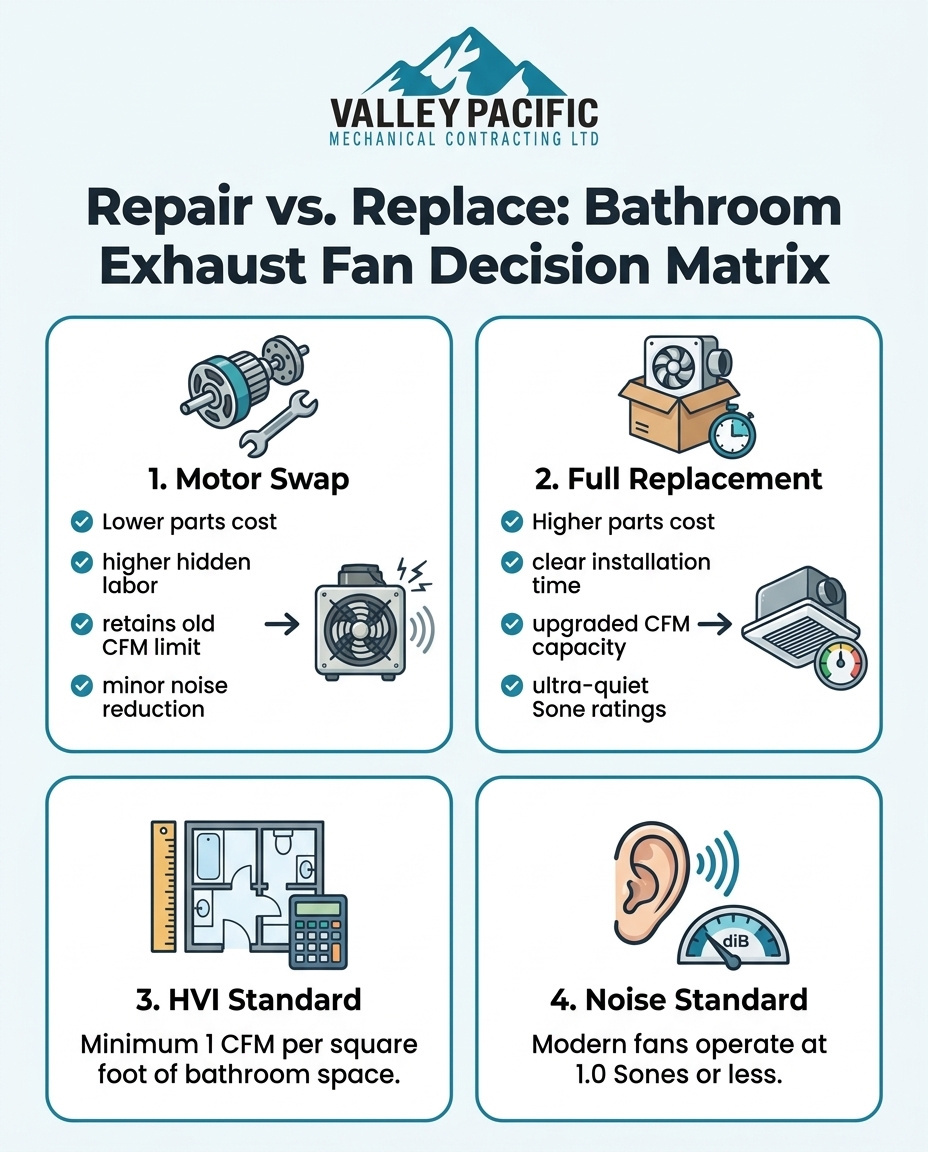
The Home Ventilating Institute (HVI) recommends at least 1 CFM of ventilation per square foot of bathroom space. For bathrooms larger than 100 square feet, the calculation shifts to account for specific fixtures (like adding 50 CFM for every toilet, shower, or tub). We regularly find that many older fans max out at 50 CFM, which is woefully inadequate for a standard primary bathroom.
1. Proper sizing prevents condensation: By upgrading to a unit with an appropriate CFM rating (often 80 to 110 CFM or higher), steam is evacuated before it has the chance to condense on your walls and fixtures.
2. Overcoming duct resistance: Modern fans have stronger static pressure capabilities, meaning they can effectively push air through long duct runs or multiple elbows without losing performance.
3. Smart feature integration: A full replacement allows you to install units with built-in humidity sensors. These sensors automatically trigger the fan when moisture spikes, ensuring the bathroom is ventilated even if someone forgets to flip the switch.
Achieving Ultra-Quiet Sone Ratings
Noise levels for exhaust fans are measured in Sones. A Sone is a linear measurement of sound; 2.0 Sones is twice as loud as 1.0 Sone. We frequently replace older, builder-grade fans operating at 4.0 Sones or higher—which sounds similar to a loud television or a busy office.
Modern housings are vastly superior at dampening vibration. By utilizing rubberized mounting brackets, enclosed condenser motors, and insulated metal boxes, today's premium fans frequently operate at 1.0 Sones or less. Some models are so quiet (0.3 Sones) that they include an LED indicator light just so you know they are running. Contrasting the peaceful experience of a modern fan with the harsh mechanical drone of an outdated unit makes the value of a full replacement immediately apparent to our clients.
Head-to-Head: Motor Replacement vs. Full Unit Installation
To make the best decision for your home, we find it helps to look at the direct trade-offs between a motor-only repair and a full unit installation. Both approaches require time and effort, but they yield very different results when it comes to CFM and Sone ratings.
• Moisture Clearing (CFM) — Motor Replacement Only: Limited to the original housing's maximum capacity (often undersized). — Full Unit Installation: Upgraded and properly sized to meet modern HVI standards for your room.
• Noise Reduction (Sones) — Motor Replacement Only: Minor improvement; old metal housings still vibrate and amplify sound. — Full Unit Installation: Near-silent operation; modern units often run at 1.0 Sones or less.
• Labor & Time Investment — Motor Replacement Only: High hidden labor in sourcing obsolete parts; moderate installation time. — Full Unit Installation: Upfront labor for ceiling modifications; clear, predictable installation process.
• Long-Term Reliability — Motor Replacement Only: Moderate; old housing and wiring may still fail or rust over time. — Full Unit Installation: High; brand new components, sealed housing, and modern warranties.
• Smart Features — Motor Replacement Only: Not applicable; relies on existing standard wall switch. — Full Unit Installation: Can include integrated humidity sensors, motion detectors, and LED lighting.
While a motor replacement might save you from minor drywall work today, a full unit installation guarantees that your bathroom is protected against the heavy moisture loads typical of damp BC winters for years to come.
How Professional Assessment Prevents Guesswork
Attempting to fix a ventilation issue through trial and error is incredibly frustrating. Blind parts-swaps often lead to repeated service calls, wasted time, and ongoing moisture problems. When a homeowner simply guesses at the required fan size or attempts to force a universal motor into an incompatible housing, we typically see the root cause of the poor ventilation remain unaddressed. This is why a professional assessment is so vital.
A thorough evaluation goes far beyond just listening to the rattle. Professional technicians across local service areas will physically measure your bathroom's square footage to calculate the exact CFM required. They will also inspect the existing ductwork condition. If your current fan is connected to a crushed, uninsulated, or overly long duct run, even the most powerful new motor will fail to move air effectively. Technicians will verify the roof or wall cap clearance to ensure the flapper valve opens fully, preventing backdrafts from pushing cold air back into your home.
At Valley Pacific Mechanical Contracting Ltd., we focus on a transparent evaluation process. Instead of just offering a blind parts-swap, we walk customers through every step to assess their actual CFM needs. We evaluate the static pressure of your ducting, discuss your Sone rating preferences, and provide a clear picture of what it will take to properly ventilate the space. This proper diagnostic approach saves time and ensures you understand the true cost-benefit of your choice, allowing you to invest in a solution that actually works.
Clear the Air: Partnering with Local Ventilation Experts
A clear, professional comparison of labor expectations and performance outcomes is essential for your home's long-term health. Repairing vs. replacing a noisy bathroom exhaust fan is not just about eliminating a frustrating sound; it is about ensuring your home can effectively manage the heavy moisture loads brought on by damp BC winters. Our team knows that proper ventilation protects your drywall, your paint, and your family's respiratory health by keeping mold and mildew at bay.
You do not have to live with a fan that sounds like a jet engine and performs like a gentle breeze. By evaluating your room's specific CFM and Sone rating requirements, you can make an informed decision that adds lasting value and comfort to your daily routine. If you are ready to stop guessing and start fixing, reach out for professional HVAC repair in Maple Ridge. Local experts can help you weigh your options, inspect your current setup, and execute the right long-term solution to keep your air clear and your home protected.
Frequently Asked Questions
Is it better to replace a bathroom fan motor or the whole unit?
Replacing the whole unit is generally the better option if your current fan is over ten years old, undersized for the room, or excessively loud. While a motor swap might seem like a quick fix, it retains the original, often inefficient metal housing. A full replacement ensures you meet modern ventilation standards and achieve significantly quieter operation.
Why is my bathroom exhaust fan so loud?
Excessive noise is usually caused by worn-out motor bearings, a heavy accumulation of dust throwing the blower wheel off balance, or a degraded metal housing that vibrates against the ceiling joists. Over time, the lack of lubrication in the motor causes metal components to grind, creating a harsh rattling or squealing sound. Cleaning the unit can sometimes help, but persistent noise usually indicates mechanical failure.
Can you just replace the motor in a bathroom fan?
Yes, you can replace just the motor if you can find an exact match for your specific fan model and housing. However, sourcing obsolete parts can be difficult, and universal replacement kits often require frustrating manual modifications. Furthermore, a new motor will not increase the fan's original moisture-clearing capacity.
How do I know if my exhaust fan has the right CFM for my bathroom?
The general rule established by the Home Ventilating Institute is that you need 1 CFM of ventilation for every square foot of bathroom space, up to 100 square feet. For larger bathrooms, you add CFM based on the fixtures present (e.g., 50 CFM for a shower or tub). A professional assessment can precisely calculate your needs while factoring in the length and layout of your exhaust ducting.
What is considered a good Sone rating for a quiet bathroom fan?
A Sone rating of 1.0 or less is considered very quiet and is the standard for most premium modern exhaust fans. For comparison, a rating of 4.0 Sones is roughly equivalent to the sound of a standard television or a normal conversation. Upgrading to a fan with a rating between 0.3 and 1.0 Sones will provide a virtually silent experience.


