


Preparing Commercial Gas Fitting Systems for the Pacific Northwest Winter


The High Stakes of Winterizing Coastal BC Commercial Gas Systems
Before the first deep freeze hits, there is a critical window to address your facility's mechanical vulnerabilities. Preparing commercial gas fitting systems for the Pacific Northwest winter is not something that can wait until the frost arrives. The unique climate of coastal British Columbia—where heavy atmospheric rivers are frequently followed by sudden, sharp cold snaps—creates a perfect storm for mechanical failure. In our experience working on commercial systems across Maple Ridge and the broader BC region, we see firsthand how exposed gas lines and regulators fall victim to these rapid shifts, resulting in operational downtime and severe safety hazards that can bring an entire facility to a standstill.
To protect your infrastructure, facility managers must transition from reactive emergency repairs to proactive commercial mechanical services, ensuring comprehensive commercial project services are in place before the weather turns.
Our team at Valley Pacific knows that true winterization requires experienced mechanical professionals who understand local building demands. A pattern we see often is facilities relying on basic visual checks—but coastal BC winter freezing and moisture demand a rigorous, professional approach to secure exposed lines, verify regulator integrity, and ensure uninterrupted fuel delivery. Shifting your strategy toward proactive capital planning is the only way to safeguard your operations before the first deep freeze takes hold.
Understanding the Coastal BC Freeze-Thaw Threat to Gas Infrastructure
The transition from heavy coastal rain to sub-zero temperatures poses a severe physical threat to exposed mechanical infrastructure. Our technicians typically observe the most catastrophic failures when commercial gas systems are subjected to high coastal moisture. Water inevitably finds its way into microscopic surface abrasions, joint threads, and regulator vents, setting the stage for system lockouts once the temperature plummets.
The core issue lies in the rapid freeze-thaw cycle specific to the Pacific Northwest. Water expands by approximately 9% when it freezes. When this expansion occurs inside the delicate components of a gas regulator or within compromised pipe fittings, it creates immense mechanical stress. Over time, this repeated expansion and contraction degrades the structural integrity of the metal and the seals.
Addressing these specific coastal BC winter freezing and moisture threats requires professional methodology. A licensed gas contractor must evaluate the physical condition of the infrastructure and implement targeted defenses against ice expansion. Basic maintenance routines simply cannot account for the physics of rapid temperature drops on moisture-laden equipment.
The Physics of Ice Expansion on Exposed Fittings
To fully grasp the risk, it is helpful to understand how micro-fissures evolve into major hazards. When water freezes and expands, it acts like a wedge. A tiny fissure that holds a fraction of a millimeter of water will be forced wider during a cold snap. When the ice melts, a larger void is left behind, ready to collect even more water during the next atmospheric river.
This compounding effect means that successive freeze-thaw cycles throughout the BC winter exponentially increase the risk of failure. By January, a regulator that looked perfectly fine to an untrained eye in October may be completely compromised.
• Atmospheric River (Heavy Rain) — Physical Impact on Gas Infrastructure: Moisture saturates exposed joints, insulation gaps, and regulator vents. — Long-Term System Risk: Creates the baseline condition for ice expansion and accelerates corrosion.
• Sudden Cold Snap (Freezing) — Physical Impact on Gas Infrastructure: Trapped water expands by 9%, forcing joints apart and blocking moving parts. — Long-Term System Risk: Causes immediate pressure drops, structural micro-fractures, and system lockouts.
• Thawing Period (Warming) — Physical Impact on Gas Infrastructure: Ice melts, leaving behind widened fissures that collect more moisture. — Long-Term System Risk: Compounds damage, ensuring the next freeze cycle causes exponentially worse structural harm.
Strategic Capital and Maintenance Planning for Facility Managers
Transitioning away from reactive emergency repairs is a crucial step for any commercial property owner. As a proudly Indigenous-owned mechanical partner with Métis leadership and Cree roots, Valley Pacific brings proven, community-scale experience to facility management. Having retrofitted over 700 community homes, managed 410+ installs for the Squamish Nation, secured 175 fully funded projects for the Sts'ailes Nation, and driven the active Laxgalts'ap program, we understand that true reliability comes from long-term vision, not quick fixes.
Through our Valley Pacific Community Energy Retrofit Program (VCERP), we integrate gas system health directly into your broader facility asset management strategy. Rather than waiting for a regulator to freeze and shut down your heating system in the middle of a January snowstorm, strategic capital planning allows you to identify and resolve vulnerabilities on your own schedule. This methodology leverages our deep commercial gas fitting expertise to protect your operations and maximize eligibility for federal, CleanBC, and FortisBC funding pathways.
Long-term planning also protects your operational budgets. Emergency dispatch, expedited parts shipping, and unplanned facility downtime carry a significant financial impact. By assessing the lifespan and condition of your gas infrastructure in the autumn, you can allocate resources efficiently and avoid the chaos of mid-winter system failures.
Moving Beyond Reactive Winter Repairs
The difference between reactive repairs and planned maintenance is profound. Reactive repairs guarantee facility downtime, often at the most inconvenient and dangerous times of the year. Planned maintenance, conversely, ensures seamless operation and predictable facility management.
• Lifecycle tracking: Monitoring the age and wear of critical gas regulators to schedule replacements before they fail.
• Vulnerability mapping: Identifying which sections of exposed piping are most susceptible to coastal winds and freezing rain.
• Integrated scheduling: Aligning gas system checks with broader mechanical and HVAC maintenance to minimize disruption to your tenants or operations.
• Regulatory alignment: Ensuring all upgrades and protective measures meet current Technical Safety BC mandates well ahead of required inspection dates.
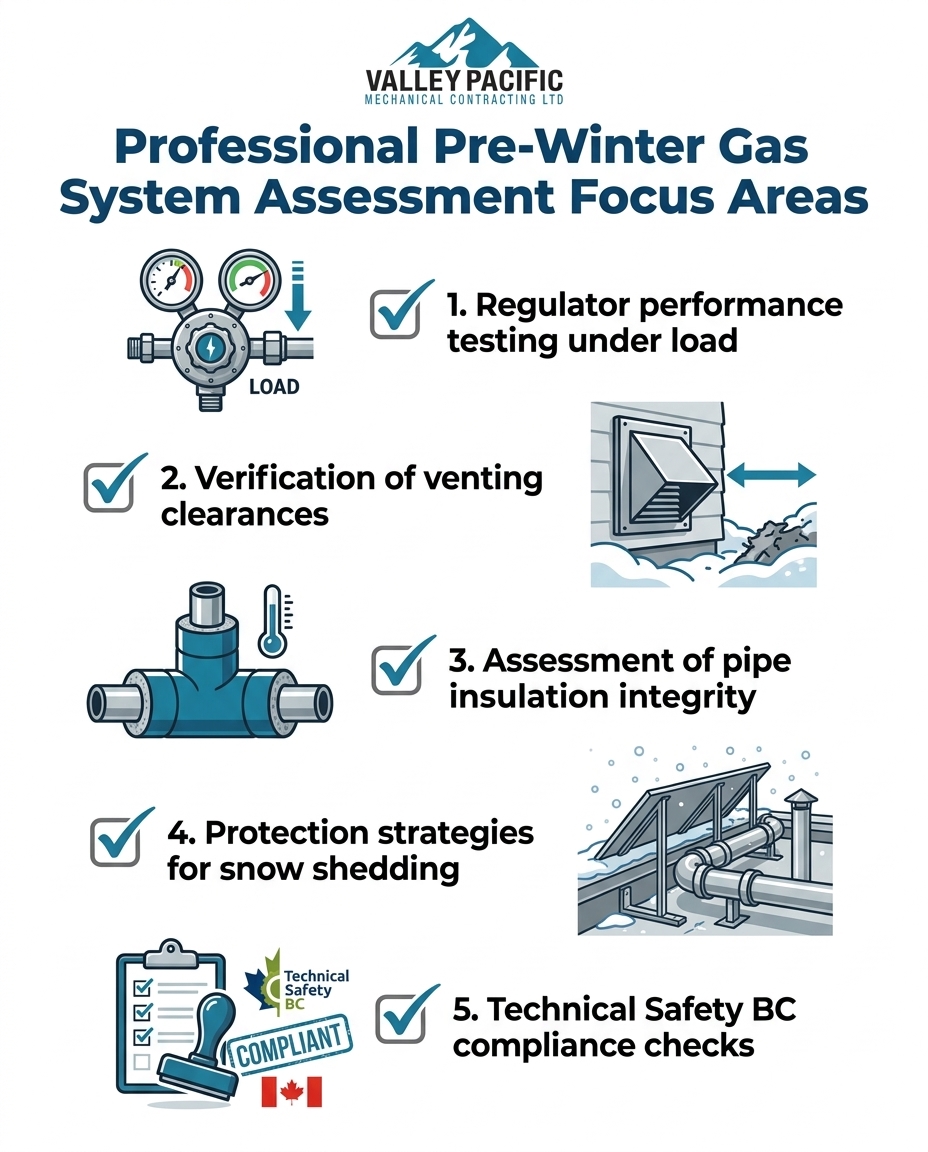
Professional Pre-Winter Gas System Assessment Focus Areas
When our licensed technicians arrive on-site to evaluate a commercial facility, we follow a rigorous methodology designed specifically for the Pacific Northwest climate. Technical Safety BC strictly mandates that only licensed gas contractors perform maintenance on these systems, as the risks associated with improper handling are severe. In our experience, a professional pre-winter assessment must go far beyond a visual once-over.
Our commercial gas fitting expertise and maintenance planning dictate a comprehensive evaluation of every component that interacts with the harsh coastal environment. Here is exactly what our professionals evaluate to secure your infrastructure:
• Regulator performance testing: Technicians test regulators under simulated load conditions to ensure they maintain correct pressure drops and respond accurately, even when ambient temperatures plummet.
• Venting clearance verification: We confirm that all gas vents are completely clear of debris and positioned to prevent blockage from accumulating snow or ice shedding from the roof above.
• Pipe insulation integrity: Every inch of exposed exterior gas piping is assessed to ensure weatherproofing is intact, preventing moisture from reaching the metal and initiating the freeze-thaw cycle.
• Structural protection checks: We evaluate the physical defenses around ground-level meters and regulators to ensure they can withstand the weight of heavy, wet coastal snow.
• Combustion air supply: Technicians verify that mechanical rooms have adequate, unobstructed airflow that will not be compromised by snowdrifts, ensuring safe and efficient fuel combustion.
Protecting Commercial Gas Meters and Regulators from Ice and Snow Shedding
One of the most overlooked hazards we see in commercial facility management is the physical threat posed by the building's own roof. Heavy, wet Pacific Northwest snow accumulates rapidly. When the temperature fluctuates, this massive weight sheds off commercial roofs, falling directly onto whatever lies below. Our team frequently responds to preventable emergencies where falling ice has sheared off piping, crushed regulators, and triggered immediate, hazardous leaks.
Technical Safety BC issues strict directives regarding the physical protection of gas infrastructure from ice accumulation and snow shedding. We recommend custom-engineered protective structures over generic covers because they must be robust enough to deflect heavy falling ice, yet carefully designed so they do not impede technician access, trap moisture, or block the critical venting required for the regulators to function safely.
Can Commercial Gas Regulators Freeze in Winter?
Yes, commercial gas regulators can and do freeze if they are not properly protected. Freezing occurs when moisture ingress—often from driving coastal rain or melting snow—enters the regulator's vent or internal diaphragm housing, followed by a sharp temperature drop. When that trapped water turns to ice, it paralyzes the internal moving parts.
To mitigate this, our professionals take specific steps to ensure regulators remain dry. This includes installing vent protectors, re-orienting vent screens to face away from prevailing winter winds, and constructing compliant overhead shelters. Managing coastal BC winter freezing and moisture is entirely about controlling where the water goes before the cold snap arrives.
Aligning Commercial Boiler Systems with Gas Winterization Efforts
Your facility's heating infrastructure does not operate in isolation. In our years of maintaining commercial boiler systems, we've seen the deeply symbiotic relationship between stable gas delivery and efficient heating performance during peak winter demand. If your gas fitting systems are compromised by the cold, the resulting pressure drops directly impact the operational health of your commercial boiler systems.
When a frozen or struggling regulator fails to deliver the precise volume of gas required, commercial boilers are forced to work harder, leading to inefficient combustion, soot buildup, and increased wear on internal components. This is why concurrent inspections are so vital. When our Valley Pacific technicians perform gas system winterization, we evaluate the broader mechanical ecosystem to ensure total facility reliability.
System-Wide Mechanical Synergy
Isolated gas issues cascade rapidly into major mechanical failures. A boiler starved of proper fuel pressure may suffer from short-cycling or fail to ignite entirely, leaving your building without heat during a critical freeze.
This system-wide approach means we look at every interconnected component. For example, while verifying gas pressure, we also prioritize boiler expansion tank maintenance. If the expansion tank is waterlogged or failing to absorb thermal expansion, the boiler is already under immense stress. Combining that existing stress with fluctuating gas pressure from a weather-compromised regulator is a recipe for a mid-winter breakdown. Our commercial gas fitting expertise and maintenance planning ensure these interdependent systems are synchronized and secure.
Executing Complex Mechanical Installations Under Winter Schedules
Facility upgrades do not always happen on a perfect summer timeline. Executing major facility upgrades or installations during tight pre-winter schedules requires a highly coordinated approach. As the weather turns, the margin for error shrinks, making it absolutely necessary to partner with a reliable mechanical contractor who can manage multiple disciplines—HVAC, plumbing, and gas—simultaneously without delaying the project.
During a recent complex project, our team faced a complicated installation where the central furnace room location made equipment placement exceptionally difficult. By presenting our transparent pricing and signature two-option approach, we walked the client through their best choices. Leveraging our multi-trade expertise—and working alongside our dedicated Indigenous youth apprentices in our trades training program—we found a highly suitable installation solution, successfully installing the combined mechanical systems despite the challenging layout and tight schedule. This level of adaptability is crucial when winter is closing in.
Strategic mechanical installations planned and executed in the autumn prevent catastrophic failures in January. Whether you are relocating commercial ductwork, upgrading rooftop units, or overhauling your boiler room, integrating these projects with your pre-winter gas system assessment ensures your facility enters the coldest months fully operational and fully compliant.
Frequently Asked Questions
Can commercial gas regulators freeze in winter?
Yes, commercial gas regulators can freeze if moisture enters the unit and temperatures drop below freezing. When water inside the diaphragm or vent turns to ice, it locks the moving parts, causing severe pressure drops or complete system failure. Professional winterization prevents this by shielding the regulator from moisture and wind-driven rain.
How do you protect gas meters from snow and ice?
Gas meters are protected using professionally designed structural shelters that deflect falling snow and ice shedding from the roof. We recommend custom-engineered covers because they must withstand heavy impact without blocking the meter's ventilation or restricting access for maintenance and emergency shut-offs. A licensed contractor ensures these structures meet all safety codes.
How often should commercial gas lines be inspected in BC?
Commercial gas lines should be thoroughly inspected by a licensed professional at least once a year, ideally in the autumn before the heavy winter weather begins. High-demand facilities or those exposed to severe coastal elements may require more frequent assessments as part of a comprehensive capital maintenance plan.
What happens if a commercial gas vent gets blocked?
If a commercial gas vent becomes blocked by snow, ice, or debris, the system cannot safely exhaust combustion gases or regulate internal pressure. This can lead to dangerous carbon monoxide buildup inside the facility or cause the equipment to shut down entirely on a safety lockout. Keeping vents clear is a critical winter safety mandate.
Why is capital planning more effective than reactive winter repairs for gas systems?
Capital planning allows facility managers to identify and resolve vulnerabilities on a controlled schedule, preventing costly operational downtime. Reactive repairs happen after a failure has already occurred, meaning you face emergency dispatch costs, potential safety hazards, and a freezing building while waiting for a fix. Proactive planning protects both your infrastructure and your budget.
What are the Technical Safety BC requirements for commercial gas maintenance?
Technical Safety BC strictly mandates that all maintenance, testing, and repair of commercial gas systems must be performed exclusively by licensed gas contractors. Facility managers are required to ensure their equipment is physically protected from environmental damage, properly ventilated, and maintained in safe working order at all times.
Secure Your Facility's Infrastructure Before the First Freeze
The unique coastal BC climate demands a proactive, professional methodology to keep your building safe and operational. Shifting to a strategic maintenance plan protects both your critical infrastructure and your facility's bottom line.
Preparing Commercial Gas Fitting Systems for the Pacific Northwest Winter
Do not wait for a sudden cold snap to reveal the vulnerabilities in your mechanical systems. With our easy online booking, you can schedule an expert assessment of your commercial gas infrastructure today to ensure your facility is fully prepared, compliant, and secure before the harsh weather arrives.


