


The Structural Risks of Cutting Bathroom Walls for Plumbing Repairs


The Hidden Cost of Invasive Shower Valve Repairs
A dripping shower head or a handle that refuses to turn is frustrating enough, but the structural risks of cutting bathroom walls for plumbing repairs often turn a minor inconvenience into a major homeowner dilemma. At Valley Pacific Mechanical Contracting Ltd., we frequently encounter shower valves that seem hopelessly trapped behind beautiful, custom tile or seamless drywall—especially in Silver Valley and Albion homes built in the early 2000s. The traditional, outdated approach to this problem involves a technician arriving with a reciprocating saw, tearing open your walls, and smashing through expensive tile just to access the plumbing behind it. This brute-force method leaves you with a functional valve but a destroyed bathroom that requires a costly, multi-trade reconstruction project to put back together.
For homeowners managing professional plumbing and mechanical services, there is a distinct decision point: do you accept the destructive wall cutting, or do you opt for specialized extraction? In Maple Ridge residential bathrooms, our team prioritizes preserving the structural envelope above all else. Modern plumbing repairs do not have to end in a messy demolition zone. Our methodology favors structural preservation over quick, destructive access, ensuring that the hidden protective layers inside your walls remain completely intact while the mechanical issue is resolved.
Understanding Your Shower's Waterproof Membrane
To understand why cutting into a bathroom wall is so dangerous, you first need to understand the unseen protective envelope hiding just beneath your tile. Most homeowners assume that ceramic tile and thick grout lines are what keep water from pouring into their wall cavities. The truth is, tile and grout are porous. They shed the bulk of the water, but they are not entirely waterproof. The true barrier is the waterproof membrane installed directly over the backing board.
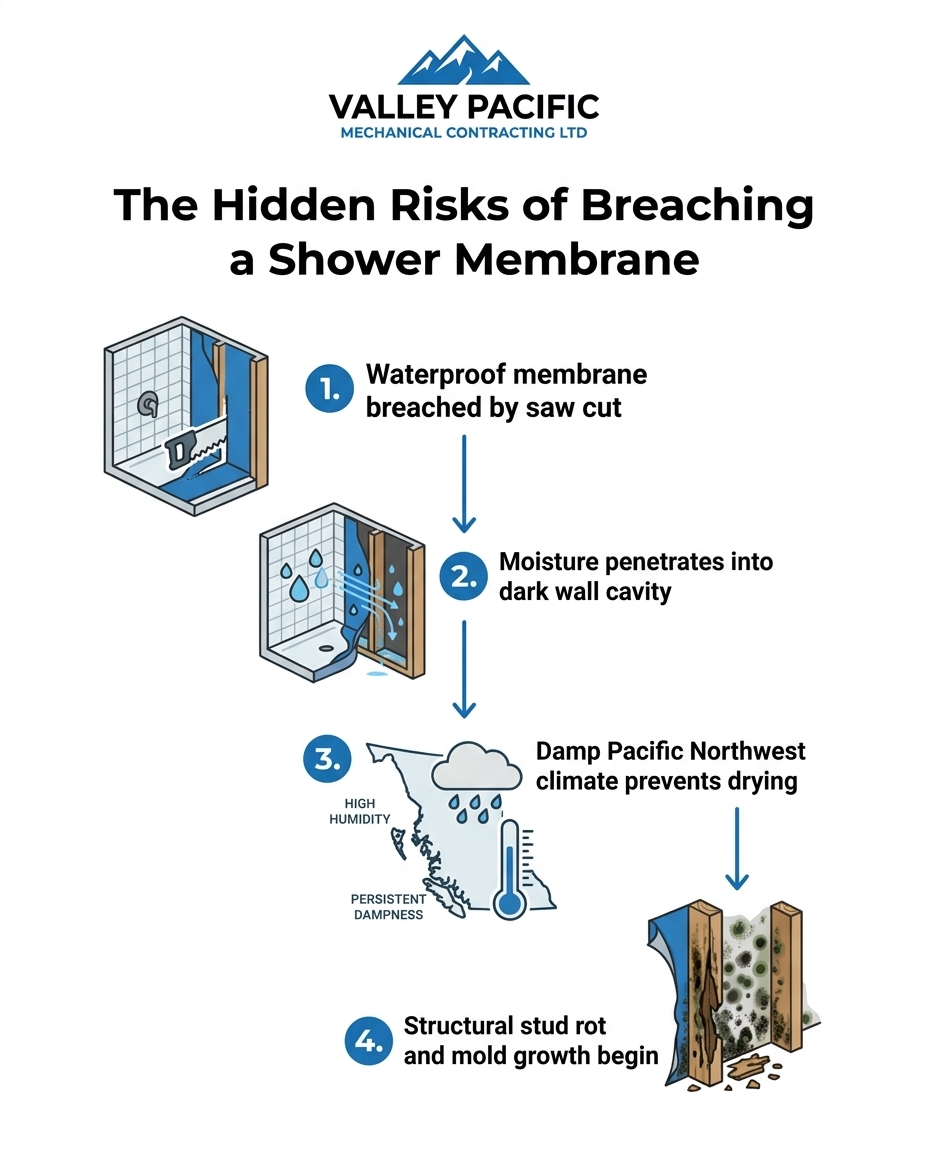
The Problem: When an inexperienced contractor or a well-meaning DIYer takes a saw to a shower wall to fix a valve, they slice directly through this critical membrane. Whether your shower utilizes a liquid-applied membrane (painted on in thick, rubberized coats) or a sheet membrane (a specialized fabric bonded to the walls), its entire purpose is to protect your structural studs from moisture.
The Cause of Failure: The Tile Council of North America (TCNA) standards dictate that waterproofing in wet zones must be continuous and unbroken. Even a 1/16th-inch breach in this envelope during a careless repair compromises the entire system. Water will always find the path of least resistance, and a jagged cut around a shower valve creates a permanent funnel for moisture to bypass the tile and enter the dark wall cavity behind it.
The Solution: Maintaining an intact indoor waterproof membrane is absolutely critical in our specific environment. The damp climate of Maple Ridge, especially during our heavy rainfall months from October to April, means that any water that gets into a wall cavity is going to stay there for a very long time. By avoiding cuts in the wet zone entirely, our technicians keep this vital protective layer completely continuous.
Tile Surface vs. Waterproof Membrane: A Comparison
• Tile & Grout — Primary Function: Aesthetic finish, wear surface, and primary water shedding. — Water Resistance Level: Water-resistant (porous, absorbs minor moisture). — Consequence of Damage: Cosmetic issues, loose tiles, easily patched with matching grout.
• Waterproof Membrane — Primary Function: Total moisture barrier protecting structural framing. — Water Resistance Level: 100% Waterproof (when continuous). — Consequence of Damage: Catastrophic moisture intrusion into wall cavity, requiring total tear-out to fix.
How Breaching the Wall Leads to Structural Rot and Mold
The mechanics of moisture penetration are unforgiving. When a membrane is compromised by cutting tools, the water that naturally seeps through the grout lines no longer hits a rubberized dead-end. Instead, it drips down the back of the tile board and makes direct contact with your home's structural framing. Because this happens behind the wall, you will not see the damage until it is far too late.
Hidden moisture buildup inside the wall cavity accelerates wood rot in structural studs at an alarming rate. As a Professional Mechanical Contractor serving the area, our team at Valley Pacific Mechanical frequently sees the aftermath of these invasive repairs. The high ambient humidity in the Pacific Northwest means that wall cavities dry out much slower—if they ever dry at all. A slow drip from a compromised membrane can turn a solid wooden 2x4 stud into a crumbling, spongy mess within a single rainy winter season. The structural integrity of the entire bathroom floor and adjacent walls can be compromised.
Furthermore, this dark, damp environment is the perfect breeding ground for dangerous mold growth. Mold flourishes behind breached shower walls, sending spores into your home's air supply through tiny gaps in the baseboards and electrical outlets. The health and safety risks associated with toxic mold are severe, particularly for families with respiratory sensitivities. Ultimately, the long-term cost of remediating extensive wood rot and black mold far exceeds the initial investment of having the plumbing repair done correctly. If you need plumbing repairs in Maple Ridge, choosing our non-destructive method is an investment in your home's lifespan.
Extracting Valves Without Destruction: Our Methodology
So, how do we fix a broken shower valve without tearing the bathroom apart? The answer lies in professional methodology and specialized tooling. Valley Pacific Mechanical's specific use of specialized pullers allows us to perform these complex repairs without destroying structural integrity. We do not rely on reciprocating saws and sledgehammers; our technicians rely on precision mechanics.
Here is an overview of how our licensed professionals approach replacing a shower valve safely (please note: this process requires commercial-grade extraction tools and should exclusively be performed by a licensed professional):
1. Isolating the Water Supply: Before any mechanical work begins, the water supply to the specific bathroom or the entire home is secured and drained to prevent any pressurized leaks during extraction.
2. Removing the Escutcheon Plate: The decorative metal plate (escutcheon) surrounding the handle is carefully unthreaded and removed. This exposes the original circular cutout in the tile and membrane—the only safe access point our team needs.
3. Deploying Specialized Pullers: Rather than cutting the hole wider, we insert specialized front-extraction tools through the existing opening. These tools are designed to grip the internal valve cartridge securely.
4. Mechanical Extraction: Using threaded leverage, the puller draws the seized or faulty cartridge (such as a stubborn Moen 1222 or Delta MultiChoice unit) straight out of the brass valve body, applying up to 300 pounds of linear force without transferring any pulling stress to the surrounding tile, membrane, or hidden pipes.
5. Precision Replacement: The new, compatible cartridge is lubricated and seated perfectly back into the valve body, and the escutcheon plate is re-sealed, leaving the bathroom completely unblemished.
This precise mechanical approach stands in stark contrast to the brute-force methods often seen in DIY attempts, where homeowners try to pry standard single-handle shower valves out with screwdrivers or pliers, frequently damaging the brass housing or snapping the copper lines behind the wall.
The Mechanics of Specialized Pullers
The genius of these professional extraction tools lies in how they isolate the valve body. A specialized puller braces itself against the solid brass housing of the valve, not against the fragile tile or the flexible copper piping. As the tool's threads are turned, it applies hundreds of pounds of direct, linear force specifically to the stuck cartridge. This prevents stress on the surrounding plumbing lines, ensuring that soldered joints inside the wall do not crack under pressure. Furthermore, this method offers a massive safety advantage by entirely avoiding the use of reciprocating saws near hidden electrical wires and pressurized pipes.
When Front Extraction Isn't Enough: Strategic Rear Access
While specialized pullers are incredibly effective, our team acknowledges that some heavily corroded or older valve bodies simply cannot be pulled from the front. If a valve housing is cracked, irreparably calcified after 15 to 20 years of hard water exposure, or structurally compromised, the entire brass unit must be replaced, not just the internal cartridge. In these specific scenarios, our professionals still avoid destroying the waterproof envelope.
Strategic Rear Access: Instead of attacking the wet zone from the front, our minimally invasive access techniques strategically bypass the bathroom entirely. We identify the wall directly behind the shower plumbing—often located in an adjacent hallway, a closet, or a bedroom. By cutting a strategic rear access panel (typically a precise 12x12 or 14x14 inch square) in this adjacent room, we can reach the back of the shower valve without ever touching the waterproof membrane.
Why Dry-Zone Cutting is Safer: Cutting standard drywall in a dry zone is vastly safer than breaching a wet-zone waterproof membrane. A hallway wall does not see hundreds of gallons of water cascading over it daily. If we cut a neat, square hole in a closet wall, it poses zero structural moisture risk to the home.
Future-Proofing the System: Once the valve is replaced from behind, these rear access panels can be cleanly framed and covered with a specialized, paintable access door. This leaves the homeowner with a fully functional shower, an intact waterproof membrane, and a convenient, non-destructive way for technicians to service the plumbing for decades to come.
Preserving Your Home's Integrity Across All Mechanical Systems
A holistic understanding of home construction is absolutely necessary for safe plumbing repairs. A mechanical contractor cannot just look at a dripping faucet; they must understand how the plumbing interacts with the framing, the waterproofing, the electrical runs, and the HVAC ducting hidden behind the drywall. Protecting the structural envelope applies to all mechanical and plumbing retrofits, not just shower valves.
One particularly wet November, our Valley Pacific Mechanical team was called in to handle various project needs including extensive plumbing work for a local homeowner. Because they needed a reliable partner to meet strict schedules across multiple residential mechanical systems, our focus on non-destructive, precise work ensured the results were perfect and the home's structural integrity remained intact. Relying on a trusted professional prevents cascading home damage. A quick, cheap fix that involves hacking through a structural stud or a moisture barrier will inevitably lead to massive secondary repairs. Quality mechanical work respects the entire ecosystem of the house.
Frequently Asked Questions About Non-Destructive Plumbing Repairs
Can you replace a shower valve without cutting the wall?
Yes, a shower valve cartridge can often be replaced without cutting the wall by using specialized professional pullers. These tools are inserted through the existing hole behind the decorative handle plate to grip and extract the internal components. By working precisely within this small opening, professionals avoid damaging the surrounding tile and waterproof membrane. If the entire brass valve body needs replacing, it is usually done via a strategic rear access panel in an adjacent room to keep the shower wall intact.
How to replace a shower valve without damaging tile?
Replacing a shower valve without damaging tile requires bypassing the wet zone entirely or utilizing specialized extraction tools. Professionals first remove the escutcheon plate to evaluate if the internal cartridge can be pulled straight out mechanically. If the valve body is fused or damaged, the safest method is to cut a rear access panel through the drywall of the room directly behind the shower. This preserves the expensive custom tile and, more importantly, the continuous waterproof membrane behind it.
Does changing a shower valve require removing tile?
Changing a shower valve does not inherently require removing tile if the right methodology is applied. Most modern single-handle valves are designed so their internal working parts can be serviced from the front without widening the existing tile cutout. When DIYers or inexperienced contractors assume tile must be smashed, it is usually because they lack the specialized pullers required to remove seized cartridges, leading to unnecessary and expensive bathroom destruction.
How much wall do I need to cut to replace a shower valve?
Ideally, you should cut zero wall inside the shower itself. Cutting into the wet zone compromises the waterproofing and structural studs. If full valve body replacement is necessary, a professional will typically cut a small, manageable square (often 12x12 or 14x14 inches) into the dry drywall on the opposite side of the plumbing wall. This rear access hole is easily covered with a permanent access panel, preventing any need for drywall patching or tile replacement.
What happens if a shower's waterproof membrane is compromised during a repair?
If a shower's waterproof membrane is compromised during a repair, water will bypass the tile and seep directly into the wall cavity. Because wall cavities lack airflow, this trapped moisture quickly leads to severe wood rot in the structural studs and dangerous mold growth. Over time, this hidden damage can compromise the structural integrity of the floor and walls, turning a simple plumbing fix into a massive, multi-trade reconstruction project.
Protect Your Bathroom With Professional Valve Extraction
Understanding the structural risks of cutting bathroom walls for plumbing repairs is the first step in protecting your home's long-term health. The value of preserving your waterproof membrane and structural studs cannot be overstated; once that barrier is broken, hidden moisture damage is almost guaranteed. We encourage homeowners to seek professional mechanical contractors who utilize specialized extraction tools and strategic access methods rather than defaulting to destructive demolition. By choosing precision over brute force, you gain the clear reassurance that non-destructive methods exist, protecting both your beautiful tile work and the vital structural framing beneath it.


