


Troubleshooting a Leaky Outdoor Faucet Before the First Freeze


Why That Dripping Hose Bib is a Winter Emergency Waiting to Happen
Late fall in the Fraser Valley means the first overnight freeze is just around the corner, and your exterior plumbing is directly in the line of fire. At Valley Pacific Mechanical, our team has spent years responding to winter plumbing emergencies across Maple Ridge, and we know firsthand that if you are currently troubleshooting a leaky outdoor faucet before the first freeze, you are dealing with much more than a minor annoyance. That slow, steady drip is a major seasonal hazard waiting to trigger a catastrophe inside your walls.
Most homeowners don't realize that a dripping hose bib is the leading catalyst for winter water damage. When you hear that drip, you are at a critical decision point: ignore it and hope for a mild winter, or take proactive steps to isolate the fixture before temperatures plummet. Ignoring the problem allows water to remain trapped in the fixture and the adjoining pipes. When that water inevitably freezes, our technicians consistently see that the resulting structural failure rarely happens outside where you can see it. Instead, the pressure forces the pipe to rupture hidden behind your drywall or siding.
Securing your exterior fixtures now is the most effective way to protect your home. By taking action today, you avoid the need for emergency plumbing services in Maple Ridge down the line. A proactive inspection and proper winterization will save you from the immense stress and disruption of a burst pipe repair when the cold weather finally hits.
The Physics of a Freeze: How Ice Destroys Interior Plumbing
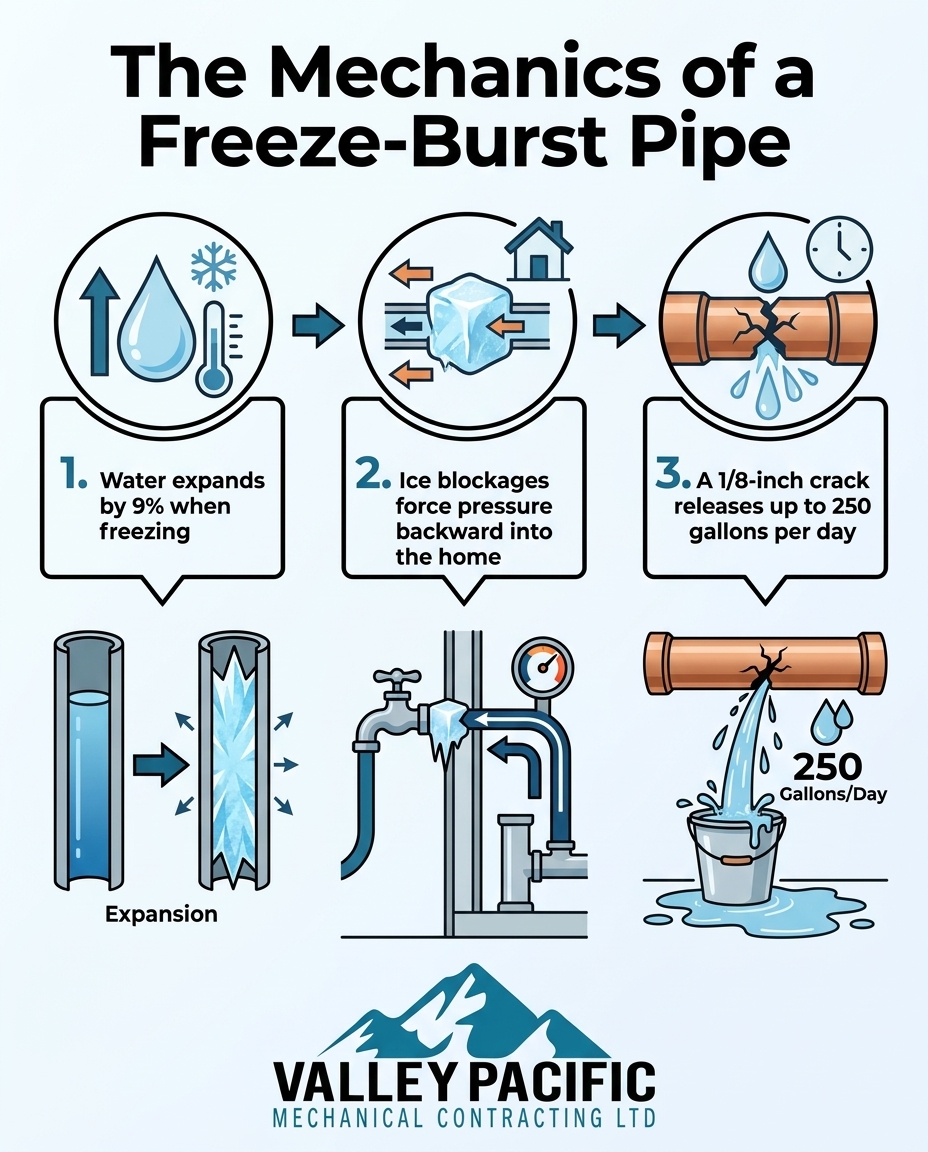
To understand why a dripping outdoor faucet is so dangerous, you have to look at the unique behavior of freezing water. Unlike most substances that shrink as they get colder, water expands by approximately 9 percent when it turns into ice. This physical expansion creates immense, unavoidable pressure inside closed plumbing systems.
The Hidden Threat of Hydrostatic Pressure
A common misconception we hear from homeowners is that the expanding ice itself pushes outward and breaks the pipe. While ice expansion certainly stresses the metal, our plumbers know that the actual rupture is usually caused by hydrostatic pressure. Based on the countless burst pipes we've repaired, here is how the mechanics actually work:
• The Blockage: The dripping water freezes near the exposed outdoor faucet, creating a solid ice plug.
• The Expansion: As the freezing temperatures push deeper into the pipe, more water turns to ice, expanding and pushing against the remaining liquid water trapped between the ice plug and the closed indoor valve.
• The Pressure Spike: Because liquid water cannot be compressed, it acts like a hydraulic ram. The trapped water absorbs the pressure of the expanding ice until the pipe walls or a weakened joint simply cannot hold it anymore.
• The Rupture: The pipe splits open, usually inside the warm interior wall where the liquid water is trapped.
Once the pipe bursts, the damage escalates rapidly. Industry data shows that a crack as small as a 1/8-inch can release up to 250 gallons of water a day. If this happens while you are asleep or away at work, you will return to severe interior flooding, ruined drywall, damaged flooring, and compromised insulation.
Navigating Deceptive Late Fall Weather in the Fraser Valley
Serving Maple Ridge and the surrounding Fraser Valley means our team deals with a highly unpredictable climate during the late fall months. We frequently see deceptive weather patterns where mild, comfortable daytime temperatures mask the imminent danger of sudden, freezing nights. It is incredibly easy to look at a sunny 12°C afternoon and completely forget about your winterization routines.
The Danger of the Freeze-Thaw Cycle
This regional climate pattern creates a localized phenomenon known as the freeze-thaw cycle, which is exceptionally brutal on exterior plumbing. Here is how the local weather actively works against a dripping faucet:
• Daytime Thawing: Mild daytime temperatures melt any ice that formed overnight, allowing the faucet to continue dripping and drawing fresh water into the exposed pipe.
• Sudden Overnight Freezes: When the sun goes down, temperatures can plummet below zero in a matter of hours, flash-freezing the fresh water that just entered the line.
• Metal Fatigue: Copper pipes and brass fittings are forced to expand and contract repeatedly day after day. This constant movement weakens solder joints and threaded connections, making a catastrophic rupture much more likely when a hard freeze finally sets in.
Because the first overnight freeze often catches homeowners completely off guard, immediate isolation of a dripping faucet is critical before November arrives. Waiting for the weather forecast to announce a deep freeze is a risky gamble that we frequently see end in extensive water damage.
Identifying the Source: Nuisance Drip or Structural Hazard?
Before you can secure your home, you need to understand exactly what is failing on your exterior fixture. While our team finds that troubleshooting a leaky faucet indoors usually involves a simple cartridge replacement, an outdoor hose bib operates under different environmental stresses. Your goal here is to observe and diagnose the issue visually without attempting unlicensed repairs that could worsen the leak.
Visual Inspection Checklist
Take a walk outside and observe the faucet carefully. Use this checklist to narrow down the source of the problem:
• Check the timing of the drip: Does the faucet only leak when the water is turned on, or does it drip constantly even when the handle is cranked completely shut?
• Inspect the vacuum breaker: Look at the bell-shaped device attached to the spout (often required by local code to prevent backflow). Is water spraying from the sides of this device when a hose is attached?
• Examine the packing nut: Look directly behind the handle. Is water weeping from the stem area where the handle meets the fixture body?
• Check the exterior wall: Look closely at the siding, brick, or stucco surrounding the pipe. Are there water stains, soft spots, or signs of moisture damage radiating from the pipe's entry point?
Comparing Common Leak Sources
• Leaks only when the hose is turned on — Likely Source of the Leak: Faulty vacuum breaker or worn hose washer — Risk Level Before a Freeze: Low (if drained properly), but indicates wear
• Weeps from behind the handle when on — Likely Source of the Leak: Loose or degraded packing nut/washer — Risk Level Before a Freeze: Moderate (water can run down the wall and freeze)
• Drips constantly from the spout when shut off — Likely Source of the Leak: Failed internal stem washer or corroded valve seat — Risk Level Before a Freeze: High (constant water supply ensures a solid ice block)
• Water leaking from the wall behind the fixture — Likely Source of the Leak: Cracked internal pipe or split fixture body — Risk Level Before a Freeze: Severe (the pipe has likely already failed)
Safe Preventative Steps You Can Take Immediately
If you have identified a constant drip, you must take action to mitigate the freezing risk immediately. As local plumbing professionals, we always emphasize that while replacing the fixture requires a licensed expert, there are safe, non-licensed steps you can execute right now to protect your property. The goal is to remove the water source from the vulnerable exterior zone.
Your Immediate Winterization Action Plan
1. Disconnect all garden hoses: This is the most critical step. A connected hose traps water inside the spigot, preventing the fixture from draining. Even a frost-free faucet will freeze and burst if a hose is left attached during a freeze. Drain the hoses completely and store them in a garage or shed.
2. Locate the interior shut-off valve: Head inside your home and find the dedicated shut-off valve for the outdoor water supply. These are typically located in the basement, a utility crawlspace, or near the water heater, directly inside from where the outdoor faucet sits.
3. Close the interior valve securely: Turn the valve clockwise until it stops. If it is a lever-style ball valve, turn it so the handle is perpendicular to the pipe. Do not force a stuck valve—if it will not budge with moderate pressure, stop immediately.
4. Bleed the exterior line: Once the inside water is off, go back outside and open the dripping faucet completely. You should see a small amount of residual water run out, followed by a slow stop. Leave the exterior handle in the "open" position for the duration of the winter. This gives any remaining trapped moisture room to expand harmlessly if it freezes.
By executing these steps, you effectively isolate the exterior fixture. Even if the outdoor valve is completely broken, cutting off the water supply from the warm interior of the house eliminates the risk of a pressurized burst.
When to Call a Professional for Winterization and Repair
There is a strict boundary between safe, preventative observation and the need for licensed professional intervention. Attempting to dismantle a corroded outdoor faucet or force a seized interior valve can result in immediate, catastrophic flooding inside your home.
You need to call a licensed plumber immediately if you encounter any of the following scenarios:
• The interior shut-off valve is stuck, heavily corroded, or missing entirely.
• The outdoor faucet continues to drip even after the interior valve is closed (indicating a failed interior isolation valve).
• The exterior fixture is physically cracked, deeply rusted, or pulling away from the wall.
Replacing internal washers, swapping out degraded O-rings, or soldering a completely new exterior fixture requires a licensed professional to ensure the system is up to code and fully watertight. Scheduling prompt service for a dripping faucet is infinitely more cost-effective than paying for emergency disaster recovery after a flooded basement.
At Valley Pacific Mechanical, we specialize in local Lower Mainland plumbing emergencies and rapid response capabilities. Whether it is an urgent pipe isolation or a major winter heating failure, prompt action matters. For instance, one local homeowner reached out to us during the winter when their boiler broke down, leaving them without hot water in the dead of cold. A technician arrived promptly, kept the homeowner updated throughout the process, and delivered a dependable, fully repaired system within hours when the weather mattered most. We bring that exact same urgency, reliability, and respectful service to your winter plumbing threats. If you are unable to secure your dripping faucet, you need urgent plumbing help before the temperature drops.
The Long-Term Solution: Upgrading to Frost-Free Sillcocks
If your current outdoor faucet is dripping, old, or heavily corroded, we highly recommend having a licensed plumber upgrade the fixture to a modern frost-free sillcock. In our experience, this upgrade permanently reduces your future freezing risks and provides lasting peace of mind for all future winters.
Anatomy of a Frost-Free Faucet
A standard outdoor faucet houses its shut-off valve right at the exterior wall, directly exposed to the cold. A frost-free sillcock is engineered entirely differently. It features a long, specialized stem that extends 12 to 18 inches deep into the interior of your home. When you turn the handle on the outside, it actually operates a shut-off valve seated deep inside the warm, heated envelope of your house.
Because the actual water stoppage occurs inside the warm zone, the exterior portion of the pipe remains empty and dry when the valve is closed. However, a frost-free faucet only works if it is installed with the correct downward pitch. The pipe must slope slightly downward toward the outside so that gravity can pull the residual water out of the spout when you shut it off. If installed improperly with an upward tilt, water will pool inside the long stem, freeze, and destroy the expensive fixture.
Upgrading to a properly pitched frost-free sillcock eliminates the frantic late-fall rush to isolate your plumbing. As long as you remember to remove your garden hoses before the freeze, the fixture will protect itself.
Frequently Asked Questions About Winterizing Outdoor Faucets
Will a dripping outside faucet freeze?
Yes, a dripping outside faucet is highly likely to freeze when temperatures drop below zero. The constant flow of water exposes fresh liquid to freezing air, which quickly builds into a solid ice plug. Once the pipe is blocked, the trapped water inside the wall will expand, leading to a massive spike in hydrostatic pressure and a high risk of a burst pipe.
What happens if an outside tap freezes?
When an outside tap freezes, the ice blockage prevents water from escaping. As the freezing pushes deeper into the pipe, the expanding ice forces the remaining liquid water backward toward the inside of your home. This intense pressure acts like a hydraulic ram, eventually causing the copper or brass pipe to split open, usually inside your walls or basement.
How do I stop my outside tap from leaking in the winter?
The safest way to stop an outside tap from leaking in the winter is to locate the dedicated interior shut-off valve for that specific line and turn it completely off. Once the interior water supply is secured, go back outside and open the tap to let the remaining water drain out. If the tap still leaks, or if you lack an interior valve, you will need a licensed professional to repair or replace the fixture.
How to fix a leaky faucet outside safely?
Safe troubleshooting involves identifying the source of the leak and turning off the indoor water supply to isolate the hazard. You should also disconnect and drain all garden hoses immediately. However, actually dismantling the outdoor fixture to replace internal stems, washers, or the entire housing requires a licensed plumber to ensure the repair is watertight and code-compliant.
Can a frost-free faucet still freeze and leak?
Yes, a frost-free faucet can still freeze and burst if a garden hose is left attached during cold weather. The attached hose traps water inside the long stem, preventing it from draining properly. When that trapped water freezes, it will expand and split the internal copper tubing, resulting in a severe leak the next time you turn the water on.
Secure Your Plumbing Before the Frost Arrives
As we've seen time and time again at Valley Pacific Mechanical, a dripping outdoor faucet is never just a minor nuisance—it is a severe interior flood risk waiting to happen. With the deceptive weather patterns in Maple Ridge and the Fraser Valley, you cannot afford to wait for the first hard freeze to test the limits of your plumbing. Taking the time to isolate your exterior fixtures today ensures your home remains safe, dry, and secure throughout the coldest months of the year.
If your interior shut-off valves are stuck, missing, or if your outdoor faucet continues to leak despite your best efforts, do not risk a winter disaster. Reach out to our local experts for a professional inspection and upgrade before the temperature drops further. Secure your plumbing now, and enjoy the peace of mind that comes with a fully winterized home.


