


Why Your Boiler Expansion Tank Needs Checking Before Turning on the Heat


Preparing Your Hydronic System for the Maple Ridge Freeze
Winter in the Fraser Valley is fast approaching, and in our years of servicing Maple Ridge homes, we've noticed that most heating equipment sits completely idle from early spring until the first frost. Why your boiler expansion tank needs checking before turning on the heat comes down to a simple mechanical reality: months of inactivity take a hidden toll on internal components. Before the pre-winter heating season in Maple Ridge BC fully sets in, that long period of dormancy can leave critical parts of your system compromised without you even realizing it.
When the first major frost hits, it creates an immediate, high-stress demand on your idle heating equipment. A central component in managing this stress is the expansion tank. Unfortunately, our team typically sees that the rubber diaphragms inside these tanks frequently stiffen or lose their vital air charge unnoticed during summer inactivity. The critical window to test this membrane's integrity is right now, before the system faces heavy, continuous daily thermal loads. Securing your boiler heating system requires a professional assessment to ensure every component is ready to handle the sudden shift from total shutdown to maximum output.
The Hidden Toll of Summer Inactivity on Expansion Tank Diaphragms
To understand why pre-season checks are so important, it helps to look at the internal anatomy of a boiler expansion tank. Inside that metal cylinder is a flexible rubber diaphragm that serves a vital purpose: it physically separates the system's circulating water from a cushion of compressed air. When the system is actively heating your home day in and day out, this rubber membrane flexes continuously, expanding and contracting as water temperatures rise and fall.
However, when the system is turned off for months at a time, that dynamic movement stops entirely. This lack of mechanical exercise leads to hidden degradation that goes far beyond basic wear and tear.
Understanding Diaphragm Stiffness
The physical properties of the internal membrane rely on regular thermal cycling to maintain flexibility. Much like a rubber band that sits in a drawer for a year, a diaphragm that sits inactive and un-flexed for months can become stiff and rigid. The vulcanized rubber loses its elasticity, meaning that when the boiler finally fires up and pushes expanding hot water against it, the membrane resists instead of yielding smoothly. This stiffness prevents the tank from absorbing pressure, effectively neutralizing the tank's primary function.
Unseen Air Charge Depletion
Beyond the rubber itself stiffening, the air cushion on the other side of the diaphragm is also vulnerable during the off-season. Even in a perfectly sealed system, microscopic air charge loss can occur over the summer without any visible external leaks. Air molecules can slowly permeate through the microscopic pores of the rubber over several months. Because this depletion happens internally, a system might look perfectly fine from the outside. This creates a false sense of security; these hidden issues only reveal themselves once the system is fired up for continuous heating and the depleted air cushion fails to provide adequate resistance.
The Mechanics of Thermal Expansion During the First Cold Snap
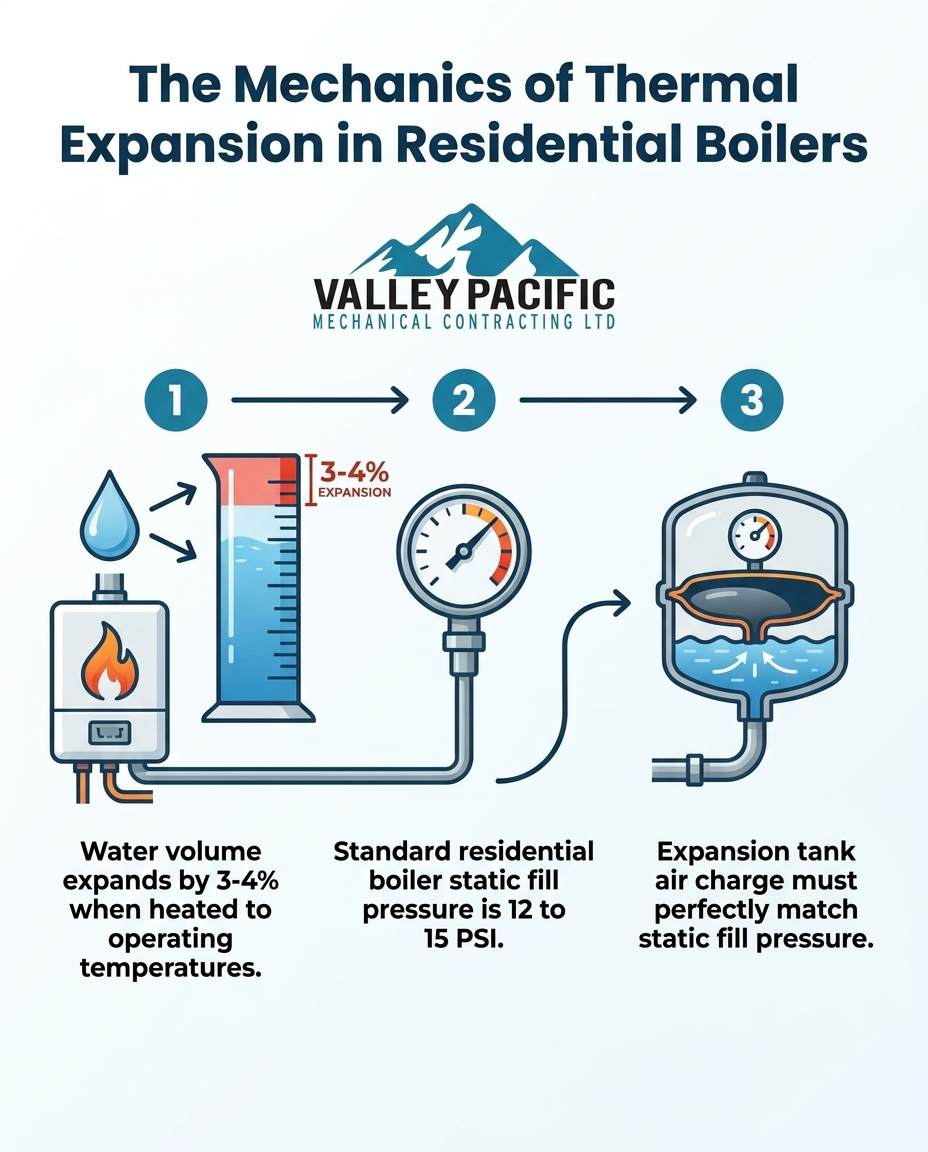
When we look at the actual physics of home heating, the necessity of a fully functional expansion tank becomes undeniable. Hydronic heating relies on water, and water changes its physical volume based on temperature. When water is heated from room temperature to standard hydronic operating temperatures (often between 160°F and 180°F), its volume expands by up to 3 to 4 percent.
In a closed-loop residential system, that expanding water has absolutely nowhere to go. Because water cannot be compressed, that 3 to 4 percent increase in volume translates directly into a massive spike in pressure. BC's coastal winter climate forces heating systems into long, high-load cycles that rapidly expose compromised diaphragms during the first cold snap. If the tank fails to absorb this expansion, the pressure inside your pipes and boiler vessel will skyrocket within minutes.
How Hydronic Pressure Builds
Standard residential boiler systems typically operate at a static fill pressure of 12 to 15 PSI when cold. As the boiler fires and the water transitions from cold idle to heated circulation, the expansion tank acts as a shock absorber to maintain equilibrium.
• Healthy Expansion Tank — Cold Static Pressure: 12 - 15 PSI — Active Heating Pressure: 18 - 22 PSI — System Risk Level: Safe / Normal Operation
• Stiff/Failed Diaphragm — Cold Static Pressure: 12 - 15 PSI — Active Heating Pressure: 30+ PSI (Relief Valve Opens) — System Risk Level: High Risk of Component Damage
• Depleted Air Charge — Cold Static Pressure: 12 - 15 PSI — Active Heating Pressure: 28 - 30 PSI (Fluctuating) — System Risk Level: Moderate to High Stress
The role of the expansion tank is to take on that extra volume so the pressure remains stable. To do this effectively, we must ensure the expansion tank air charge PSI matching the boiler's static fill pressure is perfectly calibrated. If the diaphragm is stiff or the air charge is gone, that immediate pressure spike has nowhere to go but outward against your valves, pipes, and heat exchangers.
Recognizing the Silent Warning Signs of a Failing Tank
Homeowners often assume that if their home is warm, their heating equipment is functioning perfectly. However, a failing expansion tank often presents silent warning signs long before a total system breakdown occurs. Relying on reactive signs often leads to mid-winter emergency no-heat situations.
At Valley Pacific Mechanical Contracting Ltd., our team has seen exactly how disruptive this can be. Last winter, we received an urgent call from a Maple Ridge homeowner during a severe cold snap when their boiler broke down entirely, leaving the household with absolutely no hot water or heat. Our technicians arrived promptly and repaired the entire system within hours, restoring their comfort. While rapid emergency response is crucial, proactive testing is designed to prevent these sudden failures altogether. Waiting for symptoms to appear is a dangerous strategy.
Here are the primary indicators that your system is struggling with thermal expansion:
• A weeping pressure relief valve: This is the most common symptom. If you notice a small puddle of water under the discharge pipe of your boiler's pressure relief valve, it means system pressure has exceeded the safe limit (usually 30 PSI) and the valve is dumping water to prevent a rupture.
• Erratic pressure gauge readings: If you watch your boiler's pressure gauge and notice it spiking wildly when the burner is on, and then dropping significantly when the system cools down, the expansion tank is failing to regulate the pressure.
• Unusual banging or clanking noises: Sudden pressure shifts can cause water hammer or stress noises in the piping as the expanding water forces its way through the closed loop.
• Frequent system lockouts: Modern boilers are equipped with safety sensors. If pressure fluctuates too wildly, the system may lock itself out to prevent a catastrophic failure, leaving you without heat.
Why the DIY 'Tap Test' Isn't Enough for Winter Reliability
If you search online for ways to check an expansion tank, you will almost certainly encounter advice suggesting the "tap test." This popular internet myth claims that by tapping on the side of the tank with a wrench or knuckle, you can determine its health based on the sound. The theory suggests that the top half should sound hollow (where the air is) and the bottom half should sound solid (where the water is).
While this might sound like a logical shortcut, it is entirely insufficient for ensuring winter reliability. A water-logged tank might still sound partially hollow depending on the acoustics of your mechanical room, giving homeowners a false sense of security. Furthermore, DIY testing cannot measure the actual air charge or the flexibility of the internal rubber membrane.
The Limitations of Sound-Based Diagnostics
The fundamental flaw of the tap test is that it fails to detect partial membrane stiffness or minor air charge depletion. There is a massive difference between detecting a completely ruptured, fully flooded tank and diagnosing a poorly pressurized one that is just beginning to fail. A tank with 5 PSI of air might sound identical to a tank with 15 PSI of air when tapped, but that 10 PSI difference is enough to cause severe pressure spikes in your system.
Because of the risks involved with high-pressure hot water, we strictly advise against DIY attempts to adjust tank pressure. Adding air to a tank while it is still connected to a pressurized system will result in inaccurate readings and can easily over-pressurize the loop. Securing professional mechanical services is a strict requirement for licensed intervention to prevent permanent system damage or voided manufacturer warranties.
Our Professional Diagnostic Approach: Matching PSI for Optimal Performance
Rather than relying on guesswork or listening for hollow sounds, our technicians utilize a specific, transparent diagnostic methodology to test and prep your hydronic setup. Highlighting the specific step-by-step checks our technicians perform demonstrates the hands-on expertise required to establish deep technical authority over your home's comfort.
We see the value of this thorough approach constantly. Just recently, a customer scheduled our team for regular care on their essential systems, including their boiler. By providing thorough and professional equipment maintenance that included these exact diagnostic steps, the customer was left feeling completely reassured with a reliable service provider heading into the colder months.
Here is how our technicians accurately diagnose and calibrate an expansion tank:
1. Isolating the Tank Safely: First, our technicians must temporarily isolate the expansion tank from the main hydronic loop. If we attempt to read the air valve while the tank is subjected to system water pressure, the gauge will simply read the water pressure, not the true air charge behind the diaphragm. Relieving system pressure from the water side of the tank is a mandatory step for accurate diagnostics.
2. Measuring the Baseline Charge: Once isolated, we utilize specialized, highly sensitive air gauges on the tank's Schrader valve to measure the exact air charge currently holding the diaphragm in place.
3. Calibrating the Air Charge: We then meticulously add or release air to achieve a perfect PSI match. The expansion tank air charge PSI matching the boiler's static fill pressure (typically 12 to 15 PSI) is the critical goal.
4. Testing Membrane Response: Finally, as we reintroduce system pressure, we monitor the tank's response to ensure the diaphragm flexes precisely when needed, absorbing the thermal expansion seamlessly without erratic gauge spikes.
Protecting Your Entire Heating Infrastructure
A healthy boiler expansion tank does much more than just keep the pressure relief valve from leaking; it protects your entire heating infrastructure. When a tank fails and pressure spikes are left unchecked, it causes relentless micro-stresses on every adjacent component. Over time, these daily pressure surges wear down heat exchangers, strain circulator pumps, and damage delicate zone valves.
In our experience working on Fraser Valley hydronic systems, we frequently see homes utilizing integrated mechanical systems, where boiler health impacts overall winter reliability across multiple applications, from baseboard radiators to radiant floor loops. Comprehensive maintenance extends the lifespan of this entire hydronic setup. Just as you wouldn't ignore a failing component in furnace heating systems, ignoring the expansion tank in a boiler system invites cascading failures.
Proactive care always outweighs reactive emergency repairs. By ensuring the pressure management system is perfectly calibrated before the heavy winter load begins, you protect the expensive core components of your boiler from unnecessary fatigue and premature failure.
Frequently Asked Questions About Boiler Expansion Tanks
What happens when a boiler expansion tank fails?
When a boiler expansion tank fails, the heated water has no space to expand, leading to rapid pressure spikes inside the closed-loop system. This excess pressure forces the boiler's pressure relief valve to open, dumping hot water onto your floor to prevent a rupture. If the relief valve fails or the pressure continues to fluctuate wildly, it can cause severe stress to heat exchangers, pipe joints, and circulator pumps, often resulting in a total system lockout.
How do professionals test a boiler expansion tank?
Professionals test a boiler expansion tank by safely isolating it from the main hydronic loop and relieving the water pressure against the diaphragm. Once isolated, our technicians use specialized gauges to measure the exact air pressure behind the rubber membrane. We then calibrate the tank by adding or releasing air so that the internal PSI perfectly matches the boiler's static fill pressure, ensuring optimal flexibility.
How do I know if my boiler expansion tank is bad?
The most common indicator of a bad expansion tank is water weeping or leaking from the boiler's pressure relief valve during a heating cycle. You may also notice the pressure gauge on the boiler spiking dramatically when the system heats up and dropping significantly when it cools. Frequent system lockouts or banging noises in the pipes can also signal that the tank is no longer absorbing thermal expansion.
Should a boiler expansion tank sound hollow?
While a healthy expansion tank will typically sound hollow on the air-filled side and solid on the water-filled side when tapped, this sound test is not a reliable diagnostic tool. A tank that is partially water-logged or suffering from a depleted air charge might still produce a hollow sound, masking underlying issues. Proper testing requires a professional gauge to measure the actual PSI of the air charge.
How often should an expansion tank be checked?
An expansion tank should be professionally checked and calibrated once a year, ideally during your pre-winter preventative maintenance visit. Because the rubber diaphragm can stiffen and the air charge can slowly deplete over the summer months, an annual inspection ensures the tank is fully prepared to handle the heavy thermal loads of the upcoming heating season.
Can a boiler expansion tank lose pressure while turned off over the summer?
Yes, a boiler expansion tank can easily lose air pressure while the system is turned off over the summer. Air molecules can slowly permeate through the microscopic pores of the rubber diaphragm over several months of inactivity. Additionally, the lack of thermal cycling causes the rubber membrane to stiffen, reducing its ability to flex and absorb pressure when the system is turned back on.
Secure Your Comfort Before the Cold Snaps Hit
The transition into the pre-winter heating season in Maple Ridge BC is the most vulnerable time for your hydronic equipment. Ensuring your expansion tank air charge PSI perfectly matches your boiler's static fill pressure is the only way to guarantee that thermal expansion won't trigger unexpected breakdowns, leaking valves, or pipe stress. Do not wait for a mid-winter emergency to reveal a stiffened diaphragm or a depleted air charge. Our technicians are ready to perform the precise, professional calibrations required to protect your home. Secure your comfort and schedule a comprehensive assessment of your hydronic system today to ensure a warm, worry-free winter.


