


How a Damaged Gas Valve Can Shut Down Your Entire Heating System


The Myth of the 'Broken' Furnace on a Chilly Morning
A dead furnace on a freezing morning feels like a catastrophic failure, but most homeowners don't realize that a sudden shutdown is often a sign your system is working exactly as designed. Understanding how a damaged gas valve can shut down your entire heating system changes the way you look at a mid-winter breakdown. When your system refuses to turn on, it is usually protecting your home from a much more serious hazard.
At Valley Pacific Mechanical Contracting, our team frequently gets urgent calls from homeowners waking up to a freezing house during one of our wet, chilly Pacific Northwest winter mornings. It makes the situation feel incredibly urgent, and you just want the heat back on as quickly as possible. However, modern heating systems are equipped with strict safety protocols. If a critical component like the gas valve malfunctions, the furnace enters what is known as a "hard safety lockout." This deliberate shutdown stops all operations to prevent uncombusted gas from entering your living space.
If your system is locked out, you need professional HVAC repair to safely diagnose the root cause and restore your comfort without compromising your family's safety.
What Is a Furnace Gas Valve and How Does It Regulate Fuel?
To understand why a lockout happens, you first need to know what the gas valve actually does. The furnace gas valve is the primary gatekeeper of fuel for your entire heating system. It is a complex mechanical and electrical component that opens and closes to supply natural gas directly to the burners. Without this precise regulation, your furnace cannot generate heat.
In our years of providing comprehensive furnace services across Maple Ridge and Lower Mainland BC, our technicians have seen firsthand how homes rely on these valves to cycle flawlessly thousands of times every winter. When you adjust your thermostat, it sends an electrical signal to the furnace control board. The control board then communicates with the gas valve, telling it exactly when to open and when to shut off. Checking the health of this valve is a standard part of our diagnostic process.
The Electrical and Mechanical Connection
Modern gas valves do not operate on simple mechanical springs alone. They use electromagnetic coils called solenoids. These solenoids require very precise electrical voltages to operate correctly. When the control board sends the right voltage, the magnetic field pulls the valve open against a spring. When the voltage stops, the spring snaps the valve shut.
Because this process relies on both electrical signals and physical movement, even minor physical damage or electrical faults can disrupt the operation. A weak solenoid, a frayed wire, or a tiny buildup of carbon debris can prevent the valve from opening fully or closing tightly. When the system detects that the valve is not responding perfectly to the electrical commands, it immediately flags a safety issue and begins the shutdown process.
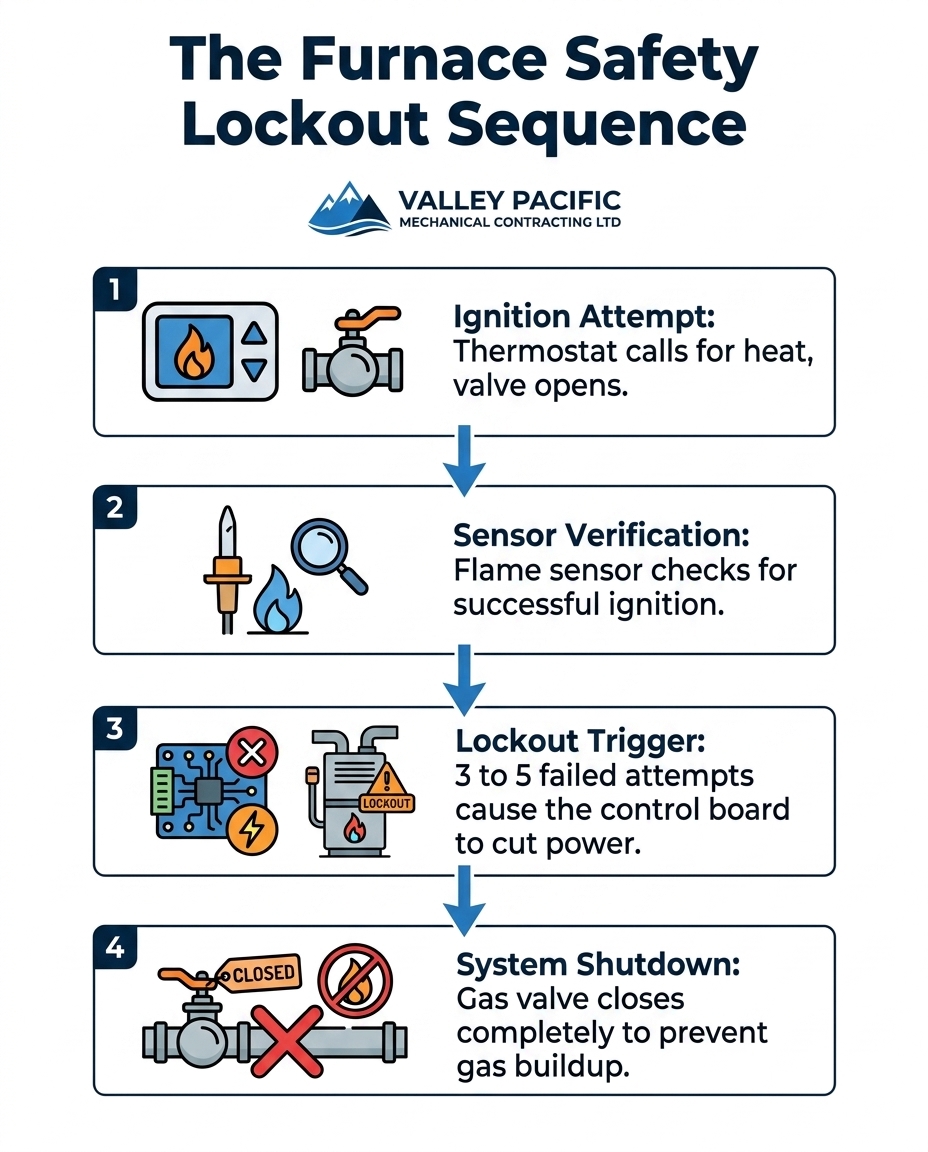
The 3-Step Safety Lockout Sequence
When our Valley Pacific technicians arrive at your home because your furnace is blowing cold air, we are looking at a very specific chain of events. We always take the time to demystify complex HVAC safety mechanisms for our customers, explaining the 'why' behind our testing. Here is exactly what happens when your gas valve or sensors detect a failure:
1. Step 1: Ignition Attempt. The sequence begins when your thermostat calls for heat. The draft inducer motor kicks on to clear the heat exchanger of residual gases. Next, the igniter warms up (usually glowing bright orange), and the control board sends a 24-volt signal to the gas valve, commanding it to open and release fuel to the burners.
2. Step 2: Sensor Verification. As soon as the gas is supposed to ignite, a critical component called the flame sensor (or thermocouple in older units) monitors the burner area for a successful flame. If the gas valve failed to open, or if the fuel did not ignite properly, the sensor will not detect the necessary heat and electrical microamps that confirm a safe fire.
3. Step 3: Valve Shutdown and Lockout. If no flame is detected within a few seconds, the control board immediately cuts power to the gas valve to halt the flow of gas. The furnace will usually wait a few minutes and try this sequence again. After 3 to 5 failed attempts, the furnace enters a hard lockout. The blower fan may run continuously to clear any lingering gas, but the furnace will refuse to attempt another ignition until it is manually reset and serviced.
Stuck Open vs. Stuck Closed: Understanding Valve Failures
A gas valve generally fails in one of two ways physically, and both scenarios trigger safety sensors to shut down the broader system. Understanding the difference between a stuck-open and a stuck-closed valve is crucial for recognizing the severity of the problem.
• Stuck Closed — What Happens: The valve refuses to open when commanded. No natural gas reaches the burner assembly. — Immediate Symptoms: Furnace clicks, igniter glows, but no fire starts. System locks out after a few tries. — Safety Risk Level: Low immediate risk, but leaves the home without heat.
• Stuck Open — What Happens: The valve fails to shut off the gas flow completely after a heating cycle ends. — Immediate Symptoms: Smell of gas around the unit, potential continuous burning even when off. — Safety Risk Level: Extremely high risk. Requires immediate evacuation and gas shutoff.
Dirt, debris, or mechanical wear over years of use can cause a valve to become physically clogged or damaged. The internal springs can lose their tension, or the solenoids can burn out. Just last season, our crew inspected a local Maple Ridge homeowner's system during a routine summer furnace service appointment, and our technician discovered a clogged and damaged valve early on. We serviced the furnace and addressed the valve issue right then and there. The furnace issue was resolved quickly, long before the cold weather arrived, preventing a sudden lockout in the middle of winter.
A stuck-closed valve is frustrating because you lose heat, but a stuck-open valve is a severe emergency. In both cases, the control board's job is to recognize that the system is operating outside of its safe parameters and initiate a hard lockout to protect your property.
Early Warning Signs Before a Total Heating Shutdown
Furnaces rarely fail without giving you a few hints first. If you know what to look for, you can often identify the symptoms of a failing gas valve before the system goes into a hard lockout and leaves you shivering.
• Furnace clicking repeatedly but failing to ignite: This is the sound of the igniter trying to do its job while the gas valve refuses to open. If you hear a series of clicks followed by the system shutting down, the valve is likely stuck closed.
• Inconsistent heating or short-cycling: If the furnace turns on and off rapidly without ever reaching the temperature set on your thermostat, the valve may be opening partially or the flame sensor may be failing to read the flame properly.
• Unusual noises from the valve area: A buzzing, humming, or rattling sound coming directly from the gas valve during the ignition sequence often indicates a failing electrical solenoid struggling to pull the mechanical valve open.
• The smell of natural gas: This is the most critical warning sign. If you smell the distinct "rotten egg" odor of natural gas near your heating unit, a valve may be stuck open or leaking.
What to Do If You Smell Gas
If you notice the smell of natural gas around your furnace, do not attempt to investigate the unit yourself. Do not flip any electrical switches, do not use a flashlight, and do not use your cell phone near the unit. Evacuate the home immediately, leave the doors open to ventilate the area, and call your local utility provider or emergency services from outside. A leaking gas valve is a severe hazard that requires an immediate professional response.
Why Bypassing a Furnace Lockout is Incredibly Dangerous
When you wake up to a freezing house, the temptation to simply flip the breaker or hit the reset button on the furnace is strong. However, repeatedly resetting a locked-out furnace without fixing the underlying gas valve issue is one of the most dangerous things a homeowner can do.
The Problem: A hard lockout is a symptom, not the disease. The control board has shut the system down because it detected an unsafe condition—usually a failure to ignite fuel or a failure to contain fuel. If you force the system to reset, you are forcing it to attempt another ignition sequence.
The Cause of Danger: If the gas valve is malfunctioning and allowing small amounts of gas to seep into the combustion chamber without igniting, that gas can pool. Natural gas is lighter than air, but it can still accumulate in a confined space if the draft inducer isn't clearing it perfectly. When you reset the furnace and the igniter glows again, it can ignite that pooled gas all at once, creating a small explosion known as a "rollout" or, in severe cases, a structural hazard.
The Solution: As licensed gas contractors, our team at Valley Pacific Mechanical strictly adheres to FortisBC guidelines, which strongly emphasize that natural gas appliances must only be serviced by professionals. We do not just guess; we use specialized tools to diagnose the exact point of failure safely. A licensed technician uses a digital manometer to measure the precise gas pressure entering and exiting the valve, ensuring it meets the manufacturer's specifications. We also use a multimeter to test the electrical voltages reaching the solenoids. By relying on a professional diagnostic, you ensure the root cause is fixed permanently, rather than just temporarily bypassed.
Preventing Unexpected Lockouts with Routine Care
The best way to deal with a gas valve failure is to prevent it from happening in the first place, a philosophy we strongly advocate at Valley Pacific Mechanical. We connect the prevention of these complex component failures to regular professional maintenance. Routine inspections catch worn solenoids, clogged valves, and dirty flame sensors long before they cause a mid-winter breakdown.
During an annual tune-up, a technician performs a comprehensive cleaning and testing process on the entire ignition system. They clean the flame sensor with specialized abrasive pads to ensure it can accurately read the microamps of a successful flame. They check the wiring harness connecting the control board to the gas valve for any signs of fraying or heat damage. They also test the manifold gas pressure to ensure the valve is opening fully and delivering the correct amount of fuel. Knowing these safety mechanisms are fully operational brings tremendous peace of mind.
Having a reliable HVAC maintenance plan ensures these checks happen automatically every year. For example, during the coldest days of the year, our emergency dispatch received a call from a customer who experienced an unexpected breakdown of their 20-year-old forced air furnace. Because the system was so old and had missed years of routine care, multiple components, including the ignition systems, were failing simultaneously. Our team provided a prompt consultation and installed a new furnace within days to restore heating quickly, but a history of regular maintenance might have caught the declining components earlier.
The Hidden Costs of Skipping Maintenance
Ignoring minor ignition issues rarely saves time or effort. A furnace that occasionally clicks and fails to start in October will almost certainly lock out completely by January. The strain of a failing gas valve can also damage the control board over time, turning a single component replacement into a much larger repair. If you want to understand the full compound effect of neglecting annual service, reading about skipping HVAC maintenance highlights exactly how small inefficiencies lead to sudden, total system shutdowns.
Restoring Your Heat Safely and Professionally
A locked-out furnace is not a broken appliance trying to ruin your morning; it is a highly engineered safety system actively protecting your home from a faulty gas valve. When the control board cuts power to the valve, it is preventing uncombusted gas from entering your living space and eliminating the risk of a dangerous buildup.
Testing, adjusting, and replacing gas components requires specialized tools and licensed expertise. If your heating system has shut down and refuses to run, do not attempt to bypass the safety controls. Seek professional diagnostic help from our team at Valley Pacific Mechanical to safely restore your heating. One of our licensed technicians will pinpoint the exact cause of the lockout, replace the damaged valve if necessary, and ensure your system is running safely and efficiently for the rest of the winter.
Frequently Asked Questions
What happens when a gas valve goes bad on a furnace?
When a gas valve goes bad, it usually fails to open or fails to close completely. If it fails to open, no gas reaches the burners, and the furnace will blow cold air or shut down entirely. If it fails to close, gas can leak into the system, creating a severe safety hazard that requires immediate professional attention.
Will a bad gas valve cause a furnace to lock out?
Yes, a bad gas valve is one of the most common reasons for a hard safety lockout. If the valve does not open, the flame sensor will not detect a fire during the ignition sequence. After a few failed attempts to detect a flame, the furnace's control board will lock the system down for safety.
How do I know if my furnace gas valve is bad?
You might hear the furnace clicking repeatedly as it tries to ignite, but no heat is produced. You may also experience short-cycling, where the furnace turns on and off very quickly. If you ever smell natural gas near the unit, this is a major warning sign that the valve is failing to contain the fuel properly.
Can a gas valve on a furnace be repaired or must it be replaced?
A faulty gas valve must almost always be replaced entirely rather than repaired. Because it is a sealed, critical safety component that regulates combustible fuel, attempting to take it apart or rebuild it is highly dangerous and violates safety codes. A licensed professional will remove the bad valve and install a brand-new, factory-tested replacement.
How many failed ignition attempts trigger a hard safety lockout?
Most modern furnaces are programmed to trigger a hard safety lockout after 3 to 5 consecutive failed ignition attempts. Once this limit is reached, the control board disables the heating cycle completely to prevent gas buildup. The system will remain locked out until a technician diagnoses the issue and manually resets the board.


