


What Happens If You Skip HVAC Maintenance



What Really Happens When You Skip HVAC Maintenance in the Lower Mainland
What happens if you skip HVAC maintenance is a question most homeowners only think to ask after something has already gone wrong — usually on the coldest evening in January or the hottest afternoon in August. By then, the damage is often well underway.
Here is a quick look at the most common consequences:
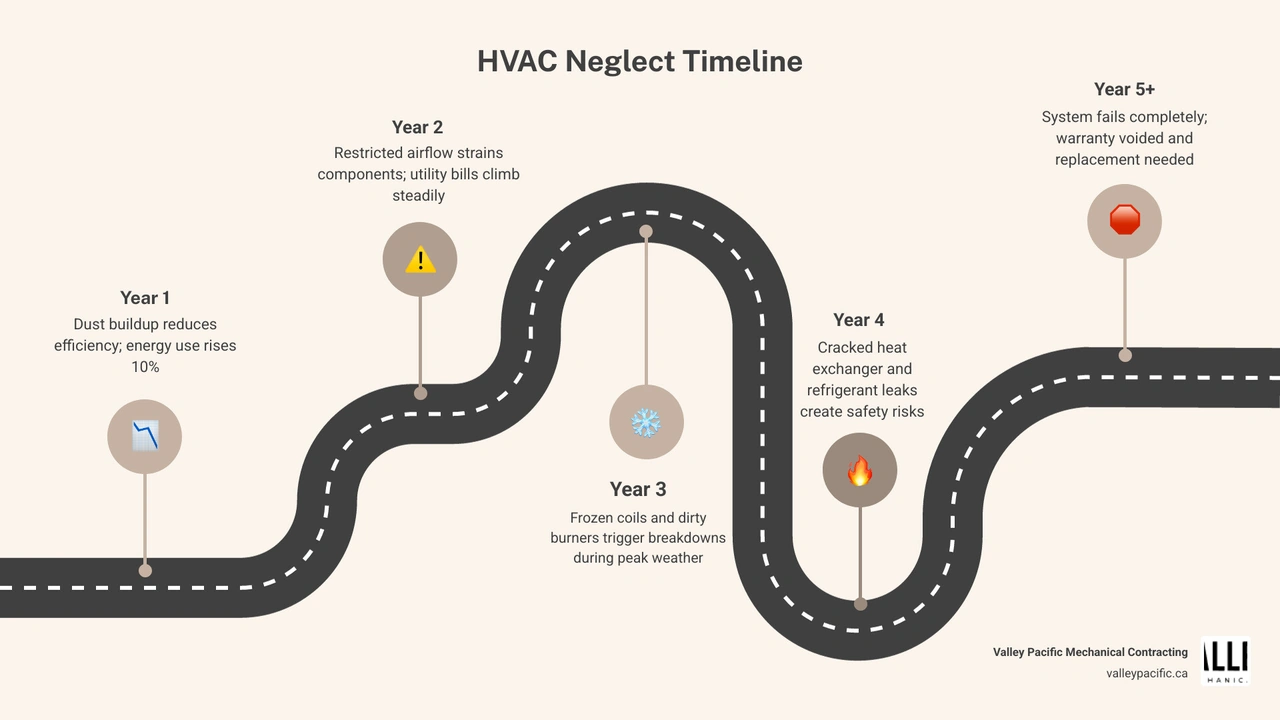
- Higher energy bills — neglected systems use 10–25% more energy to reach the same temperature
- Shorter system lifespan — a well-maintained system can last 15–20 years; a neglected one may fail in 10
- Unexpected breakdowns — often during peak demand, when repair wait times are longest
- Voided manufacturer warranty — most manufacturers require documented annual service to honour claims
- Poor indoor air quality — dust, allergens, and mold circulate through an unmaintained system
- Safety hazards — cracked heat exchangers can leak carbon monoxide; dirty components raise fire risk
The tricky part is that none of this happens overnight. HVAC systems decline slowly and quietly. You might not notice anything is wrong until your utility bill creeps up, your home stops feeling comfortable, or the system stops working entirely. For homeowners across the Lower Mainland — where BC's damp coastal climate puts extra strain on heating and cooling equipment year-round — that gradual decline can accelerate faster than many expect.
What happens if you skip hvac maintenance terms to remember:
- benefits of regular hvac maintenance in pacific northwest coastal
- how often should you service your hvac
The Real Risks: What Happens If You Skip HVAC Maintenance
When you choose to skip annual or biannual HVAC tune-ups, you are essentially shifting costs from a predictable, low-stress preventive visit to an unpredictable, high-stress emergency repair. HVAC systems do not simply run perfectly and then suddenly drop dead without reason. Instead, they undergo continuous mechanical stress.
Without regular lubrication, cleaning, and electrical calibration, minor issues begin to compound behind the scenes. This compounding strain makes your equipment highly vulnerable to "thermal shock"—the sudden stress placed on a cold or hot system when it is forced to work at maximum capacity during the first major weather event of the season.
This is why peak season failures are so common. When a heatwave hits Maple Ridge or a freezing cold snap rolls through Pitt Meadows, unmaintained systems are pushed past their breaking points, leading to emergency breakdowns when local technicians are at their busiest.
What happens if you skip hvac maintenance on your air conditioner?
During our humid Lower Mainland summers, your air conditioner works hard to keep your indoor spaces cool and dry. If you skip regular maintenance, the consequences for your cooling system can be severe:
- Frozen Evaporator Coils: Dirt and dust naturally accumulate on your indoor evaporator coil over time. This layer of grime acts as an insulating blanket, preventing the refrigerant inside the coil from absorbing heat from your home's air. As a result, the temperature of the coil drops below freezing, causing the condensation on it to turn to ice. A frozen coil completely blocks airflow and stops the cooling process.
- Severe Compressor Strain: The compressor is the heart of your air conditioning system. When airflow is restricted by dirty filters or clogged coils, the compressor has to work significantly harder and run longer cycles to cool your home. This continuous strain can lead to premature compressor failure, which is one of the most expensive parts to replace.
- Restricted Airflow: Dust buildup on fan blades and within the ductwork reduces the volume of air circulating through your home, leaving some rooms warm and stuffy.
- Refrigerant Leaks: Unserviced air conditioners can develop tiny vibrations that rub refrigerant lines together, leading to slow leaks. Low refrigerant levels force the system to run constantly without actually cooling your home, risking a total system breakdown.
By understanding these risks, you can take action before the summer heat arrives. Learn more about protecting your system in our guide on how to prevent HVAC emergencies with maintenance.
What happens if you skip hvac maintenance for your furnace?
In the damp, chilly winters of the Pacific Northwest, your furnace is your home's most critical lifeline. Neglecting it does not just threaten your comfort; it can directly compromise your family's safety:
- Cracked Heat Exchanger: The heat exchanger is the metal chamber that keeps combustion exhaust gases separate from the clean air circulating through your home. If airflow is restricted by a neglected, clogged filter, the furnace cannot dissipate heat properly. This causes the heat exchanger to overheat, expand, and contract excessively, eventually leading to metal fatigue and cracks.
- Carbon Monoxide Leaks: A cracked heat exchanger can allow carbon monoxide (CO)—a toxic, tasteless, odorless, and colorless gas—to leak directly into your home's breathing air. This is a severe, life-threatening safety hazard.
- Dirty Burners and Ignition Issues: Dust and soot buildup on the burners can prevent clean combustion, leading to inefficient heating and yellow pilot lights (which indicate incomplete combustion).
- Flame Sensor Malfunctions: The flame sensor is a safety device that detects whether a flame is present when the gas valve is open. If this sensor becomes coated in carbon or dust, it will fail to detect the flame and automatically shut down your furnace, leaving you without heat on a freezing winter night.
Recognizing the warning signs of a struggling heating system can save you from a winter disaster. Discover the early indicators in our article on HVAC system may fail soon signs.
How neglect affects heat pumps in the winter
Heat pumps are incredibly popular across Langley, Surrey, and the rest of the Lower Mainland because they provide highly efficient heating and cooling in our temperate coastal climate. However, because they work year-round, they experience double the wear and tear of a standard furnace or air conditioner.
During a wet BC winter, outdoor temperatures often hover just above freezing, causing frost to accumulate naturally on the outdoor coil. A healthy heat pump regularly enters a "defrost cycle" to melt this ice. However, if the system's sensors are dirty, or if the outdoor coils are clogged with autumn leaves and dirt, the heat pump may fail to defrost properly.
When this happens, the unit can become completely encased in ice, forcing it to rely entirely on its expensive auxiliary electric heat strips to keep your home warm. This winter strain dramatically increases your electricity bills and can quickly burn out the fan motor or compressor. To avoid these issues, regular check-ups are essential. Explore the benefits of regular HVAC maintenance in Pacific Northwest coastal regions to see how seasonal care keeps your heat pump running smoothly.
Financial and Efficiency Impacts of Neglect
Many homeowners skip HVAC maintenance in an attempt to save money. However, this is a classic "cost-shifting" mistake. The money saved by skipping a seasonal tune-up is quickly eaten up by rising monthly operating costs and eventual repair bills.
An unmaintained air conditioner loses roughly 5% of its operating efficiency every single year it goes without service. When dust coats the coils and moving parts lose their lubrication, the electrical draw of the system spikes. The system must run much longer cycles to reach the temperature set on your thermostat.
For example, a neglected system might take 40 minutes to lower your home's temperature by a single degree, whereas a clean, well-calibrated system could achieve the same result in 20 minutes. This extra run time translates directly to higher utility bills.
To put the financial impact into perspective, consider this comparison between maintained and neglected residential systems:
| System Condition | Average Lifespan | Annual Efficiency Loss | Average Monthly Energy Bill Impact | Risk of Emergency Breakdown |
|---|---|---|---|---|
| Well-Maintained | 15–20 Years | 0% – 1% | Baseline (Optimal) | Extremely Low (Under 10%) |
| Neglected (1-2 Years) | 12–14 Years | 5% – 10% | 10% – 15% Increase | Moderate |
| Neglected (3+ Years) | 8–10 Years | 15% – 25% | 20% – 30% Increase | Extremely High (Over 80%) |
Over time, these efficiency losses and minor repairs add up to far more than the cost of a proactive maintenance plan. If you are wondering whether a structured program is right for your home, take a look at our detailed analysis: is an HVAC maintenance plan worth it.
Shorter Lifespan and Voided Warranties
An HVAC system is one of the most significant financial investments you will make in your home. Protecting that investment means ensuring it lasts as long as possible. While a properly serviced heating and cooling system can reliably keep your home comfortable for 15 to 20 years, complete neglect can easily cut that operating lifespan in half, leading to premature system failure in as little as 8 to 10 years.
This dramatic drop in lifespan is caused by a mechanical "domino effect." When one small component—such as a dirty air filter—is ignored, it restricts airflow. This restriction forces the blower motor to work harder, which causes it to run hotter and draw more electrical current.
This extra heat degrades the motor's internal bearings and places additional stress on the system's capacitors. Eventually, the capacitor fails, the fan stops spinning, the system overheats, and the compressor or heat exchanger suffers catastrophic damage. What started as a simple, dusty filter ends in a complete system replacement.
Furthermore, skipping professional maintenance can leave you financially unprotected when major components do fail. Most homeowners do not realize that manufacturer warranties are a two-way street. Major brands require documented proof of regular, professional maintenance by licensed technicians to honor parts warranties.
If your compressor fails in year five of a ten-year warranty, but you cannot provide service records showing the system was maintained annually, the manufacturer is highly likely to deny your warranty claim, leaving you to pay for the replacement out of pocket.
When faced with a major breakdown on an older, unmaintained system, you will have to make a tough decision. We break down your options in our guide on the cost of repairing old HVAC vs buying new system.
Indoor Air Quality and Home Safety Hazards
We spend a significant amount of time indoors, especially during the rainy winter months in the Lower Mainland. Because your HVAC system is responsible for circulating and filtering all the air inside your home, its cleanliness directly impacts your indoor air quality (IAQ) and your family's health.
When maintenance is neglected, your heating and cooling system stops acting as an air purifier and starts acting as a dust distributor. Dust, pet dander, pollen, and outdoor pollutants accumulate inside the ductwork and on the internal components of the system.
In our humid coastal climate, this buildup of organic dust combined with the natural condensation inside your air conditioner or heat pump creates the perfect breeding ground for mold, mildew, and bacteria. Every time your system turns on, these microscopic spores and allergens are blown directly into your living spaces, triggering asthma, allergies, and respiratory issues.
In addition to health risks, neglected systems pose serious safety hazards:
- Carbon Monoxide Poisoning: As mentioned earlier, cracked heat exchangers in gas furnaces can allow carbon monoxide to seep into your ductwork. Because CO is completely undetectable by human senses, it can build up to toxic levels without your knowledge.
- Fire Hazards: Accumulations of dust, lint, and debris inside a furnace's combustion chamber or near electrical connections can easily ignite when the system heats up. Loose electrical wiring or failing capacitors can also spark, creating a major fire risk.
- Water Damage: Clogged condensate drain lines—often caused by algae and dust buildup—can overflow, leading to water damage in your ceilings, walls, and floors, which further encourages mold growth.
Regular professional inspections are the most effective way to identify and eliminate these hidden dangers before they threaten your home. Learn more about protecting your household in our article on HVAC preventative maintenance.
Frequently Asked Questions about HVAC Neglect
Is HVAC maintenance necessary even if the system seems to be working fine?
Yes, absolutely. The most effective maintenance is performed before problems become visible, audible, or disruptive. HVAC systems are highly resilient and will continue to run even when components are dirty, out of alignment, or wearing down. However, they do so at the cost of higher energy consumption and increased internal wear.
By the time you notice weak airflow, strange noises, or uneven temperatures, your system has likely been struggling and sustaining internal damage for months. Preventive care allows a licensed technician to identify "silent" issues—such as a weakening capacitor, a minor refrigerant leak, or a slightly misaligned burner—and correct them before they cause a major system failure.
To see exactly what goes into keeping your system running smoothly behind the scenes, read our breakdown of what does an HVAC maintenance plan include.
How often should HVAC maintenance be performed?
Professional HVAC maintenance should be performed at least twice a year: once in the spring for your air conditioning system (or heat pump's cooling components) and once in the fall for your furnace (or heat pump's heating components).
Because heating and cooling rely on entirely different mechanical processes, separate seasonal inspections ensure each system is clean, safe, and fully prepared for the extreme demands of the upcoming summer heat or winter cold. If you use a heat pump year-round, biannual servicing is especially critical due to the constant workload placed on the system.
What DIY maintenance tasks can homeowners handle?
While complex electrical diagnostics, refrigerant handling, and deep heat exchanger inspections must always be left to licensed professionals, there are several simple DIY tasks homeowners can perform between service visits to keep their systems running efficiently:
- Change Air Filters Regularly: Check your furnace or air handler filter once a month. Replace it every 1 to 3 months, or more frequently if you have pets, allergy sufferers, or a busy household.
- Clear Outdoor Unit Debris: Keep at least two feet of clear space around your outdoor condenser unit or heat pump. Regularly clear away fallen leaves, grass clippings, weeds, and snow.
- Keep Vents Unobstructed: Ensure that indoor supply and return vents are not blocked by furniture, heavy rugs, or drapes.
- Monitor System Performance: Keep an eye out for early warning signs like subtle changes in airflow, unusual sounds (clicking, squealing, or rattling), or unexpected increases in your energy bills.
- Check Thermostat Batteries: Replace the batteries in your thermostat once a year to prevent communication issues between your controller and your HVAC equipment.
Conclusion
Skipping HVAC maintenance might feel like an easy way to save a few dollars in the short term, but the long-term consequences—ranging from soaring utility bills and premature system failure to serious safety hazards like carbon monoxide leaks—are simply not worth the risk.
At Valley Pacific Mechanical Contracting, we have spent over 30 years helping homeowners across Maple Ridge, Pitt Meadows, Langley, and the surrounding Lower Mainland communities enjoy worry-free, year-round comfort. Our team of experienced, licensed technicians is dedicated to providing a truly "headache-free" experience, backed by our 24/7 emergency service and the Daikin Comfort Promise.
Don't wait for a system failure to take action. Give your family the peace of mind, safety, and reliable comfort they deserve. Explore our comprehensive Maintenance Plan today or reach out to us to schedule your seasonal tune-up.


