


Why Fall is the Best Time to Test Your Furnace Control Board


Beating the Winter Freeze: Why Early Diagnostics Matter
Autumn in Maple Ridge BC is quickly approaching, which is exactly why fall is the best time to test your furnace control board before the freezing weather arrives. Your heating system has likely been sitting dormant since the spring, and assuming it will fire up flawlessly on the first cold night is a risky gamble. Homeowners face a critical window for heating preparation right now. At Valley Pacific Mechanical Contracting Ltd., we've seen too many local families left shivering and scrambling for help after discovering a failed component on a freezing November night.
To avoid this stressful scenario, ensuring your furnace heating systems are thoroughly inspected is the smartest move you can make. Choosing to schedule a professional diagnostic cycle in early fall catches hidden faults before they cause a total breakdown. Proactive diagnostics prevent the extreme discomfort of sudden winter failures.
• Hidden wear and tear: Components degrade even when not in use.
• Emergency avoidance: Finding an issue in September is a minor inconvenience; finding it in November is an emergency.
• System reliability: A tested board ensures your furnace responds immediately to your thermostat.
• Peace of mind: Knowing your system is ready for the first freeze lets you enjoy the changing season without worry.
By taking action now, you secure your home's comfort and protect your equipment from the intense strain of winter operation.
The Central Command: Understanding Your Furnace Control Board
Most homeowners know they need to change their air filters, but the internal electronics of a heating system often remain a mystery. The control board acts as the central computer for your entire unit. It is the brains of the operation, managing complex sequences that keep your home warm and safe. During the September to November transition, this component shifts from being completely inactive to working overtime.
If the board fails to communicate properly with the rest of your heating equipment, the furnace cannot operate safely or effectively. Modern boards are highly sophisticated and even store historical fault codes that indicate intermittent issues you might never notice on your own. Understanding how this central command center works highlights why we always stress the importance of professional attention.
The Sequence of Operation
When your thermostat calls for heat, the control board initiates a very specific, carefully timed sequence. If any part of this sequence fails, the board shuts the system down to protect your home.
1. Clearing the chamber: The board first initiates the draft inducer motor. This pushes out any lingering combustion gases from the previous cycle, ensuring a safe environment for the new ignition.
2. Ignition and fuel: Next, it triggers the ignitor to heat up or spark, and simultaneously opens the gas valve to supply fuel to the burners.
3. Verification and distribution: Finally, the board monitors the flame sensor to confirm a fire is actually present. Once confirmed, it engages the main blower motor to push warm air through your vents.
Every single step must happen in the exact right order, at the exact right millisecond. A compromised board disrupts this timing, leading to a system that refuses to heat your home.
The Summer Slumber: How Dormancy Affects Electrical Components
Furnace electronics sit dormant for months, often in unconditioned spaces like basements or crawlspaces. While the system rests, the environment around it does not. In areas like Maple Ridge BC, the local climate plays a massive role in the health of your HVAC equipment.
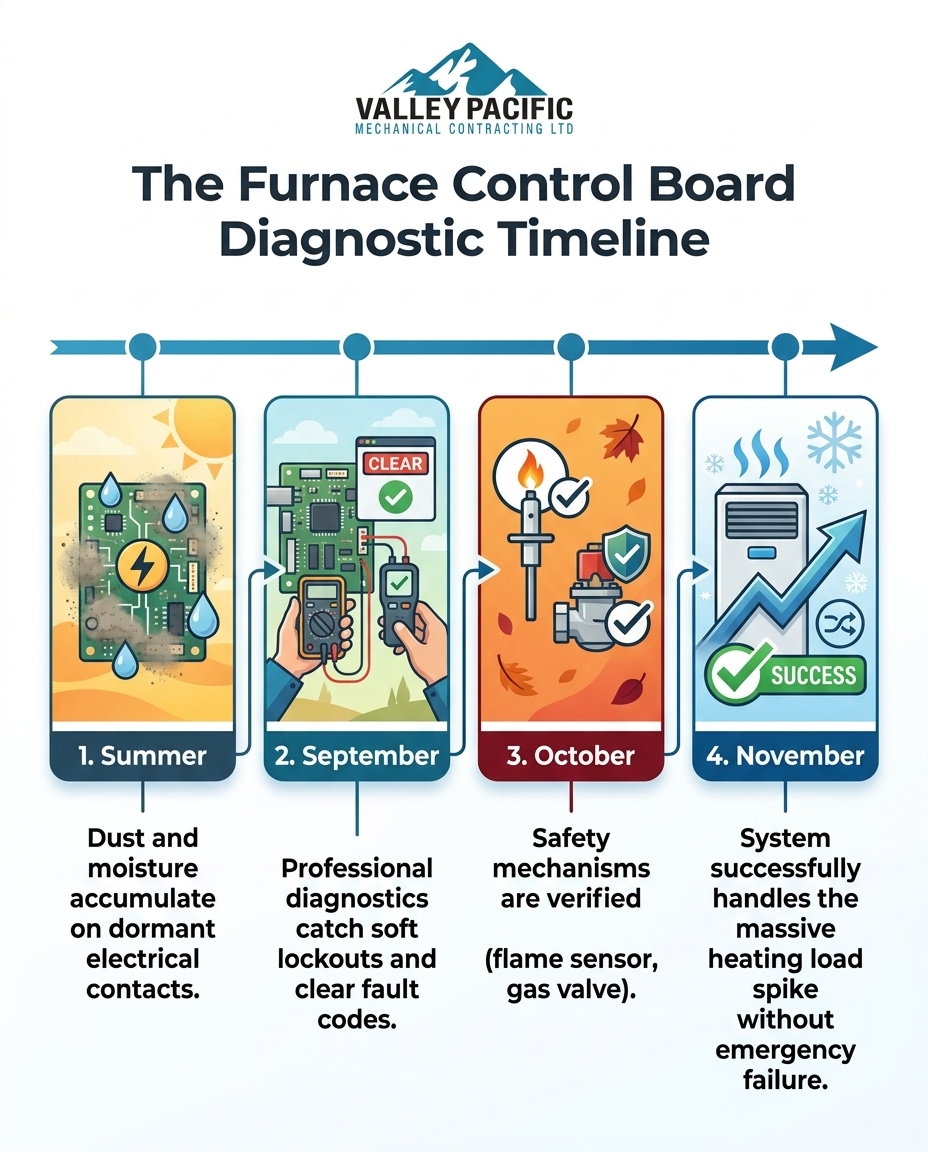
Maple Ridge experiences significant autumn precipitation, which naturally increases ambient indoor humidity. This damp air easily makes its way into unconditioned spaces, directly affecting dormant electronics before the freezing winter temperatures even hit. Dust buildup combined with this ambient moisture can seriously compromise sensitive electrical contacts on the control board.
The risks of a dormant system:
• Oxidation: Moisture in the air can cause microscopic corrosion on the board's metal contacts.
• Dust insulation: Settled dust acts as an insulator, causing the board to overheat when it finally turns on.
• Pest interference: Spiders and small insects often seek shelter in control panels over the summer, building webs that disrupt electrical flow.
In our years of servicing Maple Ridge homes, our team consistently finds that when the system is fired up for the first time in the fall, these compromised contacts cause misfires or electrical shorts. A pre-season inspection clears away this off-season accumulation before it translates into a costly electrical fault. Preparing the board for the heavy lifting of winter means addressing the environmental toll of the summer slumber.
Decoding the Warning Signs: Soft Lockouts vs. Hard Lockouts
Early in the season, during the mild September to November transition, compromised boards often give subtle warning signs before they fail completely. The most common symptom is a "soft lockout." This is an intermittent shut-off where the furnace detects a minor fault, shuts down temporarily for safety, and then resets itself to try again.
Homeowners might notice short-cycling during this phase. The furnace turns on, runs briefly, but shuts off before the house reaches the set temperature on the thermostat. Because the system eventually turns back on, many people ignore the problem. However, our technicians frequently visit homes where ignoring these soft lockouts inevitably led to a "hard lockout." A hard lockout means the control board has detected a persistent, dangerous failure and shuts the entire system down permanently until a professional resets and repairs it.
• System Behavior — Soft Lockout: Furnace shuts down temporarily but tries to restart after a set time. — Hard Lockout: Furnace shuts down completely and will not attempt to restart.
• Homeowner Experience — Soft Lockout: Noticeable short-cycling; house eventually warms up, but inefficiently. — Hard Lockout: Complete loss of heat; blowing cold air or no air at all.
• Underlying Cause — Soft Lockout: Intermittent sensor drops, dirty flame sensor, or early board failure. — Hard Lockout: Repeated soft lockouts, major component failure, or severe safety risk.
• Required Action — Soft Lockout: Schedule a diagnostic to catch the issue early. — Hard Lockout: Requires immediate professional intervention to restore heat.
Catching these intermittent faults early prevents total system failure. If your system is experiencing repeated lockouts, you may be facing a larger decision about repairing or replacing a failing furnace control board. Addressing a soft lockout in October is far easier and less stressful than dealing with a hard lockout during a December snowstorm.
Beyond the Basics: What a Professional Diagnostic Cycle Reveals
Testing a control board requires specialized multimeters, specific calibration tools, and a deep understanding of complex electrical schematics. This is never a DIY project. A professional diagnostic cycle digs deep into the unseen health of your heating system, revealing issues that are invisible to the naked eye.
During a thorough inspection in Maple Ridge BC, technicians retrieve stored fault codes that the homeowner cannot see. These codes act like a vehicle's check engine light history, telling the technician exactly where the system struggled over the past year. The diagnostic cycle tests the micro-amp readings of the flame sensor and verifies the precise voltage drops across the board's relays.
The professional difference:
1. Reading the history: Extracting fault codes to identify intermittent issues that only happen occasionally.
2. Voltage verification: Ensuring the board is sending the exact right amount of power to the blower motor and gas valve.
3. Micro-amp testing: Measuring the tiny electrical currents that confirm the safety sensors are reading accurately.
This thorough testing ensures every sequence fires correctly before the heavy heating season begins. Transparency is a core part of this process. For example, when a customer reaches out to our team at Valley Pacific Mechanical Contracting Ltd. for fall maintenance, our responding technicians take the time to walk them through every single step of the diagnostic process. Explaining these fault codes and voltage readings ensures you have complete clarity about your furnace's health, rather than just taking a technician's word for it.
Protecting Your Home: The Link Between the Board and Safety Mechanisms
The control board is much more than just a power switch; it is the ultimate safety mechanism for your entire furnace. It continuously monitors the flame sensor while the unit is running. If the gas valve opens but no flame is detected, the board immediately shuts off the gas supply to prevent dangerous fuel buildup in your home.
A failing board might misread this critical sensor data. In some cases, it might shut down a perfectly safe furnace, leaving you without heat. In a much worse scenario, a compromised board might fail to shut down the system during a genuine malfunction. During the September to November transition, verifying these safety relays is absolutely vital for your family's protection.
Professional diagnostics verify that all safety relays are responding instantly to potential hazards. We recently had a homeowner schedule their regular fall maintenance for their heating equipment, and our thorough, professional inspection of these exact safety mechanisms provided the reassurance they needed heading into winter. Having a trusted expert verify that your safety switches are fully operational is the core benefit of a preventative maintenance plan. It guarantees that if something goes wrong inside the combustion chamber, your control board will react exactly as it should to keep your home safe.
Surviving the Spike: Preparing for the Heavy Heating Load
The transition from mild September weather to freezing November temperatures on the coast creates a massive, sustained heating load on your system. A furnace that runs for ten minutes a day in the early fall will suddenly be asked to run for hours at a time when the first deep freeze arrives.
This sudden drop in temperature stresses every component, but the control board takes the brunt of the electrical demand. A control board that manages short cycles in mild weather will often fail under the stress of continuous winter operation. The electrical relays get hotter, the voltage demands remain constant for longer periods, and any minor weaknesses in the board's circuitry will quickly turn into a total failure.
Testing the board before this spike ensures it can handle the electrical demand of constant use. Proactive scheduling avoids the rush of emergency calls when the weather suddenly turns harsh. In our experience providing HVAC repair in Maple Ridge, if you wait until the system is already failing under the heavy load, you will be competing with hundreds of other homeowners for service. Getting ahead of the weather spike is the most reliable way to guarantee uninterrupted warmth.
Secure Your Home's Comfort Before the Cold Hits
A clear understanding of your control board's health provides immense peace of mind as the seasons change in Maple Ridge BC. Early testing catches hidden faults, clears away summer moisture damage, and ensures your safety mechanisms are fully operational before they are tested by extreme weather. Do not wait for a freezing night to find out your system's central computer is compromised. Ensure reliable heat all winter by trusting our team to verify your system's electronics today.
Frequently Asked Questions
What causes a furnace control board to fail?
A furnace control board typically fails due to age, electrical surges, or environmental factors like excess moisture and dust buildup. Over time, the constant heating and cooling cycles can cause microscopic cracks in the circuit board's solder joints. Additionally, a failing component elsewhere in the furnace, such as a shorted blower motor, can send a power surge back to the board and damage its relays.
How do professionals diagnose a furnace control board?
Professionals diagnose a control board using specialized multimeters to test voltage drops and micro-amp readings across the circuitry. They start by retrieving any stored fault codes from the board's memory, which indicate past intermittent failures. The technician will then run the furnace through a complete heating cycle, measuring the electrical input and output at each stage—from the draft inducer to the gas valve—to ensure the board is sending the correct signals at the precise right time.
Can a furnace run with a bad control board?
In most cases, a furnace cannot run safely or consistently with a bad control board. The board is the central computer managing the sequence of operations; if it fails, it usually triggers a hard lockout to prevent the system from operating unsafely. Occasionally, a partially failing board might allow the furnace to run in short bursts (short-cycling), but this is highly inefficient and will quickly lead to a complete breakdown.
How do I know if my furnace control board is bad?
You will usually notice that your furnace is behaving erratically, such as turning on and off before the house is warm, or failing to turn on at all despite the thermostat calling for heat. You might also notice a blinking diagnostic light on the lower panel of the furnace, which flashes in a specific sequence to indicate an error code. However, because these symptoms can also point to a bad thermostat or a dirty flame sensor, a professional electrical diagnostic is the only way to confirm the board is the culprit.
What is the difference between a furnace soft lockout and a hard lockout?
A soft lockout is a temporary safety shutdown where the furnace pauses operation after detecting a minor fault, but automatically attempts to restart after a set time (usually an hour). A hard lockout occurs when the furnace detects a severe, persistent safety risk or experiences repeated soft lockouts. During a hard lockout, the system shuts down completely and will not attempt to fire again until a professional technician resets and repairs the underlying issue.
Why is fall the recommended time for electrical furnace diagnostics?
Fall is the recommended time because it allows technicians to catch hidden off-season wear—like moisture damage or dust buildup on electrical contacts—before the system faces the heavy strain of winter heating. Testing in September or October ensures the furnace is ready for the sudden, massive increase in heating load that occurs when temperatures drop below freezing. Proactive fall diagnostics prevent you from experiencing an emergency no-heat situation on the coldest nights of the year.


