


Why We Walk Our Customers Through Every Step of Their HVAC Service Call


The Anxiety of the Unknown During an HVAC Breakdown
That strange noise from your furnace isn't going away on its own, and the house still feels uncomfortably chilly despite the thermostat setting. You know you need a professional, but dialing a contractor often brings a wave of immediate anxiety. Why we walk our customers through every step of their HVAC service call comes down to eliminating this exact stress from the moment we arrive at your door.
Whether you need emergency HVAC repair services to restore your home's comfort or you are scheduling routine furnace servicing and repair, our team believes in a radically different approach to home service. The traditional model of home repairs often leaves homeowners in the dark. A technician arrives, disappears into a basement or utility closet for an hour, and emerges with a piece of paper listing technical terms and a total balance due. This outdated method breeds vulnerability. How can you confidently make decisions about your home when you are relying on highly technical explanations without any visual proof?
Our core philosophy is simple: transparency must be shown, not just spoken. We understand that your heating and cooling equipment represents a significant investment in your property. When a system fails unexpectedly in Maple Ridge, the disruption to your daily life is stressful enough without the added confusion of a secretive diagnostic process. We believe the pivotal moment in any service call happens when our technician invites you to look at the unit together. By physically showing you the condition of your equipment, we replace the anxiety of the unknown with the confidence of clear, evidence-based education.
Why Verbal Explanations Aren't Enough for Peace of Mind
The HVAC industry is filled with complex terminology. From heat exchangers and limit switches to contactors and capacitors, the vocabulary used to describe your heating and cooling system can sound like a foreign language. When a contractor relies solely on verbal explanations, they inadvertently create a barrier between their expertise and your peace of mind.
The Problem with 'Trust Me' Contracting
The industry standard often involves a technician writing up a quote in the front seat of their truck and handing it to the customer at the front door. This "trust me" approach leaves homeowners feeling completely disconnected from the actual state of their equipment. If you are told that a specific part has failed, but you never actually see the part, it is entirely natural to feel a degree of skepticism. You might wonder if the repair is truly necessary, or if the technician is simply guessing at the root cause of the problem. This opaque practice does not serve the homeowner, and it certainly does not build a foundation for a long-term service relationship.
Replacing Jargon with Visual Evidence
To solve this disconnect, our methodology focuses on translating technical jargon into real-world, physical observations. We do not expect you to be an HVAC expert, which is why we take on the responsibility of being your educational partner.
Consider the difference between a verbal summary and a visual walkthrough:
• "Your system is failing because of worn or pitted HVAC valves." — Our Visual, Educational Approach: "Let me show you these valves. See this pitting on the metal? That's what's restricting your airflow."
• "The blower motor is drawing too many amps and needs replacement." — Our Visual, Educational Approach: "Listen to this grinding sound, and look at the scorch marks on this motor casing."
• "Your system is dirty and requires a deep clean." — Our Visual, Educational Approach: "Here is the blower wheel. Notice how the dust buildup is completely blocking the fins."
• Handing over a clipboard with a list of recommended parts. — Our Visual, Educational Approach: Standing next to the open cabinet, pointing a flashlight at the exact point of failure.
Seeing the physical deterioration of a specific part validates the diagnosis instantly. When you can see exactly where the failure occurred inside the system cabinet, the repair process makes logical sense. Our ultimate goal is to empower you with complete knowledge before a single repair begins, ensuring you are comfortable and informed every step of the way.
Physical Evidence: Seeing the Wear and Tear Firsthand
Providing physical evidence is standard operating procedure for our technicians, not a rare exception. We believe that guiding a homeowner to the equipment to look at the internals safely is the most important part of our visit. We want you to see the visual difference between a healthy component and a failing one.
During a recent summer service appointment, one of our technicians was inspecting a furnace and discovered a severely clogged and damaged valve. In a traditional service call, the technician might have simply noted the damaged valve on the invoice and proceeded with the repair. Instead, adhering to our transparent methodology, the technician asked the homeowner to join them at the unit. The technician pointed a flashlight directly at the component, explaining how the clog was forcing the system to overwork and showing the physical damage on the valve body itself. Because the homeowner could see the physical blockage and the resulting wear, the necessity of the repair was immediately clear. The issue was resolved quickly and on schedule, with the homeowner fully understanding exactly what was done and why.
What we typically show homeowners during a visual walkthrough:
• Worn or pitted HVAC valves: We point out the exact areas where the metal has degraded, explaining how this pitting leads to pressure drops and inefficiency.
• Electrical discoloration: We show you control boards or wiring that exhibit dark scorch marks, a clear visual indicator of electrical failure or overheating.
• Mechanical friction: We manually demonstrate how a seized bearing or a failing motor resists movement, letting you feel or hear the resistance that is straining your system.
• Airflow blockages: We pull out impacted filters or shine a light through a blocked evaporator coil so you can see exactly why your home isn't reaching the desired temperature.
This exact moment—when a technician points out a failing part rather than just listing it on a screen—is what defines our commitment to absolute transparency. It demystifies the repair process and firmly justifies the necessary intervention.
Demystifying the Diagnostic Process Step-by-Step
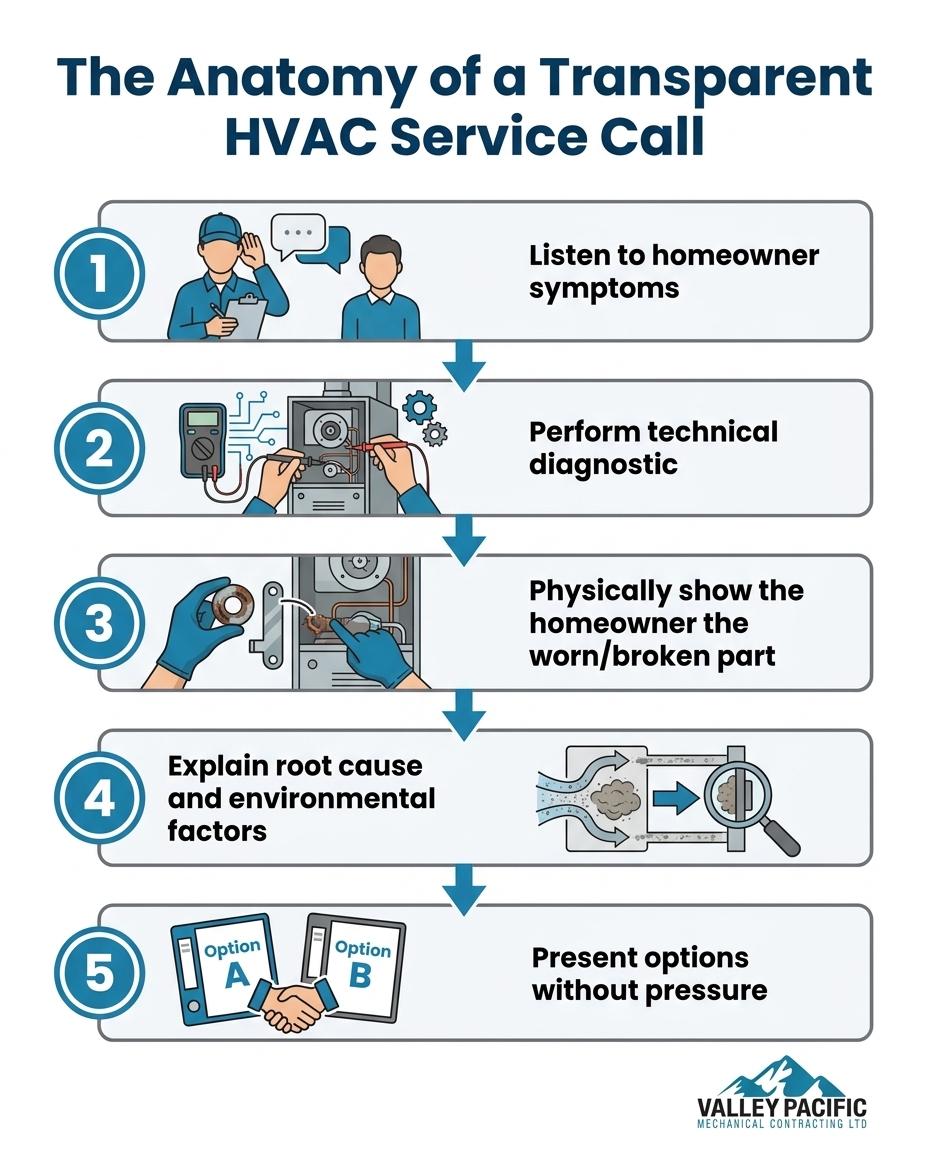
We want every homeowner in Maple Ridge to know exactly what to expect when our truck pulls into their driveway. A transparent service call follows a deliberate, educational structure designed to keep you informed from the first greeting to the final handshake. Here is how we break down the diagnostic process.
1. The Initial Assessment and Active Listening: Before we touch a single tool, we listen to you. You know your home's quirks better than anyone. We ask detailed questions about the symptoms you've noticed—whether it is a strange rattling noise, a sudden spike in energy usage, or a specific room that refuses to cool down. This conversation sets the baseline for our investigation.
2. The Technical Diagnostic Phase: Our technician then proceeds to the equipment to isolate the root cause. This involves testing electrical voltages, measuring refrigerant pressures, checking airflow metrics, and inspecting mechanical linkages. During this phase, we are gathering the hard data required to formulate an accurate diagnosis.
3. The Invitation for Physical Inspection: Once we have isolated the issue, we pause the work. We invite you to step over to the unit. We safely remove the necessary access panels and use our flashlights to highlight the specific component that has failed or is showing signs of severe wear. We explain what the part does when it is healthy, and what is happening now that it is compromised.
4. Discussing System-Wide Implications: A broken part rarely exists in a vacuum. We explain how the failure impacts the overall health of your system. For example, if we are performing heat pump maintenance and find a failing capacitor, we will explain how that weakened capacitor forces the compressor to work harder, potentially shortening the lifespan of the entire unit.
5. Presenting Your Options: Finally, we step away from the equipment and present your options clearly. Because you have seen the physical evidence, these options make logical sense. We provide our professional recommendations, but the final decision always rests in your hands, completely free of high-pressure sales tactics.
How Local Weather Accelerates Component Wear
Connecting the physical wear and tear we show you to the specific environmental challenges of our region is a crucial part of our educational approach. Heating and cooling systems do not operate in a controlled laboratory; they battle the elements every single day. The local climate directly impacts the lifespan and efficiency of your system components.
In Maple Ridge and the broader Lower Mainland, our systems endure a unique set of challenges. The damp, chilly winters create an environment where condensation and moisture are constant threats. High humidity and prolonged damp conditions can wreak havoc on metal parts, leading to accelerated oxidation and rust. When moisture infiltrates the system cabinet, it can also compromise sensitive electrical control boards, causing intermittent failures that are incredibly frustrating to diagnose without a thorough physical inspection.
Conversely, our increasingly hot summers put immense strain on air conditioning systems. Components that sat dormant through the damp winter are suddenly called upon to run continuously during July heatwaves. This drastic shift from cold and damp to hot and demanding is a primary driver of component fatigue.
When our technicians show you a rusted flame sensor or a pitted contactor, we don't just tell you it is broken; we explain why it broke. We weave in these environmental factors so you understand how the local climate contributed to the wear. This context is exactly why seasonal maintenance is so critical in this specific region. By understanding the environmental toll on your equipment, you can see the value of proactive care in preventing premature breakdowns.
Building Lasting Trust Through Complete Transparency
The psychological benefits of an educational, transparent approach cannot be overstated. When a homeowner is kept in the dark, every recommendation feels like a potential upsell. When a homeowner is educated and shown the physical reality of their system's condition, the fear of being misled completely evaporates. Transparency builds a bridge of trust that transforms a stressful transaction into a collaborative partnership.
This philosophy applies to every visit we make. Routine maintenance visits are treated with the exact same educational rigor as emergency breakdowns. We want you to see the minor wear and tear before it becomes a major failure. For instance, during a routine furnace service visit, one of our technicians was performing a standard inspection and discovered a dangerous cracked heat exchanger. Because this is a severe safety issue involving carbon monoxide risk, verbal warnings aren't enough. The technician physically showed the homeowner the fracture in the metal. Seeing the undeniable physical evidence of a safety hazard allowed the homeowner to clearly understand the gravity of the situation. Armed with this visual proof, the homeowner confidently chose to replace the unsafe furnace, resolving a dangerous situation with a sensible, competitive replacement option.
An informed homeowner is always better equipped to make difficult repair versus replacement decisions. If you can see that your system is suffering from multiple compounding issues—such as worn or pitted HVAC valves alongside a failing blower motor and a rusted cabinet—the decision to upgrade feels logical rather than forced. If you want to learn more about how we handle unexpected system failures, you can read about what to expect during an emergency service call. We are committed to being your educational partner for the entire lifespan of your home's comfort system.
Frequently Asked Questions About Our Service Process
What exactly happens during an HVAC service call?
A transparent service call involves a thorough system inspection, diagnostic testing, and a physical walkthrough of the findings with the homeowner. We begin by listening to your concerns, then we isolate the technical issue using professional tools. Most importantly, we invite you to the unit to physically see the worn or broken components, ensuring you understand exactly what is happening before we present any repair options.
How long does an HVAC diagnostic take?
A proper diagnostic typically takes 45 to 90 minutes, depending on the complexity of the issue and the time spent explaining the findings to you. We never rush the inspection process, because finding the root cause is critical to preventing future breakdowns. A significant portion of this time is dedicated to walking you through the physical evidence and answering your questions.
What questions should I ask my HVAC technician?
Always ask to see the damaged part with your own eyes. You should also inquire about the root cause of the failure—whether it was caused by age, lack of maintenance, or local environmental factors in Maple Ridge. Finally, ask what steps you can take moving forward to prevent similar issues, such as upgrading your filter schedule or booking seasonal tune-ups.
How can I trust my HVAC technician's diagnosis?
Trust is built when the technician physically shows you the problem rather than just providing a verbal summary or a written invoice. If a contractor is willing to open the cabinet, point a flashlight at a damaged component, and explain the mechanics of the failure in plain language, you can be confident in their diagnosis. Transparency is the ultimate proof of honesty.
Will I be pressured into replacing my system?
No, our philosophy is to educate and present the physical facts, allowing you to make an informed decision entirely without pressure. We will show you the exact condition of your equipment and explain the pros and cons of repairing versus replacing. Our goal is to provide you with all the visual evidence and professional context you need to choose the path that is best for your home.
Experience a New Standard of Transparent Service
You deserve to be fully educated and shown concrete physical evidence before you authorize any work on your home's heating and cooling systems. The days of accepting a "trust me" diagnosis and a confusing bill should be left in the past. We invite you to experience a service call where you are treated as a true partner in the care of your home. If you are ready to work with a team that values your understanding as much as your comfort, reach out to us to schedule your next furnace servicing and repair. We look forward to showing you exactly what transparent, evidence-based service looks like.


