


How to Master Your PNW Microclimate Without Breaking the Bank


Why the Best Smart Thermostat Schedule for Pacific Northwest Coastal Weather Is Different From Everywhere Else
The best smart thermostat schedule for Pacific Northwest coastal weather starts with understanding that this region doesn't behave like the rest of North America. The Lower Mainland — from Maple Ridge and Langley to Vancouver and Surrey — sits in a climate zone where mornings are damp and grey, afternoons can swing 10°F warmer, and "winter" rarely means hard freezes but almost always means persistent moisture.
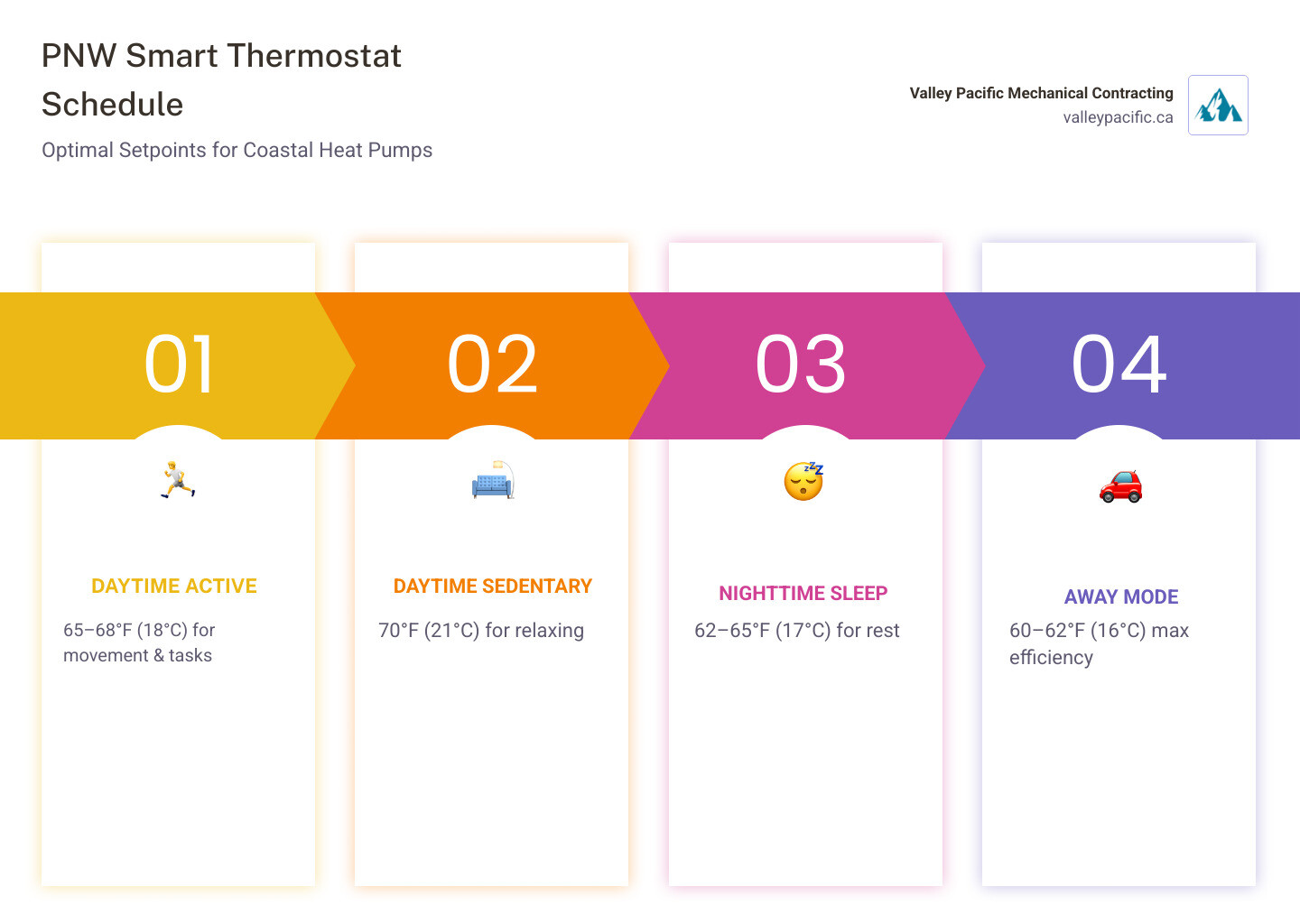
Here's a quick-reference schedule for most Lower Mainland homes:
| Period | Temperature (°F) | Temperature (°C) |
|---|---|---|
| Daytime (home & active) | 65–68°F | 18°C |
| Daytime (sedentary/relaxing) | 70°F | 21°C |
| Nighttime / sleeping | 62–65°F | 17°C |
| Away from home | 60–62°F | 16°C |
| Heat pump max nighttime setback | No more than 3°F drop | ~1.5°C |
Key PNW rule: If you have a heat pump — which is common across the Lower Mainland — limit your overnight temperature setback to no more than 3°F. Larger drops force the system into costly auxiliary heat mode, wiping out your savings.
What makes this region genuinely tricky is the combination of mild temperatures, high humidity, and frequent rain. Standard thermostat advice written for cold-climate cities or dry inland regions simply doesn't account for the damp air, coastal fog, or the fact that your home may need heating in August one week and struggle with condensation the next.
According to BC Hydro, the sweet spot for energy efficiency is 18°C (64°F) when you're active and 21°C (70°F) when you're sitting still — a range that maps well to the mild but damp conditions along the coast. The U.S. Department of Energy backs this up, noting that setting your thermostat to 68°F for heating can reduce energy consumption by up to 15% compared to higher settings, with each additional degree adding roughly 3–5% to your bill.
For homeowners in the Lower Mainland, the goal isn't just comfort — it's dialing in a schedule that works with your heat pump, your microclimate, and BC's energy programs, without turning your HVAC system into a money drain.
The Best Smart Thermostat Schedule for Pacific Northwest Coastal Weather

When we talk about the best smart thermostat schedule for pacific northwest coastal weather, we aren't just picking numbers out of a hat. We are looking for the intersection of biology and physics. In places like Maple Ridge and Pitt Meadows, the air is heavy with moisture. This humidity makes 18°C (64°F) feel much colder than it would in a dry climate like the Okanagan.
For most of us in April 2026, the goal is to stop "thermostat wrestling"—the habit of cranking the heat up to 24°C because you feel a chill, only to turn it off entirely an hour later. Instead, a smart schedule creates a steady baseline. Using Smart Thermostats Maple Ridge BC technology allows your home to anticipate these needs.
BC Hydro suggests that about 80% of couples in our region actually argue about the temperature. By setting a schedule based on activity levels—21°C when you are watching a movie in Langley and 18°C when you are cleaning the house in Mission—you can find a compromise that keeps the peace and the energy bill low.
Winter Setpoints for Damp Coastal Mornings
Winter in the Lower Mainland is less about snow and more about the "wet cold" that seeps into your bones. To combat this, we recommend a daytime setpoint of 68°F (20°C). When you go to bed, dropping the temperature to 62°F (17°C) can lead to a significant energy reduction—up to 15% according to some estimates.
However, the "morning recovery" is where many homeowners fail. In a damp coastal environment, your walls and furniture hold onto the night's chill. A smart thermostat can use "Smart Recovery" to start warming the house 30 minutes before you wake up, so you aren't stepping onto a freezing floor.
Winter Comfort Tips for the Coast:
- Layer up: Before touching the thermostat, put on a sweater or thick socks. It’s the most cost-effective "zone heating" available.
- Watch the dew point: Keeping your home at a steady 68°F helps prevent the air from reaching the dew point indoors, which causes window condensation.
- Seal the drafts: No schedule can overcome a leaky front door. Use weatherstripping to keep that expensive warm air inside.
Summer Cooling and Humidity Management
Our summers are changing. While we used to rely on a cracked window and a prayer, we now see heat waves that make air conditioning a necessity. For an efficient summer schedule, aim for 75°F (24°C) when you are home and 80°F (27°C) when you are away.
The real challenge on the coast isn't just the heat; it's the humidity and salt air. If you live near the water in Vancouver or Surrey, your smart thermostat’s dehumidification feature is your best friend. High humidity makes the air feel "heavy" and warmer than it actually is. By using your HVAC system to pull moisture out of the air, you can often feel comfortable at 75°F without needing to drop the temperature further.
When do you stop cooling and start heating? In the PNW, we look for the "October Threshold." Usually, mid-October is when overnight temperatures consistently stay below 10°C (50°F), signaling it's time to flip the switch.
Optimizing Your Schedule for Heat Pumps and Seasonal Transitions
If you’ve upgraded to a heat pump in Langley or Maple Ridge, your scheduling strategy must change. Heat pumps are incredibly efficient, but they don't like sudden, massive changes. This is where the "Set it and Forget it" philosophy comes into play.
Unlike an old gas furnace that can blast heat to bridge a 10-degree gap in minutes, a heat pump works best by maintaining a steady temperature. If you drop the temperature too low at night, the system may trigger "Auxiliary Heat" (electric resistance coils) to catch up in the morning. This is the least efficient way to heat your home.
Best smart thermostat schedule for pacific northwest coastal weather in Spring and Fall
Spring and fall in the Lower Mainland are the seasons of "The Great Thermostat Confusion." You might wake up to 5°C and fog, but by 2 PM, the sun is out and it's 18°C.
| Season | Morning (6 AM - 9 AM) | Daytime (9 AM - 5 PM) | Evening (5 PM - 10 PM) | Night (10 PM - 6 AM) |
|---|---|---|---|---|
| Winter | 68°F (20°C) | 65°F (18°C) | 70°F (21°C) | 62°F (17°C) |
| Summer | 72°F (22°C) | 80°F (27°C) | 75°F (24°C) | 72°F (22°C) |
During these transitions, keep your setback to a maximum of 3 degrees. This prevents the system from overworking. If your smart thermostat supports Smart Thermostats Maple Ridge BC adaptive staging, it will automatically use the lowest energy stage possible to keep you comfortable during these swings.
Leveraging Geofencing and Weather Integration
One of the most powerful tools for a PNW homeowner is weather integration. Our weather is influenced by atmospheric rivers and sudden coastal shifts. A smart thermostat connected to local weather data knows if a rainstorm is coming and can adjust the indoor humidity or pre-heat the house before the temperature drops outside.
Geofencing is another game-changer. By tracking your mobile phone's location, the thermostat can enter "Auto-Away" mode the moment you leave for work in Pitt Meadows. When you start your commute back from Vancouver, the geofence triggers the "Home" setting, ensuring the house is perfectly cozy the moment you walk through the door.
Advanced Features for High Humidity and Hosting
In the Lower Mainland, we fight a constant battle against dampness. Maintaining indoor humidity between 30% and 50% is the gold standard. Anything higher, and you risk mold growth in closets or behind furniture; anything lower, and you’ll deal with dry skin and static electricity.
Managing Coastal Dampness and Indoor Air Quality
Coastal dampness isn't just an outdoor problem. Vapour pressure can actually push moisture through your walls. Smart thermostats with fan cycle control can help by intermittently circulating air through your HEPA filters and ventilation system, even when the heat isn't running. This prevents "stagnant air" pockets where condensation and mold thrive.
During wildfire smoke season—which has unfortunately become a PNW staple—your smart thermostat can integrate with air quality sensors to automatically ramp up filtration when outdoor particulate levels rise. This 24/7 monitoring ensures your indoor air stays clean, regardless of what's happening outside.
Best smart thermostat schedule for pacific northwest coastal weather when hosting guests
Hosting a holiday dinner in a "cooler Northwest home" presents a unique HVAC challenge. You have ten people in the living room, the oven has been at 350°F for three hours, and someone keeps leaving the front door open.
The Proactive Hosting Schedule:
- The 2-Degree Drop: Lower your thermostat by 2 degrees roughly an hour before guests arrive. This accounts for the collective body heat of your visitors.
- Kitchen Anticipation: If you’re roasting a turkey or baking, drop the kitchen zone (or the whole house) another degree.
- Guest Mode: Use your thermostat’s "Guest Mode" or "Temporary Hold" to prevent the system from entering "Away" mode while you’re all gathered in the living room.
- Room Sensors: Place a remote sensor in the main gathering area. This prevents the thermostat (often located in a hallway) from thinking the house is cold while your guests are sweating in the lounge.
Watch out for the "Staircase Effect." Heat rises, and in many Langley or Surrey homes with open staircases, the upstairs can become a sauna while the downstairs stays chilly. Adjusting your upstairs vents or lowering the upstairs setpoint can help balance the load.
Passive Strategies to Support Your Smart HVAC System
A smart thermostat is the brain of your home, but your windows and walls are the body. To get the most out of the best smart thermostat schedule for pacific northwest coastal weather, you need to support your technology with passive strategies.
Ceiling Fans and Window Treatments
Ceiling fans are not just for summer. In the winter, reverse your fan to rotate clockwise at a low speed. This pulls cool air up and pushes the warm air trapped at the ceiling back down to where you are. This simple trick allows you to lower your thermostat by a degree or two without losing comfort.
Window treatments are equally vital. In the summer, close blinds on the south-facing side of your home to block solar gain. In the winter, open them during the day to let the sun heat your floors, then close heavy thermal curtains at night to seal off "thermal bridges"—those cold spots where heat escapes through the glass.
Local Rebates and Professional Maintenance
We are lucky in British Columbia to have access to excellent incentive programs. Organizations like CleanBC, BC Hydro, and FortisBC frequently offer rebates for residents who upgrade to smart thermostats or high-efficiency heat pumps.
Available BC Incentives:
- Smart Thermostat Rebates: Often available as instant discounts or mail-in rebates for ENERGY STAR certified models.
- Heat Pump Grants: Significant funding is often available for switching from fossil fuels to electric heat pumps.
- Income-Qualified Programs: Enhanced grants for households that meet specific income criteria to help with energy-saving retrofits.
Of course, the best schedule in the world won't save you money if your filters are clogged or your outdoor unit is buried in maple leaves. Annual tune-ups are essential. We recommend a spring check-up for cooling and a fall check-up for heating to ensure your system is ready for the seasonal shift.
Frequently Asked Questions about PNW Thermostat Scheduling
When is the best time to switch from cooling to heating in the Lower Mainland?
While every year is different, we generally see the transition happen in mid-October. Look for a stretch of three days where the overnight low stays below 10°C (50°F). If you have a smart thermostat with "Auto" mode, it can handle this transition for you, but keep the "deadband" (the gap between heating and cooling) at least 3 degrees to prevent the system from cycling too often.
How much can I save with a smart thermostat in a coastal climate?
Homeowners in coastal regions like ours can typically expect to save about 8% to 10% on their annual heating and cooling costs. Because our heating season is long and mild, the "micro-adjustments" a smart thermostat makes—like lowering the heat while you’re at the grocery store—add up more significantly than they would in a climate with a short, intense winter.
Why does my heat pump show "Aux Heat" during cold snaps?
"Aux Heat" stands for Auxiliary Heat. This usually kicks in when the outdoor temperature drops so low that the heat pump can't pull enough heat from the air to meet your thermostat's setpoint. It also happens during "Defrost Mode" to prevent the outdoor coils from icing up. If you see this frequently when it's above 0°C, it might be time for a professional inspection.
Conclusion
Mastering your PNW microclimate is about working with the weather, not against it. By implementing the best smart thermostat schedule for pacific northwest coastal weather, you can enjoy a cozy, damp-free home without the dread of a massive utility bill.
At Valley Pacific Mechanical Contracting, we’ve spent over 30 years helping neighbors in Maple Ridge, Langley, Mission, and across the Lower Mainland navigate these exact challenges. As an Indigenous-owned business, we take pride in our community and our "headache-free" approach to home comfort. Whether you need a simple Smart Thermostats Maple Ridge BC installation or a full heat pump overhaul, our licensed technicians are here to help with the Daikin Comfort Promise.
Ready to stop guessing and start saving? Let’s get your home dialed in for the coastal season ahead.


