


Is Your HVAC Over the Hill? Knowing When to Say Goodbye



Is Your HVAC Over the Hill? Here's How to Tell
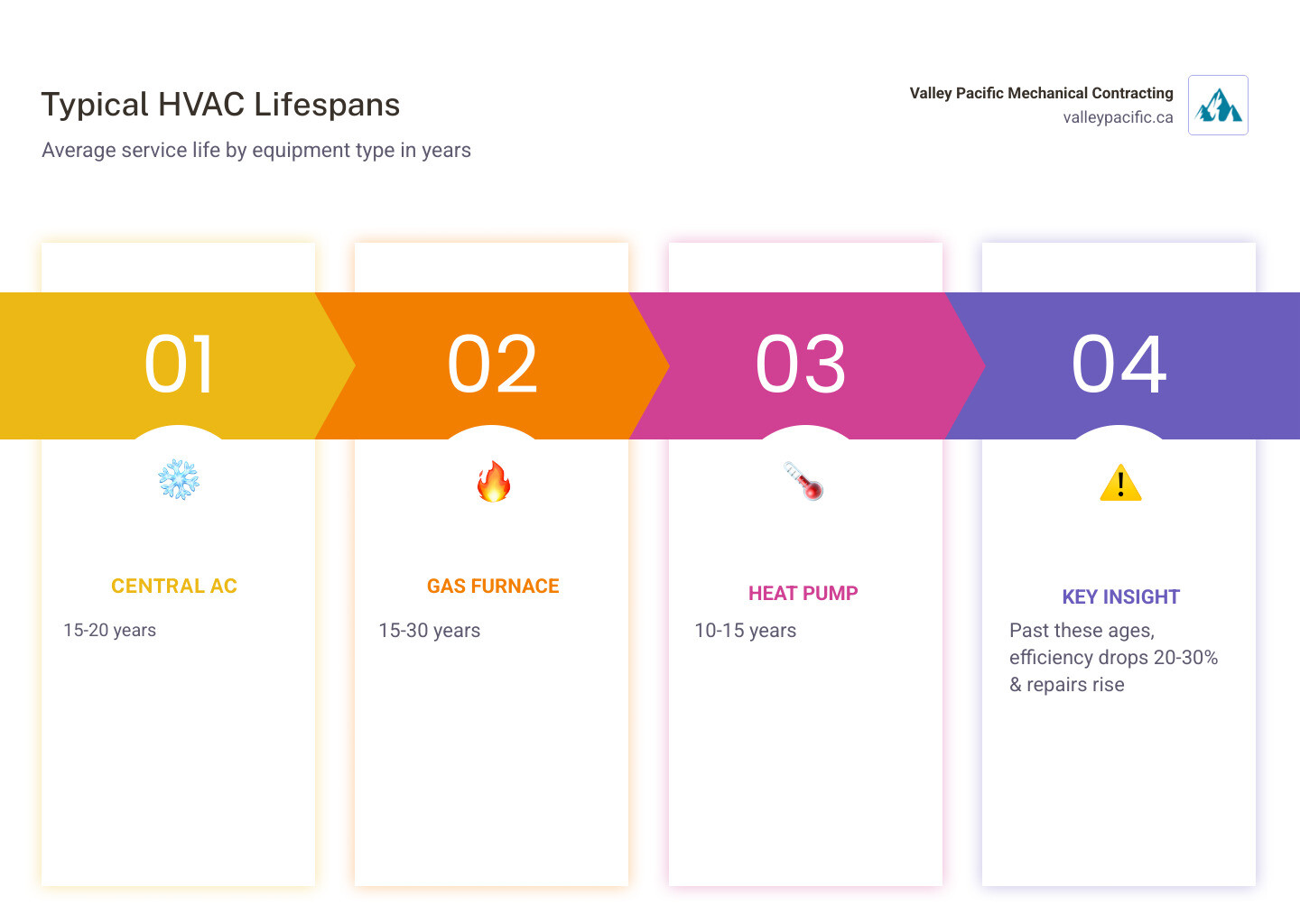
How old is too old for an HVAC system is one of the most common questions homeowners in Maple Ridge, British Columbia ask — and the answer depends on more than just the number on the nameplate. As a general rule:
- Central air conditioners: 15–20 years
- Gas furnaces: 15–30 years
- Heat pumps: 10–15 years
If your system is approaching or past these ranges and showing signs of trouble, it's time to take a serious look at replacement.
Most homeowners don't think about their HVAC until something goes wrong — usually on the hottest day of summer or the coldest night of winter. By then, the decision gets made for you, often at the worst possible time. Nearly one in three homeowners faces a major HVAC breakdown before their system even reaches its expected lifespan, according to industry data. That's not bad luck — that's an aging system quietly losing ground year after year.
The good news is that age alone doesn't always mean it's time to replace. A well-maintained system in the Lower Mainland can push past the average. But once a system crosses certain thresholds — in age, efficiency loss, or repair frequency — keeping it running starts costing more than replacing it.
This guide walks you through exactly how to evaluate your system's age, what warning signs to watch for, and how to make a smart, confident decision about what comes next.
Understanding Lifespans: How Old Is Too Old for an HVAC System?
When we talk about the lifespan of heating and cooling equipment, we aren't just looking at when the machine stops turning on. We are looking at the "economic life" of the unit. At Valley Pacific Mechanical Contracting, we’ve seen systems in Langley and Pitt Meadows that are 25 years old and still puffing along, but they are doing so at a massive cost to the homeowner in terms of monthly utility bills and safety risks.
So, how old is too old for an HVAC system? Generally, once a central AC or furnace hits the 15-year mark, it enters a high-risk zone. By year 12, many central air systems have already lost 20% to 30% of their original efficiency. If you are noticing that your home isn't as comfortable as it used to be, you might see some signs you need a new AC installation manifesting as uneven cooling or a unit that never seems to stop running.
Step-by-Step: How to Determine How Old Is Too Old for an HVAC System

If you’ve recently moved into a new home in Mission or Maple Ridge, you might not know exactly when your equipment was installed. Here is how we recommend finding out:
- Locate the Nameplate: On your outdoor AC or heat pump, there is a metal nameplate. On a furnace, it’s usually inside the front cabinet door.
- Find the "MFR DATE": Many modern manufacturers clearly print the month and year of manufacture.
- Decode the Serial Number: If there is no date, look for the serial number. Often, the first few digits represent the week and year. For example, a serial number starting with "0526" might mean it was built in the 5th week of 2026.
- Check Installation Records: Look for a sticker from the installing contractor. If you’re still unsure, you can always check if your old AC is ready for replacement by having a professional technician verify the age and condition for you.
Average Service Life by Equipment Type
Different components of your home comfort system age at different rates because they face different levels of stress.
- Central AC (15–20 years): These units live outside, exposed to the BC rain and fluctuating temperatures. The median service life is often closer to 12–15 years in humid or coastal-influenced climates.
- Gas Furnaces (15–30 years): Because they are sheltered indoors, furnaces typically last the longest. However, the heat exchanger — the heart of the furnace — is subject to intense thermal expansion and contraction that can lead to cracks after two decades.
- Heat Pumps (10–15 years): Heat pumps work double duty, providing both heating and cooling. Because the compressor runs year-round, they often reach the end of their life sooner than a dedicated furnace or AC. If you notice your system struggling in the winter, it’s worth checking for signs your heat pump needs repair before the unit fails entirely.
Key Signs Your System is Reaching the End of the Road
Age is a number, but performance is a reality. Even a "young" system can be "too old" if it wasn't installed correctly or maintained. We often tell our clients to look for the "Slow Bleed" — those small, frequent issues that indicate a system may fail soon.
Efficiency Red Flags: Signs Your HVAC System Is Too Old
By the time a central air system hits its 10th birthday, it is likely operating at only 80-85% of its original efficiency. This degradation happens quietly. You might notice your utility bills creeping up by $20 or $30 a month compared to the same time last year, even though the weather hasn't changed.
Older systems often have lower SEER (Seasonal Energy Efficiency Ratio) ratings. Moving from an old 10 SEER unit to a modern 16 or 18 SEER system can reduce your cooling energy use by nearly 40%. If you find yourself constantly adjusting the thermostat to stay comfortable, it's a sign that the system can no longer keep up with the demand, which is a common indicator of when to install a new AC system.
Mechanical Failures and Safety Risks
Beyond the wallet, there are safety concerns to consider. For furnaces, the biggest risk is a cracked heat exchanger. This can allow carbon monoxide to leak into your home’s air supply. Because this is a life-safety issue, a cracked heat exchanger often triggers a mandatory system shutdown.
Another major factor for air conditioners is the R-22 refrigerant phase-out. If your AC was built before 2010, it likely uses R-22 (Freon). Production and import of R-22 were banned in 2020. If an old R-22 unit develops a leak, the cost to "recharge" it with reclaimed gas is astronomical — often making a simple repair more expensive than a down payment on a new unit. If you're experiencing issues where your furnace won't ignite, it could be a simple part or a sign of deeper mechanical fatigue.
The Decision Framework: When to Repair vs. Replace
Deciding whether to sink more money into an old unit or invest in a new one can be stressful. To help our customers in the Lower Mainland, we use two primary economic "rules of thumb."
| Factor | Repair It | Replace It |
|---|---|---|
| Age | Under 10 years | Over 15 years |
| Repair Cost | Minor (under $500) | Over 50% of replacement cost |
| Efficiency | Bills are stable | Bills increasing 20%+ |
| Comfort | Even temps throughout | Hot/Cold spots; humidity issues |
| Refrigerant | Uses R-410A | Uses R-22 (Freon) |
One common symptom of an aging, oversized, or failing furnace is "short cycling," where the unit turns on and off rapidly. Understanding furnace short cycling signs and solutions can help you decide if the fix is worth the investment.
Evaluating the $5,000 Rule for Modern Systems
The $5,000 Rule is a simple math equation: Age of System × Cost of Repair.
If the result is greater than $5,000, it’s generally considered "too old" to be worth the repair.
- Example: A $600 repair on a 12-year-old system (12 x 600 = 7,200) suggests replacement is the better financial move.
- Example: A $300 repair on an 8-year-old system (8 x 300 = 2,400) means you should probably stick with the repair.
Maximizing Longevity in the Lower Mainland Climate
Our climate in places like Maple Ridge and Langley is unique. We deal with high humidity and, in some areas, salt air from the coast. These factors can accelerate corrosion on outdoor coils. This makes HVAC preventative maintenance absolutely vital.
The Role of Preventative Maintenance in Extending Life
We’ve seen well-maintained systems last 5 to 10 years longer than neglected ones. Regular service doesn't just prevent breakdowns; it keeps the system running at peak efficiency so it doesn't have to work as hard.
Some quick preventative maintenance tips you can do yourself include:
- Changing your air filters every 1–3 months.
- Keeping the area around your outdoor unit clear of debris and plants.
- Ensuring vents inside the house aren't blocked by furniture.
Frequently Asked Questions about HVAC Age
Should I replace my AC and furnace at the same time?
In many cases, yes. Your AC and furnace often share the same blower motor and ductwork. Replacing them as a "matched system" ensures that both components are designed to work together at maximum efficiency. It also saves you money on labor costs, as our technicians only have to make one trip to perform the installation.
What is the best time of year to replace an HVAC system?
The "shoulder seasons" — spring and fall — are the best times. During the peak of summer or winter, HVAC companies are flooded with emergency calls, and equipment can sometimes be backordered. Scheduling in the spring or fall ensures you get the best availability and that your home is ready before the extreme weather hits.
How does the R-22 phase-out affect my old unit?
If your unit uses R-22, it is effectively on borrowed time. Because the refrigerant is no longer produced, even a small leak can lead to a repair bill that rivals the cost of a new system. Furthermore, R-22 is harmful to the ozone layer, so upgrading to a modern R-410A or R-32 system is much better for the environment.
Conclusion
At Valley Pacific Mechanical Contracting, we understand that your home is your sanctuary. With over 30 years of expertise serving the Lower Mainland, from Mission to Langley, we pride ourselves on providing a "headache-free" experience. Whether you need a simple tune-up to squeeze a few more years out of your unit or a full system upgrade, our licensed technicians are here to help 24/7.
As a Daikin Comfort Pro, we stand behind our work with the Daikin Comfort Promise, ensuring that your investment in a new system is protected for years to come. Don't wait for a total system failure to start thinking about your home's comfort. If you're wondering if your system is "over the hill," contact us today for a professional evaluation of our comprehensive HVAC services.


