


Stop Your Money from Evaporating This Summer



Why Your Summer AC Bill Keeps Climbing — and What You Can Do About It
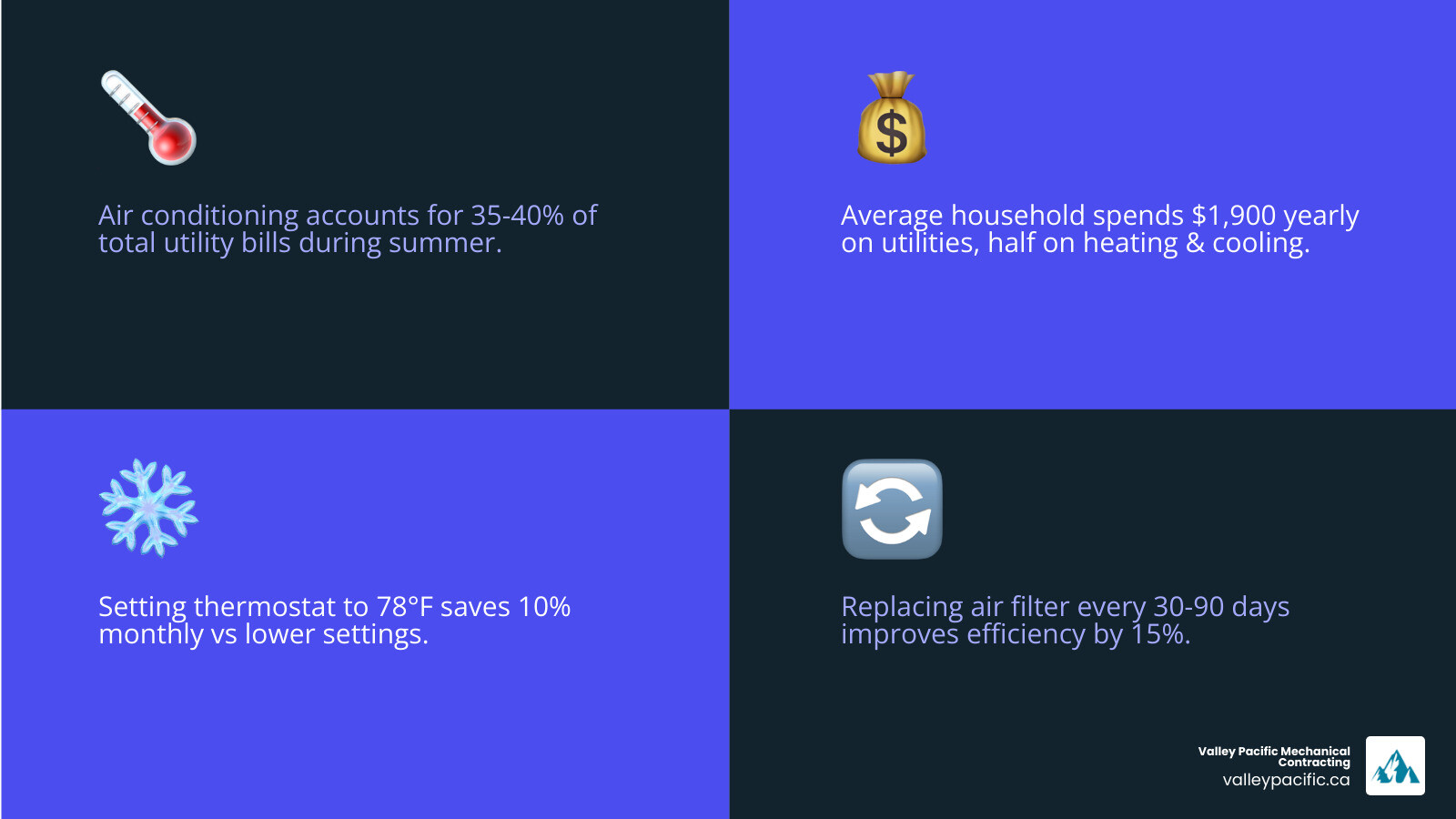
How to lower AC bills during summer is one of the most common questions homeowners across the BC Lower Mainland ask when the warm months arrive — and for good reason. According to the US Department of Energy, air conditioning alone can account for 35 to 40 percent of your total utility bill. Some estimates put summer cooling even higher, at up to 50 percent of your home's power bill during peak months.
Here is a quick overview of the most effective ways to lower your AC bills this summer:
- Set your thermostat to 78°F (26°C) when you are home and raise it by 7 to 10 degrees when you are away
- Use ceiling fans alongside your AC to feel comfortable at a higher thermostat setting
- Replace your air filter every 30 to 90 days to prevent restricted airflow
- Close blinds and curtains on sun-facing windows during the hottest part of the day
- Book a professional AC tune-up at least once per season to keep your system running efficiently
- Seal air leaks around doors and windows with caulk or weatherstripping
- Shift heat-generating tasks like laundry and dishwashing to cooler evening hours
- Unplug devices that draw phantom power even when not in use
- Consider upgrading to a high-efficiency unit if your current system is older or undersized
These steps range from free daily habits to smart one-time upgrades — and together they can make a real dent in what you pay to stay cool.
The average household spends around $1,900 per year on utility bills, with nearly half of that going toward heating and cooling. In the Lower Mainland, where summer temperatures have been climbing in recent years, that figure is hard to ignore. The good news is that most of the biggest savings come from simple, consistent changes — not expensive overhauls.
How to lower ac bills during summer with smart thermostat habits

One of the most effective ways to tackle rising costs is through better thermostat management. It is a common misconception that keeping your home at a frosty 70°F (21°C) all day is the only way to stay comfortable. In reality, your air conditioner works hardest when the gap between the indoor and outdoor temperature is wide.
By aiming for an optimal setting of 78°F (26°C) while you are home, you strike a balance between comfort and conservation. Research shows that you can save up to 10% a year on cooling costs by simply turning your thermostat up 7 to 10 degrees from its normal setting for eight hours a day. This is particularly useful if you are at work or out enjoying the sights in Langley or Pitt Meadows.
If you find that your system is struggling even at these settings, you might be dealing with AC Not Cooling During Heatwaves, which often points to underlying mechanical stress.
Why setting the right temperature matters for your BC home
In the Lower Mainland, we often deal with high humidity alongside heat. Your AC unit doesn't just cool the air; it removes moisture. However, for every degree you set your thermostat below 75°F, your energy use can increase by 10 to 15 percent. By keeping the temperature slightly higher and allowing the system to focus on dehumidification, you create a home that feels "crisp" rather than just "cold."
How to lower ac bills during summer by using programmable schedules
The "set it and forget it" mentality is your wallet's best friend. Programmable and smart thermostats allow you to automate your savings. You can schedule the AC to ramp up right before you get home from work and dial back while you sleep. Smart home integration even allows for remote adjustments if your plans change. Just ensure your controls are working correctly; if not, you may need to troubleshoot why your AC Remote Not Working before the next heat wave hits.
Maximize efficiency with regular system maintenance
Think of your AC like a car; it needs a tune-up to stay fuel-efficient. The single easiest maintenance task for any homeowner is changing the air filter. A dirty, clogged filter restricts airflow, forcing your system to work significantly harder to push air through the house. Simply clearing or replacing a clogged filter can save you 5 to 15 percent on your energy use.
We recommend checking your filters every 30 days, especially if you have pets or live in a dustier area of Mission or Maple Ridge. At a minimum, they should be replaced every 90 days. Regular upkeep is the core of HVAC Preventative Maintenance, preventing the system from burning out prematurely.
How to lower ac bills during summer through professional tune-ups
While filters are DIY-friendly, a professional AC Service goes much deeper. We look for dirty evaporator coils and ensure the outdoor condenser unit has at least two feet of clear space around it. If shrubs or weeds have grown too close, they choke the system's ability to release heat, driving up your bills. Professional cleaning ensures that every watt of electricity you pay for is actually going toward cooling your home.
Troubleshooting common efficiency killers in Langley and Mission
If you notice your bills spiking unexpectedly, look for these common red flags:
- Blocked Vents: Ensure furniture or curtains aren't covering your supply or return registers.
- Constant Cycling: If your unit never shuts off, it’s likely losing the battle against heat gain. You might need help Fixing AC That's Constantly Running.
- Warm Air: If the air coming out isn't cold, check out AC Vents Warm Air Causes & Solutions to identify the culprit, whether it's a refrigerant leak or a failing compressor.
Simple home adjustments to keep the heat out
Your home is essentially a thermal envelope. The more heat you let in, the more your AC has to work to pump it out. One of the most effective "hacks" is managing your windows.
| Window Treatment | Estimated Heat Reduction |
|---|---|
| Closed Blinds/Curtains | Up to 45% |
| Reflective Window Film | Up to 75% |
| Shaded Windows (Awnings/Trees) | Up to 77% |
By closing blinds and curtains on the south and west-facing sides of your home during the day, you prevent the "greenhouse effect" from skyrocketing your indoor temperature. This simple habit addresses Uneven Cooling Issues with Your AC by keeping sun-drenched rooms from becoming heat traps.
Sealing air leaks and improving insulation
If you can feel a draft around your windows or doors, you are essentially paying to cool the outdoors. Use caulk and weatherstripping to seal these gaps. Furthermore, don't forget the attic. Heat from a sun-baked roof can radiate down into your living space if your insulation isn't up to par. If you hear air escaping or strange sounds from your walls, it could be a sign of leaky ducts—often identified by AC Whistling Sound Reasons.
Strategic landscaping for natural cooling
Nature provides some of the best cooling tools available. Planting deciduous trees on the south and west sides of your home provides lush shade in the summer while letting sunlight through in the winter. Shading your outdoor AC unit with shrubs (keeping that two-foot clearance in mind!) can improve its efficiency by up to 10 percent. For more on how greenery affects your home’s ecosystem, explore Spring Air Quality Solutions for HVAC System.
Using fans and appliances strategically
A ceiling fan is not a replacement for an air conditioner, but it is a powerful partner. Fans use roughly 1/60th the energy of an AC unit. By creating a "wind chill effect," a fan makes you feel up to 4 degrees cooler than the actual room temperature. This allows you to set your thermostat higher without any loss in comfort.
Pro Tip: Ensure your fan is rotating counter-clockwise in the summer to push a cool breeze directly downward. Fans cool people, not rooms—so turn them off when you leave the space to save even more.
Shifting heat-generating tasks to off-peak hours
Appliances like ovens, dishwashers, and dryers generate a massive amount of internal heat. If you run these during the hottest part of the afternoon, your AC has to work double-time to neutralize that heat. Try to shift these tasks to the early morning or late evening.
Additionally, check your water heater. It accounts for about 18 percent of home energy use. Lowering the temperature to 120°F (49°C) saves money and reduces the ambient heat in your utility room. If your home's electrical system is under strain from too many appliances running at once, you might find yourself wondering Why is My AC Circuit Breaker Tripping.
Managing airflow and "energy vampires"
"Energy vampires" are devices that draw power even when turned off—think coffee makers, chargers, and game consoles. Unplugging these or using smart power strips can reduce the overall load on your home. Be careful with vent management, too; while it's tempting to close vents in unused rooms, this can actually increase pressure in your ductwork and lead to leaks. It's usually better to keep them open to maintain system balance and prevent the scenario where your AC Suddenly Stops Working due to frozen coils.
Knowing when it’s time for a high-efficiency upgrade
If your air conditioner was installed before 2010, it likely has a SEER (Seasonal Energy Efficiency Ratio) rating of 10 or less. Modern units are required to be much more efficient, often starting at 14 or 15 SEER2. Upgrading to an ENERGY STAR certified unit can slash your cooling costs by a massive margin. If you are constantly calling for repairs, it might be time to ask: Is Your Old AC Ready for Replacement?
Why proper sizing is critical for your next installation
Buying the biggest AC unit on the market isn't the solution. An oversized unit will "short cycle," turning on and off rapidly. This fails to remove humidity and wears out the parts faster. Conversely, a unit that is too small will run non-stop, never reaching your desired temperature. This is Why AC Sizing Matters for Installation. We can help you determine What Size AC Unit Does Home Need based on your square footage, window placement, and insulation levels.
Modern cooling solutions for the Lower Mainland
For homes without existing ductwork, or for those looking for the ultimate in efficiency, heat pumps and ductless mini-split systems are becoming the gold standard in BC. These systems offer incredibly precise control and can both heat and cool your home. If you're seeing Signs You Need a New AC Installation, it's worth exploring these modern AC Installation options that are specifically designed for our West Coast climate.
Frequently Asked Questions about Lowering AC Bills
What is the best temperature to set my AC at in the summer?
The US Department of Energy recommends 78°F (26°C) when you are at home. If that feels too warm initially, try raising the temperature by one degree each day to acclimate. For every degree you raise it, you can save about 3% on your cooling costs.
Should I close the vents in rooms I am not using?
Generally, no. Most modern HVAC systems are designed to operate with a specific amount of air pressure. Closing more than one or two vents can cause the pressure to back up, potentially leading to frozen coils, duct leaks, or a cracked heat exchanger. It is better to keep the air flowing freely throughout the house.
How often should I really change my air filter?
In the Lower Mainland, we recommend checking your filter once a month during the peak summer and winter months. If it looks grey or dusty, change it. At the very least, replace it every 90 days to ensure your system doesn't have to struggle to breathe.
Conclusion
Staying cool in the Lower Mainland shouldn't have to cost a fortune. By combining smart thermostat habits, basic DIY maintenance, and strategic home adjustments, you can keep your home comfortable while keeping your utility bills grounded. Whether you're in Langley, Mission, or Maple Ridge, a little bit of preparation goes a long way in preventing "bill shock" in August.
At Valley Pacific Mechanical Contracting, we bring over 30 years of expertise to every home we visit. We understand the unique climate challenges of the BC Lower Mainland and are committed to providing a "headache-free" experience. From routine tune-ups to full high-efficiency installations, we are here to ensure your home remains a sanctuary all summer long. If you're ready to optimize your home's Air Conditioning system, give us a call today!


