


Frequency Matters and Your HVAC Needs a Schedule



Why How Often You Service Your HVAC Directly Affects Your Comfort and Costs
How often should you service your HVAC is one of the most important questions you can ask as a homeowner — and the short answer is: at least twice a year.
Here is the quick breakdown most homeowners need:
| System Type | Recommended Service Frequency |
|---|---|
| Central AC or gas furnace | Once per season (spring + fall) |
| Heat pump (year-round use) | Every 6 months minimum |
| Older systems (10+ years) | Every 6 months, or quarterly |
| New systems (under 5 years) | Once per year at minimum |
| Homes with pets or allergies | More frequent filter checks + biannual service |
The standard recommendation from HVAC professionals is straightforward:
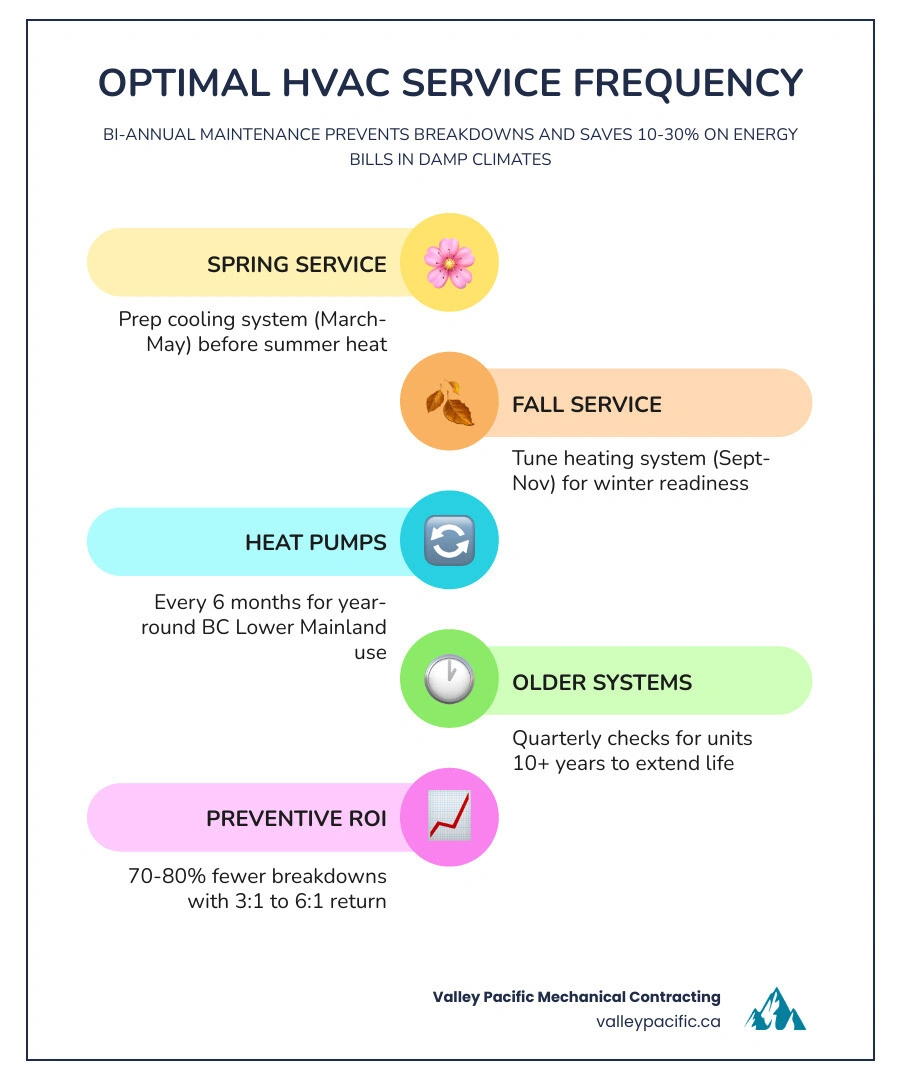
- Spring — service your cooling system before summer heat arrives
- Fall — service your heating system before winter sets in
- Year-round systems (like the heat pumps common across the BC Lower Mainland) — service both seasons, without fail
Think of it the way you think about your car. You would not drive tens of thousands of kilometres without an oil change. Your HVAC system runs just as hard — sometimes harder — and it deserves the same consistent attention.
Here in the Lower Mainland, that reality hits close to home. Maple Ridge, Langley, Surrey, and the surrounding communities all deal with damp coastal winters, humid summers, and systems that often run year-round. That kind of continuous use accelerates wear, clogs filters faster, and puts extra stress on components like fan motors, coils, and condensate drains.
The good news? Research consistently shows that annual maintenance prevents 70 to 80 percent of HVAC breakdowns — and a well-tuned system uses 10 to 30 percent less energy than a neglected one. That adds up to real savings on your BC Hydro or FortisBC bill, season after season.
At Valley Pacific Mechanical Contracting, we have been helping Lower Mainland homeowners stay ahead of these issues for over 30 years. The guide below walks you through exactly what service schedule makes sense for your home, what a professional visit includes, and what warning signs to never ignore.
How Often Should You Service Your HVAC for Peak Performance?

When we talk about the "gold standard" for home comfort, we are talking about a bi-annual service schedule. In the Lower Mainland, our transition seasons—spring and fall—are the ideal windows for this work. Scheduling your cooling prep in the spring (March to May) and your heating readiness in the fall (September to November) ensures your system isn't trying to "wake up" on the hottest or coldest day of the year only to find a seized motor or a cracked belt.
Adhering to a strict HVAC Preventative Maintenance schedule allows us to catch small, inexpensive issues before they transform into "no-heat" emergencies in the middle of a January cold snap.
Seasonal vs. Annual Service Outcomes
| Feature | Annual Service (Once/Year) | Bi-Annual Service (Twice/Year) |
|---|---|---|
| Efficiency Gain | Moderate | Maximum (up to 30% savings) |
| Breakdown Risk | Reduced | Minimal (prevents 80% of issues) |
| Air Quality | Basic | Superior (cleaner coils/filters) |
| Warranty Status | Usually compliant | Fully protected |
| Lifespan | 12-15 years | 15-20+ years |
While a brand-new system under five years old might hum along with just a yearly check, older units or those facing the heavy demands of a large family home require more frequent eyes. This is especially true for heat pumps. Because these systems provide both heating and cooling, they essentially work double-time compared to a standalone furnace. We recommend checking out our Seasonal Heat Pump Maintenance Tips to understand why these versatile units need specific care every six months to handle our coastal dampness.
Understanding how often should you service your hvac components
Your HVAC system is a complex collection of moving parts, electrical circuits, and chemical refrigerants. Over months of operation, fan belts can stretch, bearings can lose lubrication, and electrical connections can vibrate loose.
Regularly checking these components is vital because:
- Lubrication reduces friction in motors, preventing burnouts.
- Electrical tightening prevents "pitting" or arching that can fry expensive control boards.
- Thermostat calibration ensures your system isn't running longer than necessary, which saves you money.
For a deeper dive into these technicalities, our HVAC Preventative Maintenance Tips provide a great roadmap of what needs attention and why.
Adjusting schedules for older systems and pets
If your system is celebrating its 10th or 15th birthday, it is officially in its "senior years." Much like an older car, it needs more frequent checkups to maintain its efficiency. For these older units in Langley or Pitt Meadows, we often suggest moving toward quarterly inspections.
Furthermore, our furry family members play a huge role in how often should you service your hvac. Pet dander and fur are the enemies of airflow. They clog filters rapidly and can coat evaporator coils, forcing the blower motor to work twice as hard. If you have multiple pets or family members with severe allergies, staying on top of Heat Pump Maintenance is the best way to keep your indoor air breathable and your energy bills predictable.
Why Regular Maintenance is Crucial for Lower Mainland Homeowners
In April 2026, we are seeing energy costs continue to be a top concern for residents across British Columbia. The financial argument for maintenance is staggering: every dollar spent on prevention typically saves between $3 and $6 in energy and repair costs.
A neglected system doesn't just cost more to run; it dies sooner. While a well-maintained HVAC system can easily last 20 years, a neglected one often fails by year 12. Replacing a full system is a significant investment; extending its life by nearly a decade through simple maintenance is one of the smartest financial moves a homeowner can make.
Beyond the wallet, there is the issue of safety. For those with gas furnaces, our Furnace Maintenance Langley BC Complete Guide emphasizes the importance of inspecting the heat exchanger. Small cracks in this component can allow carbon monoxide to leak into your home. Regular professional checks ensure your family is safe from this "silent killer."
Finally, consider your manufacturer’s warranty. Most major brands require proof of annual or bi-annual professional service to keep the warranty valid. Without those service records, a major part failure could leave you paying out of pocket for a repair that should have been covered.
What to Expect During a Professional HVAC System Check
When we arrive for a professional HVAC System Check, we aren't just looking at the unit; we are performing a comprehensive health exam. A typical visit lasts between 60 and 90 minutes and includes a multi-point inspection designed to optimize every facet of the system.
One of the most impactful tasks is cleaning the coils. Dirty coils can reduce cooling efficiency by a whopping 40%. We also verify refrigerant levels; contrary to popular belief, systems don't "use up" refrigerant. If it's low, there’s a leak, and finding that leak early can save the entire compressor from failing.
For those with specialized heating, such as boilers in older Maple Ridge homes, our Boiler System Maintenance includes checking pressure relief valves and ensuring the combustion process is clean and efficient.
Specialized care for dual-function systems
Heat pumps require a unique set of eyes. In our damp Lower Mainland climate, the defrost cycle is critical. If this cycle fails, your outdoor unit can turn into a solid block of ice during a Pitt Meadows frost. During a service visit, we test the reversing valve and ensure the sensors are correctly triggering the defrost mode.
Because heat pumps are often "always on," we also focus heavily on component lubrication and coastal dampness protection. We’ve developed Comprehensive Heat Pump Service Plans specifically to address these local challenges, ensuring your system remains a reliable source of comfort year-round.
Essential DIY Tasks and Warning Signs of System Failure
While professional service is non-negotiable, your habits between visits play a massive role in how often should you service your hvac. Think of DIY tasks as the "daily vitamins" that keep the system healthy between its "doctor's appointments."
The most important thing you can do is maintain a clear perimeter around your outdoor unit. We recommend at least two feet of clearance. Trim back the blackberry bushes, clear away fallen Maple Ridge leaves, and ensure snow doesn't pile up against the fins in winter. Restricted airflow at the outdoor unit is a leading cause of system strain.
Homeowner habits and how often should you service your hvac filters
Your air filter is the lungs of your home. A clogged filter doesn't just hurt your air quality; it can raise your energy bills by 5% to 15%. Even worse, it strains the blower motor, potentially leading to a costly burnout.
We recommend checking your filters monthly. If you can’t see light through the filter when holding it up to a lamp, it’s time for a change. For those who find this task easy to forget, our Furnace Filter Replacement Service can take the guesswork out of the equation.
The "1-3 month" rule is a baseline. If you have a Golden Retriever or a wood-burning fireplace, you might find yourself needing a fresh filter every 30 days to keep your airflow at 100%.
Red flags requiring immediate professional attention
Even with the best maintenance, parts eventually wear out. Knowing the warning signs can help you call us before a total breakdown occurs. Watch for these "red flags":
- Unusual Noises: Squealing, banging, or rattling usually indicates a loose belt or a failing motor bearing.
- Weak Airflow: If some rooms are "dead zones" for air, you could have a blockage or a failing blower.
- Short Cycling: If your system turns on and off every few minutes, it is stressed and likely overheating.
- Rising Utility Bills: A sudden spike in your gas or electric bill without a change in weather is a classic sign of a system losing its efficiency.
- Strange Odors: Musty smells can indicate mold in the coils, while "burning" smells could mean electrical issues.
Frequently Asked Questions about HVAC Servicing
Is once a year enough for a newer system?
While a brand-new system is less likely to break down, once a year is the bare minimum. However, for homes in the Lower Mainland using heat pumps for both heating and cooling, we still strongly recommend twice-yearly service. The goal isn't just to fix what's broken; it's to maintain the "factory-fresh" efficiency that makes a new system worth the investment.
Does maintenance really protect my manufacturer warranty?
Yes, absolutely. If you read the fine print of almost any major HVAC manufacturer’s warranty, you will find a clause stating that the equipment must be maintained by a licensed professional. If a major component like a compressor or heat exchanger fails, the manufacturer may ask for service records. If you haven't had your annual or bi-annual tune-ups, they can legally deny your claim, leaving you with a massive bill.
How long does a typical professional service visit take?
For most residential systems in Langley or Mission, a thorough maintenance visit takes between 60 and 90 minutes. If the system hasn't been serviced in several years, it may take a bit longer to perform a deep cleaning of the coils and burners. We respect your time and aim for a "headache-free" experience, getting your system back to peak performance efficiently.
Conclusion
Maintaining a comfortable home in the Lower Mainland shouldn't be a source of stress. By understanding how often should you service your hvac and sticking to a consistent schedule, you can enjoy lower energy bills, better air quality, and the peace of mind that comes with a reliable system.
At Valley Pacific Mechanical Contracting, we bring over 30 years of expertise and our Indigenous-owned values of community and integrity to every job. Whether you are in Maple Ridge, Pitt Meadows, or Langley, our licensed technicians are ready to help you protect your investment. With our Daikin Comfort Promise and 24/7 emergency availability, we are committed to keeping your home comfortable in every season.
Ready to take the guesswork out of your home maintenance? Explore our Maintenance Plan and let us handle the schedule for you, so you can focus on enjoying your home.


