


Mini Split Installation: Answering Common Homeowner Questions About Winter Frost


Waking Up to a Frozen Heat Pump: Cause for Panic?
Is your outdoor heating unit suddenly encased in a layer of white ice on a cold morning? Getting common homeowner questions answered often starts with understanding why heating equipment appears to freeze up. During wet winter nights, seeing frost covering the metal fins of your outdoor unit forces an immediate decision: is this a completely normal part of the system's operation, or are you facing a sudden mechanical failure that requires an emergency repair?
Waking up to see frost on the outdoor unit often causes immediate worry about a complete heating failure. Homeowners frequently wonder if they need to call for emergency repairs right away, fearing that their compressor has broken down or that their home will soon lose all its heat. The sight of ice on a machine that is supposed to generate warmth feels contradictory and alarming.
In most cases, this frost is a completely normal part of the system's daily operation. Heat pumps are specifically engineered to handle winter weather, and ice formation on the exterior coil is an expected byproduct of extracting heat from cold air. Understanding the difference between normal operation and a mechanical failure saves unnecessary stress and prevents you from paying for emergency service call fees when your equipment is actually doing exactly what it was designed to do.
Before you reach for the phone in a panic, it helps to understand the baseline mechanics of your system. Exploring ductless HVAC solutions reveals that these systems are built with automatic safeguards to manage winter weather. Knowing how to read the signs of your system's normal behavior empowers you to monitor your home's heating confidently, even during the coldest, dampest months of the year.
Why Frost Accumulates After Your Mini Split Installation
To understand why ice forms on your outdoor unit, you have to look at the basic physics of how your system generates heat. Unlike a traditional gas furnace that burns fuel to create warmth, a heat pump moves existing heat from the outside air into your home. Even when it feels freezing outside, there is still ambient thermal energy in the air.
The Problem: The outdoor coils must get extremely cold to extract heat from the winter air. In fact, the refrigerant inside the outdoor unit drops to a temperature much lower than the ambient air outside. When the outdoor air blows across these super-chilled metal coils, any moisture in the air immediately condenses onto the metal.
The Cause: This condensation freezes rapidly under specific atmospheric conditions. The Lower Mainland's moderate coastal climate creates the perfect environment for this phenomenon. Because the region experiences high humidity combined with near-freezing temperatures (0-5°C), the air is heavy with moisture. This wet, heavy air causes frost to accumulate on outdoor coils much faster than it would in areas that experience deep, dry, inland cold. In our coastal climate, frost accumulation is a daily occurrence rather than a rare event during cold snaps.
The Solution: A proper mini split installation accounts for this heavy moisture. Technicians install the outdoor unit on elevated stands or brackets to ensure that when the ice eventually melts, the water has plenty of clearance to drain away safely before it can refreeze around the base of the unit. Proper placement also ensures adequate airflow, which helps the system manage this normal moisture efficiently without becoming overwhelmed.
Sensory Signs of a Normal Defrost Cycle
Because frost buildup is inevitable during wet winter nights, your system is equipped with an automatic feature called a defrost cycle. This is a built-in mechanism designed to melt the ice before it can restrict airflow and reduce heating efficiency. Knowing what this cycle looks and sounds like will help you recognize normal operation.
Here are the sensory signs that your system is running a normal, healthy defrost cycle:
• A noticeable whooshing sound: When the system detects enough frost buildup, it temporarily reverses its cycle. You will likely hear a loud whoosh or hiss. This is the sound of the internal reversing valve shifting directions to send warm, pressurized refrigerant back to the outdoor coils.
• The outdoor fan stops spinning: To allow the outdoor coils to heat up quickly and melt the ice, the system turns off the outdoor fan motor. The compressor will continue to hum, but the fan blades will remain completely still.
• Visual steam rising from the unit: As the hot refrigerant rapidly melts the frost off the cold metal coils, you will often see plumes of white vapor rising from the top of the unit. This visual steam is just melting frost, though homeowners often mistake it for smoke.
• Cooler air indoors: Because the system is temporarily borrowing heat from inside the house to melt the outdoor ice, you might notice the indoor air feels slightly cooler. Most modern systems will shut off the indoor fan or run it on a very low speed to prevent blowing cold air into your living space.
• A short duration: The entire automatic defrost cycle typically lasts between 5 to 15 minutes. Once the sensors detect that the ice has melted, the reversing valve shifts back, and standard heating mode resumes.
If you observe these signs, your system is functioning perfectly. The internal sensors are doing their job, and there is no need to intervene.
Normal Defrosting vs. Mechanical Failure
While a light layer of frost is normal, heavy ice accumulation can signal a severe problem. It is highly beneficial to know exactly where the line is drawn between a system that is taking care of itself and a system that is crying out for professional help.
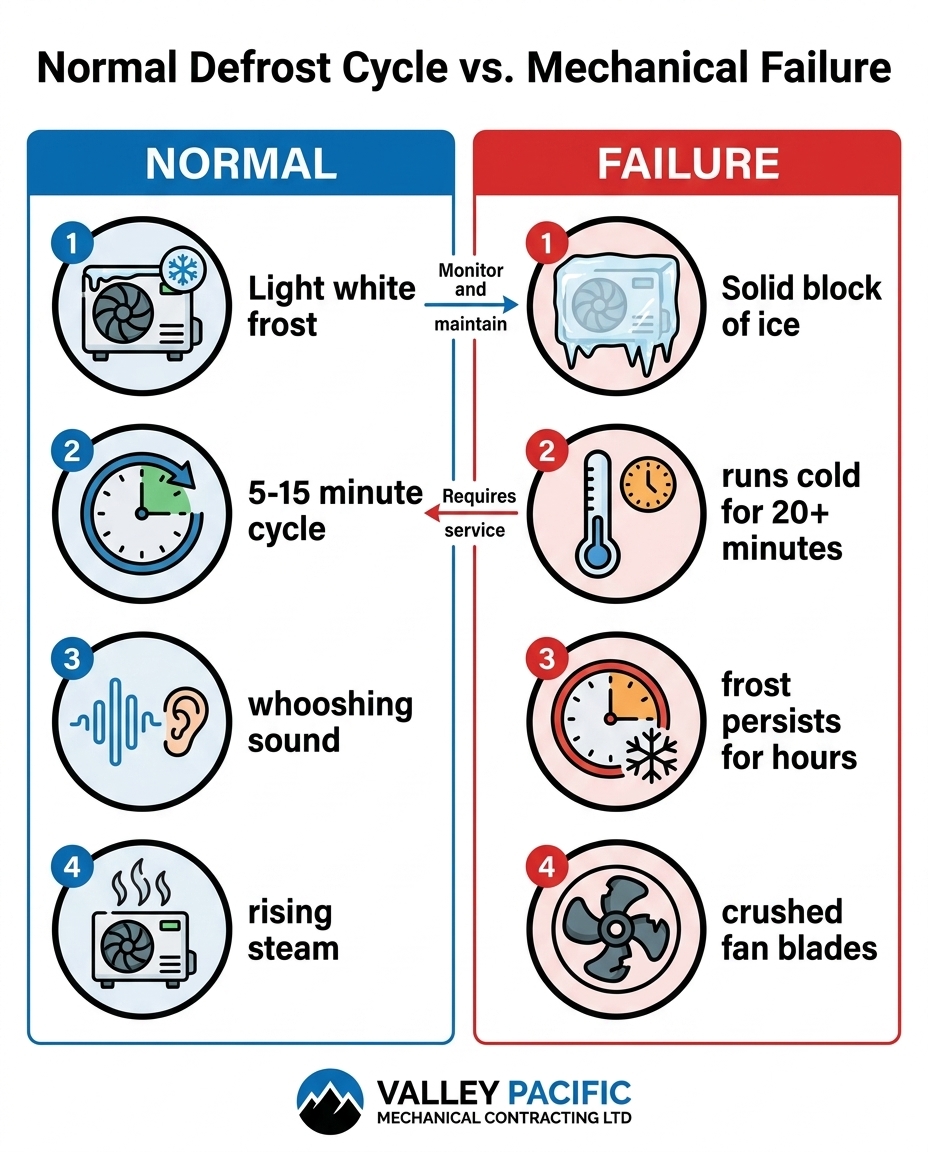
The table below breaks down the differences between standard operation and a mechanical malfunction when outdoor conditions hover around near-freezing temperatures (0-5°C):
• Ice Appearance — Normal Defrosting: A light, even coating of white frost on the metal fins. — Mechanical Failure: A solid block of dense, clear ice encasing the entire unit.
• Cycle Duration — Normal Defrosting: Frost clears entirely within 5 to 15 minutes. — Mechanical Failure: Frost persists for several hours without the unit initiating a defrost cycle.
• Airflow Quality — Normal Defrosting: Indoor air remains neutral or pauses briefly during the cycle. — Mechanical Failure: System blows cold air indoors for more than 20 minutes continuously.
• Physical Impact — Normal Defrosting: Fan blades spin freely once the cycle ends and normal heating resumes. — Mechanical Failure: Ice is physically crushing the metal coils or bending the fan blades.
If your system exhibits the signs in the "Mechanical Failure" column, the automatic cycle cannot handle the buildup. This usually points to underlying issues like dirty air filters restricting airflow, blocked outdoor coils, low refrigerant levels, or a malfunctioning defrost control board.
Signs It's Time to Call a Professional
If you notice that the outdoor unit is completely encased in thick, clear ice, you have a problem that requires attention. Clear ice, unlike white frost, indicates that water is melting and refreezing repeatedly without ever fully draining away. If this ice begins crushing or bending the fan blades, turn the system off immediately to prevent catastrophic motor failure. Additionally, if the system blows cold air indoors for more than 20 minutes without returning to heating mode, the reversing valve or the internal sensors have likely failed. In these scenarios, reaching out to an expert who specializes in heat pump systems is the safest course of action.
How Expert Sizing Prevents Excessive Freezing
One of the most overlooked factors in preventing excessive winter freezing is the initial sizing of the equipment. An undersized unit works continuously without resting, desperately trying to meet the thermostat's demands. Because it never cycles off, the outdoor coils remain in a constant state of deep chill, causing the unit to freeze over much faster than a properly sized system.
Accurate load calculations during the initial setup prevent the system from being overworked. A typical pattern we see involves homeowners needing reliable equipment during winter construction or renovation projects. In one instance, a local homeowner required a new HVAC setup during a winter project; the installation met the tight construction schedule perfectly and delivered flawless heating results because the system was sized correctly from day one. Proper sizing ensures the equipment matches the home's square footage, window layout, and insulation levels exactly.
Working with a licensed professional ensures that you benefit from advanced technology. Valley Pacific Mechanical's expertise as licensed HVAC technicians and certified Daikin Comfort Pro dealers ensures you receive precise sizing and reliable inverter technology. Advanced inverter systems automatically monitor ambient temperatures and manage frost without manual user intervention. Instead of running at full blast and shutting off abruptly, inverter compressors adjust their speed continuously, providing steady heat while managing coil temperatures to reduce unnecessary frost buildup during wet winter nights.
Year-Round Versatility: Transitioning to Summer Cooling
While managing frost is a major focus during the colder months, these systems are not just for managing cold weather; they provide highly efficient summer cooling as well. Understanding the long-term value helps contextualize the initial investment. The exact same mechanical principles that keep your home warm in December will keep it perfectly chilled in July.
The secret lies in the reversing valve. The same reversing valve that temporarily shifts to melt winter frost is used permanently during the summer to extract heat from inside the home and dump it outside. When you switch your thermostat to cooling mode, the indoor coils become cold to absorb heat from your living room, and the outdoor coils become hot to release that heat into the summer air.
Because the outdoor unit does so much heavy lifting in both seasons, maintaining clear outdoor coils year-round ensures optimal efficiency in both modes. Dust, pollen, and lawn clippings can clog the outdoor fins during the summer, just as ice does in the winter. A dirty coil forces the compressor to work harder, driving up energy bills and increasing the risk of breakdowns. When exploring your overall air conditioning options, remember that keeping the outdoor unit clear of debris in the summer directly translates to better, more reliable performance when near-freezing temperatures (0-5°C) return in the winter.
Frequently Asked Questions About Heat Pump Defrosting
When the temperature drops, homeowners naturally have questions about their equipment. Here are direct, concise answers to the most common homeowner worries regarding winter frost and defrost cycles.
Is it normal for my heat pump to have ice on it?
Yes, a light layer of frost is entirely normal when outdoor temperatures drop near freezing. The outdoor coils get very cold to extract heat from the air, causing ambient moisture to condense and freeze on the metal fins. As long as the ice is a thin, white layer and not a solid, thick block, your system is operating exactly as intended.
How long does a heat pump defrost cycle take?
A standard cycle takes between 5 and 15 minutes, after which normal heating resumes. The exact duration depends on how much frost has accumulated and how cold it is outside. Once the internal sensors detect that the coil temperature has risen enough to melt the ice, the system automatically switches back to heating your home.
What does a heat pump defrost cycle sound like?
You will likely hear a loud whoosh or hiss as the internal valve reverses the refrigerant flow, followed by the fan stopping. This sudden change in noise often startles homeowners, but it is simply the sound of pressurized refrigerant changing directions. The compressor will continue to hum quietly while the outdoor fan remains motionless.
Why is my mini split freezing up in winter?
High humidity combined with cold temperatures causes moisture to freeze on the coils. During wet winter nights, this happens frequently. However, if the unit freezes into a solid block of ice that encases the entire machine, it may indicate low refrigerant levels, a failing sensor, or poor airflow caused by a dirty indoor filter.
Can I pour hot water on my frozen heat pump?
Never pour hot water or use sharp tools to chip away ice, as this can severely damage the delicate aluminum fins and internal components. Hot water can also cause rapid temperature changes that crack metal parts, and it will quickly freeze again, making the problem worse. If the automatic cycle is not clearing the ice, call a professional to diagnose the root cause.
Should I turn off my heat pump if it's steaming?
No, the steam is simply the frost melting off the coils during the automatic defrost cycle. Let the system run its course. Homeowners often mistake this rising water vapor for smoke and panic, but it is a harmless and expected part of the melting process. Turning the system off manually will interrupt the cycle and leave the ice partially melted.
For more details on how these systems compare to traditional setups year-round, reviewing a cost comparison of mini splits vs central AC can help you understand the long-term operational differences.
Ensure Reliable Heating With Professional Support
Understanding normal defrost cycles empowers you to avoid unnecessary panic when the temperature drops. By recognizing the whooshing sounds, the rising steam, and the short duration of a standard cycle, you can confidently monitor your system during near-freezing temperatures (0-5°C). Using a clear checklist of symptoms helps identify when a real malfunction is occurring so you only pay for service calls when you truly need them.
If your system is consistently struggling with heavy ice, running cold air indoors for extended periods, or failing to initiate its defrost cycle, a professional assessment can restore efficiency. Proper sizing, expert installation, and regular maintenance are the keys to a system that handles winter weather flawlessly. Explore professional mini split installation and maintenance to keep your home comfortable and your system running smoothly all season long.


