


The Importance of Transparent Pricing When Quoting Heat Pump Installations


The Hidden Risks of Vague HVAC Estimates
You finally decide it is time to upgrade your home's heating and cooling system from an aging 10 SEER air conditioner to a modern setup, but when the contractor hands over the estimate, you are left staring at a single, lump-sum number at the bottom of the page. This frustrating scenario perfectly illustrates the importance of transparent pricing when quoting heat pump installations. Without a detailed breakdown of the proposed work, you are essentially flying blind, completely unable to determine what equipment you are actually buying or what level of craftsmanship you are paying for.
For homeowners in Maple Ridge, receiving an opaque, single-number estimate is a major red flag that should immediately pause your decision-making process. In our years of serving local neighborhoods like Silver Valley and Albion, we have seen how a lump-sum quote often serves as a convenient curtain for untrustworthy contractors to hide substandard equipment, omit necessary structural modifications, or set the stage for unexpected backend fees once the project is already underway. Knowing how to demand and evaluate an itemized quote before committing to a contractor is a crucial decision point for any major home improvement project.
Transparent pricing is not just a nice-to-have feature; it is an established industry best practice designed specifically for consumer protection. When you are looking into heat pump installations, you deserve to see exactly where your investment is going. The most effective way to protect your home and your budget is to request a transparent quote right from the start, ensuring that every piece of equipment, labor hour, and necessary upgrade is clearly documented.
Why Lump-Sum Quotes Obscure the True Scope of Work
The problem: A lump-sum quote groups every aspect of a complex HVAC installation into one vague total. It fails to separate the cost of the physical unit from the labor required to install it, and it completely ignores the auxiliary materials needed to integrate the new system into your home's existing ductwork and electrical grid. This leaves homeowners entirely in the dark regarding the true scope of work.
The cause: Why do some contractors rely on this opaque method? In many cases, vague estimates are used intentionally to obscure the omission of necessary structural or electrical modifications. When a contractor plans to cut corners—perhaps by reusing old, degraded 3/8-inch refrigerant lines or skipping crucial ductwork adjustments needed to handle higher airflow (CFM)—a lump-sum quote hides these missing elements. Furthermore, our team frequently meets homeowners who thought they were getting a premium, high-efficiency 18 SEER2 system, only to discover later that the contractor installed a standard 14.3 SEER2 builder-grade model because the exact specifications were never put in writing.
The solution: Demanding an itemized estimate forces the contractor to lay their cards on the table. This is especially critical when dealing with advanced technology like cold-climate air-source heat pumps. These sophisticated systems require precise installation protocols, specific auxiliary components, and expert labor. An itemized quote breaks down the project piece by piece, allowing you to verify that the contractor has accounted for every necessary step, material, and labor requirement. By breaking the project down, you protect yourself from contractors who quote low initially, only to hit you with "unforeseen" change orders halfway through the job.
Essential Components of a Transparent Heat Pump Quote
At Valley Pacific Mechanical Contracting Ltd., our core philosophy over our years in business prioritizes upfront, honest breakdowns so there are zero surprise charges. We believe that an educated homeowner is our best customer, which is why a professional quote should always read like a clear blueprint for your project. Last winter, during a mid-January freeze, a Maple Ridge homeowner in the Cottonwood area needed help deciding on the best equipment for their specific layout. By reviewing an itemized breakdown, our team provided clear guidance on equipment selection, and our technician Cody performed the installation exactly as outlined, resulting in a successful, stress-free upgrade.
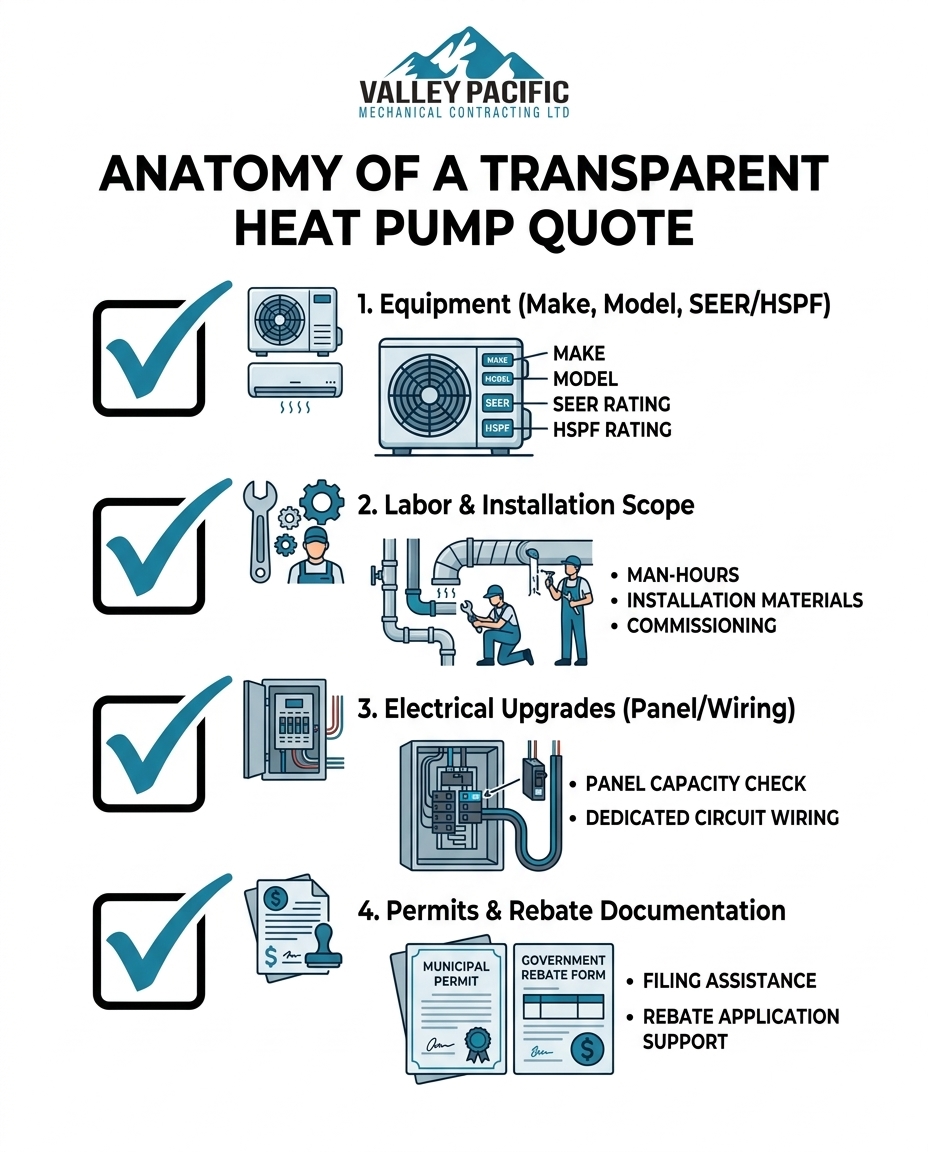
If you are evaluating an estimate, here are the non-negotiable elements that must be explicitly detailed:
• Equipment Specifications: The quote must list the exact make, model number, and efficiency ratings (such as SEER2 and HSPF2) of the proposed system. This ensures you receive the exact unit you agreed upon.
• Labor and Installation Scope: There should be a clear designation of the labor required for your specific home layout, including any custom sheet metal work, duct modifications, or complex routing of refrigerant lines.
• Electrical Upgrades: The estimate must include dedicated line items for any necessary electrical panel upgrades, new breakers, or wiring changes required to support the new system safely.
• Permits and Rebate Documentation: A professional quote provides written confirmation that all local municipal permits are included in the scope of work and that the contractor will provide the necessary paperwork for energy rebate applications.
• Warranty Information: Clear documentation outlining both the manufacturer's equipment warranty and the contractor's specific labor guarantee.
The Critical Role of Itemized Electrical Upgrades
Modern HVAC systems, particularly high-efficiency cold-climate air-source heat pumps, draw significant power. They are designed to operate efficiently, but they still require a robust, stable electrical supply to function safely and effectively. Maple Ridge's damp, chilly winters require robust heating solutions, which frequently necessitate specific electrical panel upgrades that must be explicitly itemized before any work begins. Older 100-amp residential electrical panels, common in 1970s and 1980s tract homes, simply cannot handle the additional 30 to 50-amp load without a dedicated circuit or a complete service upgrade.
Our electricians and HVAC installers always warn clients about contractors who rely on vague, lump-sum quotes and use electrical requirements as a loophole. They will quote a low initial number to win the job, begin the installation, and then suddenly inform the homeowner that the existing electrical panel is insufficient. This results in a "surprise" electrical fee halfway through the project, leaving the homeowner trapped into paying whatever the contractor demands to get their heating system running.
Avoiding Mid-Project Surprise Fees
Transparent quoting eliminates this stressful scenario entirely. A professional contractor conducts a thorough initial home assessment, inspecting not just the ductwork, but the electrical panel as well. By identifying these necessary upgrades during the initial consultation—not after demolition begins—the contractor can provide itemized electrical lines that protect the homeowner's budget.
The upfront advantage: When electrical upgrades are clearly separated as dedicated line items, you know exactly what the electrical work entails. You can see the scope of the wiring changes, the panel modifications, and the specific labor attached to those tasks. This level of detail ensures that your home will safely support the new system while keeping your financial planning completely secure from mid-project surprises.
How Itemized Invoices Protect Your Energy Rebate Eligibility
Upgrading your home's heating and cooling system is a significant investment, and many homeowners rely on generic energy rebate programs and tax credits to help offset the initial outlay. However, these programs are notoriously strict regarding documentation. They require detailed, indisputable proof that the installed equipment meets their specific efficiency criteria. A vague, lump-sum invoice is frequently rejected outright by rebate programs because it simply does not prove the exact model that was installed or how the labor was allocated.
During a recent February cold snap, a Maple Ridge customer's 20-year-old, 80% AFUE furnace broke down unexpectedly on the coldest days of the year. Following a thorough consultation, a detailed quotation was provided, and the installation was completed within a few days. Because the initial quote was properly itemized with specific AHRI reference numbers, the heating was restored quickly, and the homeowner seamlessly received all necessary generic rebate documents post-installation without any bureaucratic delays.
To ensure your paperwork is ready for rebate applications, an itemized quote smoothly transitions into an itemized invoice through the following steps:
1. Securing specific model numbers: An itemized quote lists the exact AHRI (Air-Conditioning, Heating, and Refrigeration Institute) matching numbers for both the indoor and outdoor units, which is a strict requirement for most generic utility incentives.
2. Separating labor from qualifying equipment: Many tax credits only apply to the cost of the high-efficiency equipment itself, not the labor or auxiliary materials. An itemized invoice clearly delineates these costs, making it easy for a tax professional to calculate your eligible credit.
3. Documenting code compliance: Rebate programs often require proof that the installation was permitted and performed to local codes. Itemized quotes that include permit fees demonstrate compliance right on the final invoice.
Comparing Contractor Estimates Side-by-Side
When you are gathering estimates for cold-climate air-source heat pumps, you will likely receive a mix of quoting styles. Teaching yourself how to use transparent quotes to evaluate multiple contractors effectively is the best way to ensure a quality installation. When our team sits down with homeowners to review multiple bids, we constantly remind them that the golden rule of comparing two quotes is ensuring both specify the exact same scope of work. This is impossible if one contractor provides a detailed, multi-page breakdown and another hands you a single number on a business card.
It is crucial to warn against simply choosing the lowest number if one quote is a lump-sum and the other is itemized. The lower, lump-sum quote is almost certainly leaving out critical components—like a new smart thermostat, custom sheet metal transitions, or the 240-volt electrical disconnect box—that you will end up paying for later. Transparent pricing reflects a contractor's overall integrity and communication style. If they are willing to be open about their costs before they win your business, they are far more likely to be honest and communicative during the installation process itself.
• Equipment Details — Lump-Sum Quote: Often vague (e.g., "Install new 3-ton unit") — Itemized Quote: Lists specific make, model, and efficiency ratings
• Electrical Work — Lump-Sum Quote: Rarely mentioned upfront — Itemized Quote: Clearly detailed as a separate line item if needed
• Rebate Readiness — Lump-Sum Quote: High risk of rejection by utility programs — Itemized Quote: Provides exact data needed for generic applications
• Cost Certainty — Lump-Sum Quote: High risk of mid-project surprise fees — Itemized Quote: Locks in the scope of work and protects the budget
The comparison strategy: When evaluating your options, line up the itemized quotes and verify that each contractor is proposing similar equipment tiers. If you are also weighing different types of systems, having a clear breakdown makes a cost comparison of mini-splits vs central AC much more accurate, as you can see exactly how the labor and material requirements differ between the two technologies.
Planning Your HVAC Investment with Confidence
Knowing the exact breakdown of costs removes the anxiety from major home improvements. When you understand exactly what you are paying for, you transition from feeling like a vulnerable consumer to an empowered homeowner. We have seen firsthand how this clarity is especially important when undertaking larger projects that involve multiple trades or significant modifications to your living space.
One summer during an August heatwave, a local homeowner in Hammond required extensive HVAC work, including complex duct relocations to accommodate a new variable-speed air handler, as part of a major home renovation in Maple Ridge. Because the project was quoted transparently from the start, our friendly, prompt, and professional team carried out the work without any hidden backend fees, ensuring the successful completion of the HVAC work right on schedule and perfectly aligned with the broader renovation budget.
Furthermore, clear pricing allows homeowners to explore appropriate payment solutions without the fear of escalating costs. When the total investment is locked in through an itemized contract, you can confidently review flexible financing options to find a monthly payment plan that fits your household budget. Demanding transparency is your right as a homeowner, and it remains the ultimate mark of a professional, trustworthy HVAC contractor.
Taking the Next Step Toward a Transparent Installation
A professional HVAC quote should always separate the equipment, the labor, and any necessary structural or electrical upgrades. When you receive a detailed, itemized breakdown for a cold-climate air-source heat pump capable of heating efficiently down to -15°C, you gain the peace of mind that comes from knowing exactly what is happening in your home. You can verify equipment quality, ensure your electrical system is safely prepared, and confidently submit your paperwork for generic energy rebates.
At Valley Pacific Mechanical Contracting Ltd., we encourage readers to actively seek out contractors who prioritize upfront honesty and detailed communication. If you are ready to explore your options without the fear of hidden fees, recognizing the importance of transparent pricing when quoting heat pump installations is your first line of defense. Take control of your home comfort journey and request a transparent quote today to see exactly how a professional installation should be planned.
Frequently Asked Questions
What should an HVAC quote include?
An HVAC quote should include a detailed, itemized breakdown of the entire project. It must list the exact make and model of the equipment (such as a 3-ton variable-speed unit), separate the labor costs, detail any required electrical or ductwork upgrades, and confirm the inclusion of local permits. This level of detail ensures you know exactly what you are paying for before work begins.
Why are lump-sum heat pump quotes a red flag?
Lump-sum quotes are a red flag because they obscure the true scope of work by grouping all costs into a single number. This vague format allows untrustworthy contractors to hide substandard equipment, omit necessary electrical upgrades, or set the stage for surprise backend fees. Without itemization, you cannot verify the quality of the installation.
How do I compare heat pump installation quotes?
To compare quotes effectively, ensure that each estimate is fully itemized so you can evaluate them side-by-side. Check that both contractors are proposing the same tier of equipment, including the same auxiliary components, and accounting for the same electrical upgrades. Never simply choose the lowest lump-sum number, as it likely omits critical necessary work.
Are there hidden costs in heat pump installation?
There can be hidden costs if you accept a vague estimate, particularly regarding electrical panel upgrades or custom ductwork modifications. However, a transparent, itemized quote eliminates these hidden costs by identifying all necessary structural and electrical requirements during the initial home assessment. A professional contractor puts all potential costs in writing upfront.
Do I need an itemized invoice to qualify for generic energy rebates?
Yes, most generic energy rebate programs and tax credits require an itemized invoice as proof of eligibility. These programs need to see the specific AHRI matching model numbers and a clear separation of equipment costs from labor to process your application. A lump-sum invoice is frequently rejected for lacking this essential detail.
Why do contractors charge separately for electrical upgrades?
Contractors charge separately for electrical upgrades because modern heating systems often draw significant power that older residential panels cannot handle. Upgrading a 100-amp panel to a 200-amp service or running a dedicated 240-volt circuit requires specific electrical materials, permits, and specialized labor. Itemizing these upgrades ensures the homeowner understands exactly what is required to run their new system safely.


