


Upgrading Your Coquitlam Home's Exhaust Fans to Prevent Winter Mold


The Hidden Impact of Damp BC Autumns on Your Home's Structure
As the season shifts toward prolonged rain and dropping temperatures, upgrading your Coquitlam home's exhaust fans to prevent winter mold becomes an urgent priority. In our years serving Maple Ridge, Coquitlam, and the broader Lower Mainland, our team at Valley Pacific Mechanical has seen firsthand how autumn rainfall spikes significantly starting in October, drastically reducing the margin of error for poor indoor ventilation. When the cold weather arrives, you naturally seal up your windows and turn up the heat, which traps daily moisture inside your living spaces. Without a powerful way to expel that humid air, the moisture levels inside your home rise rapidly.
Most homeowners don't realize that aging or undersized exhaust fans fail to clear this moisture effectively. Instead of venting outside, that warm, humid air often finds its way up into your cold, unheated attic space. This creates hidden attic condensation that quietly rots wood and feeds mold growth long before you see any signs in your living room. Addressing this concrete problem requires action before the heavy winter rains set in. If you want to protect your home's structural integrity, exploring comprehensive HVAC and mechanical services and booking professional mechanical installations is the smartest preventative step you can take.
How Warm Indoor Air Creates Winter Mold Risks in the Attic
Understanding the physics of indoor air helps clarify why poor ventilation threatens your entire home. Warm air naturally rises. Every time you take a hot shower, run the dishwasher, or boil pasta, you generate significant amounts of airborne moisture. If your bathroom or kitchen lacks proper extraction, that humid air drifts upward, passing through recessed lighting fixtures, attic hatches, and tiny gaps in your ceiling drywall.
Coquitlam's mountain-adjacent climate makes this dynamic especially dangerous. The local geography traps dampness, creating a sharp contrast between your heated indoor living space and the freezing outdoor air. When that escaping warm, moist air collides with the freezing structural components of your unheated attic, the results are immediate. The moisture reaches its dew point and transforms from a vapor back into liquid water.
This condensation coats your roof decking, saturates your insulation, and creates the perfect environment for aggressive fungal growth. During damp BC autumns and freezing winters, our technicians frequently receive emergency calls for suspected roof leaks. When we arrive on-site, we often discover that those "leaks" are actually heavy condensation dripping back down from the attic ceiling because the home's ventilation system failed.
The Condensation Cycle
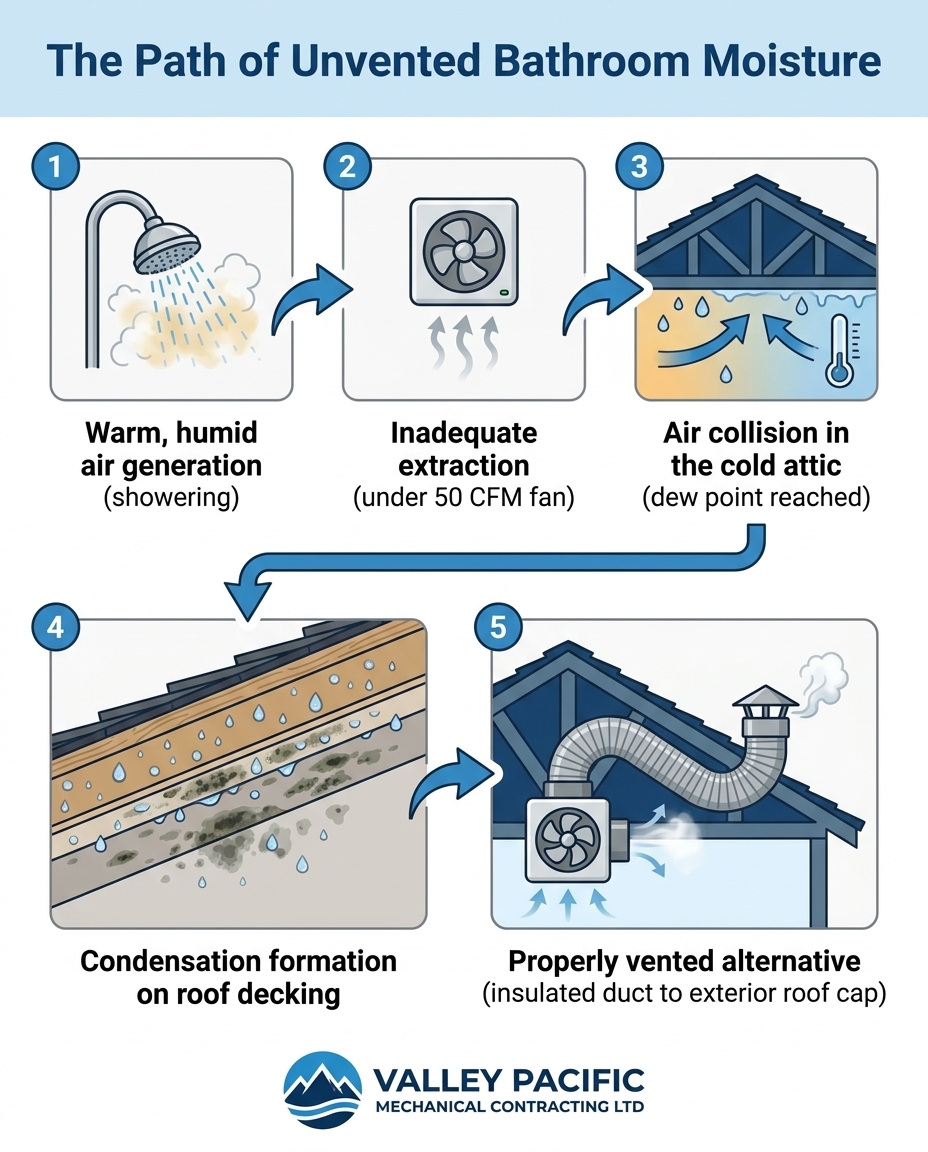
In our field experience, the process of attic moisture accumulation follows a predictable and destructive cycle:
• Moisture generation: Daily activities like bathing and cooking release dense water vapor into the air.
• Inadequate extraction: Weak fans leave the majority of that humidity suspended in your indoor air rather than pushing it outside.
• The dew point effect: The vapor rises into the attic, hits the freezing roof trusses and plywood decking, and instantly condenses into liquid water.
Identifying the Early Warning Signs of Poor Bathroom Ventilation
You do not have to wait for a catastrophic attic mold discovery to know your ventilation system is struggling. Your bathroom gives off several early warning signs that your exhaust fan is failing to handle the moisture load. Catching these symptoms early during damp BC autumns allows you to upgrade your equipment before structural damage occurs.
When our team inspects residential ventilation systems, we look for several primary indicators that your current setup is inadequate:
• Prolonged mirror fog: If your bathroom mirrors remain steamed up for more than ten minutes after you finish showering, your fan is not moving enough air to protect the room.
• Peeling paint and wallpaper: Constant exposure to high humidity degrades adhesives and causes wall finishes to bubble, crack, or peel away from the drywall.
• Surface mildew growth: Dark spots forming on your ceiling, in tile grout, or along silicone caulking indicate that moisture is lingering far too long after bathing.
• Loud but ineffective operation: A fan motor that grinds, rattles, or roars while failing to pull steam out of the air is wasting energy. Noise does not equal airflow; it usually indicates failing bearings.
• Damp smells upstairs: A musty, heavy odor in your upper hallways or near the attic hatch strongly suggests that moisture is trapped in the structure above you.
• Frost accumulation: If you safely peek into your attic during a cold snap and see white frost on the underside of the roof nails or decking, you have a severe ventilation emergency.
Ignoring these warning signs leads to degraded insulation, rotting roof trusses, and poor indoor air quality that affects your entire household.
Why Standard Builder-Grade Exhaust Fans Fail in High-Moisture Environments
In our experience working in local homes, we find that many properties still rely on the original, builder-grade exhaust fans installed decades ago. These basic units were designed to meet the bare minimum building requirements of their time, not to handle the heavy moisture loads of modern living. The primary metric for exhaust fan power is CFM, which stands for Cubic Feet per Minute. This number dictates exactly how much air the unit can push out of the room.
Standard builder-grade fans often push 50 CFM or less. In a moderately sized bathroom, especially in Coquitlam where outdoor humidity is already high, 50 CFM is entirely insufficient. Furthermore, aging fan motors lose efficiency over time. A fan rated for 50 CFM ten years ago might only move 25 CFM today due to dust buildup, worn bearings, and general mechanical fatigue.
Beyond weak motors, the installation methods of the past present a massive risk. Decades ago, it was common practice for builders to vent bathroom exhaust fans directly into the ceiling joists or let them dump air freely into the open attic space. This practice directly causes the condensation issues mentioned earlier. If you are dealing with this exact scenario, fixing a bathroom exhaust fan that vents warm air into your attic is the single most important step you can take to protect your roof structure.
Modern homes require high-efficiency units that pull adequate air volume and route it safely through dedicated, insulated pathways directly to the outdoors.
The Importance of Exterior Venting and BC Building Codes
Replacing a weak fan motor is only half the battle. Where that air travels matters just as much as how fast it moves. Part 9 of the BC Building Code specifically governs residential ventilation requirements, and the regulations are clear: all exhaust fans must vent directly to the outdoors. Venting into a soffit, a crawlspace, or an open attic is a severe code violation and a massive structural hazard.
When moist air is pushed into a soffit, the natural airflow of the home often sucks that same moisture right back up into the attic through the soffit vents. Our team at Valley Pacific Mechanical maintains a deep understanding of local BC building codes, ensuring that every exhaust fan upgrade we perform includes proper, code-compliant exterior venting to protect your home's structure. We know from extensive field experience that taking shortcuts with ductwork leads directly to insulation degradation and destructive winter ice damming.
Code-Compliant Ducting
Proper exterior venting requires specific materials and routing techniques to function safely during freezing weather:
• Insulated ducts: Moving warm, moist air through a freezing attic requires insulated ductwork. If the pipe is uninsulated, the steam will condense inside the tube and leak back down through your bathroom ceiling.
• The shortest, straightest path: Every bend and elbow in a duct reduces the fan's effective CFM. Installers route the ducting using the shortest possible path to the exterior to maintain maximum airflow.
• Proper roof or wall caps: The exterior exit point must feature a high-quality cap with a built-in damper. This damper opens when the fan runs and seals shut when the fan turns off, preventing freezing drafts and pests from entering your home.
Securing your ventilation system against damp BC autumns means ensuring the entire pathway—from the bathroom ceiling to the roof cap—meets modern safety standards.
Choosing High-Efficiency Exhaust Fans for Your Home
When you decide to upgrade, we advise our clients that selecting the right equipment makes a tremendous difference in daily comfort and long-term home protection. Modern high-efficiency exhaust fans offer features that older models simply cannot match. The first step is calculating the correct CFM for your specific bathroom. A general rule of thumb requires 1 CFM for every square foot of floor space, but bathrooms with high ceilings, jetted tubs, or multiple showerheads require significantly more power. Generally applicable energy rebates may also apply to qualifying high-efficiency ventilation upgrades, so we recommend homeowners verify current programs with their local utility provider.
One of the best features available on modern units is the built-in humidity sensor. Homeowners frequently turn off their exhaust fans the moment they step out of the shower. Unfortunately, the room is still full of moisture. Fans with humidity sensors monitor the air automatically. They continue running until the room is completely dry, and then shut themselves off. This removes the guesswork and ensures your Coquitlam home remains protected even if your family forgets to leave the switch on.
Noise level is another critical factor. Fan noise is measured in "sones." Older fans often operate at 3.0 or 4.0 sones, which sounds like a loud television static. Because they are so loud, people avoid turning them on. Modern high-efficiency fans equipped with DC motors often run at less than 0.3 sones. They are virtually silent, meaning you can run them at night without waking the household.
• Airflow (CFM) — Standard Builder-Grade Fan: Typically 50 CFM or lower — Modern High-Efficiency Fan: 80 to 150+ CFM customized to room size
• Noise Level — Standard Builder-Grade Fan: 3.0 to 4.0 Sones (Loud and disruptive) — Modern High-Efficiency Fan: 0.3 to 1.0 Sones (Whisper quiet)
• Motor Type — Standard Builder-Grade Fan: Standard AC motor (High energy use) — Modern High-Efficiency Fan: Brushless DC motor (Energy efficient)
• Moisture Control — Standard Builder-Grade Fan: Manual wall switch only — Modern High-Efficiency Fan: Automatic humidity sensors available
Your Autumn Ventilation Upgrade Checklist Before Heavy Rains Hit
Taking proactive steps now prevents expensive structural repairs later. We recommend following this seasonal timeline to ensure your home is ready for the changing weather.
1. Inspect current bathroom fans for airflow: Perform a simple tissue test. Turn on your bathroom fan and hold a single square of toilet paper up to the grille. If the fan cannot hold the tissue tightly against the plastic cover, it is not moving enough air. Take note of any grinding or squealing noises, which indicate a failing motor.
2. Have a professional check the attic: Do not attempt to navigate your attic safely if you are unsure of the joist layout. Have a licensed technician inspect the space for existing signs of condensation, compressed insulation, or improper ducting that terminates inside the roof space.
3. Select appropriate high-efficiency fans: Work with your installer to choose units that feature the correct CFM rating for your square footage, low sone ratings for quiet operation, and built-in humidity sensors for automatic moisture management.
4. Schedule installation before the peak winter freeze sets in: Roof and attic work becomes significantly more difficult once frost, ice, and heavy rain dominate the forecast. Book your upgrades during damp BC autumns while the weather is still manageable.
Remember that addressing ventilation often ties into broader system health. If your ductwork is compromised or your home struggles with general airflow, reaching out for local HVAC repair ensures your entire property breathes properly throughout the winter.
Frequently Asked Questions About Bathroom Fans and Attic Condensation
Can a bathroom fan cause attic mold?
Yes, a bathroom fan can absolutely cause attic mold if it is improperly installed. When an exhaust fan vents directly into the attic space instead of routing through the roof to the outdoors, it pumps warm, humid air straight into a freezing environment. That moisture condenses on the wood decking and insulation, creating the perfect dark, damp conditions for aggressive mold growth.
Do bathroom fans prevent mold?
Properly sized and vented bathroom fans are your first line of defense against indoor mold. By actively pulling heavy steam out of the bathroom and exhausting it outside your home, they prevent humidity from settling on your walls, ceilings, and drywall. For the best protection, the fan must run during the shower and for at least twenty minutes afterward.
Why is my attic damp in the winter?
Attics usually become damp in the winter due to indoor air leaks and poor ventilation. Warm air from your heated living space rises, carrying moisture from cooking, breathing, and bathing. If this air bypasses your exhaust fans or leaks through attic hatches, it hits the freezing roof structure and turns into condensation, making the entire space feel wet.
Where should a bathroom exhaust fan vent?
A bathroom exhaust fan must always vent directly to the exterior of your home. Building codes require the use of insulated ducting that terminates at a dedicated roof cap or a specialized exterior side-wall vent. Venting into a soffit, a crawlspace, or an open attic is unsafe and violates residential building regulations.
How long should an exhaust fan run after a shower to clear humidity?
An exhaust fan should run for at least 20 to 30 minutes after you finish showering to fully clear the humidity. Turning the fan off immediately leaves lingering moisture in the air, which eventually settles on surfaces. Upgrading to a fan with an automatic humidity sensor ensures the unit runs exactly as long as needed without manual monitoring.
Secure Your Attic Against Winter Moisture Today
Preventing attic mold is significantly easier and less costly than remediating it after the damage is done. Time is limited before the heavy winter weather makes attic work and roof capping difficult. Do not let an aging, noisy fan compromise your home's structural health for another season. Take action now to ensure your indoor air is properly managed and safely exhausted outdoors. Contact our team at Valley Pacific Mechanical to schedule professional mechanical installations and get the peace of mind that comes with a dry, healthy home.


