


The Great Chill-Off: Comparing Ductless and Ducted Cooling


The Central AC vs Ductless Mini Split Comparison Every Lower Mainland Homeowner Should See
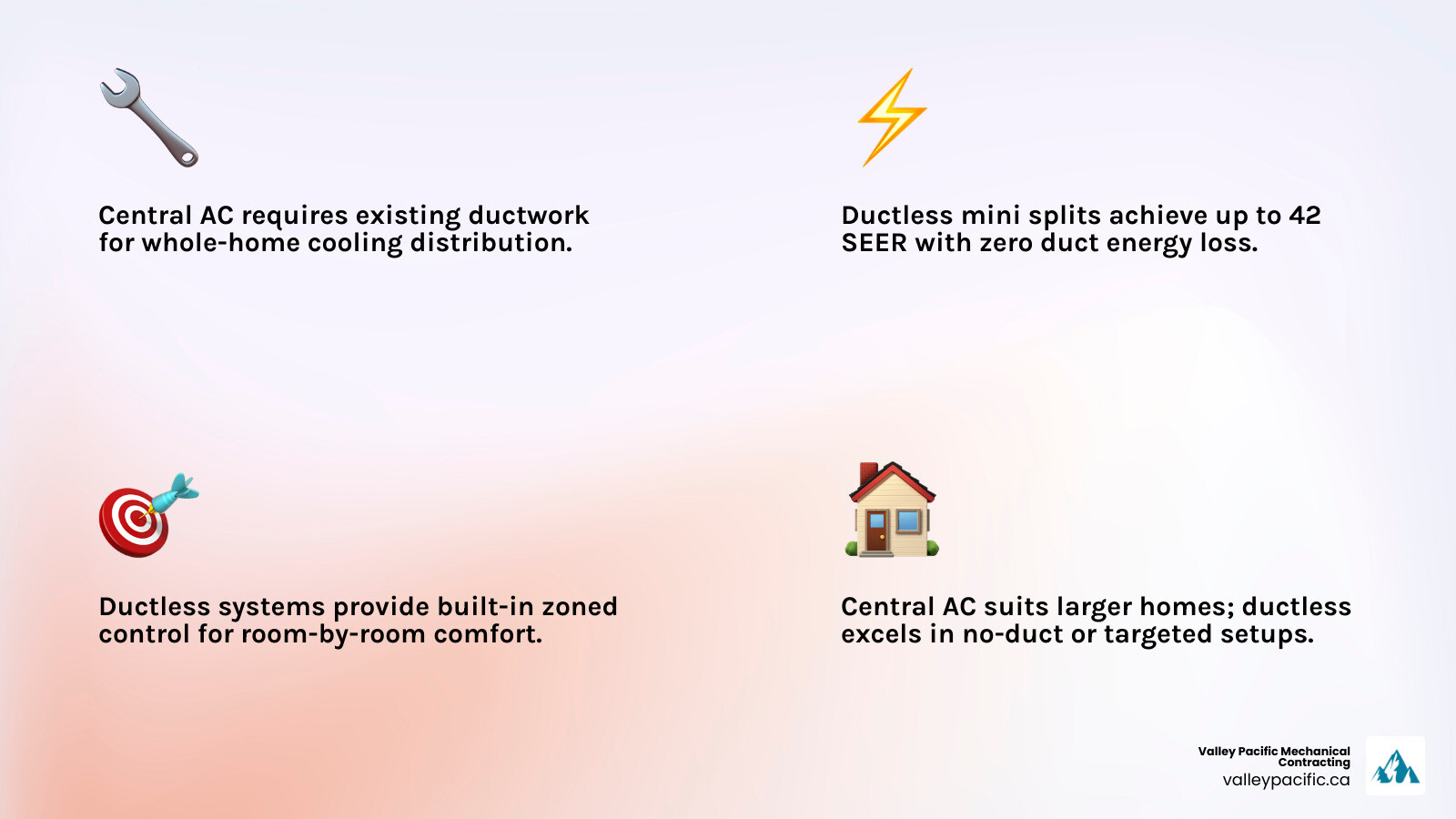
The central ac vs ductless mini split comparison comes down to a few key questions: Does your home have existing ductwork? How many rooms do you need to cool? And how much do energy savings matter to you long-term?
Here's a quick breakdown to help you decide:
| Factor | Central AC | Ductless Mini Split |
|---|---|---|
| Requires ductwork | Yes | No |
| Best for | Whole-home, larger homes | Targeted zones, no-duct homes |
| Energy efficiency | Up to 26 SEER | Up to 42 SEER |
| Installation disruption | Higher (if no ducts exist) | Minimal (small wall opening) |
| Zoned control | Limited (add-on required) | Built-in, room by room |
| Heating capability | Paired with furnace | Built-in heat pump option |
| Lifespan | ~15 years | 20-30 years |
If your home already has well-sealed ductwork, central AC is a proven, cost-effective way to cool your whole house from one thermostat. If your home has no ductwork — or you want precise room-by-room control — a ductless mini split is often the smarter, more efficient choice.
Homeowners across the Lower Mainland, from Maple Ridge to Langley to Surrey, face this exact decision every summer. BC's mix of older heritage homes, newer additions, and varying lot sizes means there's rarely a one-size-fits-all answer. The right system depends on your home's layout, your comfort goals, and how your existing infrastructure is set up.
One thing is clear: choosing the wrong system can mean years of higher energy bills or uncomfortable rooms that your cooling system just can't reach. Understanding the real differences between these two technologies is the first step to making a confident, informed choice.
I'm looking to upgrade my home's cooling. How do I start a central AC vs ductless mini split comparison?
When we sit down with families in Pitt Meadows or Mission to discuss their cooling options, the conversation usually starts with the bones of the house. Your home's "infrastructure"—specifically whether you have a network of ducts hidden behind your walls—is the biggest fork in the road.
A central ac vs ductless mini split comparison isn't just about which unit looks better; it's about how air moves through your living space. Central air conditioning is a "whole-home" solution. It treats your house as one large, interconnected bubble. If you have an existing furnace and ductwork that are in good shape, central AC is often the path of least resistance. It uses the same vents you already have to distribute "the big chill" everywhere at once.
On the other hand, ductless mini splits are the kings of targeted comfort. Instead of one giant machine in the basement or attic pushing air through miles of metal tubes, you have small, sleek indoor units (often called "heads") mounted directly in the rooms you use most. This setup is a game-changer for homes that were built before central air was standard or for modern homes where certain rooms always seem to stay five degrees warmer than the rest of the house.
If you're dealing with a system that has reached the end of its life, or you're tired of window units that rattle your teeth, exploring a Mini Split Installation Replacement can open up possibilities you might not have considered, such as reclaiming your window views and significantly lowering your hydro bill.
Key Advantages in the Central AC vs Ductless Mini Split Comparison
The most significant "win" for ductless technology is energy efficiency. Because there are no ducts, there is zero "duct loss." In a traditional central system, the U.S. Department of Energy (and our own local experience in BC) suggests that 25% to 30% of your cooling energy can leak out of holes in the ductwork or get lost as it travels through unconditioned spaces like attics or crawlspaces. It’s like buying a gallon of milk but having a third of it leak out of the carton before you get it home!
Another massive advantage is zoned control. With a ductless system, your bedroom can be a crisp 18°C for sleeping while the guest room stays at 22°C to save energy. This level of customization is built into the DNA of a Ductless AC Installation, whereas central systems usually require expensive motorized dampers and complex control boards to achieve anything similar.
Making Your Choice: Central AC vs Ductless Mini Split Comparison Factors
As we move through 2026, aesthetics have become a major talking point. Central AC is virtually invisible; all you see are the floor or ceiling vents you're already used to. Ductless systems require a unit to be mounted on the wall, floor, or ceiling in each room. While modern designs are much sleeker than the "white boxes" of a decade ago, they are still a visible part of your decor.
Home size also plays a role. Generally, if your home is over 2,000 to 2,500 square feet and already has a healthy duct system, central air is often the most straightforward way to ensure uniform cooling. However, if you live in a smaller home or a heritage house in Langley where installing ducts would mean tearing out beautiful lath-and-plaster walls, ductless is the undisputed champion. For many, the choice is simplified by looking at their current setup through an AC Installation lens to see what fits their architecture best.
Disadvantages and Trade-offs to Consider
No system is perfect. Central AC's biggest drawback is its "all or nothing" nature. If one part of the system fails, the whole house gets hot. It also requires professional duct cleaning every few years to maintain indoor air quality.
Ductless systems, while incredibly efficient, require more frequent homeowner interaction. You’ll need to pop the cover and rinse the filters every 2 to 4 weeks to keep them running at peak performance. Additionally, the upfront investment for a multi-zone ductless system can sometimes be higher than a simple central AC swap if your ducts are already in place. If you ever notice water dripping from an indoor head or a strange noise, you'll want to schedule an AC Repair quickly to protect the sensitive electronics inside these high-tech units.
How do these systems actually work to cool my house?
To understand the central ac vs ductless mini split comparison, we have to look under the hood. Both systems use the same basic scientific principle: they don't actually "create" cold; they remove heat. They use a chemical called refrigerant to soak up the heat inside your home and dump it outside.
Think of refrigerant like a sponge. Inside your house, the "sponge" is cold and dry, ready to soak up heat and moisture. Once it's full, it travels through copper lines to the outdoor unit, where a compressor squeezes the "sponge," releasing the heat into the outdoor air. The now-chilled refrigerant then heads back inside to start the process all over again.
Many modern systems, especially ductless ones, utilize "inverter technology." Traditional AC units are like a light switch—they are either 100% on or 100% off. This leads to those annoying temperature swings where you're too cold, then too warm. Inverter technology is more like a dimmer switch. It allows the system to slow down or speed up to match the exact cooling needs of the room, which is why a Heat Pump AC system is so much quieter and more efficient than older models.
The Mechanics of Ductless Mini Splits
In a ductless setup, the indoor unit acts as its own air handler. It pulls air directly from the room, passes it over the cold evaporator coils, and blows it back out. Because each indoor head has its own thermostat and fan, it only works as hard as that specific room requires. This is the secret to their high SEER2 ratings (which can reach as high as 42 in 2026). Regular Mini Split Service ensures that the delicate sensors and variable-speed motors stay calibrated for this precision work.
How Central Air Conditioning Distributes Comfort
Central AC relies on a single, powerful air handler (usually part of your furnace) to push air through a maze of ducts. It’s a "forced-air" system. The air is pulled from the house through "return" vents, filtered, cooled at a central coil, and then blasted back through "supply" vents. While it’s great for moving large volumes of air, it relies heavily on the integrity of those ducts. If your ducts are leaky or uninsulated, you're essentially paying to cool your attic. Keeping up with AC Service is vital here to ensure the central blower motor isn't straining against clogged filters or leaky pipes.
Which system is more energy efficient for a home in Langley or Maple Ridge?
Efficiency is where the central ac vs ductless mini split comparison gets really interesting for BC residents. In our region, where electricity rates are a constant consideration, the numbers matter.
| Efficiency Metric | Central AC (High-End) | Ductless Mini Split (High-End) |
|---|---|---|
| Max SEER2 Rating | ~26 | ~42 |
| Energy Loss to Ducts | 20% - 30% | 0% |
| Compressor Type | Variable/Multi-stage | Variable-speed Inverter |
As of April 2026, the industry has fully transitioned to SEER2 (Seasonal Energy Efficiency Ratio 2) standards, which provide a more accurate look at how systems perform in real-world conditions. Ductless systems consistently outperform central AC because they don't have to fight the physics of moving air through long, restrictive ducts.
For homeowners in Maple Ridge, checking a Ductless AC Service Guide Maple Ridge BC can show you how local climate factors—like our humid summers—affect these efficiency ratings.
Eliminating Energy Waste with Ductless Technology
Ductless technology eliminates "thermal bypass"—the phenomenon where cool air warms up as it travels through a hot duct in your ceiling. By delivering the cooling exactly where it's needed, mini splits can save up to 30% more energy than even a high-efficiency central system. In places like Langley, where summer afternoons can get surprisingly sweltering, this efficiency translates directly into lower monthly bills. Our Ductless AC Service Langley BC Guide highlights how these systems handle our specific regional humidity and temperature spikes.
Zoning and Individual Room Temperature Control
The ultimate efficiency tool is zoning. Why cool the kitchen and living room at 2 AM when everyone is asleep in the bedrooms? Central AC usually cools the whole house regardless of where you are. Ductless systems allow you to turn down the units in empty rooms. This occupancy-based cooling is the most effective way to reduce your carbon footprint and your bills simultaneously. If you're planning a renovation, a Mini Split Installation allows you to design these zones from the ground up for maximum impact.
Is a ductless system better for older homes without existing vents?
For the heritage homes in Langley’s historic areas or the older character houses in Mission, the central ac vs ductless mini split comparison usually has a clear winner. Installing new ductwork in an existing home is a massive undertaking. It involves cutting holes in ceilings, built-in wardrobes, and floors, and it can add a staggering amount to your total project cost—sometimes doubling it!
Ductless mini splits are the "non-invasive" surgery of the HVAC world. All we need is a three-inch hole in the exterior wall to run the refrigerant and power lines. This makes them perfect for:
- Attic conversions where ceiling height is at a premium.
- Finished basements that stay damp and cold.
- New room additions that your current furnace can't handle.
- Older homes with boiler systems and baseboard heaters that have no ducts at all.
For residents in Mission, our Ductless AC Service Guide Mission BC provides specific tips on retrofitting these systems into older architecture without ruining the home's aesthetic charm.
Heating Capabilities for Year-Round Comfort
One of the best "hidden" features of a ductless mini split is that most of them are actually heat pumps. This means they can reverse the cooling process in the winter to provide highly efficient heat. In our mild Lower Mainland climate, a ductless heat pump can often handle the majority of your heating needs, only needing a backup on the very coldest nights of the year. This year-round utility makes Ductless AC Service a smart investment for every season.
When a Hybrid Approach Makes Sense
Sometimes, the best central ac vs ductless mini split comparison result is "both." We often see homeowners who have a central system that works fine for the main floor but leaves the upstairs bedrooms like a sauna. In these cases, we can install a single-zone mini split as a "booster" for the master suite. This hybrid approach gives you the best of both worlds: the convenience of central air for the main living areas and the precision of ductless for the problem zones. If your existing setup is struggling, a Mini Split Repair or a strategic addition might be exactly what your home needs.
What are the maintenance and air quality differences I should know?
Air quality is a major factor in the central ac vs ductless mini split comparison. Central systems are generally better at whole-home air filtration. Because they move such a large volume of air through a single, high-quality pleated filter, they are excellent at removing dust and allergens from the entire house. They can also be easily fitted with whole-home humidifiers or UV air purifiers.
Ductless systems have smaller, built-in filters in each head. While they are great at cleaning the air in that specific room, they don't have the "lung capacity" of a central system. However, they are often better for people with severe allergies because there are no dusty ducts for mold or pet dander to hide in. For those in Pitt Meadows, our Ductless AC Service Guide Pitt Meadows BC goes into detail on how to maintain these filters to ensure your indoor air stays fresh during wildfire season or high-pollen days.
Noise Levels and Aesthetic Considerations
If you value peace and quiet, ductless is the way to go. Indoor mini split units are whisper-quiet, often operating at 19 to 26 decibels—that’s softer than a whisper in a library! You’ll barely notice they’re on. Central AC systems have the "whoosh" of air moving through vents, which some people find comforting and others find distracting.
Visually, we can use "line hides" to cover the copper pipes on the outside of your house, painting them to match your siding so they blend in perfectly. Inside, placement is key. A professional AC Service visit can help you determine the best spot for a unit so it provides maximum comfort without becoming the focal point of the room.
Expected Lifespan and Long-Term Reliability
With proper care, a ductless mini split can last 20 to 30 years. Central AC units typically have a lifespan of about 15 to 20 years. The difference often comes down to the technology; the variable-speed compressors in mini splits experience less "start-stop" stress than traditional central units. Regardless of which path you choose, staying on top of AC Repair and annual maintenance is the only way to ensure you get the full value out of your investment.
Frequently Asked Questions
Can ductless mini splits provide heating as well as cooling?
Yes! Most modern ductless systems are heat pumps. They are incredibly efficient at heating your home during our BC winters, often providing significant savings over baseboard heaters or older furnaces.
Are ductless mini splits quieter than central air systems?
Generally, yes. Because the noisy compressor is located outside and the indoor fans are designed for low-decibel operation, ductless units are significantly quieter than the forced-air "whoosh" of a central system.
Which system is ideal for room additions or homes without ductwork?
Ductless mini splits are almost always the better choice for additions or non-ducted homes. They avoid the high cost and mess of installing new ductwork and allow you to cool the new space without overtaxing your existing HVAC system.
Conclusion
Choosing between central AC and a ductless mini split is a big decision, but you don't have to make it alone. At Valley Pacific Mechanical Contracting, we’ve spent over 30 years helping our neighbors in Langley, Maple Ridge, Mission, and Pitt Meadows find their perfect "chill."
Whether you’re looking for a headache-free AC Installation or need expert advice on a complex multi-zone setup, our team is here to help. As a Daikin Comfort Pro, we stand behind every job with the Daikin Comfort Promise, ensuring that your home remains the sanctuary it’s meant to be.
Ready to find your perfect cooling solution? From 24/7 emergency support to expert seasonal maintenance, we’ve got the Lower Mainland covered. Explore our full range of Air Conditioning Services today and let us help you beat the heat!


