


How Ductless Systems Keep Coastal Homes Dry and Cool



Why Humid Coastal Weather Is Hard on Your Home's Comfort System
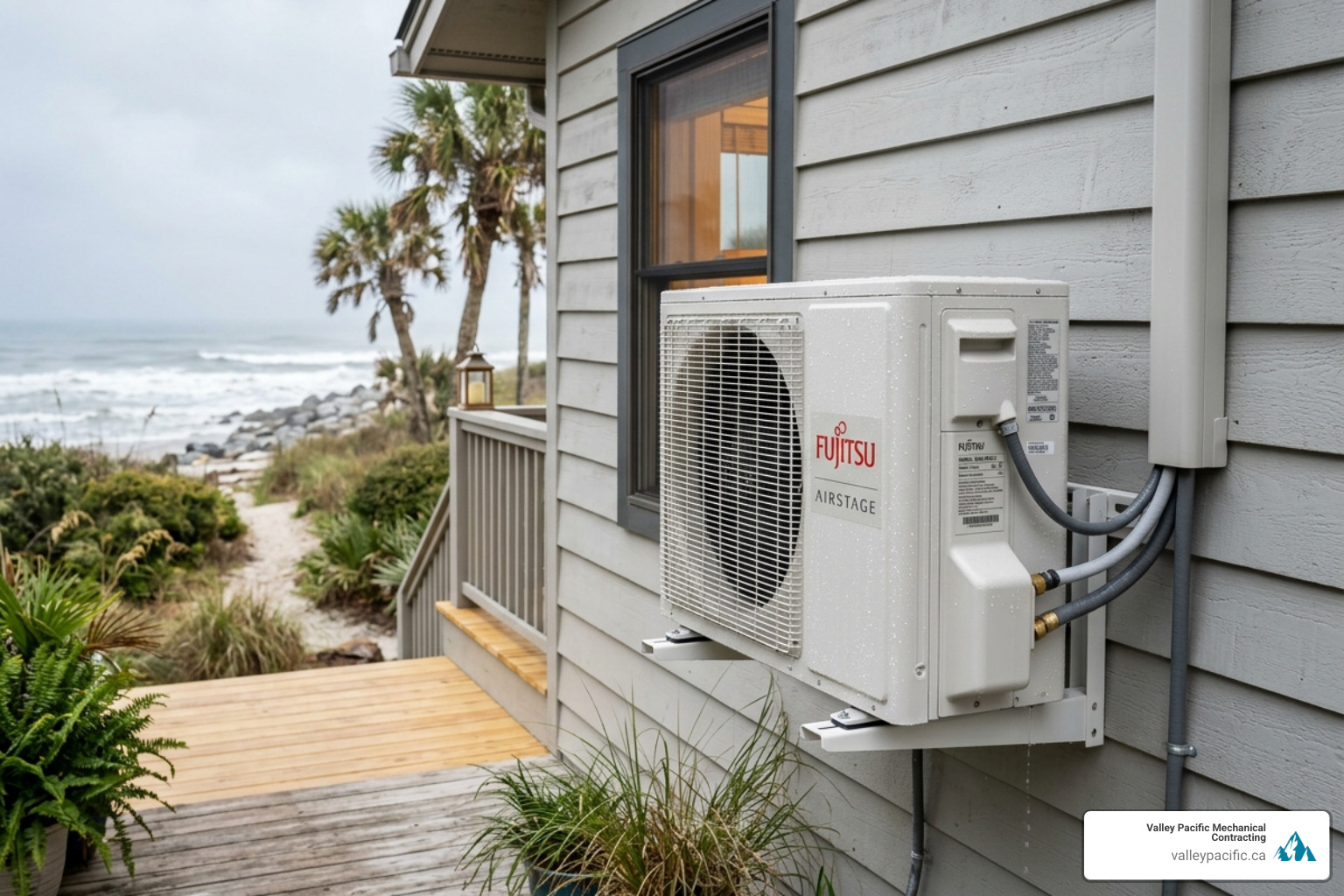
How ductless systems handle humid coastal weather is one of the most important things to understand if you own a home in the Lower Mainland of British Columbia. The region's proximity to the ocean, combined with long stretches of damp, overcast weather, creates a humidity challenge that standard HVAC systems often struggle to meet.
Here is a quick answer:
- Variable-speed compressors run longer at lower capacity, pulling more moisture from the air without short-cycling
- Dry mode reduces fan speed so coils stay colder longer, boosting dehumidification even when cooling isn't needed
- Zoned operation means you only condition occupied spaces, preventing stale, humid air from building up in unused rooms
- Coastal-rated components — including epoxy-coated coils and stainless steel hardware — resist the salt corrosion that degrades standard units in marine environments
- Proper BTU sizing (25–30 BTU per square foot in humid zones) ensures the system runs long enough to remove latent moisture, not just lower the temperature
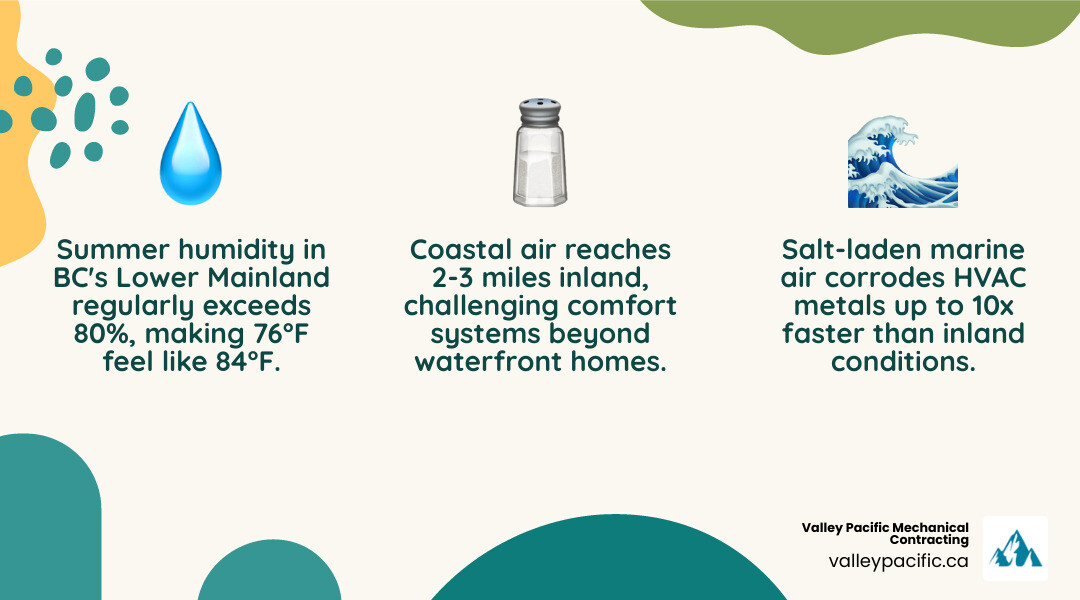
Salt air in the Lower Mainland doesn't just affect homes right on the water. Corrosive marine air can reach HVAC equipment two to three miles inland, and metals in coastal environments corrode up to ten times faster than in dry inland conditions. At the same time, summer humidity along the BC coast regularly climbs above 80%, making indoor air feel far warmer and stickier than the thermometer suggests. A room sitting at 76°F with 80% relative humidity can feel as uncomfortable as 84°F at normal humidity levels.
For homeowners in Maple Ridge, Langley, Surrey, Vancouver, and surrounding communities, choosing the right system — and maintaining it properly — makes a real difference in year-round comfort, air quality, and how long your equipment lasts.
How ductless systems handle humid coastal weather in the Lower Mainland
When we talk about how ductless systems handle humid coastal weather, the conversation usually starts with the "brain" of the unit: the inverter-driven, variable-speed compressor. In the Lower Mainland, our weather is rarely "all or nothing." We have those long, misty mornings in Langley or Pitt Meadows where it isn't necessarily scorching hot, but the air is thick enough to wear.
Traditional central AC systems are often oversized and operate like a light switch—they are either 100% on or 100% off. When a traditional unit kicks on, it blasts cold air until the thermostat is satisfied, then shuts down. In a humid climate, this "short-cycling" is a disaster. The air gets cold quickly, but the system doesn't run long enough to actually remove the water vapor. You end up with a house that is cold but clammy—the perfect environment for dust mites and that "old beach house" smell.
ductless mini-split systems operate differently. Instead of stopping and starting, the variable-speed compressor modulates its output. It might run at 20% capacity for hours on end. This continuous operation is the secret to superior dehumidification. Because the air is constantly moving over the cold evaporator coils, the system extracts significantly more moisture per hour than a traditional system.
In fact, these systems are so efficient at managing what we call "latent heat load" (the heat held by moisture) that they often provide 30-40% energy savings compared to conventional systems in humid coastal environments. By staying in a low-power "steady state," they avoid the massive energy spikes required to start a traditional compressor, all while keeping your indoor relative humidity within the "Goldilocks zone" of 45-55%.
Advanced Features for Managing Coastal Moisture
Beyond the compressor, modern mini-splits come equipped with specific tools designed to fight the dampness of the BC coast. One of the most effective is "Dry Mode." While many homeowners think of their AC as just a cooler, Dry Mode turns the unit into a dedicated, high-capacity dehumidifier.
In Dry Mode, the system lowers the fan speed significantly. By slowing down the airflow, the air spends more time in contact with the freezing cold coils. This allows the moisture to condense and drain away more effectively without drastically dropping the room temperature. This is a lifesaver during those "shoulder seasons" in Maple Ridge or Mission, where it’s 18°C and raining—too cool for AC, but too humid to be comfortable.
Another benefit of mini split installation is independent zone control. Coastal homes often have varying humidity levels; a basement in a Pitt Meadows home might be much damper than a sun-drenched loft. With a ductless system, each indoor head monitors its own zone. You can set the "dry" settings higher in the basement while keeping the upstairs on a standard cooling schedule.
This precision doesn't just improve comfort; it’s a frontline defense for indoor air quality. By keeping humidity below 60%, we prevent the growth of mold and mildew, which are common headaches in the Lower Mainland. Furthermore, because there are no ducts, there is no place for moisture to collect and breed spores—a common issue with traditional ducted systems where condensation can hide in unconditioned attic or crawlspace ducts.
Protecting Your Investment from Salt Air and Corrosion
If you live within a few kilometers of the Georgia Strait or even along the tidal reaches of the Fraser River, salt air is the "silent killer" of HVAC equipment. Salt is hygroscopic, meaning it attracts water. When salt particles land on the aluminum fins of a standard AC condenser, they trap moisture against the metal, leading to galvanic corrosion.
Without protection, a standard HVAC unit in a salty environment might only last 5 to 7 years before the coils begin to crumble. This is why we prioritize "coastal-rated" equipment. When we perform ductless ac service, we often see the difference that specialized coatings make.
Comparison: Standard vs. Coastal-Rated Ductless Units
| Feature | Standard Unit | Coastal-Rated Unit (e.g., Gold Fin/Blue Fin) |
|---|---|---|
| Coil Coating | Bare Aluminum | Epoxy, Phenolic, or Gold/Blue Fin Acrylic |
| Hardware | Zinc-plated steel | Stainless steel or high-grade treated fasteners |
| Circuit Boards | Standard | Conformal-coated (moisture/salt resistant) |
| Expected Lifespan | 5–8 Years (near coast) | 10–15+ Years (with maintenance) |
| Corrosion Resistance | Low | High (up to 300% better) |
How ductless systems handle humid coastal weather and salt spray
The "Gold Fin" or "Blue Fin" technology you’ll see on premium units refers to a specialized hydrophilic coating applied to the condenser coils. This coating serves two purposes: it prevents salt from sticking to the metal and helps water (condensate) shed off the fins faster. This keeps the heat exchange process efficient and prevents the "conductive brine" that eats through aluminum.
Even with these coatings, mini split service is non-negotiable in the Lower Mainland. We recommend a monthly "freshwater rinse" for the outdoor unit. Using a gentle garden hose (never a pressure washer!) to rinse the salt buildup off the coils can extend the life of your system by years. In a salty environment, a well-maintained coastal unit can easily reach a 15-20 year lifespan, whereas a neglected one might fail in half that time.
Optimizing how ductless systems handle humid coastal weather through proper sizing
Sizing a system for a coastal home is more of an art than a science. In drier climates, HVAC contractors often use a "rule of thumb" based on square footage. On the BC coast, that's a recipe for a clammy home. We use a Manual J calculation, which takes into account the "latent load"—the energy required to remove moisture from the air.
In humid zones like ours, we typically aim for 25–30 BTU per square foot. If the system is too large (oversized), it will cool the room so fast that it shuts off before it has a chance to dehumidify. This leaves the air feeling "heavy." If it's too small, it will run constantly but never reach the setpoint.
When you're looking into mini split installation replacement or a fresh ductless ac installation, ensure your technician is looking at the humidity levels of your specific neighborhood. A home in the "fog belt" of Delta or near the mountains in Mission faces different moisture challenges than a home in a drier pocket of the valley.
Best Practices for Coastal Installation and Maintenance
Installation day is the most important day in the life of your ductless system. In the Lower Mainland, we have to account for more than just the weather—we have to account for the geography.
- Elevation is Key: We always recommend mounting outdoor units at least 12 to 18 inches off the ground. In coastal areas, this protects the unit from localized flooding during heavy rains and keeps it away from the salt-heavy air that hangs closer to the damp soil.
- Strategic Placement: Whenever possible, we install the outdoor condenser on the "leeward" side of the house (the side protected from the prevailing ocean winds). This reduces the direct "sandblasting" effect of salt-laden air.
- Storm Resilience: Coastal storms can be fierce. We use heavy-duty wall brackets or reinforced pads to ensure the unit stays level and secure during high winds.
For homeowners looking for specific local advice, we have developed detailed guides for different communities. Whether you need a ductless ac service guide maple ridge bc, a ductless ac service guide mission bc, or are looking for tips in pitt meadows or langley, the core message is the same: consistency is king.
Frequently Asked Questions about Coastal Ductless Systems
Can a mini-split cool my whole house in a humid climate?
Absolutely. While many people think of mini-splits for single rooms, multi-zone systems can connect up to eight indoor heads to one outdoor condenser. This allows you to maintain perfect humidity levels throughout the entire house. Because each head operates independently, you aren't wasting energy cooling (and dehumidifying) the guest room when nobody is using it.
How often should I clean the filters in a salty environment?
In the Lower Mainland, especially during the spring pollen season or the damp autumn, we recommend checking your filters every 2 to 4 weeks. Salt and moisture can make dust "clumpy," which clogs filters faster than in dry climates. Clean filters are essential for maintaining the airflow needed for effective dehumidification.
Will salt air void my ductless system warranty?
This is a tricky one. Many standard manufacturer warranties actually exclude corrosion damage if the unit is installed within a certain distance (usually 1–3 miles) of the coast. This is why it is vital to choose a "coastal-rated" unit and work with a professional team that understands how to register your system for "Seacoast Warranty" extensions where available.
Conclusion: Your Partner in Coastal Comfort
At Valley Pacific Mechanical Contracting Ltd., we understand the unique relationship between the Pacific Ocean and your home's comfort. As an Indigenous-owned business based right here in Maple Ridge, we’ve spent over 30 years helping our neighbors in Langley, Pitt Meadows, Mission, and across the Lower Mainland navigate the challenges of our beautiful, but damp, climate.
How ductless systems handle humid coastal weather isn't just a technical specification to us—it's the key to making sure your home is a sanctuary, not a swamp. Whether you’re looking for a new installation or need expert service to protect your existing unit from the salt air, our team of licensed technicians is ready to help. We stand behind the Daikin Comfort Promise, ensuring that your "headache-free" experience starts the moment you call us.
Ready to take control of your indoor climate? Explore our ductless solutions today and discover why a mini-split is the ultimate upgrade for coastal living.


