


The Definitive Guide to New HVAC Benefits Beyond Comfort



Why New HVAC Benefits Beyond Comfort Matter for Lower Mainland Homeowners
The new HVAC benefits beyond comfort are more significant than most homeowners realize — and if you're weighing whether a system upgrade is worth it, here's the short answer:
A new HVAC system can deliver:
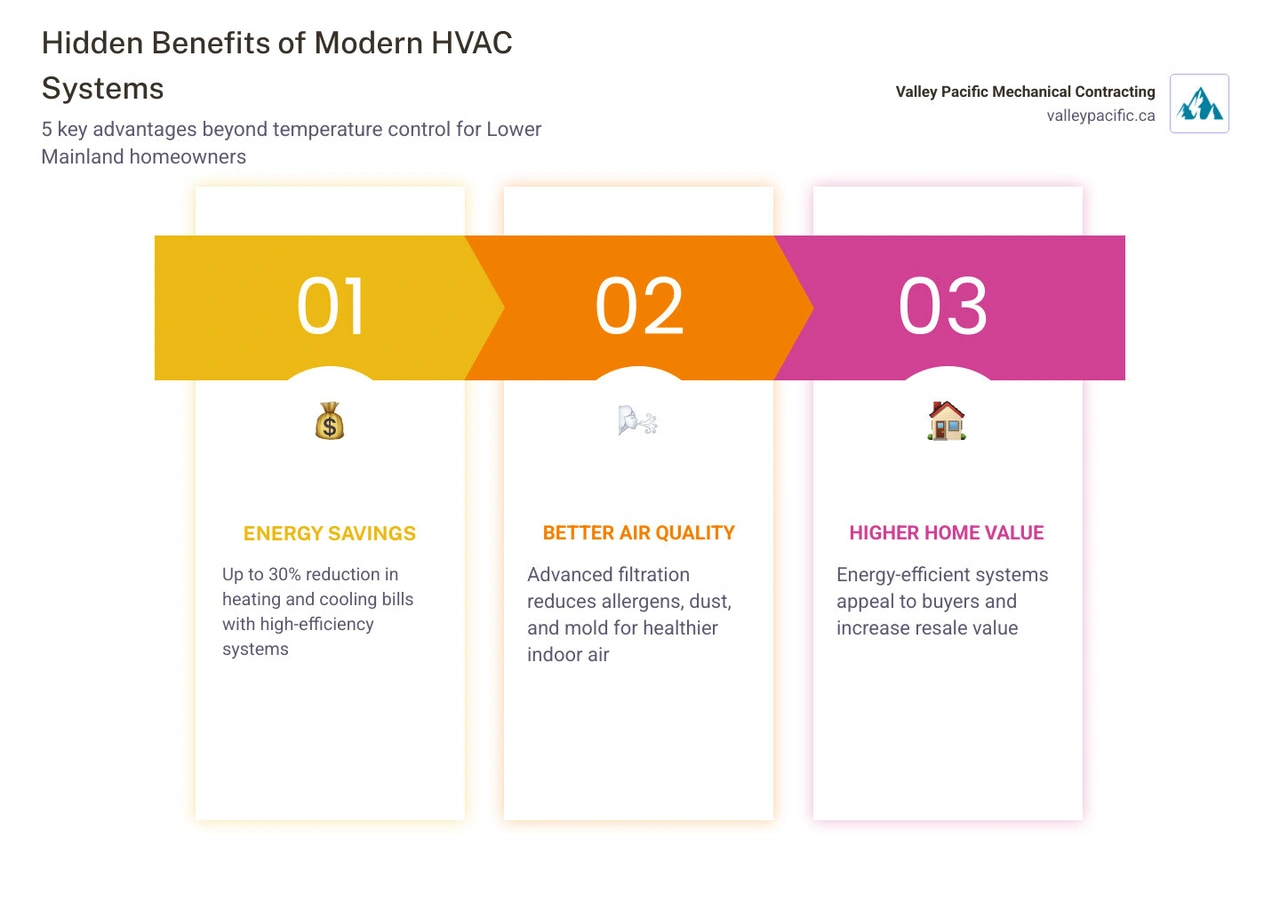
- Lower energy bills — up to 30% savings on heating and cooling costs
- Better indoor air quality — advanced filtration reduces dust, allergens, and mold spores
- Higher home value — energy-efficient systems are a top feature for today's buyers
- Quieter operation — modern units run as low as 42dB, improving sleep and focus
- Environmental impact — reduced greenhouse gas emissions and eligibility for CleanBC and BC Hydro rebates
- Smarter control — programmable thermostats and zoning can cut energy use by 21–42%
Most people replace their HVAC system when it stops working. But waiting for a breakdown means missing years of savings, health improvements, and home comfort upgrades that a modern system quietly delivers every single day.
In the Lower Mainland, where heating and cooling demands shift significantly between seasons, an outdated system doesn't just cost you in comfort — it costs you in energy waste, air quality, and money left on the table. Heating and cooling account for nearly half of a typical home's energy use, and older systems are far less efficient at managing that load than today's technology.
Whether your system is aging, your bills are climbing, or you're simply curious what a modern upgrade could do for your home, the benefits go well beyond staying warm in winter and cool in summer.
Financial Gains, Property Value, and Energy Efficiency

A new HVAC system is not just a comfort upgrade. It is often a long-term efficiency upgrade, a maintenance upgrade, and a resale upgrade all rolled into one tidy mechanical package.
1. Lower monthly energy use can add up fast
One of the biggest practical benefits is reduced energy waste. Research consistently shows that replacing an older, inefficient HVAC system with a high-efficiency model can reduce heating and cooling bills by up to 30%.
That matters because heating and cooling make up a large share of household energy use. In a Lower Mainland home, where damp winters and warmer summer stretches both put strain on equipment, efficiency is not a small detail. It is the difference between a system that works smart and one that works overtime.
If you want a deeper look at seasonal savings, see How High Efficiency Systems Reduce Summer Costs and How to Lower AC Bills During Summer.
2. Better duct performance means you stop paying to heat the attic
A surprising amount of conditioned air never reaches the rooms it is meant to serve. In many homes, about 20% to 30% of the air moving through ducts is lost through leaks, holes, or poor connections.
That means even a good system can underperform if the ductwork is neglected. When we evaluate a new HVAC installation, proper sizing, airflow, and duct condition are a major part of making the upgrade actually deliver on its promise.
Think of it this way: buying a high-efficiency system but keeping leaky ducts is a bit like filling a nice insulated coffee mug with a hole in the bottom.
3. New systems usually mean fewer repairs and more predictable ownership
Older HVAC systems tend to cost homeowners in small, annoying ways before they fail in one dramatic, "why is the house 29 degrees?" kind of way.
Modern systems are designed for longer service life and more stable performance. With professional installation and regular maintenance, a residential HVAC system can often last 15 to 25 years. That longer lifespan can mean:
- Fewer breakdowns
- Less emergency repair stress
- Better parts availability
- More predictable operating performance
- Improved peace of mind during weather extremes
4. A modern HVAC system can support home value and buyer confidence
Yes, buyers notice kitchens and bathrooms. They also notice whether the home has an aging furnace and noisy old AC that looks like it remembers dial-up internet.
A newer HVAC system can improve property value and marketability because it signals:
- Better energy performance
- Lower expected maintenance
- Updated core infrastructure
- Greater move-in readiness
- Comfort and efficiency the buyer does not need to "deal with later"
For more on this, read How a New HVAC System Increases Home Value.
5. Rebates and financing options can improve the math
In British Columbia, homeowners may be able to reduce out-of-pocket upgrade costs through available rebate programs, especially for qualifying energy-efficient systems such as heat pumps. Depending on eligibility, CleanBC and BC Hydro incentives may be stackable.
Useful resources:
- BC and Federal Energy Rebates for HVAC Upgrades
- Heat Pump Rebates Available in BC
- How to Apply for Energy Rebates in British Columbia
Table: Efficiency improvements and where savings often come from
| Upgrade area | What improves | Why it matters |
|---|---|---|
| High-efficiency equipment | Lower energy use | Can reduce heating and cooling bills by up to 30% |
| Sealed or improved ducts | Better air delivery | Helps avoid 20% to 30% air loss |
| Smart thermostat | Smarter scheduling | Can save up to 10% annually with strategic settings |
| Zoning | Room-by-room control | Can reduce unnecessary conditioning in unused spaces |
| Proper installation | Better overall performance | Helps system reach expected efficiency and lifespan |
New HVAC Benefits Beyond Comfort for Your Health and Wellness
Comfort is easy to notice. Health-related HVAC benefits are quieter. But in many homes, they are the real game changer.
6. Advanced filtration can reduce dust, pollen, and airborne irritants
Modern HVAC systems can support much better indoor air quality than older equipment, especially when paired with upgraded filtration and ventilation.
Depending on the system design, homeowners may benefit from:
- Higher MERV-rated filters for finer particle capture
- Whole-home air purification add-ons
- Better ventilation management
- Improved air circulation through properly sized equipment
These upgrades can help reduce common irritants such as dust, pollen, pet dander, and mold spores. That can be especially helpful for people with allergies, asthma, or general respiratory sensitivity.
If you are planning a broader upgrade, HVAC System Upgrades Complete Guide is a helpful place to start.
7. Humidity control supports healthier indoor living
Temperature is only part of comfort. Humidity is the sneaky co-star.
When indoor humidity is poorly controlled, homes can feel clammy, stuffy, or damp even when the thermostat says everything is fine. Excess moisture can also create conditions that encourage mold and mildew growth.
Modern HVAC technology often manages humidity more effectively through better airflow control, variable-speed operation, and more consistent runtime. That can help:
- Reduce damp indoor conditions
- Limit mold-friendly environments
- Improve comfort without overcooling
- Protect finishes, furnishings, and stored items
In a Lower Mainland climate, where dampness is a familiar guest, this benefit is especially important.
8. Cleaner air may support long-term wellness
We should be careful not to treat HVAC as a medical device. But cleaner air absolutely supports a healthier home.
When systems reduce airborne pollutants and keep humidity balanced, households often experience fewer indoor triggers. That can mean less irritation from allergens, fewer stale-air complaints, and a home that simply feels fresher day to day.
Health-supporting HVAC features often include:
- High-efficiency filtration
- Controlled ventilation
- Better moisture management
- Reduced buildup of dust in circulated air
- More consistent airflow throughout the home
9. Quieter operation can improve sleep, focus, and day-to-day life
This is one of the most overlooked new HVAC benefits beyond comfort.
Modern systems are dramatically quieter than many older units. Some advanced equipment can operate as low as about 42 dB under certain conditions, which is a meaningful drop in background noise.
That can improve:
- Sleep quality in bedrooms near outdoor units
- Concentration in home offices
- Phone and video call clarity for remote work
- General peace and quiet in open living areas
If your current system sounds like it is trying to taxi for takeoff every time it starts, a quieter upgrade can feel like a quality-of-life improvement immediately.
List: Health-improving features worth asking about
- High-MERV filtration compatibility
- Whole-home air purification options
- Humidity control
- Variable-speed fans and compressors
- Balanced ventilation
- Quiet operation features
- Zoned airflow for more even air distribution
Smart Technology and Environmental Sustainability
New HVAC technology has become much smarter in the last several years, and that intelligence does more than add convenience. It can also improve efficiency, reduce waste, and support broader sustainability goals.
If you are considering a heat pump or high-efficiency upgrade in BC, Heat Pump Benefits for British Columbia Homeowners is a strong next read.
Smart Technology and New HVAC Benefits Beyond Comfort
Smart features are not gimmicks when they are matched to the right home. They are tools that help your HVAC system stop running when it does not need to and work harder only where it should.
10. Smart thermostats can save energy without daily fiddling
Strategic thermostat adjustments can save up to 10% annually on heating and cooling costs. Smart thermostats make that easier by automating setbacks, schedules, and occupancy-based control.
Useful features may include:
- Programmable schedules
- Remote access by phone
- Geofencing
- Learning routines based on occupancy
- Energy-use reporting
For homeowners who want to fine-tune summer savings, see Best Thermostat Settings for Summer Savings.
11. Zoning helps you stop conditioning empty rooms
Zoning is one of the most practical ways to reduce waste in larger homes, split-level layouts, households with different schedules, or homes with hot and cold spots.
Instead of treating the entire home as one giant room, zoning allows different areas to be controlled independently. Research cited in the planning material shows zoning can reduce energy use by roughly 21% to 42% in the right setup.
That can be especially useful if:
- Bedrooms need different temperatures than living spaces
- Someone works from home during the day
- A basement suite or bonus room is used differently
- Parts of the home sit empty for long periods
For additional ideas, check out Summer Energy Saving Tips.
Environmental Impact and New HVAC Benefits Beyond Comfort
12. Modern systems can reduce your home's carbon footprint
Environmental benefits are no longer limited to "uses a bit less power." Newer HVAC equipment can support substantial emissions reduction, especially when homeowners switch from older fossil-fuel-heavy systems to high-efficiency electric options such as heat pumps.
That matters locally and globally. Cooling equipment consumed an estimated 5,000 TWh of electricity worldwide in 2022, and demand is projected to rise sharply by 2050. More efficient equipment helps reduce strain on the grid and lowers the emissions associated with heating and cooling.
In practical homeowner terms, environmental gains can include:
- Lower electricity waste
- Reduced fuel consumption
- Fewer greenhouse gas emissions
- Better alignment with energy-efficiency targets
- Progress toward lower-carbon living in the Lower Mainland
13. Heat pumps and all-electric systems support sustainability goals
Heat pumps are one of the clearest examples of new HVAC benefits beyond comfort because they can deliver heating and cooling with much less wasted energy than older systems.
For homeowners looking at broader sustainability goals, a high-efficiency heat pump can help support:
- Reduced reliance on fossil fuels
- More efficient year-round heating and cooling
- Eligibility for applicable provincial utility incentives
- Improved readiness for future energy standards
If rebates are part of your planning, review Heat Pump Rebates Available in BC and How to Apply for Energy Rebates in British Columbia.
14. Better dehumidification and efficiency go hand in hand
Newer HVAC design trends are also improving how systems handle moisture. Traditional air conditioners often overcool air just to remove humidity, which wastes energy. Advanced systems are getting better at separating moisture control from raw cooling demand.
The takeaway for homeowners is simple: better humidity control can mean lower energy use, better comfort, and a healthier indoor environment all at once.
Frequently Asked Questions about HVAC Upgrades
I'm looking to upgrade my home's heating. Who in the Lower Mainland specializes in energy-efficient systems?
If you are in Mission, Maple Ridge, Pitt Meadows, or Langley and want an energy-efficient heating upgrade, we recommend working with a licensed local contractor who understands Lower Mainland weather patterns, available rebate pathways, and proper system sizing for BC homes.
At Valley Pacific Mechanical Contracting, we help homeowners upgrade aging systems with modern options designed for efficiency, performance, and long-term reliability. That includes heat pumps, air conditioning, indoor air quality improvements, and full HVAC system planning for homes that need more than a simple equipment swap.
Concerned about the air quality in my house. Can anyone recommend advanced air purification services?
Yes. If indoor air quality is a concern, the right solution is usually more than just changing the filter and hoping for the best.
We recommend an in-home assessment that looks at:
- Filter compatibility
- Airflow issues
- Humidity levels
- Ventilation needs
- Existing duct condition
- Household factors like pets, allergies, and remote work
For homeowners in Pitt Meadows, Maple Ridge, Langley, Mission, and surrounding Lower Mainland communities, IAQ upgrades may include better filtration, humidity control, and ventilation improvements tied into the HVAC system you already have or plan to install.
How do I maximize my savings with a new system in British Columbia?
The best way to maximize savings is to think beyond the equipment itself.
A strong upgrade plan usually includes:
- Choosing a high-efficiency system matched to the home
- Making sure ducts and airflow are addressed
- Adding smart thermostat control where appropriate
- Considering zoning for uneven or multi-use homes
- Applying for eligible CleanBC and BC Hydro rebates
- Having the system professionally installed and maintained
The biggest savings usually come from combining efficient equipment with smart controls and proper installation. For many BC homeowners, rebates can make that timing even better.
Conclusion
A modern HVAC upgrade is about much more than warmer winters and cooler summers. It can help lower utility bills, improve indoor air quality, reduce noise, support better sleep and productivity, raise home appeal, and move your home toward lower-carbon operation.
That is why the new HVAC benefits beyond comfort deserve a closer look, especially for homeowners across the Lower Mainland.
At Valley Pacific Mechanical Contracting, we are proud to be an Indigenous-owned, Maple Ridge-based company serving homeowners throughout the Lower Mainland with a headache-free approach, 30+ years of expertise, and 24/7 emergency service when it is needed most. Whether you are planning ahead or replacing an aging system, we can help you make sense of your options and choose an upgrade that works for your home long after installation day.
For the next step, visit More info about our HVAC services.


