


The Best Cooling Systems for Lower Mainland Homeowners Compared



Cooling Your Lower Mainland Home: Central Air or Mini Split?
Central air vs mini split for the Lower Mainland homes is one of the most common questions BC homeowners face as summers in the Fraser Valley and Greater Vancouver area grow longer and warmer. If you already have ductwork, central air is often the simpler path to whole-home cooling. If your home runs on baseboard heaters or a boiler — or if you want room-by-room control — a ductless mini split is likely the better fit.
Quick answer at a glance:
| Factor | Central Air | Ductless Mini Split |
|---|---|---|
| Requires ductwork | Yes | No |
| Best for | Homes with existing ducts | Older homes, additions, condos |
| Zoned cooling | Limited | Yes — room by room |
| Energy efficiency | Good (up to ~20 SEER) | Excellent (up to 38 SEER) |
| Heating capability | With a heat pump or furnace | Built-in with heat pump models |
| Noise level (indoor) | 50–75 dB | 19–30 dB |
| BC rebate eligible | Sometimes | Yes — CleanBC, BC Hydro |
| Vancouver zero-emission rules | Check system type | Heat pump models comply |
Both systems can keep your home comfortable through Vancouver's humid summers and mild winters — but the right choice depends on your home's layout, existing infrastructure, and how you use your space day to day.
Here in the Lower Mainland, the stakes are a little different than elsewhere in Canada. Vancouver's 2025 zero-emission requirements for new and replacement heating systems, BC Hydro's clean hydroelectric grid, and the unique mix of older heritage homes, laneway houses, and newer builds all shape which system makes the most sense for your situation.
This guide breaks down everything you need to know — from efficiency ratings and installation realities to BC-specific rebates and long-term maintenance — so you can make a confident, informed decision for your home.
Understanding Central Air vs Mini Split for the Lower Mainland Homes
When we talk about central air vs mini split for the lower mainland homes, we are essentially looking at two different ways to move heat out of your house. In April 2026, as we look toward another warm summer, understanding these mechanics helps you choose a system that won't just cool you down, but will do so efficiently.
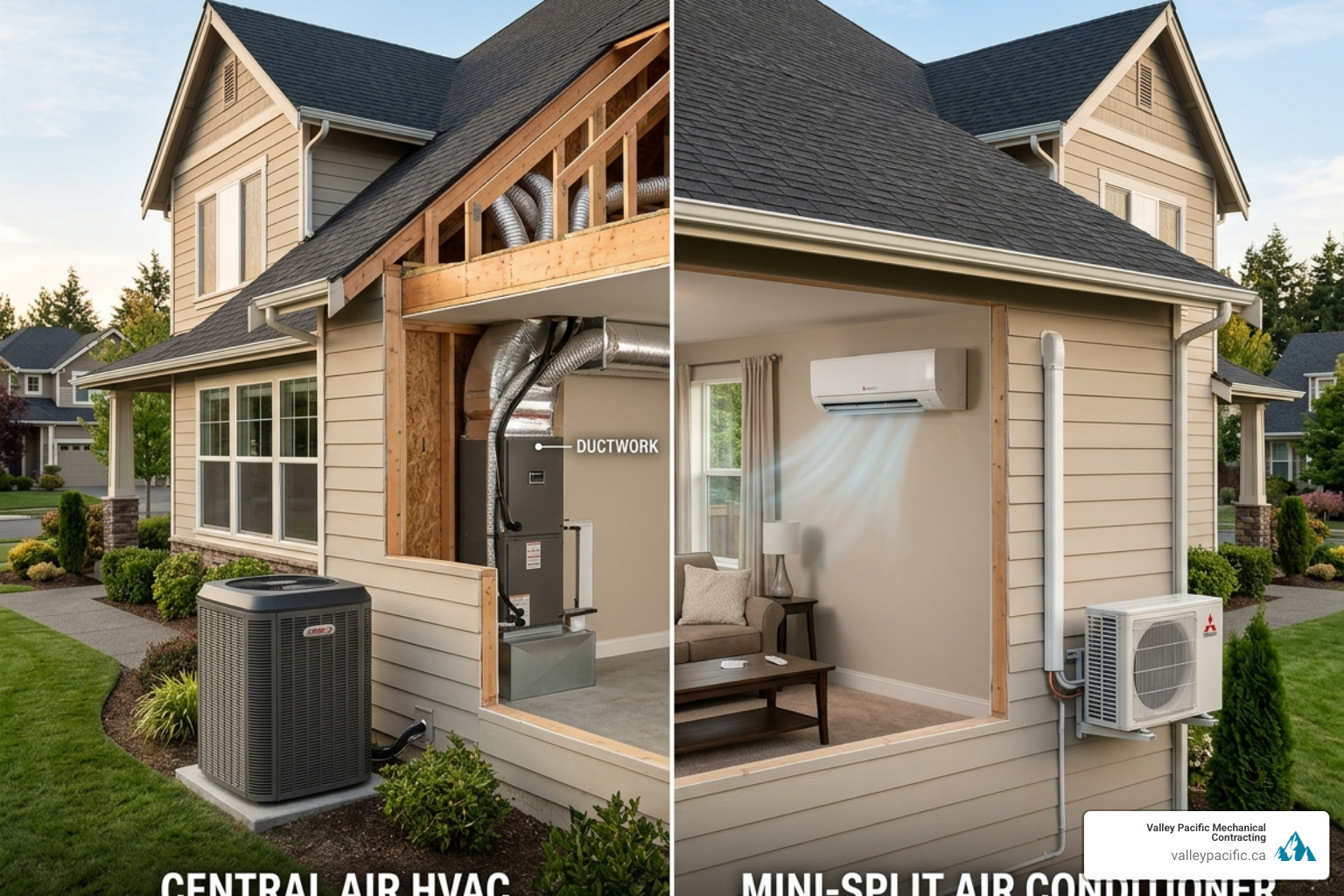
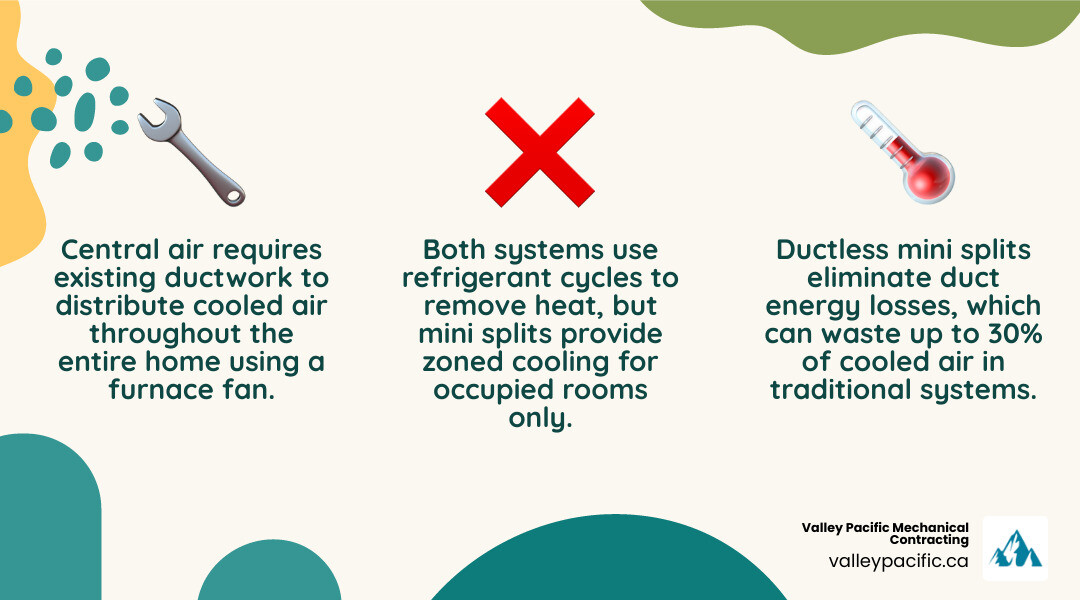
Air Conditioning systems generally fall into two categories: those that use ducts and those that don't. A central system is a "whole-house" solution. It uses a large outdoor condenser unit to cool refrigerant, which then travels to an indoor evaporator coil. Your home’s furnace fan then blows air across that cold coil and pushes it through the vents in every room.
On the flip side, Ductless mini splits skip the vents entirely. They consist of an outdoor compressor connected to one or more indoor air handlers (often called "heads") via small refrigerant lines. These heads are mounted directly on the wall or ceiling of the rooms you want to cool.
How Central Systems Utilize Existing Infrastructure
If your home in Langley or Maple Ridge was built with a forced-air furnace, you already have the "highway" needed for central air. We can often perform an AC Installation by adding a cooling coil to your existing furnace setup.
This is often the most straightforward approach for newer builds. It provides uniform cooling throughout the entire house, managed by a single central thermostat. However, because it relies on your existing vents, the efficiency of the system is only as good as your ductwork. If your ducts are leaky or uninsulated—common in older Fraser Valley crawls spaces—you can lose up to 30% of your cooling energy before it even reaches your living room. Keeping up with regular AC Service is vital here to ensure the blower motor and coils are clean and capable of pushing air effectively.
The Functionality of Ductless Technology
Ductless systems are the ultimate problem-solvers for homes without existing vents. Whether you live in a heritage home in Vancouver or a modern laneway house in Pitt Meadows, Mini Split Installation Replacement offers incredible flexibility.
Instead of tearing into walls to install bulky metal ducts, we only need to drill a small, three-inch hole to connect the indoor and outdoor units. This "multi-zone" capability means you can have a unit in the master bedroom, one in the kitchen, and one in the basement suite—each with its own remote or smart control. If you already have a system and notice it's struggling with the humidity, a professional Ductless AC Service can ensure the refrigerant levels are perfect for peak performance.
Efficiency and Performance in the BC Coastal Climate
Efficiency is where the debate over central air vs mini split for the lower mainland homes gets interesting. In BC, we are fortunate to have an electricity grid powered primarily by hydroelectricity. This makes electric-based cooling and heating much greener than gas-based alternatives.
With the City of Vancouver’s move toward zero-emission systems by 2025, the focus has shifted heavily toward high-efficiency Heat Pump AC technology. Heat pumps, which include most modern mini splits, can be 200% to 300% efficient because they move heat rather than creating it.
| Efficiency Metric | Central AC | Ductless Mini Split |
|---|---|---|
| Typical SEER Rating | 16 – 22 | 20 – 38 |
| Energy Loss | Up to 30% (Ducts) | 0% (Direct Delivery) |
| Cooling Control | Whole Home | Individual Zones |
For homeowners seeking Heat Pump AC Services Maple Ridge BC, the long-term energy savings often outweigh the initial setup, especially when you consider that mini splits allow you to turn off cooling in rooms you aren't using.
Energy Savings and Zoned Cooling Benefits
Top-tier mini splits can reach SEER (Seasonal Energy Efficiency Ratio) ratings as high as 38. To put that in perspective, a standard central AC usually hovers around 16 to 20 SEER. Because there is no energy lost through leaky ducts, the air coming out of a ductless head is exactly the temperature you paid for.
If you are looking for a Ductless AC Service Guide Langley BC, or perhaps a Ductless AC Service Guide Pitt Meadows BC, you'll find that the ability to "zone" your home is the biggest driver of lower BC Hydro bills. Why cool the guest room all day if you only sleep in the master bedroom? Mini splits give you that granular control.
Performance During Humid Summers and Mild Winters
The Lower Mainland is famous for its "damp cold" and humid summer afternoons. Modern cooling systems do more than just lower the temperature; they act as powerful dehumidifiers.
Mini splits excel here because they use inverter technology, allowing them to run at lower, more consistent speeds to pull moisture out of the air without "short-cycling" (turning on and off rapidly). This is also why they are excellent for shoulder-season heating. When it’s 5°C outside in Mission, a mini split can keep you cozy far more efficiently than electric baseboards. If your system ever falters during a humid stretch, prompt AC Repair Mission BC or a quick Mini Split Service can get your indoor air quality back on track.
Choosing the Right System for Your Specific Home Layout
Your home’s architecture is often the deciding factor. A sprawling 3,000-square-foot home in Langley with a modern furnace is a natural candidate for central air. However, a 1920s heritage home in Vancouver with beautiful lath-and-plaster walls is a different story.
For those planning on aging in place, comfort and ease of use are paramount. Both systems can integrate with smart home apps, allowing you to adjust the temperature from a tablet or smartphone. This is particularly helpful for seniors who may have mobility challenges. If you’re in a multi-level home and the upstairs is always five degrees hotter, you might need AC Repair Maple Ridge BC to check your duct balancing, or you might consider adding a "hybrid" mini split to that top floor. Reading a Ductless AC Service Guide Maple Ridge BC can help you understand how these additions work alongside existing systems.
Is a mini split for the lower mainland homes better for older houses?
In short: usually, yes. Many older homes in the Lower Mainland rely on hot water radiators or electric baseboards, meaning there are no ducts to "piggyback" on for central AC.
Installing ducts in a finished home is a massive renovation—you’d have to drop ceilings and cut into closets. A Mini Split Installation avoids all that. It’s also the go-to choice for laneway houses and garage suites where space is at a premium. For those in the valley, a Ductless AC Service Guide Mission BC can provide more localized tips on maintaining these units in our specific climate.
When is central air vs mini split for the lower mainland homes the right choice for families?
For a busy family with kids running between rooms, uniform cooling is often preferred. Central air provides a consistent "set it and forget it" experience. You don't have units mounted on the walls, and the only thing you see are the unobtrusive floor or ceiling vents.
If your home already has a duct system in good repair, central air is a cost-effective way to achieve whole-home comfort. However, if some rooms are always stuffy, you might need AC Repair Pitt Meadows BC to look for blockages or leaks. Regular AC Repair and maintenance ensure that every member of the family stays cool, regardless of which room they are in.
Maintenance and Longevity for BC Cooling Systems
No matter which path you choose, your system is an investment that requires care. Central air systems typically last 15 to 20 years, while mini splits usually see a lifespan of 12 to 15 years, though high-quality models can last longer with perfect maintenance.
Maintenance for central air involves changing the furnace filter every 3 months and ensuring the outdoor fins are clear of Fraser Valley cottonwood seeds and debris. Mini splits require you to rinse the indoor filters every few weeks during peak summer use.
One of the biggest "quality of life" differences is noise. Modern mini splits are whisper-quiet, operating between 19 and 30 decibels—quieter than a library. Older central systems can be much louder (50-75 dB), though modern high-efficiency units often include sound-dampening blankets to keep the peace. If you hear rattling or buzzing, it's time for AC Repair Langley BC or a Mini Split Repair to prevent a small issue from becoming a total system failure.
Frequently Asked Questions about Lower Mainland Cooling
Do these systems provide heating as well?
Yes! Most modern mini splits are actually air-source heat pumps. They can reverse the cooling process to pull heat from the outside air (even when it's cold) and pump it into your home. This provides highly efficient heating down to -25°C in some models, making them a year-round climate control solution. Central systems can also be configured as "dual-fuel" setups, using a heat pump for most of the year and a gas furnace only during those rare, deep-freeze weeks in January.
Are there BC-specific rebates for these installations?
Absolutely. Through programs like CleanBC Better Homes and BC Hydro, Lower Mainland residents can often access thousands of dollars in rebates when switching from fossil fuels (like oil or gas) to a high-efficiency heat pump. Because these programs change frequently, it's best to consult with us during your Mini Split Installation Replacement consultation to see which current incentives apply to your specific project.
Which system is quieter for bedrooms?
If silence is your priority for sleep, the mini split wins. Because the noisy compressor is located outside and the indoor fan is specifically designed for low-decibel operation, you’ll barely know it’s on. Central air is also quiet, but you will hear the "whoosh" of air moving through the vents, and older ductwork can sometimes creak or rattle as it expands and contracts with temperature changes. A professional Ductless AC Service can ensure your unit stays as quiet as the day it was installed.
Conclusion
Choosing between central air vs mini split for the lower mainland homes doesn't have to be a headache. Whether you're looking for the invisible, whole-home power of central air or the high-efficiency, zoned precision of a ductless system, the goal is the same: a comfortable home where you can escape the summer heat.
At Valley Pacific Mechanical Contracting, we bring over 30 years of expertise to every job. As an Indigenous-owned business serving Maple Ridge, Langley, Mission, and the surrounding communities, we understand the local climate and the unique needs of BC homeowners. We are proud to offer the Daikin Comfort Promise, ensuring that your installation is handled with the highest level of professional care.
From 24/7 emergency repairs to helping you navigate the latest energy rebates, we are here to provide a "headache-free" experience. If you’re ready to upgrade your home’s Air Conditioning, give us a call today. Let’s find the system that keeps your family cool for years to come.


