


How to Prevent Mold via HVAC Maintenance: 5 Methods That Guarantee Results



Why How Proper HVAC Maintenance Prevents Mold Growth Matters for Lower Mainland Homeowners
How proper HVAC maintenance prevents mold growth is one of the most important things homeowners in Maple Ridge, BC and across the Lower Mainland can understand — especially in a climate where damp, mild conditions create near-perfect conditions for mold year-round.
Here is a quick answer if you need it now:
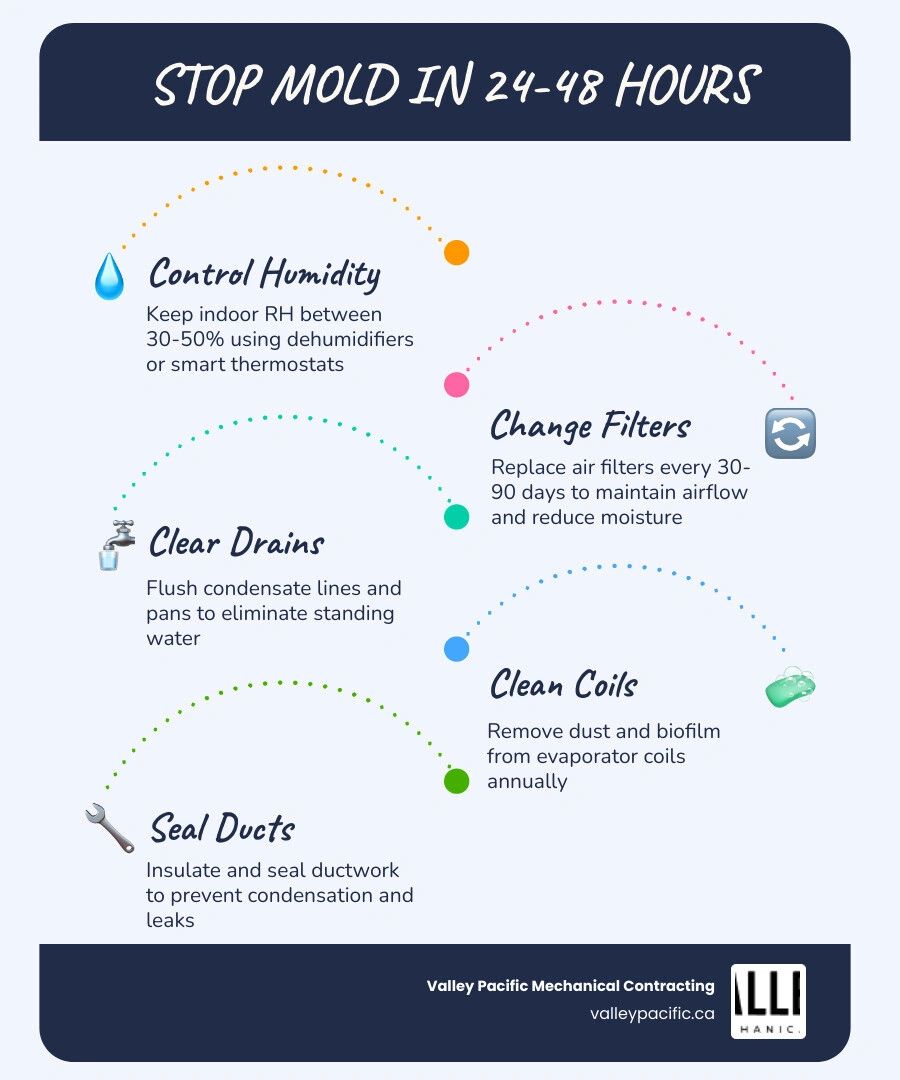
5 ways proper HVAC maintenance prevents mold growth:
- Change air filters every 30 to 90 days to keep airflow moving and prevent moisture buildup
- Clear condensate drain lines and pans regularly to eliminate standing water
- Seal and insulate ductwork to stop humid air from condensing inside your system
- Clean evaporator coils annually to remove the dust and organic matter mold feeds on
- Control indoor humidity between 30% and 50% using dehumidifiers or smart thermostats
Mold spores are always floating in the air around us — they are invisible, and you cannot stop them from entering your home. What you can control is whether they find a place to land and grow. That place is often your HVAC system.
When an HVAC system is neglected, it quietly creates the three things mold needs to thrive: moisture, dust, and dark undisturbed spaces. Condensation builds up on evaporator coils, drain pans collect standing water, and dirty filters trap organic material that becomes mold food. According to the EPA, indoor relative humidity above 60% creates conditions where mold thrives — and once moisture and a food source are present, mold colonies can begin forming in as little as 24 to 48 hours.
The good news? This is almost entirely preventable. Regular, targeted HVAC maintenance breaks the cycle before it starts — protecting your home, your system, and the air your family breathes every day.
The Science of Moisture: How Proper HVAC Maintenance Prevents Mold Growth
To understand why mold loves heating and cooling systems, we have to look at how these systems handle moisture. Your air conditioner or heat pump does not just cool your home; it also acts as a large-scale dehumidifier.
As warm, humid air from your home is pulled across the incredibly cold evaporator coils, the air quickly cools down. Because cold air cannot hold as much moisture as warm air, water vapor condenses out of the air and onto the surface of the coils. This is the exact same process that causes sweat to form on a cold glass of iced tea on a warm summer afternoon in Langley or Mission.
Under normal, well-maintained conditions, this moisture drips off the coils, collects in a drip pan, and flows harmlessly out of your home through a condensate drain line. However, if any part of this system is neglected, the moisture stays trapped inside. Stagnant moisture combined with the dark, dusty interior of your system provides the perfect breeding ground for mold. This is why investing in routine HVAC Preventative Maintenance is the single most effective shield you have against biological growth.
Understanding How Proper HVAC Maintenance Prevents Mold Growth via Humidity Control
The ultimate key to mold control is moisture control. The Environmental Protection Agency (EPA) sets the gold standard for indoor relative humidity at 30% to 50% to prevent mold growth. Once the indoor relative humidity climbs above 60%, you enter the high-risk zone where mold can thrive and colonize without needing a plumbing leak or standing water.
During our humid coastal shoulder seasons in the Lower Mainland, keeping your home in that safe 30% to 50% sweet spot can be a challenge. When your HVAC system is operating efficiently, it extracts gallons of water from your indoor air every single day. However, if your system is short-cycling (turning on and off too quickly, which is common with oversized units) or suffering from restricted airflow, it cannot run long enough to properly dehumidify your home.
We highly recommend keeping a simple, inexpensive tool called a hygrometer in your main living areas. This device measures your indoor relative humidity in real-time, letting you know exactly when your home is drifting into mold-friendly territory. Following professional HVAC Preventative Maintenance Tips ensures your system's moisture-removal capacity is always operating at its peak.
The Mold Trifecta: Moisture, Dust, and Dark Spaces
Mold is a biological organism that requires three simple elements to establish a colony:
- Moisture: Standing water, condensation, or high humidity.
- A Food Source: Organic material, which in an HVAC system is almost always household dust, skin cells, pet dander, and pollen.
- A Suitable Temperature: Mold thrives in temperatures between 32°F and 120°F (0°C to 49°C), which perfectly matches the temperature inside residential ductwork and air handlers.
When you neglect your system, you essentially open a five-star resort for mold. Stagnant, dusty air provides the "buffet," the dark interior of the metal cabinets provides the shelter, and condensation provides the water.
Furthermore, when dirty filters restrict airflow, the air inside your ducts becomes stagnant. Stagnant air allows localized humidity to build up in pockets, even if your thermostat reads a normal humidity level. Learning How to Maintain Your Heating and Cooling System is all about disrupting this trifecta by keeping the system clean, dry, and well-ventilated.
5 Essential HVAC Maintenance Methods to Stop Mold Growth
By taking proactive, preventative measures, you can dramatically improve your system's efficiency while ensuring that mold never gets the chance to take root.
To help you choose the right filtration strategy for your home, here is a comparison of standard vs. high-efficiency filters:
| Filter Type | MERV Rating | Spore Capture Efficiency | Best Used For | Impact on Airflow |
|---|---|---|---|---|
| Standard Fiberglass | 1 - 4 | Very Low (<20%) | Protecting equipment from large dust | Minimal |
| Pleated Cotton/Polyester | 5 - 8 | Moderate (50% - 70%) | Average homes without pets | Low to Moderate |
| High-Efficiency Pleated | 8 - 13 | High (70% - 90%) | Homes with pets, allergies, or mold concerns | Moderate (Requires system compatibility) |
| HEPA | 17 - 20 | Near Perfect (99.97%) | Severe asthma, clinical environments | Extremely High (Requires specialized system) |
1. Change Air Filters Regularly to Prevent Airflow Restrictions
Your air filter is your system's first line of defense against mold. Its primary job is to trap dust, pet dander, and airborne mold spores before they can enter your air handler and settle on the damp evaporator coils.
If you do not change your filter regularly, it becomes heavily clogged. This leads to two major issues:
- The Filter Becomes a Breeding Ground: The trapped dust on the filter combined with normal indoor humidity turns the filter itself into a food source. If the filter gets damp, mold will start growing directly on it, sending spores straight into your living spaces.
- Restricted Airflow and Frozen Coils: When airflow is choked by a dirty filter, the cold air stays trapped inside the air handler. This causes the temperature of the evaporator coil to drop below freezing, turning the condensation on the coil into solid ice. When that ice eventually melts, it produces an overwhelming amount of water that overflows the drain pan and floods your system.
To keep your air clean, we recommend upgrading to pleated filters with a MERV rating between 8 and 13. These filters are highly effective at trapping microscopic mold spores without putting excessive strain on your system's blower motor. For more detailed guidance, check out our resources on How Often Should You Change Your HVAC Air Filter and how to select the Best Air Filter for Your Home.
2. Keep Condensate Drain Lines and Pans Clear of Standing Water
Because your air conditioner extracts so much water from the air, the condensate drain system must work perfectly. Over time, the dark, wet environment of your condensate drain pan and drain line becomes the perfect home for algae, dust, and biological slime.
If this mixture builds up, it will clog the narrow drain line. With nowhere to go, the water backs up, filling the drain pan and eventually spilling over into your home's structure. Standing water that sits in a drain pan for more than 24 hours is a guaranteed recipe for rapid mold colony formation.
As a handy DIY maintenance task, you can flush your condensate drain line with a cup of regular white vinegar mixed with warm water once every few months. The natural acidity of the vinegar helps break down early algae buildup and keeps the line flowing freely. Additionally, professional technicians will always check that your drain pan is properly sloped toward the drain exit so that water cannot pool in the corners. Keeping these lines clear is a vital step in How to Prevent HVAC Emergencies with Maintenance.
3. Seal and Insulate Ductwork to Eliminate Sweating
Many homeowners in Pitt Meadows and Maple Ridge have ductwork that runs through unconditioned spaces like attics, crawl spaces, or unfinished basements. During the warm humid months, these spaces become incredibly hot and sticky.
If your metal ducts are leaky or poorly insulated, the cold air flowing inside them chills the metal exterior of the duct. When the hot, humid air of your attic or crawl space comes into contact with this cold metal surface, the ducts begin to "sweat."
This external condensation quickly soaks into any surrounding fiberglass insulation or nearby drywall. Wet insulation cannot be easily cleaned; it holds onto moisture like a sponge and must be completely replaced once mold takes hold. Sealing leaky ducts prevents cold air from escaping and keeps the outer surfaces warm, completely eliminating the sweating phenomenon.
4. Clean Evaporator Coils Annually to Remove Organic Food Sources
Even with high-quality air filters, tiny dust particles will eventually make their way onto your indoor evaporator coils. Over time, this dust combines with the constant condensation on the coil to form a sticky, organic film known as biofilm.
This biofilm acts as a highly concentrated food source for mold. Once mold begins growing on the tightly packed aluminum fins of your evaporator coil, it severely restricts heat transfer. This makes your system work much harder to cool your home, driving up your energy bills and shortening the lifespan of your equipment.
Cleaning these delicate coils requires specialized biodegradable chemical cleaners and a gentle touch to avoid bending the fragile aluminum fins. An annual professional HVAC System Check includes a thorough coil inspection and cleaning to keep this critical component dry, clean, and mold-free.
5. Install Advanced IAQ Technology Like UV-C Lights
If you want to take your mold prevention to the next level, several advanced indoor air quality (IAQ) technologies can assist your maintenance routine:
- UV germicidal lights: These specialized ultraviolet (UV-C) lights are installed inside your air handler, pointing directly at the evaporator coil. The UV-C light penetrates the cellular walls of mold spores, bacteria, and viruses, deactivating their DNA so they cannot reproduce or form colonies.
- Whole-home dehumidifiers: In coastal BC, outdoor humidity can remain high even when temperatures are mild. A whole-home dehumidifier works alongside your existing HVAC system to pull excess moisture out of the air without over-cooling your home.
- Smart thermostats: Modern smart thermostats can be programmed to run "dehumidification modes," which run the system at a lower fan speed to maximize the amount of moisture extracted from the air during cooling cycles.
Recognizing the Warning Signs of Mold in Your Ventilation System
Because your HVAC system is largely hidden behind walls and inside utility closets, mold can grow silently for months before you notice a physical spot. Knowing the early warning signs can save you from a massive remediation project down the road.
Musty Odors and Dirty Sock Syndrome
The absolute first warning sign of an HVAC mold issue is a distinct, musty odor. In the HVAC industry, we often refer to this as "dirty sock syndrome."
If you notice a stale, earthy smell resembling damp gym socks the moment your heating or cooling system kicks on, it is a clear indicator of microbial buildup on your coils or inside your ductwork. When the system is off, the mold sits in stagnant water; once the fan starts, it throws those musty odors and airborne spores directly into your living spaces.
Visible Growth and Physical Health Symptoms
If the mold issue is left unaddressed, you will eventually start seeing physical evidence. This often appears as small black, green, or gray speckles forming around your supply registers and air vents.
At the same time, your family may begin experiencing unexplained health symptoms that seem to improve when they leave the house. These symptoms can include:
- Frequent sneezing and nasal congestion
- Itchy, watery eyes and throat irritation
- Unexplained headaches and chronic fatigue
- Increased asthma attacks or respiratory infections
Indoor air pollution can run two to five times higher than outdoor levels when mold takes hold in a ventilation system. If you notice these physical signs, it is time to take immediate action.
Professional Inspections vs. DIY Maintenance
While there are plenty of simple tasks you can handle on your own, complete mold prevention requires a partnership between diligent homeowners and licensed professionals.
Why Professional Inspections Show How Proper HVAC Maintenance Prevents Mold Growth
Licensed technicians have the specialized tools, safety gear, and training required to inspect the deep, inaccessible areas of your system. During a professional visit, a technician will perform deep coil cleanings, measure system airflow pressures, inspect the heat exchanger, and check the structural integrity of your ductwork.
Investing in a regular plan is the best way to keep your system on a consistent schedule. To learn more about what these visits entail, read our guides on Is an HVAC Maintenance Plan Worth It and What Does an HVAC Maintenance Plan Include.
Safe DIY Tasks for Homeowners
To keep your system running smoothly between professional visits, here are the safe, effective tasks you can perform yourself:
- Check and replace your air filters every 30 to 90 days.
- Keep outdoor condenser units clear of leaves, grass clippings, and debris.
- Ensure all indoor supply and return vents are open and unblocked by furniture or drapes to maintain proper airflow.
- Monitor your home's relative humidity using a hygrometer.
Signing up for a dedicated Maintenance Plan is an easy way to automate your home's comfort and safety throughout the year.
Frequently Asked Questions About HVAC Mold Prevention
How quickly can mold grow in air ducts?
If standing water, high humidity (above 60%), and a food source like accumulated dust are present, mold spores can germinate and begin forming visible colonies within 24 to 48 hours.
What is the ideal indoor humidity level to prevent mold?
The EPA recommends keeping your indoor relative humidity between 30% and 50%. Keeping your home below 50% relative humidity dramatically reduces the risk of condensation forming on cold HVAC surfaces.
How often should I replace my air filters in the Lower Mainland?
For most homes in Maple Ridge, Pitt Meadows, Langley, and Mission, air filters should be replaced every 30 to 90 days. However, if you have pets, suffer from seasonal allergies, or run your system constantly during peak summer and winter months, you should check them monthly and replace them as soon as they appear gray or dusty.
Protect Your Home and Air Quality with Valley Pacific Mechanical Contracting
Maintaining a clean, dry, and mold-free HVAC system is essential for protecting your property and your family's health. At Valley Pacific Mechanical Contracting, we have been providing headache-free HVAC, plumbing, and mechanical services to homeowners across Maple Ridge, Pitt Meadows, Langley, and Mission for over 30 years.
As an Indigenous-owned business, we pride ourselves on our customer-first approach, fast response times, and our status as a Daikin Comfort Pro. Whether you need a seasonal check-up, an indoor air quality upgrade, or 24/7 emergency support, our licensed technicians are ready to help.
Don't let your heating and cooling system become a breeding ground for mold. Schedule professional HVAC services today with the team at Valley Pacific Mechanical Contracting and breathe easier knowing your indoor air is clean, dry, and safe.


