


How often should you change your hvac air filter?



Why Knowing How Often Should You Change Your HVAC Air Filter Matters for Your Home's Comfort
How often should you change your HVAC air filter is one of the most common — and most overlooked — questions homeowners ask. The short answer:
| Household Type | Recommended Replacement Frequency |
|---|---|
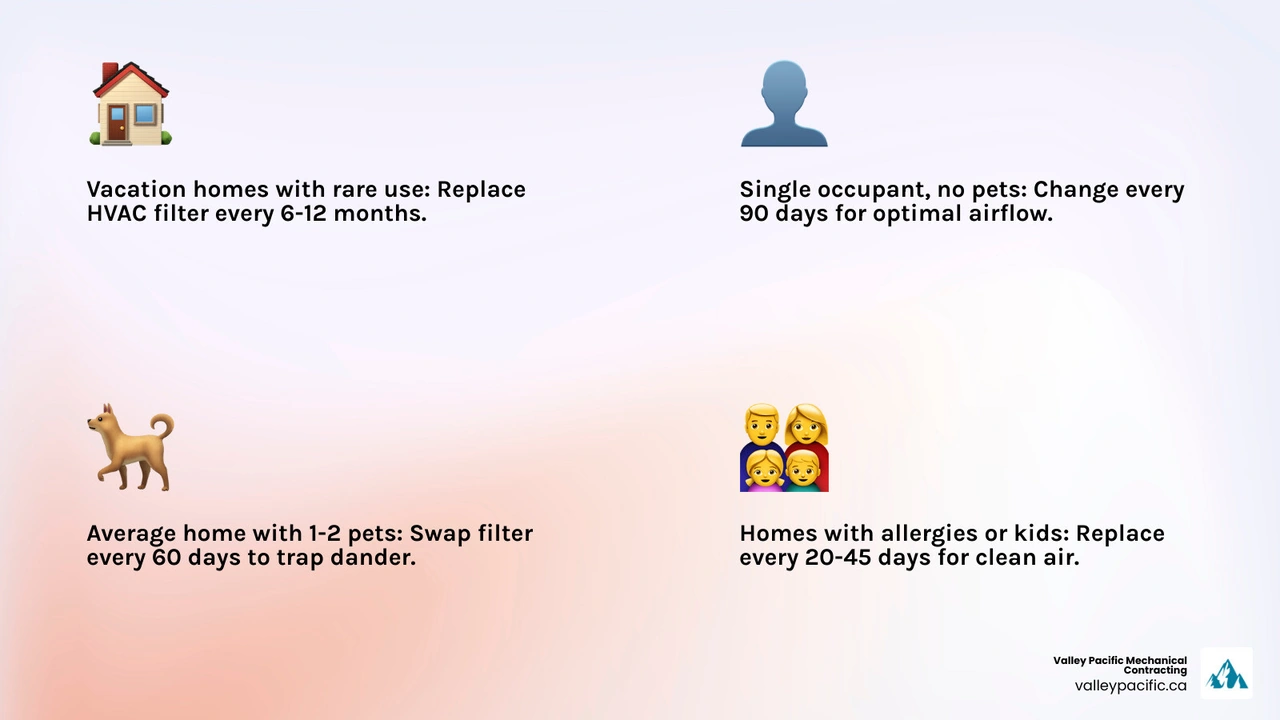
| Vacation home / rarely occupied | Every 6-12 months |
| Single occupant, no pets | Every 90 days |
| Average home, 1-2 pets | Every 60 days |
| Home with allergies, asthma, or children | Every 30-45 days |
| Multiple shedding pets or high dust | Every 20-30 days |
But that general schedule is just the starting point. Here in the Lower Mainland — where wildfire smoke, wet winters, and seasonal pollen shifts are a real part of life — your filter can fill up faster than those standard timelines suggest.
A clogged filter doesn't just mean dustier air. It forces your HVAC system to work harder, drives up your energy bills, and can shorten the life of equipment you've invested thousands of dollars in. According to the U.S. Department of Energy, replacing a dirty, clogged filter can improve your system's efficiency by 5 to 15% — a meaningful difference you'll notice on your bill.
The type of filter you use matters just as much as how often you swap it out. A basic 1-inch fiberglass filter and a 4-inch pleated HEPA-style filter live in completely different replacement schedules — and using the wrong one for your system can cause just as many problems as ignoring it altogether.
This guide covers everything you need to know: filter types, MERV ratings, household factors, and a simple step-by-step replacement process — so you can keep your home's air clean and your HVAC running smoothly year-round.
I'm looking for a guide on how often should you change your hvac air filter in the Lower Mainland
If you are living in Maple Ridge, Pitt Meadows, or Langley, you know that our weather is anything but predictable. In April 2026, we might be dealing with a sudden heat wave or a lingering damp spring. This local climate plays a massive role in answering the question: how often should you change your hvac air filter?
As a general rule of thumb, most professionals suggest a baseline of 90 days. However, at Valley Pacific Mechanical Contracting, we often tell our neighbors that 90 days is the absolute maximum. Think of it like an oil change for your car; you could wait until the light comes on, but your engine will be much happier if you stay ahead of the grime. For a standard 1-inch pleated filter, a 60-day cycle is often the "sweet spot" for maintaining peak efficiency.
The technical term we look for is "airflow impedance." Your HVAC system is designed to "breathe" a certain amount of air. When a filter gets loaded with dust, pet hair, and Fraser Valley pollen, it acts like a mask that is too thick to breathe through. Your blower motor has to work twice as hard to pull air through that wall of dirt.
To ensure your system is handling the load correctly, a regular HVAC System Check is vital. During these checks, we don't just look at the filter; we look at the toll a dirty filter has taken on the internal components. Manufacturer guidelines usually provide a "best-case scenario" timeline, but they don't always account for a humid Pitt Meadows winter or a dusty Mission summer.

What factors influence how frequently I need to replace my home's air filter?
No two homes in the Lower Mainland are exactly alike. A small condo in Langley will have vastly different needs than a sprawling farmhouse in Maple Ridge. Several key factors determine your personal replacement schedule:
- Home Size: Larger homes circulate more air. While you might think a bigger house means the dust is "spread out," it actually means the HVAC system is moving a higher volume of air through the filter every hour.
- Occupancy: The more people living in the home, the more "stuff" ends up in the air. We’re talking about skin cells (the main ingredient in household dust), lint from clothing, and general foot traffic bringing in dirt from outside.
- Outdoor Pollution: If you live near a busy road or a construction site, your filter is the first line of defense against outdoor particulates.
- HVAC Runtime: During peak seasons—like a freezing January or a scorching August—your system runs almost constantly. More runtime equals more air filtered, which leads to a faster buildup of debris.
- Construction Dust: If you’ve recently renovated your kitchen or bathroom, drywall dust and sawdust can clog a brand-new filter in just a few days.
We always recommend checking out our Spring Air Quality Solutions for HVAC System for more localized advice on managing these variables. Additionally, if you are using a heat pump, keep in mind that these systems run year-round for both heating and cooling. You can find specific tips in our Seasonal Heat Pump Maintenance Tips.
How often should you change your hvac air filter if you have pets or allergies in Maple Ridge?
Pets are wonderful, but they are "filter killers." Dog and cat hair, along with microscopic dander, are among the heaviest loads a residential system faces. If you have a Golden Retriever that sheds like it’s his full-time job, you are looking at a replacement every 20 to 45 days.
Pet dander is particularly tricky because it is sticky and microscopic. It doesn't just sit on the surface of the filter; it embeds itself in the fibers, quickly reducing the available surface area for airflow. For those with asthma or severe allergies, a fresh filter is non-negotiable. A dirty filter can actually become a source of allergens, blowing dust and triggers back into your living space every time the heat kicks on.
The role of home occupancy and local BC air quality
In the Lower Mainland, we also have to consider the "Big Smoke." Wildfire seasons have become more intense, and even if the fire isn't in your backyard, the smoke settles in the valley. During these periods, we've seen filters turn black in a matter of two weeks. If the air quality outside is poor, your filter is working overtime to keep your indoor air breathable.
Conversely, if you have a vacation property or a "snowbird" home that sits empty for months, your filter might last six months or longer. However, we still recommend a Maintenance Plan to ensure that when you do return, your system isn't trying to push air through a filter that has been sitting in a damp environment, which can sometimes lead to musty odors.
Concerned about air quality? Here is how filter types and MERV ratings affect your schedule
Not all filters are created equal. When you walk down the aisle at a local hardware store in Langley, you’ll see options ranging from a few dollars to the price of a fancy steak dinner. Here is how they break down:
| Filter Type | Material | Typical Lifespan | Best For |
|---|---|---|---|
| Fiberglass | Spun glass fibers | 30 days or less | Basic protection for the system only |
| Pleated | Synthetic or cotton paper | 60-90 days | Average homes; good balance of cost/airflow |
| High-Efficiency | Deep pleats/specialty media | 3-6 months | Allergy sufferers; high-performance systems |
| HEPA | Dense glass fibers | 6-12 months | Maximum air purification; requires specific housing |
Fiberglass filters are the "old school" option. They are designed primarily to keep large debris (like a stray sock or a giant dust bunny) out of your furnace's motor. They do very little for your actual air quality and clog very quickly because they have so little surface area.
Pleated filters are the modern standard. Because the material is folded into "V" shapes, the filter has much more surface area to trap particles without immediately blocking airflow. If you're looking for professional help choosing the right fit, our Furnace Filter Replacement Service can take the guesswork out of it.
How often should you change your hvac air filter based on its thickness?
Size matters! Most standard homes use a 1-inch thick filter. Because these are thin, they have limited "holding capacity." They fill up fast and need frequent changes.
However, many newer systems or upgraded setups use 4-inch or even 5-inch "media filters." These look like a thick accordion. Because they have a massive amount of surface area, they can often last 6 to 12 months. These are high-capacity filters that offer excellent filtration without the frequent maintenance of 1-inch versions. Just be sure your HVAC cabinet is designed for them; you can’t simply jam a 4-inch filter into a 1-inch slot!
Understanding MERV ratings and airflow
MERV stands for Minimum Efficiency Reporting Value. It’s a scale from 1 to 16 that tells you how well the filter traps particles.
- MERV 1-4: Basic fiberglass. Captures large particles only.
- MERV 8-11: The "Sweet Spot." Great for most residential homes in Pitt Meadows. It captures dust, pollen, and mold spores without putting too much "static pressure" (strain) on your blower motor.
- MERV 13-16: High-efficiency. These can trap bacteria and smoke particles.
Expert Tip: Be careful about going too high on the MERV scale if your system isn't designed for it. A MERV 16 filter is so dense that some older furnace motors will struggle to pull air through it, leading to overheating and potential motor failure. We always check for this balance during our HVAC Preventative Maintenance visits.
How can I tell if my filter is dirty and what happens if I don't change it?
You don't always need a calendar to tell you it's time for a swap. Your eyes and nose are great diagnostic tools.
The "Light Test": This is the gold standard for DIY inspection. Remove your filter and hold it up to a bright light or a window. If you can clearly see light passing through the fibers, it still has some life left. If the light is blocked or looks very dim and "muddy," that filter is full and needs to go.
Other Signs of a Clogged Filter:
- Visible Dust: If you notice a grey, fuzzy layer on the intake vents or the filter itself.
- Increased Dusting: If you find yourself having to dust your furniture every two days, your filter is likely failing to trap circulating particles.
- Musty Odors: A "dirty sock" smell when the heat or AC kicks on often points to a dirty filter or coils.
- Longer Cycles: If your system seems to be running forever just to reach the temperature on the thermostat.
- Rising Bills: A spike in your BC Hydro or FortisBC bill without a change in weather often means the system is struggling against a clog.
For more detailed signs and preventative care, see our HVAC Preventative Maintenance Tips.
Risks of neglecting your HVAC maintenance
Ignoring your filter isn't just about air quality; it’s about protecting your wallet. A clogged filter is the leading cause of HVAC breakdowns.
- Frozen Coils: In the summer, your air conditioner’s evaporator coil needs a steady flow of warm air to keep from getting too cold. If the filter blocks that air, the coil can actually drop below freezing, turning into a block of ice and shutting down the whole system.
- Overheating: In the winter, your furnace needs airflow to move heat away from the heat exchanger. Without it, the unit can overheat and "trip" a safety limit switch, or worse, crack the heat exchanger.
- Short Cycling: This is when your system turns on and off rapidly. It’s incredibly hard on the components and is often caused by the system "choking" for air.
- Efficiency Loss: As mentioned, a 5-15% loss in efficiency is common. Over a year in the Lower Mainland, that adds up to a lot of wasted money.
For a deeper dive into keeping your heating system healthy, check out our Furnace Maintenance Langley BC Complete Guide.
I need a simple way to change my filter safely—what are the steps?
Changing a filter is one of the few HVAC tasks that is truly DIY-friendly. Follow these steps to do it safely:
- Turn Off the System: Go to your thermostat and turn the system to "Off." This prevents the fan from kicking on while you have the filter out, which could suck dust and debris directly into the delicate internal machinery.
- Locate the Filter: The filter is usually located in the return air duct or in a slot right next to the furnace or air handler. In some homes, it might be behind a large intake grille in a wall or ceiling.
- Remove the Old Filter: Slide it out gently. Take note of the size (e.g., 16x25x1) printed on the side. You’ll need this exact size for the replacement.
- Check the "Airflow Arrow": This is the most important step! Look at the frame of the new filter. You will see an arrow. This arrow must point toward the furnace/air handler and away from the return duct. Think of it as pointing in the direction the air is traveling.
- Slide in the New Filter: Ensure it fits snugly. There shouldn't be large gaps around the edges where air can "bypass" the filter.
- Replace the Cover: Secure any latches or screws.
- Turn the System Back On: Set your thermostat back to your desired temperature.
Pro Tip: Use a permanent marker to write the date of installation on the edge of the filter frame. That way, there’s no guessing when you check it next month!
Frequently Asked Questions about Air Filter Maintenance
Should I use washable or disposable air filters?
While washable filters seem environmentally friendly, we generally recommend high-quality disposable pleated filters for most residential systems. Washable filters often have lower MERV ratings and can be a breeding ground for mold if they aren't 100% dry before you put them back in. Most homeowners find the convenience and superior filtration of disposables to be worth it.
Is it safe to run my HVAC system without a filter for a day?
We strongly advise against this. Running your system without a filter—even for a few hours—allows dust, pet hair, and debris to coat the evaporator coils and the blower motor. This can cause immediate efficiency drops and may require a professional cleaning to fix. If you realize you’re out of filters, it’s better to leave the system off until you can run to the store in Maple Ridge or Pitt Meadows to grab a new one.
Do I need to change my filter more often during a BC summer?
Yes! In the Lower Mainland, our summers have become hotter, meaning our air conditioners and heat pumps are running much more frequently. If you are using your AC daily, you should check your filter every 30 days. For more summer-specific advice, see our Heat Pump Maintenance guide.
Conclusion
At the end of the day, the answer to how often should you change your hvac air filter isn't a single number—it’s a habit. By checking your filter once a month and replacing it as needed, you are taking the single most important step in DIY home maintenance. You'll enjoy cleaner air, lower bills, and a system that lasts for years to come.
At Valley Pacific Mechanical Contracting, we’ve spent over 30 years helping our neighbors in Langley, Maple Ridge, Pitt Meadows, and Mission stay comfortable. We believe in a "headache-free" experience, whether we’re performing a complex installation or a simple routine check. As a Daikin Comfort Pro, we stand behind our work with a commitment to quality and transparency.
If you’d rather leave the maintenance to the pros, or if you’re concerned about your indoor air quality, we’re here to help. Our Maintenance Plan is designed to give you total peace of mind, ensuring your system is always running at its best, no matter what the BC weather throws our way. Give us a call today—we’re ready to help you breathe easier!


