


The High Price of Keeping Your Ancient HVAC on Life Support



My HVAC Keeps Breaking Down in Maple Ridge — Should I Repair It or Replace the System?
If your HVAC system keeps acting up, it can be hard to know whether another repair makes sense or if it is time to move on to a new system. For homeowners in Maple Ridge and across the Lower Mainland, this usually becomes urgent during a winter cold snap or a summer heat wave.
Here is a simple starting point before we dig deeper:
Quick Guide: Should You Repair or Replace?
| Situation | Likely Best Move |
|---|---|
| System under 10 years old, minor repair | Repair |
| Repair addresses one isolated issue | Repair |
| Major component failure on older equipment | Replace |
| System uses R-22 refrigerant and needs a recharge | Replace |
| Two or more breakdowns in the past 24 months | Replace |
| Cracked heat exchanger or CO risk detected | Replace immediately |
| System 15+ years old with major component failure | Replace |
Most homeowners only start thinking about this when something stops working. That moment of stress is exactly when a clear, practical process helps most.
The truth is, repeated repairs on an aging system can lead to more disruption, more energy waste, and more comfort problems over time. But replacement is not always the right first move either, especially if the system is younger or the issue is straightforward.
This guide walks you through how to think about it clearly, so you are not guessing.
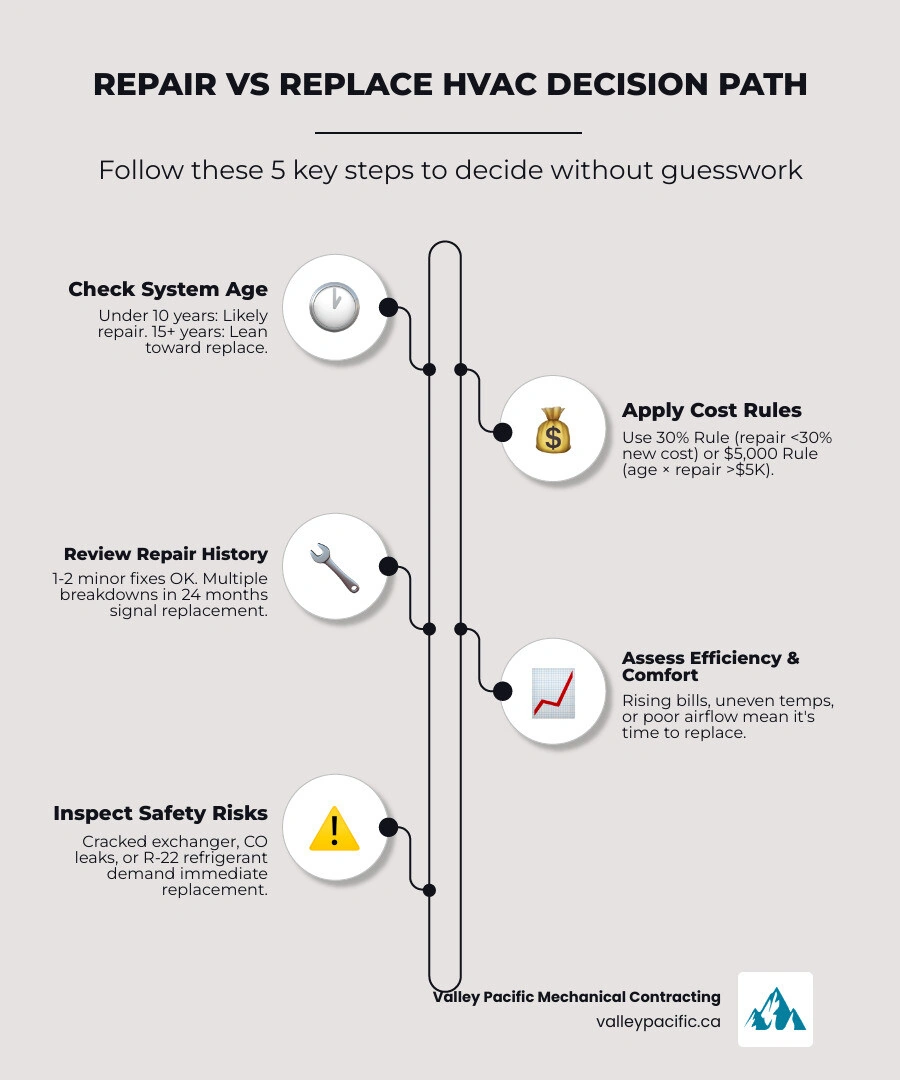
How to Decide Whether to Repair or Replace Your HVAC System
The best repair-or-replace decisions are rarely based on one dramatic breakdown. They usually come down to patterns: age, repair frequency, comfort, efficiency, and whether the equipment is becoming too unreliable for day-to-day use.
A good way to simplify the decision is to compare what the system is doing today with what it is likely to do over the next few years.
| Repair signals | Replacement signals |
|---|---|
| Newer system | Older system near end of lifespan |
| One isolated issue | Repeated breakdowns |
| Minor part failure | Major component failure |
| Still under warranty | Warranty expired |
| Good airflow and comfort | Uneven temperatures and poor airflow |
| Stable energy use | Rising utility bills |
| Uses current refrigerant | Uses outdated refrigerant |
| Safe operation confirmed | Safety concerns present |
Start With the Three Biggest Decision Filters
1. System age
Age matters because HVAC systems lose efficiency and reliability over time, even when they still technically run. In the Lower Mainland, many systems can last well into the 10 to 15 year range with proper maintenance, and some go longer. But after that point, more major parts tend to fail, and replacement becomes more worth considering.
2. Repair history
One repair is normal. A string of repairs is a pattern.
If you have had two or more unscheduled breakdowns in the past couple of years, your system may be moving from fixable to frustrating. We always suggest looking at cumulative repairs, not just the current issue. Small repairs have a sneaky way of becoming an ongoing problem.
3. Efficiency drop
If your equipment still runs but your home feels less comfortable, takes longer to heat or cool, cycles more often, or your bills keep climbing, the system may be losing efficiency. That hidden waste can be just as important as the repair itself.
Use Repair-or-Replace Rules of Thumb Carefully
Rules of thumb are helpful, but they are not magic. Think of them as screening tools, not final answers.
A few simple checks can help:
- Is the system older and needing frequent service?
- Is the repair tied to a major component instead of a small part?
- Does the equipment use outdated refrigerant?
- Is the home still uncomfortable even when the system is running?
- Are you planning to stay in the home long term?
- Would a newer system improve reliability and comfort enough to justify the change?
Think Beyond the Immediate Fix
The biggest mistake homeowners make is comparing one repair visit to the question of replacement and stopping there.
A smarter question is: what is likely to happen over the next five years?
An older system may need:
- More frequent service calls
- Harder-to-find parts
- Higher energy use
- More refrigerant-related issues
- More frustrating hot and cold spots around the house
A new system may bring:
- A fresh warranty period
- Better comfort and airflow
- Lower operating costs
- Quieter performance
- Better compatibility with smart controls and indoor air quality upgrades
That is why “can it be repaired?” is not always the same as “is it worth repairing?”
Signs Your HVAC System Needs Repair Now or Replacement Soon
Some systems fail dramatically. Others send a long trail of hints first.
If you are seeing warning signs, it helps to know which ones point to a straightforward repair and which ones are trying to tell you the whole system is aging out. We cover more of these in our guide to signs your HVAC system may fail soon.
Common warning signs include:
- Uneven temperatures between rooms
- Weak airflow
- Short cycling
- Strange sounds like banging, rattling, squealing, or buzzing
- Rising energy bills without a clear reason
- Excess indoor humidity in summer
- Dry or stale air in winter
- Thermostat settings not matching how the house actually feels
Typical Signs a Repair Still Makes Sense
Repair is often the smart move when the problem is isolated and the rest of the system is in good shape.
Examples include:
- Capacitors, contactors, igniters, or sensors failing
- Thermostat issues
- Minor electrical components wearing out
- Drain line clogs
- A blower or fan issue on an otherwise healthy system
- Equipment that is still under parts warranty
If your system is newer, has not needed repeated repairs, and still heats or cools well, a repair can absolutely be the right answer.
Red Flags That Usually Point to Replacement
Some issues are less about one failed part and more about overall decline.
Common replacement signals:
- Frequent breakdowns
- Major compressor or heat exchanger issues
- Obsolete or discontinued parts
- Poor comfort even after service
- Constant thermostat battles in the home
- Noticeably higher utility bills year over year
- The system struggles during peak summer or winter weather
- The equipment is already in the 10 to 15+ year range
If that sounds familiar, our article on whether your old AC is ready for replacement can help you spot the difference between temporary trouble and end-of-life decline.
Safety Problems That Should Never Be Delayed
A few issues move this out of the “budget decision” category and into the “deal with it now” category.
Replace immediately or shut the system down and have it inspected if there is:
- A cracked heat exchanger
- Carbon monoxide concerns or alarms
- Burnt wiring or electrical damage
- Persistent refrigerant leaks
- Smoke, burning smells, or signs of overheating
A cracked heat exchanger is especially serious because it can allow combustion gases, including carbon monoxide, into the air stream. That is not a “we will think about it next month” problem.
How to Determine HVAC Age, Lifespan, and Refrigerant Risk
Before making any decision, confirm what you actually have. Many homeowners know the thermostat age better than the equipment age.
Where to Find the Age of Your System
Check:
- The nameplate on the outdoor condenser or heat pump
- The label inside the furnace cabinet
- The air handler or boiler data tag
- The serial number and manufacturing information
Sometimes the manufacture date is printed clearly. Other times it is coded into the serial number. If it is not obvious, we can identify it during an inspection.
Expected Lifespan by Equipment Type
General lifespan ranges are:
- Central AC: often around 15 to 20 years
- Gas furnace: often around 15 to 20 years, sometimes longer with excellent maintenance
- Heat pump: often around 10 to 15 years because it runs for both heating and cooling
- Boiler: often longer, depending on type, water quality, and maintenance
Local conditions matter too. In the Lower Mainland, damp weather, long run times, and deferred maintenance can shorten real-world lifespan.
When Outdated Refrigerants Make Repairs Hard to Justify
Refrigerant can completely change the repair-vs-replace conversation.
R-22 systems
If your system uses R-22, major repairs are often hard to justify. R-22 was phased out years ago, and supply is limited to reclaimed stock. That means leak repairs and recharges can become very expensive very quickly. If an older unit needs refrigerant work and uses R-22, replacement is often the more sensible path.
Most systems built before 2010 are strong candidates for R-22, though you should always check the label to confirm.
R-410A systems
R-410A has been common for many years, but the industry is moving toward newer refrigerants. That does not mean every R-410A system needs replacing today. It does mean long-term serviceability and future refrigerant trends are worth factoring in if the system is already aging and facing a major repair.
In short:
- Minor repair on a current refrigerant system: often repairable
- Major leak on an old R-22 system: often not worth chasing
Efficiency, Rebates, and Long-Term Savings: The Hidden Side of the Decision
A repair may restore operation. It does not restore lost efficiency from older equipment design.
Why Efficiency Ratings Change the Math
Efficiency ratings tell you how much heating or cooling you get for the energy used.
Key ratings include:
- SEER2 for air conditioners and heat pumps
- AFUE for furnaces
- HSPF for heat pump heating efficiency
Older systems, especially ones that are 10 to 15 years old or more, are usually far less efficient than current models. Newer high-efficiency systems can often reduce energy use while improving day-to-day comfort.
Beyond the rating itself, new systems often include:
- Variable-speed motors
- Better humidity control
- More even temperatures
- Quieter operation
- Smarter staging instead of harsh on-off cycling
That means the upgrade is not only about the utility bill. It is also about how the house feels.
Incentives Homeowners Should Check Before Deciding
For homeowners in Maple Ridge, Pitt Meadows, Langley, Mission, and nearby Lower Mainland communities, incentives can make replacement more appealing.
Before deciding, check for current programs through:
- CleanBC
- FortisBC
- BC Hydro
- Federal efficiency programs that may apply to qualifying equipment
These programs change over time, so always verify current eligibility and approved equipment requirements before making a final decision.
Comfort Upgrades Older Systems Usually Cannot Deliver
Sometimes replacement wins because of quality-of-life improvements, not just repair avoidance.
A modern system may offer:
- Better filtration and indoor air quality options
- More consistent airflow
- Better humidity control during sticky summer weather
- Smart thermostat integration
- Zoning options in some homes
- Quieter outdoor and indoor operation
If your current system still “works” but never quite makes the house comfortable, that is an important clue. Our complete guide to HVAC system upgrades explains how newer equipment can improve more than just temperature.
When Repairing an Old HVAC System Is Still the Smarter Move
Yes, replacement gets a lot of attention. But repair is still the right call in plenty of situations.
Repair-friendly situations include:
- The system is on the younger side
- The issue is isolated and clearly diagnosed
- The unit has been well maintained
- There have been no repeat breakdowns
- The repair is relatively small compared to replacement
- The equipment still operates efficiently
- You need a practical short-term solution while planning a future upgrade
Best-Case Scenarios for Repairing an Older Unit
Even a 10- to 15-year-old system may still be worth repairing if:
- This is the first major issue
- The rest of the system is in solid shape
- Airflow and comfort are still good
- It uses a serviceable refrigerant
- It has a strong maintenance history
- The repair addresses the root cause rather than just a symptom
This is especially true for wear items or single-part failures. Not every older system needs to be retired at the first sneeze.
When to Replace Both Furnace and AC at the Same Time
If your air conditioner and furnace are both older, replacing them together is often the smarter long-term move.
Why?
- Matched systems are designed to work together
- Airflow and efficiency are better when components are paired properly
- Mixing old and new equipment can reduce performance
- Compatibility issues can shorten equipment life
- You avoid replacing one half now and the other half shortly after
If both sides of the system are in the same age range, a coordinated replacement can be more efficient and less disruptive. We talk more about timing in when to install a new AC system.
How a Professional Assessment Helps You Make the Right Financial Decision
A proper HVAC assessment should go beyond “this part failed.”
We look at:
- Equipment age
- Overall condition
- Safety concerns
- Airflow performance
- Ductwork condition
- Repair history
- Refrigerant type
- System sizing and load needs
- Whether the home would benefit from different equipment altogether
That full-picture approach matters because sometimes the root issue is not just the unit. It may be poor airflow, duct leakage, bad sizing, or a combination of small issues making the system seem older than it is.
If you are unsure whether your current setup is worth saving, our article on signs you need a new AC installation is a helpful next step.
Cost of Repairing Old HVAC vs Buying New System: FAQs Homeowners Still Ask
Is the cost of repairing old HVAC vs buying new system usually worse after multiple breakdowns?
Usually, yes.
Multiple breakdowns change the equation because the issue is no longer a single repair. It becomes declining reliability. Even if each repair seems manageable on its own, repeated failures often signal broader wear across motors, boards, coils, electrical components, or refrigerant lines.
A repair log helps here. If you keep seeing the same van in the driveway for the same old system, your HVAC is trying to tell you something.
Should I replace my furnace and AC together if only one has failed?
Sometimes yes, sometimes no.
If one component has failed but the paired equipment is also old, replacing both at once is often the better call. That is especially true when both are past the 10- to 12-year mark. If the other half is much newer and properly matched, replacing only the failed portion may still make sense.
This is where professional inspection matters most, because compatibility and airflow are not things we recommend guessing on.
Can a home inspection or future sale make replacement the better choice?
Absolutely.
Older HVAC equipment often gets flagged during home inspections, especially if it is near end-of-life, shows poor maintenance, or raises safety concerns. Even if it still runs, buyers may see it as a near-future expense and negotiate accordingly.
If you plan to sell soon, replacement can sometimes improve buyer confidence, reduce inspection friction, and make the home easier to market. If you are staying long term, the decision leans more heavily on comfort, reliability, and efficiency.
Conclusion
The right answer is rarely “always repair” or “always replace.” It is about making a clear decision based on age, repair history, safety, refrigerant type, efficiency, and how your home is actually performing.
If your system is still repair-friendly, great. Fix it and keep it maintained.
If it is old, inefficient, unreliable, or showing safety risks, replacement may save you stress, energy waste, and repeat breakdowns in the long run.
At Valley Pacific Mechanical Contracting, we help homeowners across Maple Ridge, Pitt Meadows, Langley, Mission, Surrey, Vancouver, and the Lower Mainland make that call without pressure or guesswork. As an Indigenous-owned HVAC and mechanical services company with 30+ years of experience, we focus on clear advice, licensed technicians, fast response times, and a customer-first approach that keeps your home comfortable through every season.
If you want help evaluating your system, explore our services, learn more about furnace replacement in Maple Ridge, BC, or review our heating replacement options in Maple Ridge, BC.
And if your furnace is making suspicious noises that sound like it is rehearsing for its final performance, we are here to help.


