


A Comprehensive Guide to How HVAC Load Calculations Work



Why Understanding How HVAC Load Calculations Work Is the First Step to Year-Round Comfort
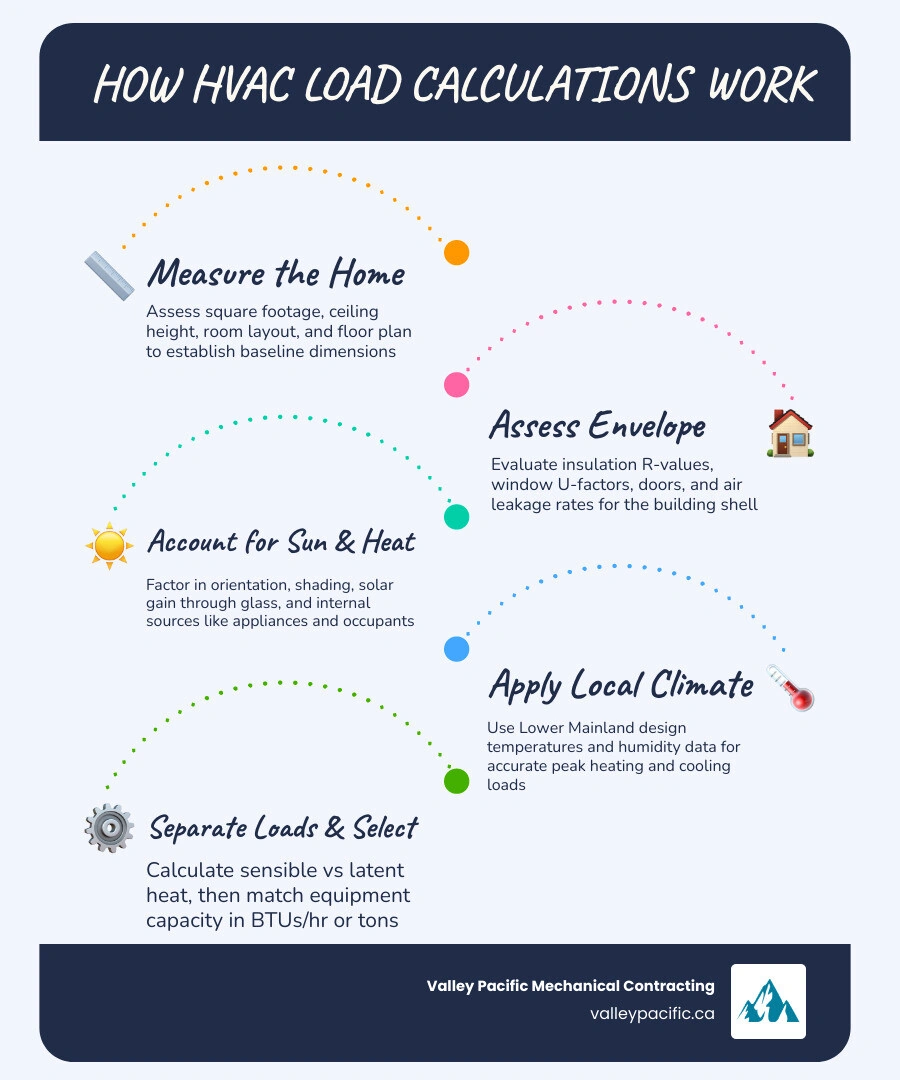
How HVAC load calculations work comes down to one core idea: figuring out exactly how much heating or cooling your home needs — no more, no less. An HVAC load calculation is a detailed analysis of your home's specific characteristics that determines the right system capacity in BTUs per hour. It accounts for your local climate, building materials, windows, insulation, and how people actually use the space.
Here is a quick breakdown of the process:
- Measure the home — square footage, ceiling height, room layout, and floor plan
- Assess the building envelope — insulation R-values, window U-factors, doors, and air leakage
- Factor in sun exposure — orientation, shading, and solar heat gain through glass
- Account for internal heat sources — occupants, appliances, lighting, and electronics
- Apply local climate data — outdoor design temperatures for the Lower Mainland, BC
- Calculate ventilation and infiltration loads — fresh air requirements and air leakage rates
- Separate sensible and latent heat — temperature load vs. humidity load
- Total the peak heating and cooling loads — expressed in BTUs per hour or tons of capacity
- Select equipment to match — using the load result, not a rule of thumb
The goal is a system that is sized just right — not oversized, not undersized. An oversized system short-cycles, leaving your home humid and uncomfortable. An undersized one runs constantly and wears out faster. Getting this right from the start protects your investment and your comfort through every season.
For homeowners across Maple Ridge, Pitt Meadows, Langley, Surrey, and Greater Vancouver, accurate load calculations are especially important given the Lower Mainland's variable climate — cool, wet winters and increasingly warm summers that both make demands on your system.
What Is an HVAC Load Calculation and Why It Matters
In home comfort, "size matters," but bigger isn't always better. An HVAC load calculation is the mathematical process we use to determine the exact amount of thermal energy (heat) that must be added to or removed from a space to maintain a comfortable temperature.
This calculation is measured in British Thermal Units (BTUs). One BTU is roughly the amount of energy released by burning a single wooden match. In the HVAC industry, we often speak in "tons." One ton of refrigeration equals 12,000 BTUs per hour. So, a 3-ton air conditioner can remove 36,000 BTUs of heat from your home every hour.
Why does this matter so much? Because your HVAC system is the heart of your home's environment. If the heart is too big or too small for the "body" it serves, the whole system suffers. Accurate sizing ensures:
- Energy Efficiency: You aren't paying for more power than you need.
- Humidity Control: Systems that run for the correct cycle length can properly pull moisture out of the air.
- Comfort: No more "hot spots" or "cold zones" in different rooms.
- Equipment Lifespan: A properly sized unit doesn't turn on and off 50 times a day, which reduces mechanical wear and tear.
How HVAC Load Calculations Work for Heating and Cooling
When we look at how hvac load calculations work, we have to consider two different scenarios: heating and cooling.
For heating, we calculate heat loss. This is the rate at which heat escapes through your walls, windows, and roof during a chilly January night in Langley or Mission. We need a furnace or heat pump that can replace that heat at the same rate it's being lost.
For cooling, we calculate heat gain. This includes the heat coming in from the sun, the heat generated by your oven or computer, and even the heat given off by the people living in the house. This is further broken down into sensible heat (the heat you feel on a thermometer) and latent heat (the moisture or humidity in the air). A proper calculation ensures your AC can handle both.
Why Proper Sizing Beats Rules of Thumb
In the old days, many contractors used a "rule of thumb," such as "one ton for every 500 or 600 square feet." While this might provide a ballpark figure, it is often wildly inaccurate for modern Lower Mainland homes.
A 1,500-square-foot home built in the 1970s with original windows and thin insulation has much higher heating and cooling needs than a brand-new 1,500-square-foot home built to current BC Energy Step Code standards. If you use a rule of thumb, you’ll likely end up with an oversized system. This leads to short cycling, where the system turns on, blasts the house with air, and shuts off before it has a chance to dehumidify the air or circulate it properly. Conversely, an undersized system will have a constant runtime, struggling to reach the thermostat setpoint on a hot July afternoon.
Manual J vs. Square Footage Estimates: What Changes
If square footage is a "guess," Manual J is the "science." Developed by the Air Conditioning Contractors of America (ACCA), Manual J is the industry standard for residential load calculations. It moves away from broad estimates and into a room-by-room analysis.
| Feature | Square Footage Estimate | Manual J Calculation |
|---|---|---|
| Accuracy | Low (Ballpark only) | High (Precise) |
| Insulation | Ignored | Factor in R-values |
| Windows | Ignored | Considers type, size, and U-factor |
| Orientation | Ignored | Considers which way the house faces |
| Occupancy | Ignored | Factors in number of residents |
| Result | Often oversized | "Goldilocks" sizing (Just right) |
How HVAC Load Calculations Work in a Manual J Assessment
When we perform a Manual J assessment, we don't just look at the floor. We look at everything. We take on-site measurements of every room, including ceiling heights and the square footage of every window and door.
We then input this data into specialized software. This software combines your home’s physical data with local weather patterns. The result is a comprehensive design report that tells us exactly how many BTUs each room needs. This allows us to not only pick the right unit but also ensure the HVAC system design delivers the right amount of air to the right places.
Why an Older System’s Size Is Not a Reliable Replacement Guide
Many homeowners assume that if they have a 3-ton unit now, they should just buy another 3-ton unit. This is known as a "box swap," and it's a common mistake.
Over the last 15 to 20 years, you may have upgraded your insulation, installed high-efficiency windows, or added a new addition. Perhaps you’ve sealed up air leaks in the attic. All of these changes alter your home's "load." If your home is now more airtight and better insulated, that old 3-ton unit might be way too big for your current needs. Always insist on a fresh calculation before a replacement.
The Main Factors Included in a Residential Load Calculation
The "building envelope" is the shell of your home that keeps the outside weather out and the inside comfort in. Every part of this shell affects the load.

Building Envelope Factors That Change the Load
- Walls and Attic: We look at the R-value (resistance to heat flow). Better insulation means lower loads.
- Windows: We check the "U-factor" (how well the window prevents heat from escaping) and the Solar Heat Gain Coefficient (SHGC), which measures how much solar radiation comes through the glass.
- Air Leakage: Every home "breathes," but too much leakage through gaps and cracks increases the work your HVAC system has to do.
- Foundation and Roof: Whether you have a crawlspace, a slab, or a basement—and whether your roof is dark shingles or a reflective material—all changes the math.
Sun Exposure, Orientation, and Internal Heat Gains
Which way does your living room face? A home with massive south-facing windows will have a much higher cooling load in the summer than a home shaded by trees or facing north. We also factor in internal heat gains. This includes:
- Occupants: Each person adds about 250 to 400 BTUs of heat to the home.
- Appliances: Your stove, dishwasher, and even your refrigerator generate heat.
- Electronics: Large TVs and computers can act like small space heaters.
Ductwork, Ventilation, and Infiltration
Even the best HVAC unit can't do its job if the "veins" of the system—the ducts—are failing. We look at duct leakage and whether your ducts run through unconditioned spaces like a hot attic or a cold crawlspace.
We also calculate the ventilation load. Modern homes are built so tight that they require fresh air systems to maintain indoor air quality. This fresh air must be heated or cooled as it enters, which adds to the total load. We typically aim for a design volume flow rate of 400 CFM (Cubic Feet per Minute) per ton of air conditioning to keep things moving correctly. You can learn more about keeping these components in shape in our HVAC system check guide.
How Design Conditions Affect the Final HVAC Size
We don't size an HVAC system for the hottest or coldest day in history; we size it for "design conditions." These are established by ASHRAE (American Society of Heating, Refrigerating and Air-Conditioning Engineers) based on decades of weather data.
Why Outdoor and Indoor Design Conditions Matter So Much
In the Lower Mainland, our "design day" for heating is based on temperatures that the area stays above 99% of the time. For cooling, we use temperatures that are only exceeded 1% of the time.
If we sized a system for a "once-in-a-century" heatwave, the system would be massive. For the other 364 days of the year, it would be horribly inefficient, short-cycling and failing to control humidity. By using standard design conditions, we ensure the system is perfectly tuned for 99% of our local weather in places like Pitt Meadows and Maple Ridge.
Room-by-Room Loads vs. Whole-Home Loads
A whole-home load tells us what size unit to put outside. A room-by-room load tells us how to balance the air. This prevents the common "master bedroom is a sauna, but the basement is a fridge" problem. By calculating the specific needs of each room, we can determine:
- How many supply registers are needed.
- The size of the duct branches.
- Whether a zoning system is necessary to keep everyone happy.
What Happens When an HVAC System Is Oversized or Undersized
Improper sizing is the root cause of most homeowner complaints. Here is why getting the calculation right is so critical.
Problems Caused by Oversizing
It sounds counterintuitive, but a system that is too powerful is a major headache.
- Humidity Issues: An oversized AC cools the air so fast that the thermostat reaches its goal before the system has time to remove moisture. This leads to a "cold and clammy" feeling.
- Short Cycling: Frequent starts and stops are hard on the compressor and fan motor, leading to premature failure.
- Noise: Oversized systems often push too much air through ducts that weren't designed for it, causing whistling or rushing sounds.
Problems Caused by Undersizing
- Constant Running: On a hot day, an undersized unit will run 24/7 without ever reaching the temperature you want.
- High Energy Bills: Because the system never rests, your electricity or gas meter is constantly spinning.
- Extreme Weather Strain: When a real cold snap hits Mission or Langley, an undersized furnace simply won't be able to keep the house warm enough for safety.
How Accurate Load Calculations Improve Efficiency, Comfort, and Durability
When your system is "right-sized," it runs in longer, more efficient cycles. This allows for better air filtration and superior humidity control. It also means fewer breakdowns, as the equipment is operating exactly within its design parameters.
To keep that perfectly sized system running for years to come, we recommend following HVAC preventative maintenance steps. If you're considering an upgrade, check out our HVAC system upgrades complete guide to see how modern technology pairs with accurate sizing.
When Homeowners Should Ask for a New Load Calculation
You don't need a load calculation every year, but there are "milestone" moments when it's non-negotiable:
- Replacing your current system: Never assume the old size was right.
- Adding an addition: A new sunroom or bedroom changes the total volume of air your system must handle.
- Finishing a basement: This adds significant square footage and changes the heat loss profile of the lower floor.
- Energy upgrades: If you just spent thousands on new triple-pane windows and spray-foam insulation, your old HVAC unit is likely now oversized.
- Heat Pump Conversion: Moving from a gas furnace to a high-efficiency heat pump requires precise data to ensure the new system can handle our BC winters.
Questions to Ask Before Replacing Equipment
When a technician visits your home in Maple Ridge or Langley, don't be afraid to dig into the details. Ask them:
- "Can I see the Manual J report for my home?"
- "What outdoor design temperature did you use for our area?"
- "Did you account for my new windows/insulation?"
- "Are my existing ducts large enough for the airflow this new unit requires?"
Situations That Change Your Home’s Heating and Cooling Load
- Renovations: Tearing down walls changes airflow patterns.
- Occupancy Changes: If you went from a family of two to a family of five, your internal heat gain has increased.
- Air Sealing: Professional weatherstripping and attic sealing can significantly drop your heating load.
Updating your system based on a new load calculation doesn't just improve comfort—it can actually be a selling point. Learn more about how a new HVAC system increases home value here.
Frequently Asked Questions About How HVAC Load Calculations Work
Is square footage alone enough to size an HVAC system?
No. Square footage is only one piece of the puzzle. It doesn't account for ceiling height (volume), insulation quality, window orientation, or air leakage. Two houses with the same square footage can have completely different HVAC needs.
Do load calculations include ducts and ventilation?
Yes. A professional Manual J calculation factors in "duct loss" (heat lost as air travels through pipes) and the "ventilation load" (the energy needed to condition fresh air brought into the home).
Can accurate load calculations help a heat pump last longer?
Absolutely. Heat pumps are designed for steady, consistent runtimes. Accurate sizing prevents the frequent starting and stopping that strains the compressor, ensuring your investment lasts as long as possible.
Conclusion
At Valley Pacific Mechanical Contracting, we believe that a "headache-free" experience starts with getting the fundamentals right. We don't believe in "guesstimates" or rules of thumb that lead to high bills and uncomfortable rooms. With over 30 years of expertise serving the Lower Mainland, our licensed technicians take the time to understand the unique "load" of your home.
Whether you are in Langley, Pitt Meadows, Maple Ridge, or Mission, we are here to provide the precision engineering your home deserves. From the initial load calculation to the final installation and ongoing maintenance, we stand by the Daikin Comfort Promise to ensure you are happy with your home's climate every single day.
Ready to find the "Goldilocks" system for your home? Explore our services or contact us today to schedule a professional assessment.


